Haring, the iconic New York street artist, became a pop culture icon but never developed a market to rival Basquiat, his more collectible contemporary. A sale of his subway drawings, at Sotheby’s, aims to change all that.
in terms of direct impact on the art that festooned the New York City subways in the 1970s, Haring is clearly the more significant figure than Basquiat.
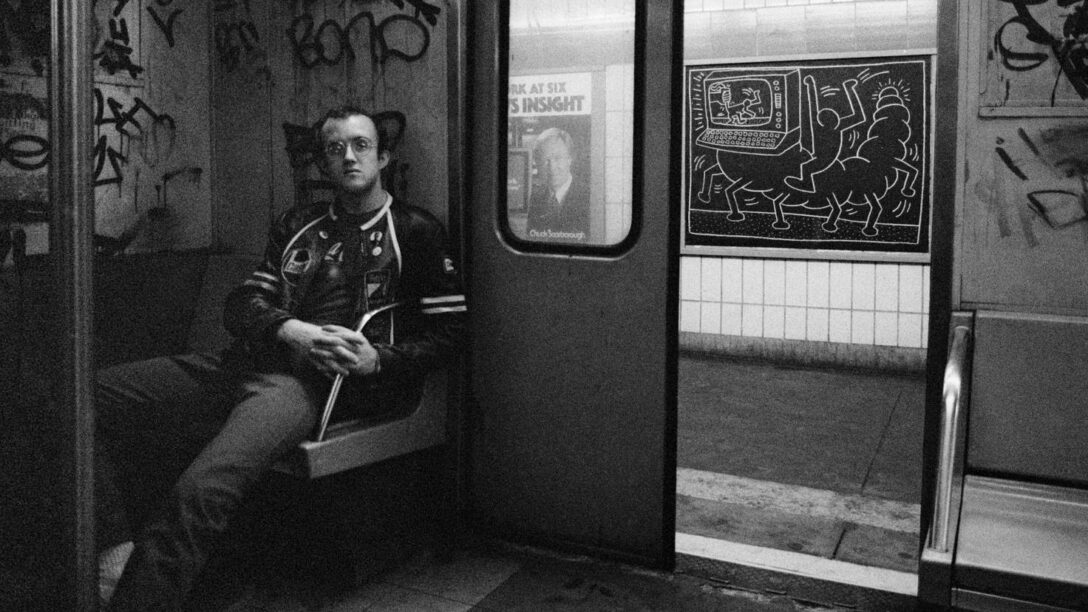
Photo: Tseng Kwong Chi
Keith Haring is an enigma as an artist. Passionately committed to the idea that art is for everyone, he worked out the iconography of his art over a period of five years, drawing on blank advertising panels in the New York City subway system during the early 1980s while a student at the School for Visual Art. “He used the city as his canvas,” collector LarryWarsh told me.
That work—filled with his distinctive visual language of crawling babies, dancers, television and boombox-headed figures, spaceships and dolphins—was never meant to be collected. Who would collect drawings by an unknown artist killing time waiting for the subway? Even though his work was making him famous with New York City transit officers and subway riders, Haring would have preferred that the work get papered over with ads or fade into the patchwork of graffiti. And yet, as Haring’s art became beloved by New Yorkers, people began to pull down the drawings and save them. Haring’s response to the success of his accidental public art project was to collaborate with photographer TsengKwongChi, who documented the drawings shortly after Haring left his trail of art across the Manhattan mass transit system.
The resulting book of photographs, Art in Transit, might have been the only evidence of Haring’s formative years as an artist, before he started working with Tony Shafrazi’s gallery and, later in his career, making art on canvases that could be easily sold to collectors. Or they would have been, anyway, if Warsh had not spent the same period collecting the works as quickly as Haring could draw them.
Forty years after Haring emerged from the New York City graffiti scene, along with his peer and antithesis, Jean-Michel Basquiat, Sotheby’s will be selling Warsh’s collection of 31 subway drawings during the November day sales. Across town at Christie’s, there’s a Basquiat drawing on paper from the same era, estimated at $20 million, that will go on auction during the evening sale. The most expensive of Haring’s subway drawings, by contrast, is estimated at $500,000. There’s one on offer for as little as $40,000.
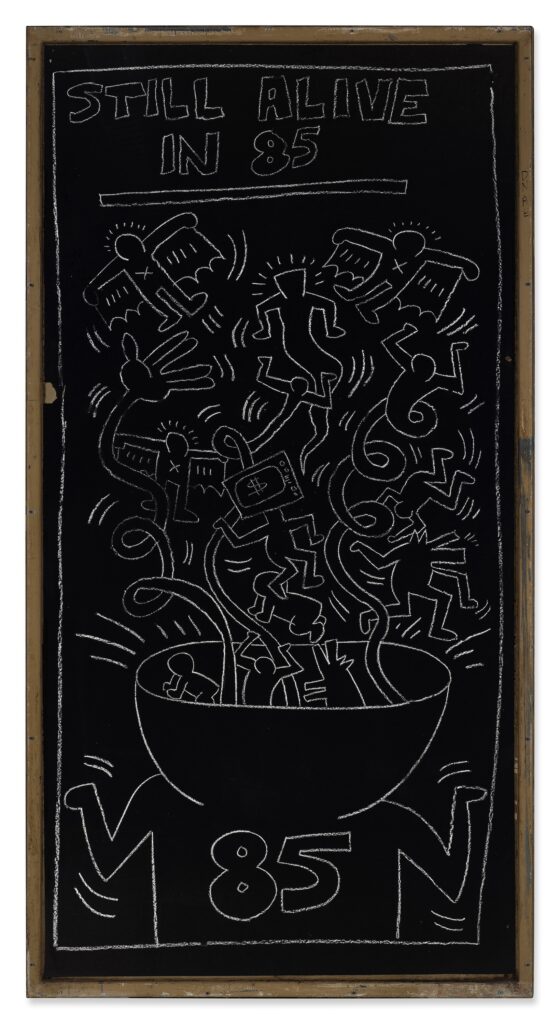
Keith Haring, Untitled (Still Alive in ’85), estimated at $500,000
Haring vs. Basquiat
There are many reasons for the disparity in value between Haring and Basquiat, both of whom died around the same time. (Basquiat overdosed in 1988; Haring died of complications from AIDS in 1990.) The conventional wisdom is that Basquiat, who also painted on unconventional armatures of all sorts, made work to be sold in galleries. That was his goal. Haring’s mission to create art for everyone meant that even once his career had skyrocketed aboveground, as he said in 1984, “ The subway is still my favorite place to draw.” But there could be any of a dozen other reasons why fate has left us with a $110 million Basquiat and a $5.9 million Haring as their respective top auction prices.
In conversations about art, imagery, and the importance of the New York graffiti scene, no one would privilege either of these artists over the other. (Among the surviving works from that period, there is a subway drawing that shows Haring’s crawling babies and Basquiat’s signature crown.) In fact, in terms of direct impact on the art that festooned the New York City subways in the 1970s, Haring is clearly the more significant figure. “I arrived in New York,” Haring wrote in the introduction to the book documenting his subway drawings, “at a time when the most beautiful paintings being shown in the city were on wheels—on trains—paintings that traveled to you instead of vice versa.”
Haring spent two years looking at graffiti while he struggled as a young man to find his vision and voice as an artist. He tried performance; he tried video; he drew inspiration from William S. Burroughs and studied semiotics. Eventually, graffiti won out. There was, he observed, an “obvious mastery of drawing and color.” But what impressed Haring the most was “the scale, the pop imagery, the commitment to drawing worthy of risk and the direct relationship between artist and audience.”
As much as Haring admired graffiti art, he had no intention of “jumping on the band-wagon and imitating their style.” Instead, he would begin to paint on tarpaulins and other objects and conceive of more ambitious public projects. “With Keith, you have a world of mediums,” Warsh told me, “where the sum total is, ‘Wow, this guy is really smart.’” This point will be made when Crystal Bridges opens its exhibition, in March of 2026, in Bentonville. Keith Haring in 3D, curated by GlennAdamson, will explore the wide ambit of a groundbreaking artist whose last concern was making paintings for collectors.
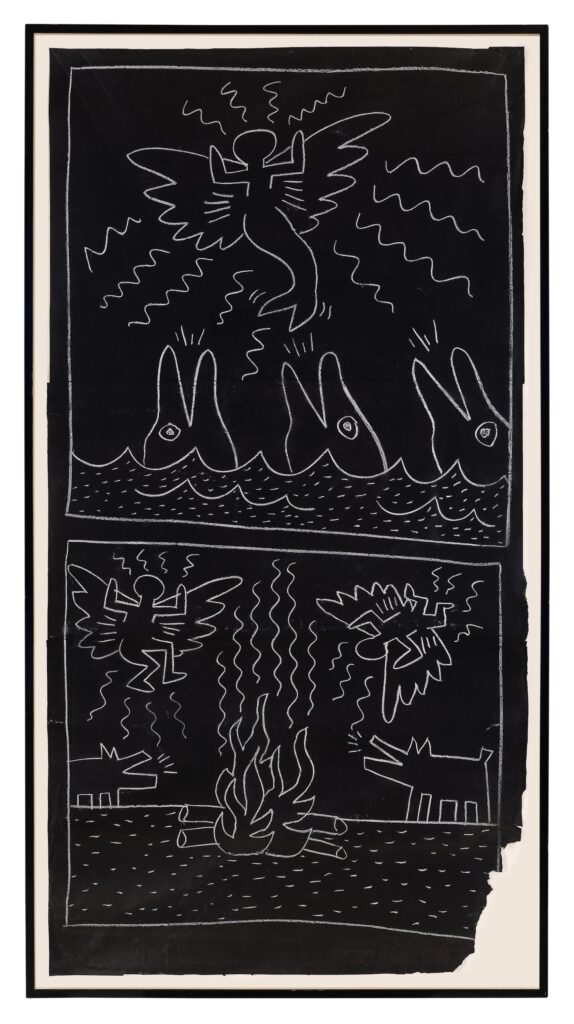
Keith Haring, Untitled (Mermaid – Angel, Dolphins, Angels, Barking Dogs) (c. 1981-83), estimated at $500,000.
The Infinite Stream
Collectors, of course, play their own role in the career and reputation of an artist. Warsh, who was living downtown in the early ’80s, became obsessed with the work of Basquiat and Haring. (He would eventually sit on the Basquiat authentication committee before it was disbanded.) And with both Basquiat and Haring, Warsh did not have to consider whether their work was important. He knew immediately that it was.
If collectors have a role in culture, it is to see the future, or—as Warsh put it in the introduction to the catalog of the 2012 Brooklyn Museum exhibition of the subway drawings—to “recognize, with great clarity, that a given artwork or artist is … significant to the art and culture of their time. … Collectors, with their passion for discovery and confidence in their own tastes, sometimes have a knack for seeing ahead in this way.”
In fact, Warsh’s defiance of Haring’s own preference that the subway drawings disappear under a palimpsest of advertising imagery is also part of what collectors do. (As Warsh put it, “They pull from the infinite stream of objects and images that cross their paths.”) What Warsh liked about the subway drawings is that they were not pristine and bear the “rips and wrinkles” of their origins in the dirty New York of punk rock and disco. Now, 40 years later, Warsh is selling the drawings to realize some value for himself after having held them for so long—the entire group has an estimate of more than $6 million and is backed by a Sotheby’s guarantee—though only Warsh knows how much money he has spent over that time storing the works, sponsoring exhibitions and catalogs, and otherwise promoting Haring’s legacy.
One of the advantages of the art market and auction houses is that their sales are also marketing for the value of the works that they have sold. In other words, Sotheby’s isn’t simply creating a virtual subway station of the era and showing archival footage of Haring at work. If the works sell for numbers much higher than their estimates (and they are clearly estimated to sell), the momentum will have an impact on Haring’s reputation. The strong sale of so many objects from the same body of work should raise interest in that body of work and the artist. Warsh would love nothing more than to see museums bidding and buying these drawings; it’s really the first chance they would have to do so. And that, as far as Warsh is concerned, is the best route to archiving Haring’s art for everyone.
Didn't get an email? Check your spam folder and confirm the spelling of your email, and try again. If you continue to have trouble, reach out to fritz@puck.news.
Didn't get an email? Check your spam folder and confirm the spelling of your email, and try again. If you continue to have trouble, reach out to fritz@puck.news.
Member Exclusive
Get access to this story
Create a free account to preview Puck’s full offering, including exclusive articles, private emails from authors, and more.