{{ 'now' | timezone: 'America/New_York' | date: '%b %d, %Y' }} |
|
|
Hello, and welcome back to The Best & The Brightest. I’m Leigh Ann Caldwell,
wishing you a happy Sunday. I flew out to the West Coast this morning to participate in a forum for journalists at Stanford’s Hoover Institution, where we’ll be discussing some of the top issues of the day, including free speech, China, and biotechnology.
Remember that there are just a few more days left of Puck’s fourth anniversary sale, and if you take advantage now, you’ll get all that Puck has to offer—including, of course, our Washington coverage, but also Ian
Krietzberg’s fantastic coverage of A.I., William Cohan on Wall Street, and Dylan Byers’s unparalleled insights into the media business. Get your discount here (or buy a gift subscription for a friend).
Below, what I’m hearing about how
congressional Republicans are responding to Trump’s declining poll numbers on immigration and the economy. Plus, a closer look at the shifting politics of next week’s government shutdown—and why the conventional wisdom about winners and losers may be totally wrong.
But first… |
- Funding
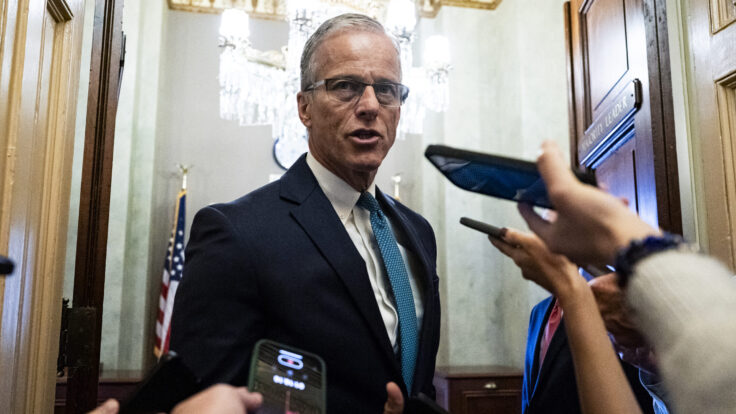
brinkmanship: With Congress no closer to a deal to keep the government open past midnight on Tuesday, Senate leaders John Thune and Chuck Schumer both appeared on Meet the Press this morning to point fingers at the other and finesse their messaging ahead of what could be a protracted shutdown battle. First up was Thune, who declared that Democrats had taken “the federal government hostage” just to get “a whole laundry list of things that they
want”—namely an extension of expiring Affordable Care Act subsidies and the reversal of Medicaid cuts in Republicans’ One Big Beautiful Bill. Though Thune told NBC’s Kristen Welker that he’s willing to “have that conversation,” he insisted that Republicans wouldn’t capitulate under duress and would be willing to talk after the government is funded. Notably, Thune avoided saying whether he supports Trump’s threat to fire federal workers en masse in a
shutdown.
Schumer, for his part, attempted to reframe any potential shutdown as the fault of the party in power. “There is going to be huge pressure on Republican senators, congressmen, and even Trump to do something about this horrible healthcare crisis,” he said. The Democratic minority leader said it was “a good first step” that Trump was scheduled to meet with Congress’s top two Democrats and the Republican leaders on Monday, after backing out of a meeting with himself and House
Democratic leader Hakeem Jeffries last week. But Republicans are offering a different narrative for that conversation, too. On CNN’s State of the Union, House Speaker Mike Johnson remarked that the point of the meeting isn’t to have a negotiation, but rather to provide Trump an opportunity to “convince” the Democrats “to follow common sense.” - January 6 déjà vu: Trump’s vengeance tour may next arrive at the
doorstep of Christopher Wray. In a weekend Truth Social post, Trump accused the former F.B.I. director of “lying” about the events of January 6, and said agents in Wray’s F.B.I. were “probably acting as Agitators and Insurrectionists” in the riot. Many on the right—including Rep. Barry Loudermilk, the chair of a new January 6 subcommittee—are
convinced that the F.B.I. somehow conspired to instigate the events that unfolded that day. Yet no evidence has emerged to support that contention, and even the F.B.I.’s current leader, Kash Patel, has contradicted Trump’s accounting, telling Fox News this week that the dozens of plainclothes agents at the Capitol
were only there for crowd control.
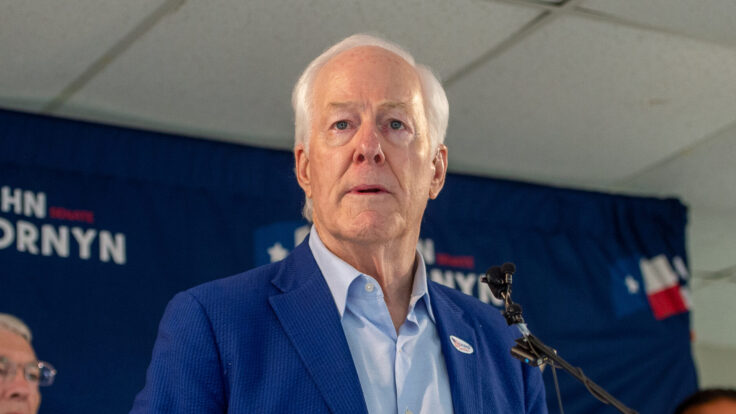
- Cornyn’s puzzling endorsement: Last week, Sen. John Cornyn, facing a tough primary challenge from Texas A.G. Ken Paxton, revealed the endorsements he’s secured from 15 former members of Congress—including Tom DeLay, the former House Majority Leader. DeLay, of course, was a giant in Texas politics… but he also resigned after being indicted for conspiracy to violate
campaign finance laws. “He is trustworthy, he is honest, he is effective, and we need him to be reelected to the U.S. Senate,” DeLay wrote of Cornyn. It’s a strange endorsement, perhaps, when Cornyn’s campaign has focused on Paxton’s own ethics problems, including his impeachment for bribery and abuse of office. (Paxton was acquitted by the Texas Senate.)
|
|
|
The president’s favorables are sliding, even on his best issues. But Capitol Hill
Republicans are determined to sink or swim with Trump—and they’re convinced they’ll be on the right side of the shutdown blame game, too. |
|
|
House Republicans are determined to defy history and maintain control of the House in the first midterm of
their party’s presidential term, although you wouldn’t know it from the way they’re mostly ignoring the polls. According to the latest Washington Post–Ipsos survey, Donald Trump is underwater on all of the key issues from his campaign, with about six in 10 Americans disapproving of his handling of the economy and
immigration—the two issues that propelled him to victory in 2024. That poll is not an outlier. Trump’s overall favorability has fallen considerably since his inauguration, from nearly 50 percent in late January to about 40 percent today. Even Joe Biden was more popular at this point in his presidency.
Usually, when a president
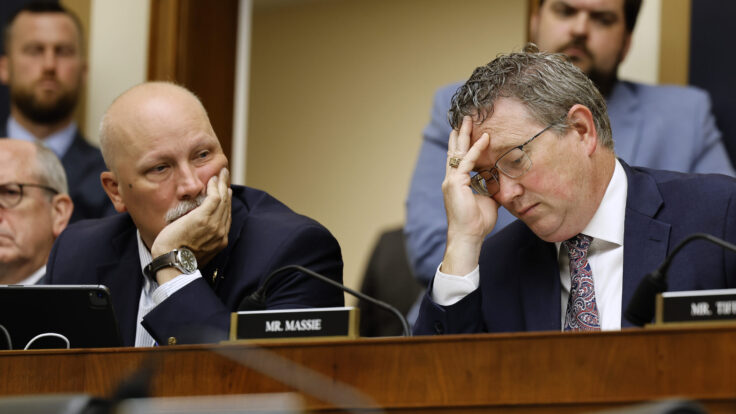
becomes unpopular, fissures emerge between members and their party leader. But other than nonconformists like Rep. Thomas Massie and Sen. Rand Paul, and a few isolated incidents, there’s little evidence that members are distancing themselves from Trump, even back in their districts, away from the glare of the national press.
So, I asked a half-dozen Republican aides and strategists when we might see lawmakers acknowledging the concerns of
voters who say tariffs are raising prices, or that ICE should be focusing on deporting criminals, not gardeners and grandmothers. The answer: Maybe never. “No one is even talking about it,” one of my most plugged-in House Republican sources told me, referring to the warning signs in the data. That includes members facing serious electoral danger in 2026.
Endangered or not,
Republicans feel they have to sink or swim with the president. His political team, of course, has demanded as much, and his wrath will keep members in line. But Republicans have also calculated that, despite his unfavorables, siding with Trump gives them a better chance of winning. After all, he turns out low-propensity voters, who tend to stay home during the midterms when he’s not at the top of the ballot. As one Republican strategist told me, politics in this environment is no longer local,
echoing former Democratic House Speaker Tip O’Neill. “If we nationalize the election, the better chance we get to turn out the base and get low-propensity voters,” the strategist said. In an Economist/YouGov poll
showing Trump with only 39 percent approval overall, 86 percent of Trump voters still supported him.
In any case, as Republicans like to point out, Democrats are even
more unpopular than Trump. A Quinnipiac poll this week found that only 30 percent of registered voters have a favorable view of the party, while 54 percent disapprove—the lowest rating Dems have gotten since Quinnipiac started asking the question in 2008. (The same poll found that Trump and the Republican Party had an approval rating of 38 percent.) A Democratic strategist
insisted this doesn’t presage the outcome of the midterms—the party just lost a presidential election and has no leader, so of course they’re not having their best showing, this person argued. Still, you can see why Republicans might be bullish.
It also explains why G.O.P. candidates have generally changed tack from the 2018 midterms, the first they faced with Trump as president. At the time, Republicans in swing districts and states mostly ran away from him, and his campaign appearances
were largely sequestered to reliably conservative terrain. In the swing states he visited, Republican candidates lost, including Nevada Sen. Dean Heller and Arizona Sen. Martha McSally. House Republicans, meanwhile, lost a net 40 seats. In fact, only two swing-district Republicans from that era are still around to run in this one: California Rep. David Valadao (who lost in 2018 and reclaimed his seat the next cycle) and Pennsylvania’s
Brian Fitzpatrick.
This cycle, even Valadao and Fitzpatrick have no plans to run from the president, but they do have a much narrower tightrope to walk. “It goes back to the fact that what Republicans have found, year after year, is that they need him, and his voters, to win,” one Republican strategist said. Valadao and Fitzpatrick are also two exceptions to the party’s nationalized, Trump-or-nothing midterm attitude, with both staying hyperfocused on local issues.
Valadao’s political director, Robert James, told me the candidate will focus on water and the economy in his farming district. Fitzpatrick, whose office didn’t respond to requests for comment, is one of two Republicans (the other being Massie) to vote against the One Big Beautiful Bill. |
In any case, the more immediate concern for members of both parties is the nearly inevitable government
shutdown, which should arrive in about two days. Naturally, the D.C. parlor game du jour is debating which party will receive the blame—and the intraparty conversations are all focused on how to control the narrative. In recent shutdowns, the Republicans have taken most of the heat, because they’ve refused to budge when the deadline approached (Ted Cruz in 2013, Trump in 2018, etcetera). This time, though, Democrats are the ones holding the line.
Over the past
few weeks, they’ve tried to use their vanishingly few points of leverage to force negotiations on restoring Medicaid funding and extending Affordable Care Act subsidies. Of course, it’s no coincidence that healthcare is also one of the few issues where voters trust Democrats more than Republicans. This is straight
from the 2018 playbook, when Republicans’ failed attempt to repeal the Affordable Care Act handed Democrats their defining issue for the midterms, and Dems flipped the House while tightening their margins in the Senate. For what it’s worth, the party is also united in a way they weren’t when the last funding deadline approached in March, and has become only more so ever since Trump canceled a meeting with Democratic leaders last week and in the wake of O.M.B. director Russ Vought
threatening to fire federal workers in the event of a shutdown, an aide to a more centrist Democrat told me.
Meanwhile, Republicans are doing their best to ensure that the shutdown debate does not become a debate over healthcare. They know it’s toxic territory for them, and believe it’s possible as long as they stick to the talking point that all they’re proposing is a clean, short-term government funding extension. Apparently, Vought’s threat
was meant to get Democrats to fold, but it was also good politics. As one Republican strategist told me—and if the DOGE era taught us anything—Americans aren’t necessarily sympathetic to laid-off federal workers. |
|
|
Join Emmy Award-winning journalist Peter Hamby, along with the team of expert journalists at Puck, as they let you in on the
conversations insiders are having across the four corners of power in America: Wall Street, Washington, Silicon Valley, and Hollywood. Presented in partnership with Audacy, new episodes publish daily, Monday through Friday. |
|
|
Unique and privileged insight into the private conversations taking place inside boardrooms and corner offices up and down Wall
Street, relayed by best-selling author, journalist, and former M&A senior banker William D. Cohan. |
|
|
Need help? Review our FAQ page or contact us for assistance. For brand partnerships, email ads@puck.news. You received this email because you signed up to receive emails from Puck, or as part of your Puck account associated with {{customer.email}}. To stop receiving this newsletter and/or manage all your email preferences,
click here. |
Puck is published by Heat Media LLC. 107 Greenwich St, New York, NY 10006 |
|
|
|