Welcome back to The Best & The Brightest. I’m Leigh Ann Caldwell, here in
Washington, D.C., which Trump is threatening to take over as soon as he’s done taking over New York City. Meanwhile, the administration just got the green light from the Supreme Court to
proceed with its plans for agency dismantlings and mass firings across the federal workforce. (Justice Ketanji Brown Jackson stayed on brand in writing the lone dissent.) I’ll have a lot more about this—and how the Trump administration has persuaded Congress to cede its power, too—in tomorrow’s email. Make sure you become a Puck member today.
In tonight’s issue, we’re turning things
over to Ian Krietzberg, Puck’s new artificial intelligence correspondent, who has a postmortem on how the A.I. industry lost out in the Big Beautiful Bill, and why New York is about to become the next front in the regulatory war. (Ian’s column first appeared in his new private email, The Hidden Layer, which you can add to your inbox here.)
But first…
|
|
|

| Abby Livingston
|
|
- The Chicago
Way: Former Rep. Jesse Jackson Jr. of Illinois is gunning for a political comeback more than a decade after resigning in disgrace from a 17-year stint in Congress; pleading guilty to misusing some $750,000 in campaign funds on personal expenses, including a $43,000
Rolex; and serving 17 months in federal prison. Despite all that, one of Chicago’s most prominent political nepo babies has serious local Democratic muscle behind him, including retired Rep. Bobby Rush, who called him “the most qualified and ready-made of all the candidates” to represent Illinois’ 2nd congressional district.
On one hand, it’s striking to see prominent Chicago Democrats elevating a convicted felon. After all, less than a year ago, the city was the site of a
Democratic National Convention that featured big-time Dems like Hillary Clinton and Jasmine Crockett slamming Donald Trump for running for president as… a convicted felon. But the impulse to back longtime political allies with gusto, baggage be damned, is becoming a pattern for Democratic leaders. It happened with
Joe Biden until questions about his age and fitness became absolutely unavoidable, and again with Andrew Cuomo during New York’s recent mayoral race, despite allegations of sexual harassment and a
well-documented scandal over his handling of nursing homes during Covid. Prominent New York Democrats like Michael Bloomberg, David Paterson, and Bill Clinton gave Cuomo full-throated, straight-faced endorsements just last month, not long before Zohran Mamdani felled him in the
primary.
When I reached out to Chicago Democratic consultant Tom Bowman, who doesn’t have a client in this primary, he put it bluntly: “Shame used to prevent so much stupidity in public life, but that all went out the door—or down the golden escalator, I guess. Jr. is going to learn an Andrew Cuomo lesson the hard way: The establishment is not the preference of Democratic voters.”
|
|
|

| Julia Alexander
|
|
- Dana White
goes to the White House: Trump fancies himself more of an emperor than a statesman, so maybe it’s not a surprise that he’s planning to host a UFC fight on the White House lawn next year. Trump plans to stage a July Fourth event to celebrate the country’s 250th birthday, and the leading lights of the manosphere are emerging to show their interest. Conor McGregor tweeted that he wants in, because having an Irishman fight an American would at least
approximate the historical events that brought us here, I guess?
Crass commercialization of historic U.S. landmarks aside, this sort of stunt might draw tech magnates like Mark Zuckerberg and Jeff Bezos, who still need to seek Trump’s favor as they look for regulatory relief while pumping billions into their A.I. businesses. Who knows, maybe Zuck can finally lure Elon Musk into the ring? More seriously, expect some jockeying for
the rights to broadcast this spectacle. UFC is currently marketing its media rights, and this eventized eye-roller might sweeten the package.
|
|
|
Yes, the state regulatory ban was suddenly stripped out of Trump’s signature bill, but the
A.I. industry and its army of lobbyists won’t let the hallmark technology of our time be regulated without their perspective. Which is why everyone is paying attention to a bill currently sitting on Governor Kathy Hochul’s desk. |
|
|
Last week, after a tumultuous few days, a provision in Trump’s sprawling, 900-page Big
Beautiful Bill Act barring states from regulating A.I. for the next five to 10 years was stripped out. The yanking of the so-called A.I. moratorium was, to put it mildly, a shocking twist—not least because its removal was supported by 99 senators. Adam Thierer, the think tank analyst who first proposed a federal
moratorium on state A.I. laws, called the volte-face a “major turning point in U.S. technology policy.”
In the end, it wasn’t just the bill’s hardline language that scared off a handful of Republican senators, namely Tennessee’s Marsha
Blackburn. It was also, according to several sources, the fact that there wasn’t a parallel effort to propose a national A.I. policy. Negotiators reduced the decade-long moratorium to a five-year pause, but even that was too much for Blackburn. “The current language is not acceptable to those who need these protections the most,” she said in a statement. “Until Congress passes federally preemptive legislation like the Kids Online Safety Act and an online privacy framework, we
can’t block states from making laws that protect their citizens.”
It’s obviously a disappointment for the industry’s boosters, like White House A.I. czar David Sacks. For the past two years, tech companies and lobbyists have waged a veritable crusade to convince policymakers that we can’t afford a state-by-state A.I. regulatory regime, or else our descendants will be learning Mandarin from Chinese L.L.M.s. In Meta’s public policy
proposal for the Trump administration’s pending A.I. Action Plan, the company calls explicitly for a federal preemption of state laws, since a “patchwork of state laws … will hamper American A.I. innovation.” OpenAI’s
proposal, Google’s proposal, Amazon’s
proposal, and a16z’s proposal all make similar arguments.
And yet, the public has remained pretty consistently skeptical: A 2023
YouGov poll found that 72 percent of Americans supported at least some form of A.I. regulation; more recently, a 2025 Pew Research
poll found that 58 percent of Americans were more concerned about too few A.I. regulations than too many.
In my conversations surrounding the last-minute changes to the Big Beautiful Bill, the prevailing sentiment was that the Senate had finally grasped the scale of the problem. “I think there was this realization that we can have both: We can continue to innovate, and we can have safety,” Camille Carlton, the policy director at the Center for Humane Technology,
told me. “And if the federal government wants to move forward with some sort of preemption regime, they need to step up and say, This is the law that we are going to pass that will be tied to preemption, instead of having nothing in place.” Dr. Hamid Ekbia, the director of Syracuse University’s Autonomous Systems Policy Institute, told me that the reversal demonstrated that, even in polarized times, “sanity can prevail—so that’s a good sign.”
But for how
long can it prevail against this sort of dough? In the first quarter of this year, Meta spent nearly $8 million on lobbying efforts—more than in the first quarter of 2024, according to OpenSecrets; Alphabet
spent $3.8 million, also more than it spent in the first quarter of last year; a16z spent $650,000, more than double its first-quarter spending last year; and OpenAI, after
spending $1.7 million in lobbying efforts in 2024, spent $560,000 in the first quarter of this year alone. Of course, this doesn’t count the millions in lobbying dollars spent this year by tech advocacy groups that represent many of these companies, including
TechNet and the Consumer Technology Association. The former pushed
for a “single national policy” on A.I., while the latter urged congressional leaders to “preserve” the moratorium.
In other words, the fight against state regulation is hardly over. Alix Fraser, the vice president of advocacy at Issue One, a political reform group,
warned last week that “Big Tech will try to push back against this victory. They will try to pad the pockets of every politician, and pull every lever in their power to bring this 10-year ban back.” Meanwhile, Sen. Ted Cruz and Rep. Brett Guthrie have
expressed support for the idea of a stand-alone A.I. moratorium bill.
Neither Meta, Amazon, OpenAI, IBM, nor Anthropic responded to requests for comment regarding either the death of the moratorium or their respective efforts to preserve it—although it’s worth noting that Anthropic C.E.O.
Dario Amodei has argued against a 10-year moratorium. In an emailed statement, Microsoft director of public affairs Kaitlin Haskins told me that “Microsoft did not support a full moratorium, but did lobby for a compromise that preserved the rights of states to regulate certain areas, including protecting consumers
from the use of A.I. in fraud.” A Google spokesperson pointed me to a May tweet in which it called the moratorium an “important first step to both protect national security and ensure continued American A.I. leadership.” |
Another view, offered by Gabriel Weil, a senior fellow at the Institute for Law and A.I., is
that the reversal aligns with a long-held tradition of allowing state-level experimentation to filter into, and eventually inform, federal law. “This is just a decision not to cut off that process,” he told me. Indeed, much of the state-level A.I. legislation that we’ve seen so far is relatively narrow: Tennessee’s ELVIS
Act, for instance, simply updates the state’s personal rights laws to protect artists from A.I.-generated mimicry. And while a few states have aimed a little higher, some have gotten singed in the process. Last year, California nearly enacted an infamous piece of legislation called SB 1047, which aimed to prevent “catastrophic harms” by regulating frontier models. It faced a crushing wave of lobbying from the tech industry before Gov. Gavin Newsom decided not to
sign it into law.
Now, the front line has moved to New York. In June, State Senator Andrew Gounardes and Assemblyman Alex Bores shepherded the Responsible A.I. Safety and Education (RAISE) Act through the legislature, partly building on SB 1047 while addressing some of its main critiques. For starters, RAISE applies only to
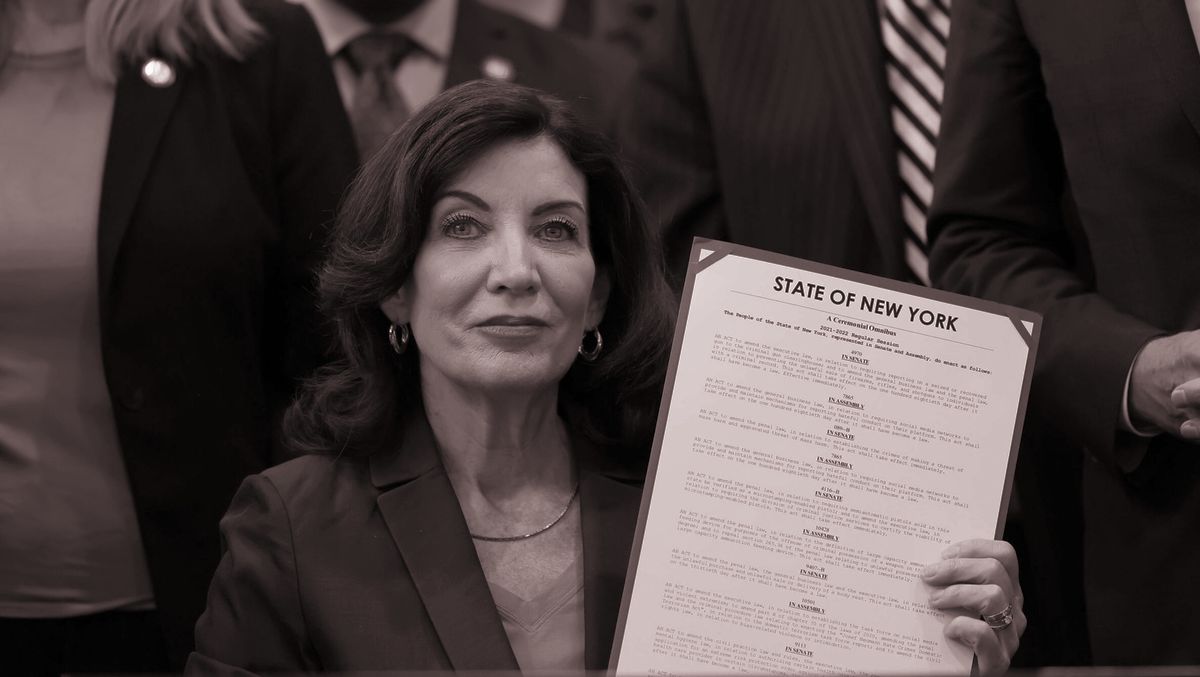
companies that spend more than $100 million to train their models, and requires transparency around safety, security, and risk-evaluation reporting, in addition to incident reporting. It also affords the New York attorney general the power to impose civil penalties of up to $30 million for violations. The bill now sits on Kathy Hochul’s desk, where Bores expects it to enter a chapter amendment process that remains unique to New York.
The
legislation would almost certainly impact the industry far beyond New York. Bores told me his goal was to set a regulatory baseline for not just the country, but also the world: “If you want access to the New York market—which most businesses on Earth do—if you are a frontier model developer, you will have to follow this,” he said, adding that it would likely apply to Chinese developers, like DeepSeek, as well as U.S. giants, regardless of where they’re headquartered.
Gounardes, however,
was more circumspect about the bill and the broader business climate. “I think, right now, the companies still following through on the voluntary commitments—it’s laudable, we applaud that,” he told me. “I’m concerned about a change in business incentives. You can very quickly see the line shift from, We’re going to be a thoughtful, responsible, A.I. corporate citizen, to, We have to win the race, no matter what the cost. And it’s that second one I find most concerning—when you
are chasing the dollar, you can be blinded to everything else.”
Naturally, as the bill floats in purgatory, the same lobbying efforts that fought against SB 1047 and for the moratorium have set their sights on Albany. The Computer & Communications Industry Association,
Chamber of Progress, and American Innovators Network—a coalition of startups and major venture capital firms, including a16z—are all staunchly opposed to the legislation,
and have urged Hochul to veto it, warning it might send A.I. companies fleeing from New York. (Tech companies used similar arguments when fighting 1047 last year.) Meanwhile, TechNYC, an advocacy group whose members include Google, Meta, and IBM, has denounced the bill’s supposed capacity to harm startups. (Bores and Gounardes, for their part, see its guardrails as a key enabler of innovation.)
Anyway, according to
polling by Beacon Research, 84 percent of New Yorkers support the RAISE Act. “This is a very strong bill,” said Bores, who emphasized the lengthy, complex industry feedback process that led to the removal of an audit requirement, among other things. “It’s one that will meaningfully improve our safety on frontier models, so
I’m very proud of the final product. But that doesn’t mean it’s 100 percent the bill I’d write if I were king.” |
|
|
Join Emmy Award-winning journalist Peter Hamby, along with the team of expert journalists at Puck, as they let you in on the
conversations insiders are having across the four corners of power in America: Wall Street, Washington, Silicon Valley, and Hollywood. Presented in partnership with Audacy, new episodes publish daily, Monday through Friday. |
|
|
Need help? Review our FAQ page or contact us for assistance. For brand partnerships, email ads@puck.news. You received this email because you signed up to receive emails from Puck, or as part of your Puck account associated with {{customer.email}}. To stop receiving this newsletter and/or manage all your email preferences,
click here. |
Puck is published by Heat Media LLC. 107 Greenwich St, New York, NY 10006 |
|
|
|