Hello and welcome back to The Best & The Brightest. I’m Leigh Ann Caldwell. Enjoy
Super Bowl LX tonight, if you celebrate, plus Bad Bunny and all the political drama the halftime show is likely to bring. My partner John Ourand, who authors The Varsity, our indispensable sports business email, will have the full readout tomorrow.
One other note before we get started: My jaw dropped on Saturday night when I got Dylan
Byers’s X alert that Washington Post publisher Will Lewis had been fired. Maybe this means that Jeff Bezos does care about the Post after all? Either way, hopefully Lewis’s much-deserved ouster at least slightly helps morale in the diminished newsroom. (Dylan will have more on Wednesday in his indispensable media newsletter, In the
Room.)
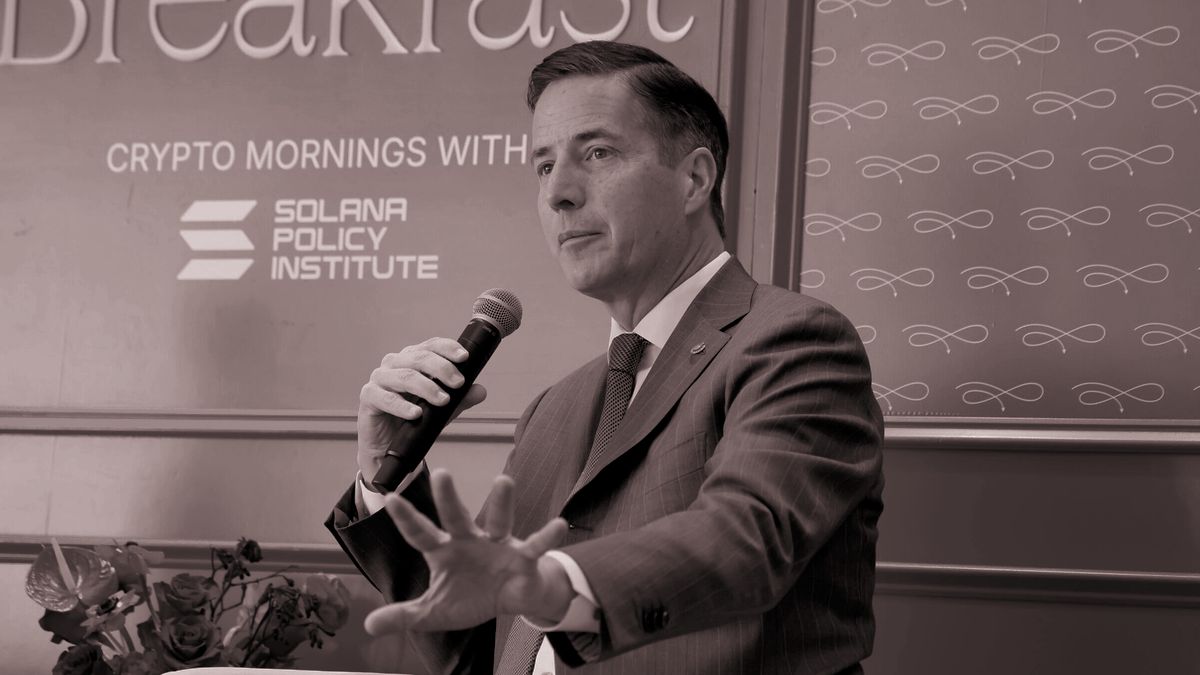
Tonight, I bring you my conversation with Ohio Sen. Bernie Moreno, who joined me for our latest Puck Power Breakfast, hosted by the Solana Policy Institute. It was a timely interview: Bitcoin was crashing, but Moreno, a former crypto entrepreneur, is bullish that new legislation—currently stalled in the Senate—will give Wall Street needed clarity. I also asked him why he thinks Donald Trump’s own crypto conflicts should not be addressed with
new ethics rules. (Make sure you’re subscribed to read his answer…)
Plus, up top: a government funding update, a surprising Republican inflection point on ICE, and the latest House G.O.P. retirement—the 30th Republican member to announce plans to leave Congress this year.
Mentioned in this issue: Hunter Biden, Paul Gosar, Mark Kelly,
Kevin Sartor, Mark Amodei, Gary Gensler, Don Jr. and Eric, Bernie Moreno, Abraham Hamadeh, Kristi Noem, Roger Wicker, Trump, Chuck Schumer, Marjorie Taylor Greene, Mark Green, Mike Waltz, Mikie Sherrill, and a Bill Cohan cameo. |
- Not
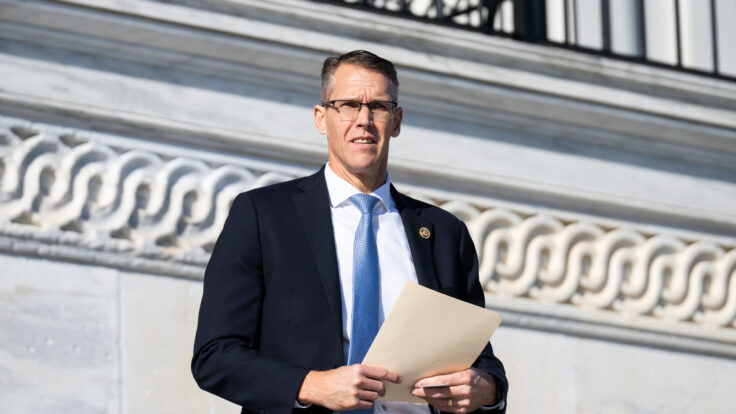
in my backyard?: The rapid proliferation of new immigration detention centers—a logistical necessity for the Trump administration’s mass deportation project—is facing opposition, and not just from Democrats. Some of the new sites are in red parts of the country, and Republicans aren’t happy about it. On Wednesday, Republican Sen. Roger Wicker of Mississippi wrote a
letter to Homeland Security Secretary Kristi Noem opposing the use of a warehouse to house 8,500 detainees in his state. He insisted that he’s not against the administration’s deportation efforts, but the proposed holding center “forecloses economic growth opportunities and replaces them
with a use that does not generate comparable economic returns or community benefits.” He also argued that the small town of Byhalia, where the warehouse is located, lacks adequate medical facilities and personnel to accommodate the influx. Plans for the facility have now been scrapped.
Meanwhile, according
to local news reports, hundreds of residents flooded a community meeting in Surprise, Arizona, last week to protest D.H.S.’s purchase of a warehouse in their town. The $70 million facility, designed to hold up to 1,500 detainees, is located just outside Phoenix, near the intersection of the districts
of Republican Reps. Abraham Hamadeh and Paul Gosar. “Reports of a large-scale detention facility in Surprise raise legitimate questions for residents, schools, first responders, and local governments,” Gosar, a member of the Freedom Caucus, wrote to Noem. “These are not anti-illegal alien concerns.” Hamadeh did not respond to a request for comment. Both of their seats are “solid” Republican, but if local anger doesn’t subside, it could be yet another political
problem for Republican lawmakers heading into November. Numerous polls show that voters have soured on ICE and the way the president is prosecuting his mass deportation agenda.
Arizona Sen. Mark Kelly told me he found out about the new facility when Kevin Sartor, the mayor of Surprise, called him this past week, and that they’re looking into ways to stop it. “The building has to be heavily modified to hold people,” Kelly said. “Well when you do that there
are environmental implications”—a legal opening, perhaps, to leverage local regulations to halt, or slow, the needed upgrades.
|
|
|
Science fuels farmers ability to grow healthy, abundant food for Americans. That’s why companies like Bayer depend on
rigorous, predictable, science-based standards to bring new tools to market for farmers. Innovation isn’t a buzzword, it’s the lifeline that gives growers more options and keeps America’s food supply secure. At Bayer, we succeed when farmers succeed. Learn more. |
|
|
- Schiff’s
midterm jitters: Democrats are raising their own alarms about election security after Trump said that he wanted to “nationalize” elections in more than a dozen blue states. As I noted last month, key House Democratic committee leaders have been quietly plotting their defense. Earlier today, Sen. Adam Schiff reiterated on ABC’s This Week that
Democrats are insisting that any bill to fund the Department of Homeland Security include a guarantee from the administration that ICE is not deployed to polling places. But he acknowledged that there’s not much that Democrats can do on their own. “The best protection we have is to mobilize the largest voter turnout in U.S. history,” Schiff said.
- An ICE freeze mini-update: Speaking of the D.H.S. funding bill, there’s just one more week for Democrats
and the White House to agree on new accountability measures for ICE before the agency’s funding technically expires. Talks are moving slowly, inside sources told me, especially considering the short timeline. Democrats unveiled their 10-point list of demands late Wednesday night and gave Republicans and the White House their proposed legislative text over the weekend. Republicans have yet to respond.
A senior Republican aide predicted they’ll need another short-term funding extension to
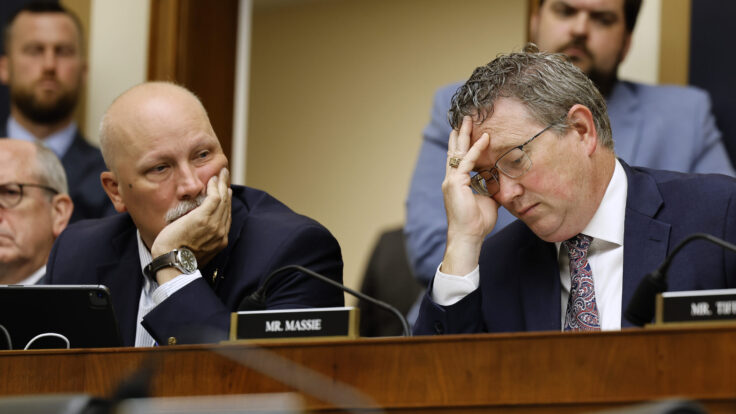
give negotiators more time, but Democrats have yet to agree on one. Last week, Senate Democratic Leader Chuck Schumer refused to say whether he’d back another continuing resolution or if he’d be okay if the agency shut down if negotiations aren’t done. - House retirement watch: Nevada Rep. Mark Amodei announced that he will retire at the end of his term. He is the 30th House Republican—and the 51st House member—to retire
or run for another office, according to Ballotpedia (and that doesn’t include Reps. Marjorie Taylor Greene and Mark Green, who retired mid-session; Rep. Mike Waltz, who was confirmed to be U.N. ambassador; or Democratic Rep. Mikie Sherrill, who won her election for governor). The last time this many members decided not to run for reelection was in 2018, when the electoral environment was… not great for Republicans.
|
|
|
The Republican senator and fierce cryptocurrency advocate sits down for an especially timely
Puck Power Breakfast conversation about his bipartisan blockchain bill, which would create a new market structure to regulate digital tokens and stablecoins alike. |
|
|
On Thursday, just as crypto markets were crashing to their lowest levels since 2024, I sat down with Ohio
Senator Bernie Moreno—a former crypto entrepreneur himself—to discuss the future of the industry. Congress, of course, has been struggling for years to get its head around digital currencies, let alone figure out how to regulate them. In the meantime, crypto has matured into a multitrillion-dollar industry that’s been increasingly integrated into traditional banking and financial vehicles, even as some corners of the industry continue to exist in a sort of grey
market.
Moreno has been trying to change that. Building on last summer’s bipartisan Genius Act, which created a regulatory framework for so-called stablecoins—digital tokens pegged to the U.S. dollar—Moreno has been pushing legislation that includes the Clarity Act, which would treat crypto as a commodity rather than a security. (The crypto industry has been advocating for the Commodity Futures Trading Commission to have a greater role in oversight, in part because they think it would be
a more lenient regulator than the S.E.C.) But the industry remains controversial in Washington: Lawmakers, alongside leading figures on Wall Street, are divided over whether to allow interest on stablecoins, or whether to ban credit card–style rewards on crypto accounts. The very pro-crypto Trump administration has so far failed to resolve the impasse.
The Clarity Act, in particular, would ostensibly resolve a number of outstanding regulatory questions about
crypto, providing a market structure that would move digital currencies into the mainstream of finance. But momentum has been impeded, in part, by Democrats’ growing discomfort with some of the ethical issues surrounding the industry. To wit: The Wall Street Journal reported last week that just before Trump’s inauguration, a top United Arab Emirates official bought a 49 percent stake in World Liberty Financial, the Trump family’s crypto company. Indeed, according to The New York
Times, the Trumps have made nearly $1 billion from crypto since his return to office. The Center for American Progress, the liberal think tank, puts that number at $1.5 billion. |
|
|
Science fuels farmers ability to grow healthy, abundant food for Americans. That’s why companies like Bayer depend on
rigorous, predictable, science-based standards to bring new tools to market for farmers. Innovation isn’t a buzzword, it’s the lifeline that gives growers more options and keeps America’s food supply secure. At Bayer, we succeed when farmers succeed. Learn more. |
|
|
And then there is the extreme volatility of crypto itself. The value of Bitcoin has plummeted in recent
months—down 50 percent since its high in October, leading analysts to suggest that the pro-Trump crypto bump has fully subsided. “It’s crashing because investors are switching into ‘risk-off mode,’ buying gold and safer equities,” my partner Bill Cohan, a former Wall Street banker, told me. “Bitcoin is purely a way to speculate, and only goes up if there is a greater fool who comes along and buys it. At the moment, the buyers are in retreat. Who knows when, or if, they’ll be
back.”
But Moreno is undaunted. During our Puck Power Breakfast conversation, the first in a series hosted by Solana Policy Institute, the senator explained why he’s so bullish on digital currencies, his strategy for legislating, and why he’s hopeful that his stalled market structure bill will soon bring order to a still wild industry. The following has been edited for length and clarity. |
Leigh Ann Caldwell: You’re a member of the Senate Banking Committee, which
is embroiled in negotiations over this market structure bill. The Senate’s version of the Clarity Act was supposed to be marked up last month, but stalled over the issue of third-party yields for issuers of stablecoin. Where do the negotiations stand right now?
Bernie Moreno: They’re extraordinarily frustrating, because we passed the Genius Act. If we pass a bill in August that does X—whatever X is—we can’t come back in January and say, Well, we’ve got to rethink it
because we don’t like what we just did. That’s what’s happening, and it’s just super bad public policy. My colleagues voted for that bill, and even put out a press release being proud that they voted for the bill, and now they’re saying there’s something fundamentally wrong with it. Stablecoin is an interesting technology, it’s great, and it’s going to do a lot of really cool things. But 90 percent of crypto is really [covered by] this market structure bill, and we should be focused on
that. Yet here we are.
There was a White House meeting the other day, trying to get the banks and the crypto industry closer to agreement on whether stablecoin issuers should be allowed to pay yields or rewards to account holders. Was there any progress?
Honestly, it’s a multilayered problem: Number one, people are afraid of new technology, and that spans generations. Number two is that this has become personal: People are fighting just for the sake of fighting.
The real issue is underlined by false flags. The idea that banks are saying there’s going to be $6 trillion in deposit flight is totally insane. If banks are saying that stablecoins will cause deposit flights, wait until they hear about Treasuries, wait until they hear about stocks, wait until they hear about bonds. When you take money out of your checking account to pay a bill, is that deposit flight? It’s just a totally nonsensical argument. I need us to get past this so we can focus on
getting market structure.
So how do you get past this? The banks are adamantly opposed, and they have advocates and allies on the Hill. Is there a space for some sort of compromise, or do banks need to drop the issue and get over it?
I think, ultimately, cooler heads will prevail. If all of a sudden, magically, we pass market structure, and every American pulls every cent out of their bank accounts and buys stablecoins, then we have mechanisms to react to something
like that. But we just need to move on. I think the banks don’t want the crypto industry to be legitimized. That’s the fundamental issue, so they’re using fake excuses.
But the night before the markup, Coinbase was the one that said the Clarity bill is unacceptable. Should it have supported the status of the bill as it was going to be marked up?
The market structure bill does have issues. Title I is problematic, which is basically saying that all these issuers have
to go first to the S.E.C., and the S.E.C. has complete and total jurisdiction. What problem does that solve? The whole reason to do market structure is so you don’t have a Gary Gensler 2.0 who basically decides, I’m just going to crush the industry. So that has to be resolved, but we’ll get it resolved. |
The Trump
Family Business
|
Another issue also appears to be the ethics component.
That’s not really true. The
issue is that Democrats want to rewrite the Constitution, and they want to make a political accusation against the president and vice president. We in Congress cannot write rules that override the Constitution. The Emoluments Clause is what regulates the ethics of the president of the United States. Congress has no business doing that. |
|
|
But The Wall Street
Journal recently reported that the Trump family signed a deal with an Emirati prince, who took a half-billion-dollar stake in their crypto company, just days before the inauguration. Is that okay?
Are you asking whether it’s okay for the children of the president of the United States to be involved in business? That has nothing to do with what the president is doing. By the way, those investments aren’t necessarily guaranteed returns either. It’s all a
distraction, and this is all said by people who should look in the mirror before they make these kinds of accusations. One thing has nothing to do with the other. Digital currencies are going to be the enabler of a future financial system that has dramatically less friction than what we have today. We accept the current financial system as this incredibly cumbersome system that relies on third parties to allow us to send and receive money; this is the future of the financial system. It will be
built somewhere. Do we want it to be built in America or not? That’s the only question at play here.
There was an attempt last Congress, before you got here, to impeach President Biden because of Hunter Biden’s business dealings after Joe Biden left the White House. Should this just be a nonissue moving forward, so families can do business deals and make a lot of money on the family name?
You’re talking apples and oranges.
Because you talk about Eric and Don Jr., who are incredibly smart, intelligent businesspeople, and Hunter, who is a degenerate, and the idea that he’s even able to make minimum wage would be a lift. So for him to get the kind of money he was getting was a complete grift. The Middle East funds are involved in a lot of things. They’re involved in a million different kinds of businesses. So I think that’s a completely different analysis. We have laws on the books,
and people will get distracted. The Emoluments Clause is crystal clear. If somebody wants to bring a case, then bring a case.
How does the Senate version of the Clarity Act come down on the issue of whether members of Congress can own crypto?
Can we own cash too, or no? Why are we discriminating against a class of stocks? What we should be doing is saying, You can’t trade stocks with inside information. But what would be the utility in saying members of
Congress can’t own a stablecoin? Stablecoins are cash. It’s basically the same thing. Why would you say you can’t own Bitcoin, but you can own gold?
Where do you land on tax policy when it comes to crypto? How far away is Congress from figuring that out?
We’re decently far away. If we can’t get market structure done, I think most of the other things are D.O.A. We have to get market structure done, then we have to have a tax policy that reflects the speed and
complexity of digital assets. And we don’t have that right now. Our job is to create an environment here in America where we’re heavily pro-innovation, with guardrails. This isn’t about regulation. In fact, it’s the opposite. If we don’t pass market structure, we also have no regulations at all, which makes these businesses not able to attract the kind of investment they need to give their investors certainty. These business models move much faster than traditional business models, and we have
to recognize that. |
|
|
Join Emmy Award-winning journalist Peter Hamby, along with the team of expert journalists at Puck, as they let you in on the
conversations insiders are having across the four corners of power in America: Wall Street, Washington, Silicon Valley, and Hollywood. Presented in partnership with Audacy, new episodes publish daily, Monday through Friday. |
|
|
Unique and privileged insight into the private conversations taking place inside boardrooms and corner offices up and down Wall
Street, relayed by best-selling author, journalist, and former M&A senior banker William D. Cohan. |
|
|
Need help? Review our
FAQ page or contact us for assistance. For brand partnerships, email ads@puck.news.
You received this email because you signed up to receive emails from Puck, or as part of your Puck account associated with {{customer.email}}. To stop receiving this newsletter and/or manage all your email preferences, click here.
|
Puck is published by Heat Media LLC. 107 Greenwich St., New York, NY 10006 |
|
|
|