Welcome back to Wall Power’s Inner Circle. I’m Marion
Maneker.
Tonight, on the eve of his return to Gagosian gallery, we have an interview with Jeff Koons about his art, his peers, and his abiding interest in surrealism. A decade ago, the Whitney Museum closed the Breuer Building with a triumphant retrospective of Koons’s art. His new show comes shortly after Mary Boone’s New York in the Eighties, which features some of Koons’s earliest and most enduring works, opened uptown at Lévy Gorvy
Dayan.
Before we get into it, I did want to remind you—especially those of you who might see me around town at the previews, galleries, and auctions these next two weeks—to say hello and let me know what you think… about the market, our coverage, and what you see going on. The best thing Wall Power can do is act as an honest broker of information. I always keep your confidence, but I’d love to hear your perspectives.
And, remember, I have remarkably thick skin. So don’t hesitate to
tell me what you think I got wrong. Believe it or not, that helps more than telling me what I got right. If you don’t want to speak in person, you can always reach me at 917.825.1391 on SMS, WhatsApp, and Signal.
Now, let’s get started… |
- The battle for I.B.s: Recently I’ve been hearing around town how many collectors and advisors are engaged in detailed conversations to secure third-party guarantees or irrevocable bids. Yesterday, I ran into an art advisor who mentioned having come across a few interesting I.B. opportunities that she needed to communicate to her clients. That made sense to me, since third-party guarantees play an important validating role in the current market; they’re seen as a sign of
strength in demand, not weakness. I was even told there were I.B.s coming in above the low estimate. (This is all anecdotal, so take it for what it’s worth.)
Then, early this morning, I got a note from a European collector who tried to get the guarantee on several lots only to be told that the consignors were not interested. That’s a surprisingly bullish sign from sellers, underscoring again how quickly the market mood seems to be lifting.
|
|
|
A MESSAGE FROM OUR SPONSOR |
|
|
- Christie’s Gerrit Dou: Yesterday, Christie’s announced that it will offer a Gerrit Dou painting, The Flute Player, with a £2 million estimate, at their Old Masters sale next month in London. The artist is noted for his pictorial language that alluded to the fleeting nature of life, art, and intellect, and this 17th century painting features the first
appearance of a musician in his work, according to the auction house. The painting comes to market two years after Christie’s sold a Dou for the record price of $7 million.
- Withers bulks up its law practice: Six months after setting up shop at Withers, former Sotheby’s head of global business development Mari-Claudia Jiménez is
expanding the firm’s hybrid advisory and law practice with the addition of attorney Frank Lord and associate Sarina Taylor. What distinguishes Jiménez and Lord, who previously worked together at Herrick Feinstein, is their experience and training in art: Jiménez got an undergraduate degree in art history; Lord has a Ph.D. in the field; and Taylor worked as a specialist in contemporary Asian art at Christie’s before going to law school.
- Lawrence Weiner manual: Not everything is happening in New York right now. Manual Arts, the Los Angeles project space run by advisors Vivian Brodie and Alex Perweiler, just opened a show of Lawrence Weiner’s work. The show features installations of the artist’s Wrenched Free, from 2014, and Confined Within the Lines, from 2012, along with the audio work Big Bang/New FLora (Red), from 1993, and
Untitled (&So Goes It), from 2013.
|
Now, let’s get to the main event… |
|
|
The 70-year-old iconoclast is back with his longtime gallery and still
elevating objects to thrilling, shiny new heights. Here, he expounds on the power of porcelain, the philosophy of reflection, and (almost) compares himself to Leonardo. |
|
|
After a four-year hiatus, Jeff Koons has returned to Gagosian
gallery, where he previously had 13 shows—beginning with an exhibition of paintings in 2001 and continuing through the success of the Celebration series and beyond, before moving to Pace in 2021. Tomorrow night, he’ll mark his return by opening his 14th show at the gallery, Jeff Koons: Porcelain Series, featuring seven large sculptures and seven paintings, both inspired by porcelain figures that Koons collects, all shown together for the first time.
The event provided a
great excuse for me to interview Koons—about the show and his reunion with Gagosian, of course, but also his fascination with craftsmanship and technology, the significance of his reflective surfaces, and why his painstaking attention to detail sometimes frustrates collectors. (His Play-Doh sculpture, for instance, took 20 years to make.) The following has been lightly edited for length and clarity. |
Stimulating Objects and High
Art
|
Marion Maneker: Tell me a little bit about this new
show. I’ve seen some of the porcelains, but I think this is the first time they’ve been shown together as a group with the related paintings.
Jeff Koons: I would say that my dialogue with this series started a long time ago. In the past, I’ve made reference to an ashtray that my grandparents used to have—a cheap, inexpensive porcelain they acquired after World War II. It was [in the shape of] a woman lying down on a couch with her legs
up, and there was a fan on her chest. You were supposed to be able to put your cigarette there, and the heat would make the legs go back and forth. I was stimulated by that object and the idea of the thrill, the excitement. There’s no way to say that that’s any less than somebody looking at a work defined in a cultural sense as being “high art,” whether it’s a Michelangelo or Canova. There’s no difference. It’s about that essence of potential that we feel—the
excitement, the blood flowing, and the chemicals within our body. That’s my connection to objects that are stimulating.
Another thing we have is this sense of internal being—our flesh, our blood. And after we get past this interface of our skin, the objects we have around us are domestic objects. That’s the next interface with the external world. And I think that these images in the porcelain series represent the type of porcelain or ceramic pieces that we would find in a more domestic
situation. |
|
|
A MESSAGE FROM OUR SPONSOR |
|
|
I think what makes your art so compelling is that underneath is this enormous
amount of technology and craft. You take something that’s fairly quotidian, in the sense that it’s an object made in some other way, but to reproduce it is an enormous undertaking.
I like to practice acceptance and to be open to everything. My work is very based in philosophy, and that’s why I work with reflective surfaces. In philosophy, the word you see most often is “reflect.” I think that’s the pull for me—it’s about the gaze, the wonder, and
the abstraction of having a dialogue with light. My work reflects its environment, and it reflects the viewer. When somebody is viewing my work, I believe it’s impossible to have any experience other than to realize it’s a personalized experience. If they move a certain way, the reflection is going to be different. It’s all about them. Automatically they become aware of their own being, their own potential, and hopefully whatever they’re curious about becomes heightened. |
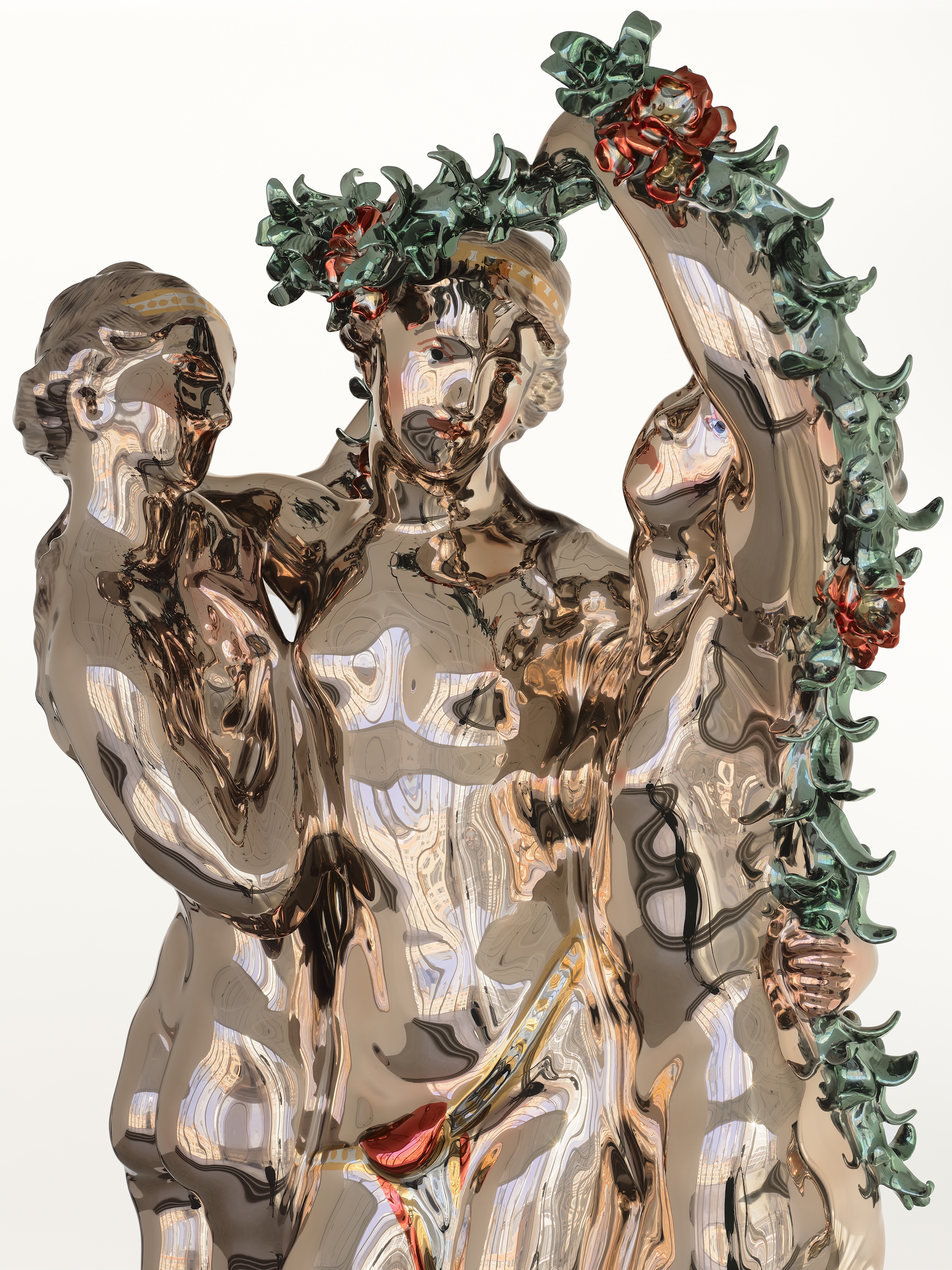
Jeff Koons, Three Graces (2016–22). Photo: Tom Powel Imaging/Courtesy of
Gagosian |
In the last 10 years, you’ve had some frustration and friction with collectors
regarding the time it takes to make some of your larger-scale works, because you are very demanding in terms of both the craftspeople and how you translate things through technology. Does it get easier, or do you just keep finding new ways to sort of push the envelope and make it a challenge to make these works?
I’m not striving for that. Technology continues to change, so you have more options. I want to make work, and I want to deliver that
work as soon as possible because I want to move on to the next project. But if we put things into perspective, people were waiting for Leonardo to deliver work for decades. It’s just the nature. I don’t mean to compare myself to him as an artist; these are stories that we know about that I can reference. When you care about something, and you’re trying to achieve something, it can take time. My Play-Doh sculpture took 20 years. My first ballerina sculpture, that I
delivered out of one block of stone, took 12 years. So it’s painful for me, because I want to make it and deliver it. But sometimes, to be able to make that work, that’s what it takes.
Who are the artists among your peers that you still see and think about?
I love all art. I love learning, through art, acceptance that everything is kind of perfect in its own being. So naturally, I love everything, and I can always get something out
of everything. I know Richard Prince is going to be having a show; I’ve always enjoyed Richard. I love David Salle’s work. I’ve always enjoyed Julian Schnabel. Julian was always so supportive of artists coming up. Cindy Sherman, Barbara Kruger—all these artists I’ve had the opportunity to show with over the years and have work juxtaposed to. |
Surrealism has become so present, and people are so engaged in it in recent
years. You mentioned a lot of these artists as influences, and yet when it comes to your art, I don’t think most people would think of it immediately as being inflected with surrealism.
That’s very perceptive, because it is really my foundation. We know that during stressful times, if we look at how art reflects its times, it can tend to go into these areas that are diverse and show a sense of personal vision. But in the moment, we also live with
the understanding that the reality of the multi-universe is that our existence is playing out through quantum physics and quantum computing. So you can imagine our relationship with narrative, and our understanding of existence and defining that and envisioning it. We have more freedom, in a way. |
|
|
Is that why you’re so interested in objects and recontextualizing them? With
a lot of the things you’ve done, it’s about taking an object and remaking it in an entirely different way. It becomes a different object. It becomes a world in itself.
I was always a painter. I studied painting in college, and when I moved to New York, my paintings got so heavy that I took them off the wall, and they started to become sculptural. And I started to work with color in a sculptural way. I think of my sculptures as paintings. And when
I would scan an object, I’d take all that information of the surface and paint my stainless-steel form with transparent colors. To me, when the 3D and 2D come together, that’s the visual arts at its most powerful.
Is this return to the Gagosian significant to you? Is it just another path toward managing your collectors and your market?
I really feel like I’m back in my orbit. We share very similar interests in the arts. It just
feels very natural to me. So I’m very happy to be back.
I love the architecture of all the galleries that Larry’s created around the world. I think they’re amazing places for art. In some manner, we can realize whatever we would like to make. I wake up every day trying to be the most I can be—the best human being, the best artist, so I can achieve my potential. So I’m really making what I want to make, and I’m very proud of the porcelain series. Throughout my creative path, at least the
last 50 years that I’ve been an artist here in New York, this has been a reflection of my journey in a dialogue of trying to find a future for myself within the world. I use the humanities, the arts, all the human disciplines to find a space for myself, to find a future, and at the same time, share that journey with the community around me, because we’re all inspired by each other. |
That should be enough for today. We will be back on Friday.
Until then,
M
|
|
|
The ultimate fashion industry bible, offering incisive reportage on all aspects of the business and its biggest
players. Anchored by preeminent fashion journalist Lauren Sherman, Line Sheet also features veteran reporter Rachel Strugatz, who delivers unparalleled intel on what’s happening in the beauty industry, and Sarah Shapiro, a longtime retail strategist who writes about e-commerce, brick-and-mortar, D.T.C., and more. |
|
|
Finally, a media podcast about what’s actually happening in the media—not the oversanitized,
legal-and-standards-approved version you read online. Join Dylan Byers, Puck’s veteran media reporter, and Julia Alexander, a longtime media analyst, as they sit down with TV personalities, moguls, pundits, and industry executives for raw, honest, sometimes salacious conversations about the business of media and its biggest egos. New episodes publish every Tuesday and Friday. |
|
|
Need help? Review our
FAQ page or contact us for assistance. For brand partnerships, email ads@puck.news.
You received this email because you signed up to receive emails from Puck, or as part of your Puck account associated with {{customer.email}}. To stop receiving this newsletter and/or manage all your email preferences, click here. |
Puck is published by Heat Media LLC. 107 Greenwich St., New York, NY 10006 |
|
|
|