{{ 'now' | timezone: 'America/New_York' | date: '%b %d, %Y' }} |
|
|
|
Welcome back to Wall Power’s Inner Circle. I’m Marion
Maneker.
Tonight, a closer look at the May sales data. In particular, I was curious to see how bidding behavior might have changed over the past three New York sales cycles as the art market recovered its top-line strength. Remember, my contention has been that lower-value items have continued to sell well—and even demonstrated real strength—through the slump. Now that the top of the market has returned, I’ll take you through that data and reveal some surprises.
Up top,
the Menil in Houston got a big gift; Phillips appointed a head of modern art in London; and Ketterer in Munich had some interesting sales—including a painting that hasn’t been exhibited in 100 years.
🚨 Just a reminder…: Puck’s Inner Circle subscribers get a discount on ARTDAI’s auction database and market intelligence platform, ArtQ One. If you sign up for the monthly package here using promo
code INNERCIRCLE, you’ll get the first month for $26, then pay $95 a month thereafter. Or just sign up for the yearly rate, which works out to only $79 per month. It’s an even better deal. (You just won’t get a discount from us.) I use ARTDAI. It’s the best tool available.
Also mentioned in this issue: Anne Wallington, Terry Winters, Jack
Shear, Wassily Kandinsky, Piero Dorazio, Leonard Lauder, Gerhard Richter, Martin Kippenberger, Elizabeth Peyton, Anish Kapoor, Mary Lovelace O’Neal, and more.
Let’s get started… |
-
Phillips appoints Anne Wallington in London: According to Phillips, collector interest in modern art has broadened. To meet that new interest, they’ve announced that Anne Wallington will join the company to head modern art in London and “play a strategic role in further strengthening Phillips’ global network of senior modern art specialists and expanding the company’s presence across Europe.”
|
|
|
|
A MESSAGE FROM OUR SPONSOR |
A MASTERPIECE IN MOTION Unmistakable style. Undeniable attention to detail. Experience composition and craftsmanship at their finest in a Range Rover.
EXPLORE
|
|
|
|
-
The Menil receives a gift of Terry Winters works: The Menil Collection in Houston received a gift of 51 prints by artist Terry Winters, donated by Jack Shear. It makes up nearly three-quarters of Winters’ output of prints in the 1980s. The artist added another 46 works, and printmakers ULAE donated the final piece of the puzzle. To celebrate the donation, as well as the Menil Collection’s 40th anniversary, the museum will mount
Terry Winters: Vitalized Geometry, opening September 25 and running through April 4, 2027. The show consists of 44 of Winters’ works, selected in consultation with the artist.
- Ketterer Kunst results: A quick update on Villa Seeburg am Staffelsee, the long-lost Wassily Kandinsky painting that Ketterer Kunst in Munich was offering with a €2 million estimate. It
sold last week for €5.5 million ($6.4 million). In the same sale, a Piero Dorazio painting that was estimated at €300,000—Tic-Tac Rosso, from 1959-60—sold for €2.58 million ($3 million).
- More Basel sales: Hauser & Wirth sold their big Gerhard Richter, Abstraktes Bild (940-7), for $20 million, and a Martin Kippenberger from 1989 for €1.45 million. David Zwirner said it sold an Elizabeth Peyton, Transmission E (E, rose) from 2026, for $1.2 million. Lisson Gallery sold two works
by Anish Kapoor for $625,000 each, and Marianne Boesky sold a Mary Lovelace O’Neal painting to a European museum for $1.5 million.
|
Now, there's more data to parse... |
|
|
|
While the big money has returned, auction houses are reducing estimates for
cheaper works to entice buyers and minimize their losses. Now, the latest data reveals a big shift is taking place in the middle market, too. |
|
|
|
There was hope that the success of the all-important May sales in New York would loosen purse
strings and usher in a new spirit of acquisitiveness for art collectors. From my conversations with dealers, however, those hopes were misplaced, or will at least require patience. It remains as hard as ever to get works sold, although many dealers tell me they’re making bigger deals… when they’re able to make them.
I thought of these conversations while going through the numbers from the May auctions—especially the data from the bidding quintiles, which show that the auction houses have
greatly reduced estimates, particularly in the lower registers. The result has been a minimization of losses in the average premium price and their confinement to the very bottom of the market. The downshift in estimates from November 2025 to May 2026 was even greater, but the same logic holds: Reductions in estimates have helped reduce the drop in average premium prices. |
|
|
|
A MESSAGE FROM OUR SPONSOR |
A MASTERPIECE IN MOTION Unmistakable style. Undeniable attention to detail. Experience composition and craftsmanship at their finest in a Range Rover.
EXPLORE
|
|
|
|
This suggests that, at the moment, the auction market is more responsive to buyers’ price
expectations than the private market; the auction houses are offering bargains, and buyers are snapping them up. Also, what’s interesting about the data below is that, as the top of the market revives, a big shift seems to be taking place in the middle market. |
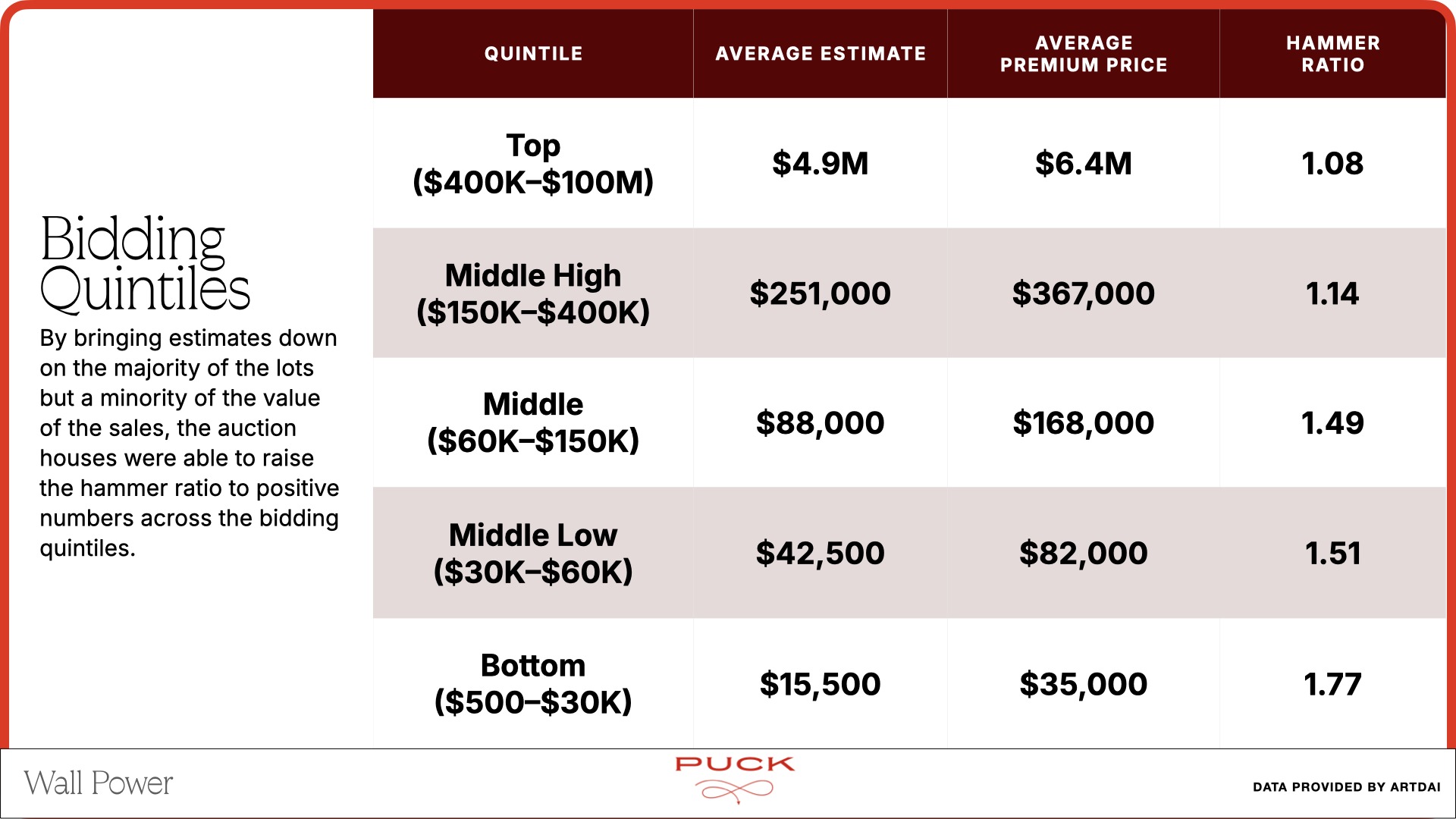
Every major auction season, I create a chart of the bidding quintiles, ranking all of the
lots offered by their presale estimates, high to low, then sorting them into five groups. The quintiles reveal the composition of each market sector, including the estimate range, average estimate, average premium prices of sold works, and overall hammer ratio. (As you know, the hammer ratio is the aggregate hammer price of all sold lots in the quintile divided by the aggregate estimates for all lots offered in the quintile.) The all-important hammer ratios measure the strength of
bidding.
Obviously, the art market isn’t a monolith. Strength at the top can mask weakness at the bottom or obscure what’s happening in the middle. You get the point. But looking at the changes in the quintiles over time—especially a volatile period like the past three seasons—is almost always revealing. |
Consignors have finally come to understand that the overall estimate level for art has been too
high. You can see that in the general shape of the market: Bidding is strongest for the lowest-priced works and gradually softens as you go up the quintiles. As we saw in the numbers two weeks ago, the overall hammer ratio rose into positive territory in the May sales, at 1.10. But the top of the market—works estimated between $400,000 and $100 million—was slightly weaker, at 1.08.
Compare that to May 2025, when the overall sales had a disappointing 0.89 hammer ratio, with the top
quintile coming in at 0.87. In November, this sector of the market had gotten noticeably stronger, with a hammer ratio of 1.10 that mirrored the overall hammer ratio. The top quintile in November 2025 was also colored by the sales of Leonard Lauder’s Klimts; the overperformance of the top Klimt greatly added to the hammer ratio.
This May, the average estimate of a work in the top quintile ($4.9 million) and average premium price ($6.4 million) were the
same as last November. But in May 2025, the average estimate in the top quintile was $3.3 million and the average premium price was $3.5 million. These numbers show the turnaround happening at the top.
That matters: In many ways, this top quintile is the art market, since it skews so heavily toward the high-value works that represent most of the total value. (In the May sales, for example, it accounted for 90 percent.) But that doesn’t mean the other quintiles don’t matter. As I’ve
said numerous times during the art market slump of the past three years, the health of the market can be seen in the demand for lower-value works and the volume of sales. Cultural property is clearly very important. The only question is how it gets distributed. |
|
|
|
That brings us to the other important observation from the bidding quintiles. This May, the average
estimate for each of the lower four quintiles and the average premium price (hammer price plus fees) were lower than in the previous two seasons. For the middle-high quintile, the average estimate and average premium price were $251,000 and $367,000, respectively. Last year they were $335,000 and $388,000, and in November they were $402,000 and $522,000. The downgrades were consistent throughout the quintiles. The middle-low quintile saw $42,500 and $82,000 as the average estimate and average
premium price; a year earlier, they were $50,000 and $82,000. In the fall, they were $68,000 and $104,000. |
It seems logical that lower estimates would attract greater bidding, which is why we’ve
seen the hammer ratios rise. But what accounts for the overall drop in estimates and selling prices for the 10 percent of the market value represented by the lower 80 percent of lots? One thought is that the wholesale downgrade in pricing is the result of the shift in property from artists currently practicing to historical material. With fewer recent auction records, the historic property tends to get estimated lower.
The weakness in that theory, however, is that we’ve been seeing a turn
toward historical works for several seasons. Why would the average estimates and prices for lots in all of the quintiles rise from May to November 2025, only to fall in May 2026, if the pricing were a result of the changing mix of property from young artists to old stuff?
We’ve heard from auction house specialists and heads of sales that they’ve been actively encouraging consignors to accept lower estimates. It appears the consignors have listened. Across the lower four
quintiles, average estimates fell, even as they held firm from November to May in the top quintile. In the middle-high and middle quintiles, the average premium price also fell, but at a much lower rate than the estimates. And in the lower two quintiles, cutting estimates either helped maintain the average premium price or boosted it. The average estimate for a work in the middle-low quintile was $50,000 in May 2025. It dropped to $42,500 this past season, while the average premium price
remained at $82,000.
In the bottom quintile, the average estimate for a lot in May 2025 was $18,000, and the average premium price was $30,000. A year later, the average estimate was slightly lower, at $15,500, but the average selling price was 16 percent higher, at $35,000. Those numbers validate the conventional wisdom that lower auction estimates generate more competition and, thus, higher prices. |
That’s my best guess on what’s going on in the art market right now. I was not expecting to see
these numbers change so much this season. I’ll be back again on Friday.
M |
|
|
|
Need help? Review our
FAQ page or contact us for assistance. For brand partnerships, email ads@puck.news.
You received this email because you signed up to receive emails from Puck, or as part of your Puck account associated with {{customer.email}}. To stop receiving this newsletter and/or manage all your email preferences, click here. |
Puck is published by Heat Media LLC. 107 Greenwich St., New York, NY 10006 |
|
|
|
|