Hello and welcome back to The Best & The Brightest. I’m Leigh Ann
Caldwell.
For all of you readers on Martha’s Vineyard—including restless Nantucketers looking to fire up the Cessna, like my partner Bill Cohan—look out for Republican Sen. Bernie Moreno. The Ohioan, who beat Democratic Sen. Sherrod Brown in the last election, told me he’s headed to the island next weekend for what he called his “annual pilgrimage” of “liberal immersion.” “I want to know how their brain works,” he said. “I
literally go around and talk to all these crazy libs.” Good luck to all on this cultural immersion project.
Meanwhile, Texas Democrats have fled the state to protest an attempt by Republicans to redraw congressional maps and wipe out as many as five seats held by Democrats. Stay tuned for my colleague Abby Livingston’s column tomorrow, which will be all about redistricting.
Today, as the Senate heads out of town until after Labor Day, I take a look
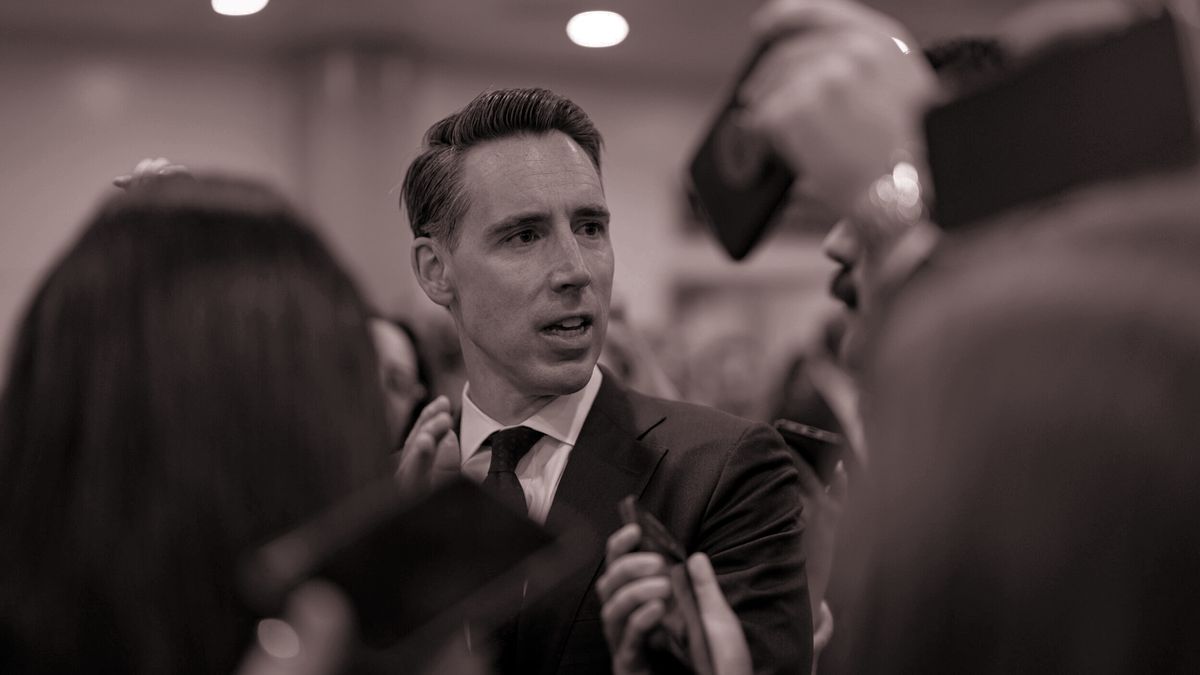
at the proposed congressional stock trading bans that keep popping up, and causing headaches for some members. That includes Sen. Josh Hawley, who wound up in President Trump’s Truth Social crosshairs over the issue. Hawley was dubbed a “second-tier” senator and a “pawn” of Democrats over what he told me was a
misunderstanding. So where was Trump getting his information? |
|
|
A MESSAGE FROM OUR SPONSOR |
|
|
- The
Senate’s dramatic August weekend: Late last night, the Senate left until after Labor Day in dramatic fashion, after negotiations broke down over the confirming of Trump’s nominees and the president got on social media to tell Senate Minority Leader Chuck Schumer to “GO TO HELL.” These aren’t just the usual partisan antics, though: When the
Senate returns in September, Republicans will consider removing the confirmation requirement for lower-level nominees, reducing the hours of debate required before voting on a nomination, or allowing themselves to confirm nominees in blocks. (These confirmation rules have been changing since 2013, when Republicans blocked Obama’s nominees.)
But the nomination fight could also have big ramifications for government funding. In exchange for his help confirming nominees,
Schumer demanded in negotiations with Senate Majority Leader John Thune that the White House unblock funding for foreign aid and health programs, and that even more nominees would be approved in October as long as the president didn’t send another rescissions package. According to a Republican aide, however, the administration didn’t take the deal. The president walked away, and then seethed on social media that Schumer had wanted “One Billion Dollars” in exchange for
confirmations.
Needless to say, this doesn’t bode well for the prospect of funding the government before September 30. And while the Senate has passed appropriations bills before the August recess for the first time since 2018—three of them, in fact—that’s just the first step in what’s sure to become a very messy process, especially if the White House gets involved. Which they will.
I heard that Trump considered installing his nominees through recess appointments—a process that
bypasses the Senate, but requires both chambers to be adjourned. But the House, of course, has already left town for the month without adjourning. If Speaker Mike Johnson brings the House back for the sole purpose of voting to adjourn, Democrats (and some Republicans) would surely revive the Jeffrey Epstein effort, which neither Trump nor Johnson wants. So that plan is out. Otherwise, Republicans could have changed the rules before recess, but that
would have been time-consuming, especially given that some Republicans might not fully be on board yet, and senators were anxious to leave town. “I’m not interested in doing anything that is just going to advantage Republicans today,” Sen. Lisa Murkowski told me, although she said the nominations process needs to be more efficient. “And then when Republicans are in the minority, we say, Who did that?”
The Senate has confirmed 135 nominees under Trump so far. But
even as Senate Republicans tout that statistic, Trump is pushing for more. It’s been a painful process, and more than 1,000 positions require Senate confirmation. Meanwhile, confirmations are one of the few points of leverage for Democrats, and they’re under a tremendous amount of pressure to push back against Trump. To wit: Schumer has not let a single Trump nominee go through without deploying every procedural step, which takes several days per nominee, eating up valuable floor
time.
It’s common practice for the two parties to negotiate a nominations package ahead of the August recess. Alas, not this August.
|
|
|
Congress’s latest, inevitably futile ritual of attempting to ban its own members from
trading stocks was particularly explosive this time around, after the president erupted at Sen. Josh Hawley over a perceived threat to his own bottom line. And yet, the latest effort may present even bigger hurdles. |
|
|
In a stream of midsummer Truth Social posts
attacking the Fed chair as “a stubborn MORON,” announcing the relocation of nuclear submarines in response to “provocative statements” by the former president of Russia, and firing a government statistician over jobs numbers he called “RIGGED,” Donald Trump also took the time to attack a putative Senate ally: Josh Hawley of Missouri, the lone Republican to vote with Democrats to advance a congressional stock trading ban out of committee. For this, the president dubbed Hawley a “second-tier” senator engaged in “SABOTAGE” by supporting a bill “that Nancy Pelosi is in absolute love with.” Heavy stuff.
Hawley, for his part, was mystified. After all, this was not a bill designed to protect Pelosi, the fourth-wealthiest member of Congress, whom Republicans regularly accuse of insider trading given that her husband’s stock portfolio consistently outperforms the market. (Pelosi has
called this accusation “ridiculous.”) On the contrary, Hawley originally named his congressional stock trading ban the PELOSI Act (Preventing Elected Leaders from Owning Securities and Investments) in a bid for Republican support. But the version that cleared the committee was eventually renamed the HONEST Act, a far less interesting backronym that
would also ban future presidents and vice presidents from stock trades. However, it notably didn’t apply to the current president—a point of confusion that set Trump off. Hawley told reporters he had no idea who gave Trump bad information. |
|
|
A MESSAGE FROM OUR SPONSOR |
|
|
Republican Sen. Rick Scott, it turns out, was the person who told Trump about Hawley’s
effort. Notably, Scott is the second-richest member of Congress, with a net worth of more than $550 million—which jumped nearly half a million dollars just last Friday, according to the congressional stock tracker Quiver Quantitative. He was happy to tell me about his conversation with the president earlier this week. “I told the president, you know, you’re included, so it means
you’ve got to sell everything,” Scott said, noting that he asked the White House what they wanted, and came up with two amendments on that basis to change Hawley’s bill—one of which would have dropped the provision including the president and vice president. “This guy has been attacked so much. Why would you give the Democrats another way to attack this guy?” Scott said. Scott and every other Republican on the Homeland Security Committee voted against Hawley’s bill, which passed with the help of
Democrats.
Trump was furious, quite publicly, which forced Hawley to explain himself in a phone call with the president. Trump “was under the impression that this current bill would cover him,” Hawley told me. The president, he went on, is now on board, given that the bill states only future presidents will have to abide by the new rules. White House Press Secretary Karoline Leavitt echoed that point, saying Trump could get behind the measure because it applies to “people like Nancy
Pelosi.” Hawley, who divested when he was elected to the Senate, said he was just looking for ways to advance a bill that he’s tried to get passed for years. “I’ve been through every iteration of this. And so I just—I want something to pass,” he told me. |
There’s a reason that Hawley, or anyone else for that matter, has failed to pass a congressional stock
trading ban into law. It’s an overwhelmingly popular issue to champion—there’s a push at least once per Congress—but there’s no real appetite from members to see it through. The only recent semi-exception is the STOCK Act of 2012, which merely required members to report every stock trade within 30 days.
In the last Congress, for instance, multiple congressional stock trading bills were introduced in the House and the Senate—some were partisan, some were bipartisan, and
none of them made it to the floor for a vote. The same thing happened during the Congress before that (and the Congress before that, and the Congress before that). From the members’ perspectives, this routine is a win-win: They can align themselves with something that’s politically popular, and appear as if they are fighting a system that the public distrusts, but they never have to actually regulate themselves.
Meanwhile, most members’ stock portfolios continue to outperform the market,
according to analysts. Tracking websites have sprung up to monitor trades and performance with information from STOCK Act disclosures. Freshman Rep. Rob Bresnahan, for instance, campaigned on banning congressional stock trading,
before becoming one of the most successful stock traders in the House. Bresnahan bought stock in the crypto companies Coinbase and Circle the week after the Senate passed its crypto-related GENIUS Act, a bill broadly supported by the industry, as it became clear the House would take it up. Coinbase stock jumped nearly 25 percent after that, peaking the day after Trump signed the bill into law. (It has since fallen, but still remains higher than when he bought the shares on June 23.) |
|
|
Bresnahan also sold his stock in Centene, a Medicaid healthcare exchange, just before Republicans slashed
Medicaid by passing the One Big Beautiful Bill Act. Centene’s stock plunged immediately, and is now worth half of its pre-OBBBA value. Speaking to his local NPR station, WVIA, Bresnahan blamed cumbersome House Ethics rules for the fact that he hasn’t put his stocks in a blind trust, and said he doesn’t want
to just abandon his portfolio. “And then do what with it?” he said. “Just leave it there and lose money and go broke?”
This is all perfectly legal under current law, and Bresnahan has not been formally accused of wrongdoing. The politics in his Scranton-area Pennsylvania swing district are another matter, however. Bresnahan barely defeated the Democratic incumbent, winning by just over a point, last cycle. “This is the reason Rob Bresnahan will lose,” a Democratic strategist said, adding
that his trades will almost certainly pop up in political ads. His fellow G.O.P. Pennsylvania Rep. Mike Kelly was also recently admonished by the House Ethics Committee for refusing to cooperate with an investigation into his wife’s sale of shares of the Cleveland-Cliffs steel company.
But congressional stock trading is a
bipartisan activity. While Democrats questioned whether Republicans were profiting off Trump’s April 2 “Liberation Day” tariffs, and the roller coaster of escalation and walkbacks that followed (a.k.a. the TACO trade), the National Republican Congressional Committee was watching Democrats’ stock activity, too. The N.R.C.C. noted that several Democrats made significant trades during that time. The vulnerable Texas Rep. Vicente Gonzalez purchased between $100,000 and $250,000 of
Apple stock on April 3, and then sold between $50,000 and $100,000 of Apple stock four days later, as the company requested an exemption from tariffs.
Then, of course, there’s the matter of Trump’s own finances. When Democrats tried to place guardrails around Trump’s crypto business in the GENIUS Act, Republicans refused, under pressure from the White House. Trump hasn’t even tried to hide the fact he’s made more than $600 million in crypto through memecoins and investments while
promoting and prioritizing the industry as president. While Trump lost money in his first term, in large part because of Covid’s impact on his resorts and properties, he has more than recovered in the intervening years, despite Eric Trump’s preposterous claim that “if there’s one family that hasn’t profited off politics, it’s the Trump
family.” The president’s attack on Hawley was fully consistent with his resistance to any effort that would curb his ability to make a buck.
In some ways, stock trading among politicians resembles the Jeffrey Epstein saga—another area where voters believe corrupt elites and politicians are playing by a different set of rules. And, like Epstein, the issue could become a problem for House Speaker Mike Johnson. When the House returns in
September, G.O.P. Rep. Anna Paulina Luna plans to force a vote on a stock trading ban with a discharge petition (a mechanism that members, including Republicans, continue to use to get around Johnson’s control of the floor) if she can get 218 signatures. Naturally, the Luna bill doesn’t place stock prohibitions on the president. |
|
|
Join Emmy Award-winning journalist Peter Hamby, along with the team of expert journalists at Puck, as they let you in on the
conversations insiders are having across the four corners of power in America: Wall Street, Washington, Silicon Valley, and Hollywood. Presented in partnership with Audacy, new episodes publish daily, Monday through Friday. |
|
|
Unique and privileged insight into the private conversations taking place inside boardrooms and corner offices up and down Wall
Street, relayed by best-selling author, journalist, and former M&A senior banker William D. Cohan. |
|
|
Need help? Review our FAQ page or contact us for assistance. For brand partnerships, email ads@puck.news. You received this email because you signed up to receive emails from Puck, or as part of your Puck account associated with {{customer.email}}. To stop receiving this newsletter and/or manage all your email preferences,
click here. |
Puck is published by Heat Media LLC. 107 Greenwich St, New York, NY 10006 |
|
|
|







_01K1KRHY8S0BDC1N648KE942TA.png "T-Mobile For Business")