{{ 'now' | timezone: 'America/New_York' | date: '%b %d, %Y' }}
|
|
|
Hello and welcome back to The Best & The Brightest. I’m Leigh
Ann Caldwell. Sadly, the Winter Olympics are coming to a close—but it was inspiring to see how thrilled the U.S. hockey team was after beating Canada for the gold. After all, these are professional players with impressive careers and almost nothing left to prove, but this win clearly hit them in a profound way. What was your favorite moment?
Meanwhile, we’re heading into a big week in Washington. President Trump will deliver the State of
the Union address on Tuesday, following the fresh Supreme Court decision that unraveled his tariffs and amid the ongoing Department of Homeland Security shutdown. Plus there’s a winter storm that has already caused the cancellation of House votes tomorrow, and it might make it difficult for members of Congress and their guests to get to D.C. ahead of the speech.
In tonight’s issue, I’m taking an inside look at a bipartisan push to save the National Governors Association, which has been
under a tremendous amount of pressure—and nearly forced into irrelevance—in the age of Trump. Plus, up top, some updates on the president’s tariff agenda and the fight over the “talking filibuster.”
By the way, I know that many of you saw the X post over the weekend in which “John Barron”—the pseudonym that Trump formerly used when calling reporters during his New York real estate days—called into C-SPAN to complain about the Supreme Court’s recent decision to nix the president’s tariffs.
A representative from C-SPAN confirmed for me that the call did happen, but no one thinks it was actually Trump, and the network later noted that the call took place while the president was in the “widely covered, in-person White House meeting with the governors” I’ll be writing about today. Anyway, that was a pretty good
impersonation.
Mentioned in this issue: Wes Moore, Kevin Stitt, Jared Polis, Tim Walz, Laura Kelly, Kathy Hochul, Spencer Cox, Donald Trump, Scott Presler, John Thune, Mike Lee,
Jeff Hurd, Hope Scheppelman, Josh Shapiro, Andy Beshear, and more…
|
|
|
A MESSAGE FROM OUR SPONSOR
|
Freight rail safely moves America forward
Safety is the foundation of America’s freight rail network. Skilled workers and advanced technologies work hand in hand to protect people, communities, and goods every day. Across 135,000 miles of track, millions of sensors and next‑generation high‑speed imaging systems continuously monitor rail equipment and infrastructure —identifying potential issues early so crews can address them long before they pose a risk. Together, they’re building a safer, more
resilient rail system that keeps America’s economy moving forward.
Learn more at aar.org/americas-engine
|
|
|
- Between
a tariff and a hard place: The economic and political consequences of the Supreme Court’s tariff ruling won’t be clear for some time. But tariffs are the one policy that Trump has consistently harped on for decades in public, and people close to him tell me he actually cares deeply about them—which all but guarantees that this will be a headache for Republicans ahead of the midterms. Higher prices are continuing to weigh on consumers, and the House recently passed a resolution that
reversed the president’s tariffs against Canada. The measure was supported by six Republicans, and Trump responded by pulling his endorsement of one of them, Colorado Rep. Jeff Hurd, and endorsing his more right-wing challenger Hope Scheppelman. The district is considered a bit of a stretch pick-up opportunity for Democrats, but some in the party think they could flip it if Scheppelman wins the primary—with a good Dem candidate.In the weeks
leading up to the SCOTUS decision, several Republicans told me they weren’t planning a legislative workaround in case the tariffs were overruled. Even if they won’t say it publicly, many in the G.O.P. are still philosophically opposed to tariffs and they don’t want to get into the middle of this particular fight, despite the court reaffirming that it was Congress’s constitutional duty. It might not matter: Trump currently has no plans to ask Congress to vote on whether he can implement tariffs
under the International Emergency Economic Powers Act (IEEPA) authority he’s been using, even if the Supreme Court insists he must. Instead, he announced a 15 percent across-the-board tariff, utilizing a different but much more limited presidential authority under Section 122 of the Trade Act of 1974, which allows him to implement tariffs for 150 days unless Congress authorizes an extension.
- Presler pressure: When Congress returns this week, Sen.
John Thune will face renewed calls to change the Senate filibuster rules, which the activist wing of his party believes is the only way to pass the SAVE America Act—legislation that would require proof of citizenship to register to vote and a voter ID to cast a ballot. Sens. Mike Lee and Rick Scott have been pushing the “talking filibuster” in the Senate, and conservative activist Scott Presler, who has a big online following,
has put the screws to Thune via a lobbying campaign on the Hill and Fox News in addition to his social media bully pulpit.Thune has been hesitant, of course, because any change to the rule would prevent other legislation and nominations from moving forward in the Senate (as I reported earlier this month). Plus, the SAVE America Act aims to solve a problem that
barely exists: Research from Cato Institute, the libertarian think tank, found that instances of noncitizens voting in federal elections are extremely rare. Their report also cited the conservative Heritage Foundation, which found just 23 instances of noncitizens voting between 2003 and 2023.
|
And now for the main event…
|
|
|
Frustrations with ICE boiled over in a private meeting of the National Governors
Association, where even Republican members were concerned with Trump’s push to nationalize elections. Meanwhile, on the sidelines, one question dominated all others: Who’s running for president?
|
|
|
The National Governors Association is one of the last remaining bastions of bipartisanship in the country—one
in which the members purport to put their states’ interests over politics. But no organization is safe from the partisan vortex of the Trump era, and America’s governors have faced a number of compounding crises in recent months: unwanted National Guard and ICE deployments, politically motivated funding decisions, the president’s threats to nationalize elections, and even a petty last-minute drama over invitations to the White House during their annual retreat, which concluded
this weekend. It’s a perilous moment that has divided the governors along partisan lines and, as in Congress, is testing their willingness to stand up to the president’s overreach.
|
|
|
A MESSAGE FROM OUR SPONSOR
|
Freight rail is a leading investor in America’s future
America’s Class I railroads invest $23 billion every year to strengthen and safeguard the nation’s rail network — a level of capital spending that’s six times higher than the average U.S. manufacturer as a share of revenue.
These investments modernize critical infrastructure, train employees, and drive safety innovations. From advanced intermodal hubs to
upgraded tracks and new customer site development, freight rail is building a safer, faster, and more reliable supply chain — ensuring customers and communities benefit from long-term, sustainable growth.
Learn more at aar.org/americas-engine
|
|
|
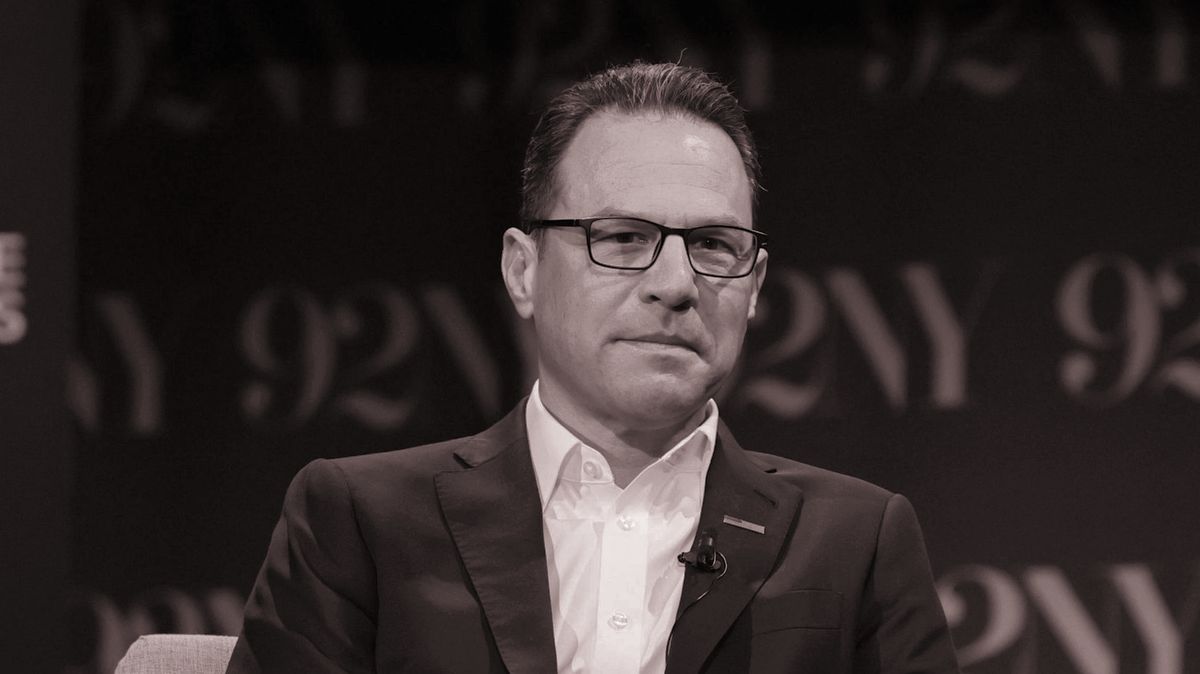
At the center of the latest dispute was Oklahoma Gov. Kevin Stitt, the chair of the N.G.A.,
and a Republican whose party used to be skeptical of federal overreach. Stitt, who is term-limited and won’t have to face the voters of his Trump +34 state again, has at times stood up for blue-state governors facing attacks from the president. His latest act of defiance came this weekend, after Trump tried to exclude two Democratic governors—Maryland Gov. Wes Moore, the N.G.A.’s vice chair, and Colorado Gov. Jared Polis—from a business meeting scheduled for
Friday at the White House. In response, Stitt wrote a letter to the governors saying that the N.G.A. will “no longer serve as the facilitator for the event” and wouldn’t take part in the official program. Naturally, this infuriated Trump, who railed against him over several social media posts, calling him “mediocre,” a “RINO governor,” etcetera.
Stitt’s stand has drawn praise from some members of the N.G.A. As one Democratic governor told me, “He’s someone who’s willing to call balls and
strikes when he’s watching this type of executive or operation, and not just do it privately.” Indeed, many Republican governors refuse to say anything in defense of their blue-state colleagues on the receiving end of Trump’s threats to state autonomy. “The delta between the ones who will call me and say, ‘Hey, just wanna let you know that we stand with you,’ but then have said nothing in public, I think, just continues to show the absolute chokehold that this president continues to have over
this party,” the governor added.
Most recently, the president’s drumbeat of threats to nationalize midterm elections has placed new strains on the group. After all, it wasn’t so long ago that Republicans vocally defended the constitutional prerogative of states to oversee their own elections amid Democrats’ failed attempt to pass the John Lewis Voting Rights Act under President Biden. “There’s a pretty universal understanding and agreement as governors that that
has to be protected,” Gov. Moore told me. And yet it’s unclear how Republican governors will respond to this latest transgression from the White House—or, indeed, whether they’ll push back at all.
|
The N.G.A., which was founded in 1908, experienced one of its lowest points last year. Minnesota Gov.
Tim Walz and Kansas Gov. Laura Kelly stepped back from the group after it refused to stand up to Trump’s federal stampede into blue states. Defense Secretary Pete Hegseth had deployed the National Guard to California over the objections of Gov. Gavin Newsom, followed by similarly unwanted incursions into Oregon and Illinois. The association mostly stayed silent. Finally in October, Newsom had enough. In a fury, he threatened to withdraw from the group, questioning the very point of the institution: “If we cannot come together on a bipartisan basis, on this basic principle of state sovereignty,” he wrote, “what purpose does the National Governors Association serve?”
It was an inflection point for Stitt, and the N.G.A. eventually engaged in some mild pushback against federal overreach. Following the killing of Alex Pretti in Minneapolis this January, the
governor’s association put out a joint statement urging “leaders at all levels to exercise wisdom and consider a reset of strategy toward a unified vision for immigration enforcement.” The language was milquetoast, but the rebuke of ICE, written on behalf of a group including more than a dozen Republicans, was somewhat extraordinary.
The frustration with ICE has only continued. In a private N.G.A. meeting on Thursday morning, the dozen governors who attended were mostly united in their
opposition to the agency’s aggressive tactics, according to a person familiar with the event. Afterward, Gov. Polis told me that there’s “a lot of agreement” among governors that deportation should be targeted toward criminals and that they unanimously understand “the importance of immigrants to our economy.” Multiple governors called for Congress to pass bipartisan immigration reform. However, as North Dakota Gov. Kelly Armstrong, himself a former congressman, told me: “On this
issue, I find it very difficult to figure out how you get 60 votes in the Senate and a majority in the House.”
|
|
|
Trump’s ongoing threat to nationalize the elections was also a topic of conversation. Governors, especially
in blue states, have said that they are starting to take actions to prevent the president from controlling their ballot process by preparing legal responses, contingency plans, and bolstering cybersecurity protections. Polis told me it was “a priority” for Colorado, which primarily votes by mail. “It’s a concern for most governors,” Utah Republican Gov. Spencer Cox told me. “We seem to have pretty broad agreement right now on the importance of federalism
again, and it’s fun to have the left agreeing with us that states should be able to work on these things.”
|
While governors from some of the biggest states—including Florida, Texas, and California—didn’t attend the
annual retreat, I’m told there was an almost comic level of jockeying between those in attendance with presidential ambitions. To wit, a Maryland state lobbyist recalled when Pennsylvania Gov. Josh Shapiro rushed to be the first speaker during a side session on crypto. Kentucky Gov. Andy Beshear, who announced his new book in time for the yearly pilgrimage to Washington, spoke at the Center for American Progress.
Of course, everywhere the
governors went—bopping from TV interviews to panel sessions to meetings with lobbyists and industry groups—they were asked the inevitable questions: Are you going to run for president? Who should run for president? (No governor declared their candidacy.) When the governors finally made their way to the White House on Friday morning, even Moore and Polis were in attendance, despite missing the initial invite. Polis told me it was “a badge of honor” to be targeted by Trump, who has been
waging a retaliatory political war on his state.
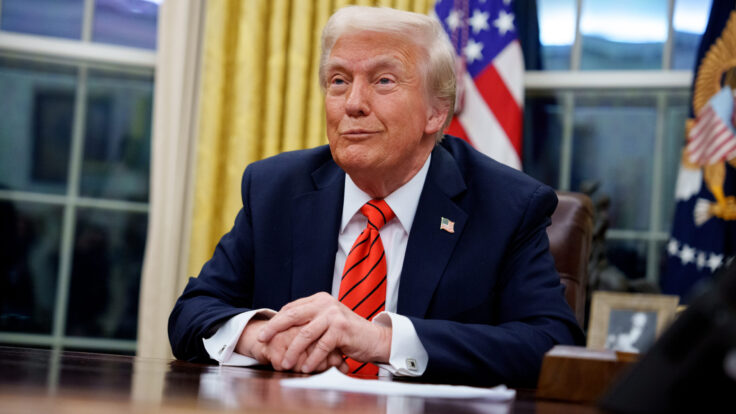
In the end, perhaps it was Polis and Moore who got the last laugh. On Friday, during their governors’ meeting with Trump at the White House, Trump was on a roll, charming the group and even playing nice with New York Gov. Kathy Hochul. But then the govs’ phones started buzzing with
the news that the Supreme Court had knocked down his tariffs. The vibe in the room shifted even though Trump, who was busy taking questions, was unaware until he was handed a note, according to a governor who attended. Trump said he was “seething,” and ended the meeting early. Suffice it to say, the tension between Trump and the blue-state governors is showing no signs of dissipating.
|
|
|
Join Emmy Award-winning journalist Peter Hamby, along with the team of expert journalists at Puck, as they let you in on the
conversations insiders are having across the four corners of power in America: Wall Street, Washington, Silicon Valley, and Hollywood. Presented in partnership with Audacy, new episodes publish daily, Monday through Friday.
|
|
|
Unique and privileged insight into the private conversations taking place inside boardrooms and corner offices up and down Wall
Street, relayed by best-selling author, journalist, and former M&A senior banker William D. Cohan.
|
|
|
Need help? Review our
FAQ page or contact us for assistance. For brand partnerships, email ads@puck.news.
You received this email because you signed up to receive emails from Puck, or as part of your Puck account associated with {{customer.email}}. To stop receiving this newsletter and/or manage all your email preferences, click here.
|
Puck is published by Heat Media LLC. 107 Greenwich St., New York, NY 10006
|
|
|
|