{{ 'now' | timezone: 'America/New_York' | date: '%b %d, %Y' }} |
|
|
Hello and welcome back to The Best & The Brightest. I’m Leigh Ann Caldwell, one
of the 190 million people in the path of this winter storm. Stay safe and try to stay sane: Many schools will very likely be canceled tomorrow, if they haven’t been already. (My kids’ schools have).
It’s been another excruciating news cycle as ICE agents killed—seemingly without any justification—a second citizen in Minneapolis in as many weeks. And it’s hard to see how conditions improve when federal accountability, often a deterrent, is essentially nonexistent. On the contrary, the
Department of Homeland Security has been rapidly hiring and unleashing new recruits into the streets with minimal training—all while Vice President J.D. Vance and top White House advisor Stephen Miller have insisted that agents have total immunity from the law. Indeed, the Justice Department has refused to investigate ICE following the killing of Renee Good. At least one F.B.I. agent and six federal prosecutors resigned when the D.O.J. pushed to
investigate Good’s widow, instead.
More on all that in tonight’s email. Plus, I take a close look at Donald Trump’s revenge campaign against blue states—and particularly those with policies that run counter to his own. It might be effective in straining state budgets and causing pain for residents, but it’s also politically risky, given that control of the House will be won or lost in red districts within those blue states. Some Republicans I’ve spoken to
are frustrated with the president, but there’s little they can—or are willing to—do about it.
Mentioned in this issue: Alex Pretti, Catherine Cortez Masto, Robin Kelly, Mark Carney, Andrew Garbarino, Kevin Stitt, Robert Jones, Darrell Issa, David Valadao, Gabe Evans, Tom Kean Jr., Mike
Lawler, Jen Kiggans, Marie Gluesenkamp Perez, Susan Collins, Janet Mills, Kristi Noem, Wes Moore, Jason Crow, and many more… |
|
|
SPONSORED BY: COALITION TO STRENGTHEN AMERICA'S HEALTHCARE |
Behind many dangerous delays in care are insurer practices that prioritize administrative hurdles over patients. Excessive prior
authorization requirements and AI-assisted coverage denials pull clinicians away from the bedside and bury care decisions in paperwork. While hospitals work around the clock to deliver timely, life-saving treatment, insurer delays and denials slow access, disrupt clinical judgment, and increase costs. When approvals take days or weeks, patients wait longer for critical care, conditions worsen, and risks rise, putting paperwork and process ahead of the care patients urgently need. |
|
|
- Will
D.C. get an ICE shutdown?: The Senate was seemingly on track to pass its final four appropriations bills this week, which included funding for the Department of Homeland Security. Yet the horrific killing of Alex Pretti, the ICU nurse who was shot by ICE agents yesterday, has dramatically changed the dynamic—and increased the chances of a partial government shutdown at the end of the week. Senate Democrats have nearly unanimously now come out against funding D.H.S.,
including Sen. Catherine Cortez Masto—a Nevada Democrat who is adamantly opposed to government shutdowns but said that she “will not support the current Homeland Security Funding bill.”
The House voted on the D.H.S. funding bill separately, but sent it on to the Senate packaged with the Defense, Labor, and Transportation bills (as well as previously passed appropriations bills funding Financial Services and the State Department). The Senate could vote separately on the D.H.S. bill, but it would take the support of all 100 senators to advance to a vote, and Senate Republicans have decided that they won’t agree to that. “We will move forward as planned and hope Democrats can find a path forward to join us,” a senior Republican aide said.
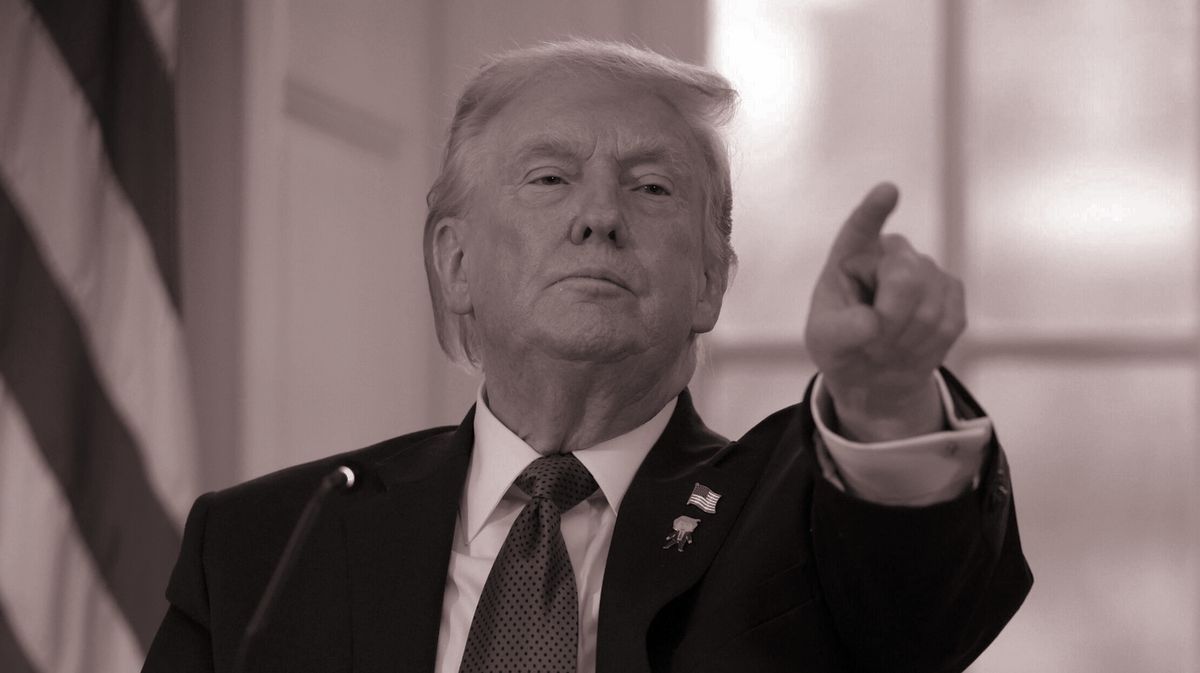
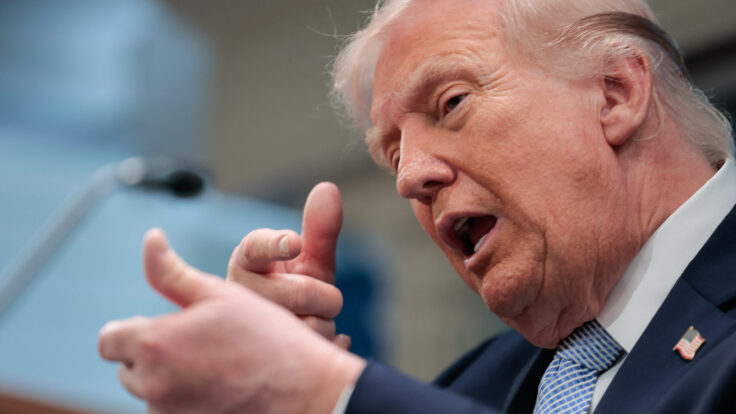
And the president has doubled down—or perhaps unveiled his opening negotiation position. In a new Truth post, he called on Gov. Tim Walz to turn over all undocumented immigrants in prisons, with warrants or arrested, and demanded that Democratic officials cooperate with federal law enforcement. He’s also calling for Congress to pass legislation to “END Sanctuary Cities.”
Notably, the current expansion and deployment of ICE in blue cities is not being funded through the normal appropriations process. Instead, it is being
underwritten by the massive injection of funding provided by the One Big Beautiful Bill that Republicans passed last year. A government shutdown over ICE would be largely symbolic—but for many Democrats, any act of defiance might be better than nothing.
Republicans are usually on comfortable turf when discussing immigration. But the conversation has now shifted into a much more contentious debate about the value of roving, masked, minimally trained, militarized federal agents
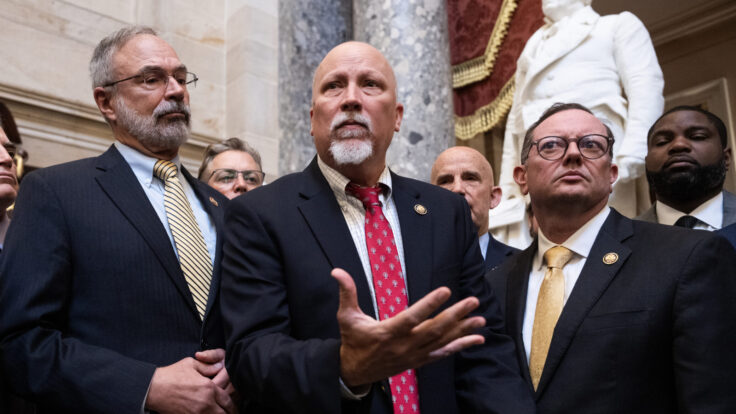
that have now killed two American citizens—and even some Republicans are beginning to speak out. New York Rep. Andrew Garbarino, who chairs the House Homeland Security Committee and is a potentially vulnerable member, said after Pretti’s death that he wants top D.H.S. officials to testify before his committee. Meanwhile, on CNN’s State of the Union this morning, Oklahoma Gov. Kevin Stitt said that “Americans don’t like what they’re
seeing” in Minnesota. “What’s the goal right now?” he added. “Is it to deport every single non-U.S. citizen? I don’t think that’s what Americans want.”
As I reported last week, House Democratic Leadership had already been quietly discussing how to investigate D.H.S. Secretary Kristi Noem, perhaps to lay the groundwork for an impeachment inquiry if they win
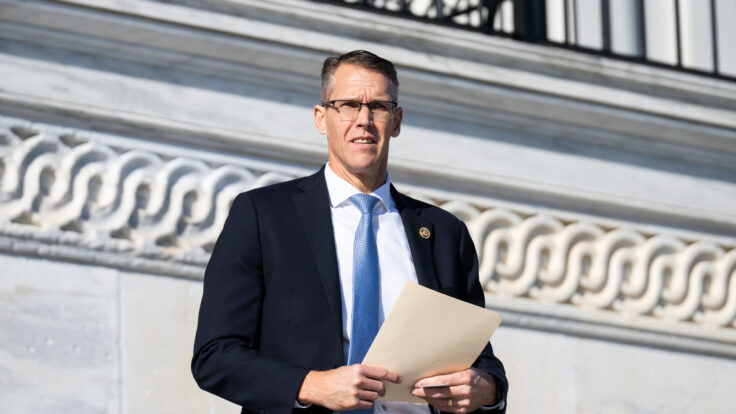
back the House (or even before). No decision had been made, but movement around those plans is likely to accelerate now. Rep. Robin Kelly’s articles of impeachment now have 111 cosponsors. - Oh Canada…: Trump announced
on Truth Social this weekend that he will impose 100 percent tariffs on Canada if they start importing more goods from China. (Canada signed a preliminary trade agreement last week with China, partly in response to Trump’s continued economic and military threats.) It’s an open question whether Ottawa will back down or seek even stronger ties to other nations as the U.S.-Canada alliance unravels. In Davos last week, Canadian Prime Minister Mark Carney delivered a
scathing speech about the U.S. under Trump. “Let me be direct. We are in the midst of a rupture, not a transition,” he said, receiving a standing ovation. “You cannot live within the lie of mutual benefit through integration, when integration becomes the source of your subordination.”
|
|
|
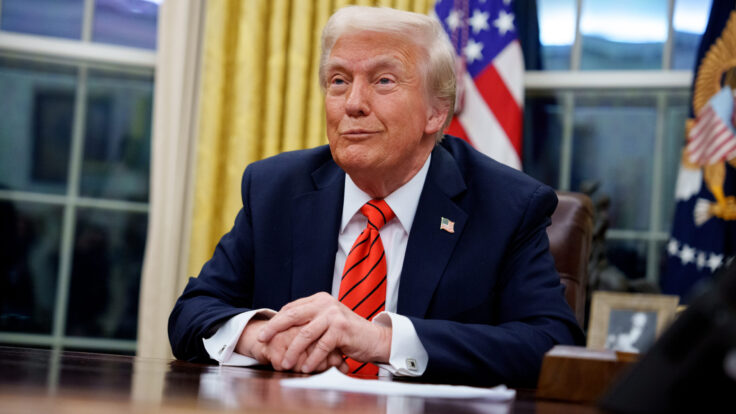
The White House is threatening to throttle federal funding to blue states, escalating
Trump’s war of retribution. On Capitol Hill, some Republicans worry it could cost them the House. |
|
|
Earlier this week, the Office of Management and Budget sent out a memo, written in typical Washington
bureaucratese, requesting that nearly every federal agency compile information on all funding being provided to a list of 14 states and the District of Columbia, purportedly to root out fraud and waste. “This is a data-gathering exercise only,” the memo stated drily. “It does not involve withholding funds, and therefore does not violate any court order.” And yet, the directive immediately sent shock waves through Capitol Hill. Every one of the targets was a blue state. |
|
|
SPONSORED BY: COALITION TO STRENGTHEN AMERICA'S HEALTHCARE |
When access to care depends on administrative approval, patients pay the price. Excessive prior authorization requirements and AI-assisted
coverage denials delay treatment and shift decisions away from doctors and toward paperwork. These insurer-driven practices add an estimated $83 billion in administrative costs alone. While hospitals work to deliver timely, affordable care, administrative barriers slow treatment, increase risk, drive up costs, and undermine trust—especially when care is time-sensitive and patients need medical decisions guided by clinical judgment, not process. |
|
|
For months, President Donald Trump has been threatening to withhold federal funding from
states that have resisted his agenda—a pressure campaign that has largely failed to bend Democratic governors to his will. But it could have significant, unintended political consequences for Republican candidates in those states, threatening G.O.P. control of the House. Of the 18 congressional races in 2026 that are considered most competitive, seven are in
the targeted blue states. The endangered Republican incumbents are Reps. Darrell Issa and David Valadao (California), Gabe Evans (Colorado), Tom Kean Jr. (New Jersey), Mike Lawler (New York), and Jen Kiggans (Virginia). There is also a toss-up seat in Washington, currently held by Democratic Rep. Marie Gluesenkamp Perez.
The White House hasn’t determined what funding, if
any, could be withheld as a result of this latest directive. But a retaliatory spending freeze wouldn’t be a great campaign issue for Republicans to have to defend. Democrats only need to pick up three seats to take back the House.
Concerns about the directive have been making their way around the Hill. Rep. Brian Fitzpatrick, a Republican representing the swingy collar counties outside of Philadelphia, told me that in the hours after news of the O.M.B. memo broke, he
heard about it from Republican Rep. Nicole Malliotakis, of Staten Island, whose seat is relatively safe but could be upended after a judge ruled last week that her district was unconstitutionally drawn. (Malliotakis’s office did not respond to requests for comment.) “I don’t think any state should be targeted,” he told me. “I don’t agree with any of these broad, sweeping responses. If there’s a problem, identify the problem and have a narrowly—narrowly—tailored response
to that.” |
This is far from the first time the president has threatened to use federal funding as a weapon against blue
states. Earlier this month, he froze funding for childcare and low-income assistance programs in California, Illinois, Minnesota, and New York, where his administration put a hold on some $18 billion in infrastructure projects, ostensibly because of “D.E.I.” (On Friday, a judge extended an earlier T.R.O. that had blocked the childcare
funding freeze.) In Colorado, where funding for social programs was also frozen, the White House has also canceled transportation grants and Department of Energy funding; relocated the U.S. Space Command headquarters to Alabama; closed a major atmospheric research facility; and vetoed a critical water infrastructure bill that had passed Congress unanimously—all actions that threaten
the reelection chances for Colorado’s four Republican congressional members.
Meanwhile, the president has also denied requests for federal disaster relief in Vermont, Illinois, and Wisconsin, where flooding last year affected the districts of endangered Republican Reps. Derrick Van Orden and Bryan Steil, who is now on the Democrats’ midterm pick-up list. In North Carolina, he denied an extension of full FEMA reimbursement for damage caused by Hurricane
Helene. (Trump, of course, once falsely claimed that Biden’s FEMA was restricting funds following the hurricane.) Democrats believe the move may have put Rep. Chuck Edwards’s district—which Trump won by 10 points in 2024—in play. It’s now trending just R+5, according to the Cook Partisan Index. |
|
|
Nor has it gone unnoticed that Trump is only surging ICE into blue states and cities. Last week, masked
immigration agents showed up in Maine for Operation Catch of the Day—a middle finger, perhaps, to Democratic Gov. Janet Mills, who has feuded with the president. But the operation has put Maine’s moderate-ish Republican senator, Susan Collins, in a difficult position. Over the past few days, Gov. Mills has called for the Senate to withhold additional funding for D.H.S., placing Collins, the chair of the Appropriations Committee, at the center of
a political firestorm over ICE. Collins, who will need the continued support of independents and some Democrats to win reelection in November, now has to decide if she is going to oppose the administration (Trump has already said she should never be elected again) and her own bill, or defend ICE’s aggressive tactics.
Some Republicans are skeptical that Trump’s retribution against blue states will make it into campaign ads. But there’s no doubt it gives Democrats another lane of attack in
a midterm year that is already trending in their favor. The president is more than 12 points underwater, and the Dems’ generic congressional ballot lead over Republicans has risen to an average of 4.9 points, according to Real Clear Politics. (This week’s New York Times poll puts his job approval at negative 16 points.)
It also seems to
validate their midterm messaging that the president is more focused on revenge and retribution than improving people’s lives or lowering prices—and some governors, like Maryland’s Wes Moore, have used it to justify their own mid-decade redistricting efforts. “It’s hurting [Republicans] a lot, and it should,” Rep. Jason Crow, a Colorado Democrat who co-chairs the D.C.C.C.’s candidate recruitment effort, told me. “Their value proposition to the voters is,
‘I’m a Republican, I’m able to cut a deal and bring home the bacon to the state and my voters.’ And that value proposition has turned out to be bullshit.”
Still, Trumpier Republicans, including California Rep. Issa—whose district became less red after California’s mid-decade redraw—have argued that the administration is doing the right thing by trying to control fraud. “Rather than portray this as just one more partisan squabble, we should be focusing on the refusal of our home state of
California to work with the federal government and protect the taxpayers’ interest,” Issa told me in a statement. “It’s astonishing that Gavin Newsom’s clear refusal to root out the fraud we know exists isn’t setting off a wildfire of press outrage and embarrassment among elected Democrats.”
In any case, Republicans don’t have many options beyond embracing Trump’s rhetoric. The president, after all, isn’t known to walk away from a vendetta. For his part, Rep. Valadao, who
represents an agricultural district in California’s Central Valley, has been trying to avoid national politics altogether. “The first midterm election after a president’s election is always really challenging, and Valadao is working to show he’s a congressman who is of the Central Valley and not a congressman of D.C.,” Valadao’s campaign strategist, Robert Jones, told me. “The most effective campaigns are the ones that can separate themselves and show independence.” |
|
|
The industry’s go-to source for unflinching reporting on the trillion-dollar business of artificial intelligence - perhaps the
single most important technology of our time. Ian Krietzberg, the powerhouse journalist behind The Deep View, delivers twice-weekly insights into the latest dealmaking and breakthroughs in A.I., and how the intersecting worlds of finance, entertainment, media, and politics are being transformed in its wake. |
|
|
Join Puck’s chief political columnist, John Heilemann, as he roams the corridors of power and influence in America on this
twice-weekly interview show, taking you beyond the headlines with the people who shape our culture: icons and up-and-comers, incumbents and insurgents, moguls and machers in the overlapping worlds of politics, entertainment, tech, business, sports, media, and beyond. The conversations are rich and revealing, unrehearsed and unexpected… and reliably impolitic. A Puck-Audacy joint, new episodes drop every Wednesday and Friday. |
|
|
Need help? Review our
FAQ page or contact us for assistance. For brand partnerships, email ads@puck.news.
You received this email because you signed up to receive emails from Puck, or as part of your Puck account associated with {{customer.email}}. To stop receiving this newsletter and/or manage all your email preferences, click here.
|
Puck is published by Heat Media LLC. 107 Greenwich St., New York, NY 10006 |
|
|
|