Hello, and welcome back to The Best & The Brightest. I’m Leigh Ann Caldwell.
Roaming the halls of the Capitol today, I ran into an old source who told me that the Proud Boys took a public tour yesterday, on the fifth anniversary of the January 6 attack. As you’ll recall, Proud Boys members played a significant role in the day’s violence. Founder Enrique Tarrio, convicted of seditious conspiracy, was serving a 22-year prison sentence until President Trump pardoned him.
In today’s issue, news and notes on the Trump
administration’s Venezuela briefing for House and Senate members, which enthralled many Republicans and frustrated more than a few Democrats. Plus, below the fold: why the Colorado congressional delegation is furious at Trump, and how the president’s bizarre revenge campaign against the state could cost Republicans the House.
Mentioned in this issue: Dan Caine, Nicolás Maduro, Joni Ernst, Bernie Moreno,
Marco Rubio, Pete Hegseth, Mike Johnson, Nancy Pelosi, Donald Trump, Joe Biden, Thomas Massie, John Hickenlooper, Dianna DeGette, Gabe Evans, Lauren Boebert, Gavin Newsom, JB Pritzker, Jared Polis, Tina Peters, Jeff Hurd,
Jeff Crank, Jessica Killin, Joe Neguse, Eileen Laubacher, and more… |
|
|
Glyphosate is backed by regulators worldwide For 50 years, glyphosate-based products have been approved and reapproved by regulators in the U.S., EU, Canada, Japan and more. Bayer stands behind these thousands of findings and legislative language that reinforces science-based processes and keeps labels uniform. At Bayer, we succeed when farmers succeed. Learn more |
|
|
- Venezuela
patriot games: Top administration officials held two separate classified briefings with the House and Senate today, but the sessions, according to members of both chambers who attended, had little to do with what comes next in Venezuela. Instead, Dan Caine, chairman of the Joint Chiefs of Staff, gave a blow-by-blow account of how the U.S. military broke into Nicolás Maduro’s fortified compound and snatched the president and his wife,
Cilia. “Honest to goodness, if you’re not proud to be an American coming out of that, and just understanding the operation and how well it was executed, I don’t know what’s wrong with you,” Iowa Republican Sen. Joni Ernst told me. “It’s like reading a Tom Clancy novel,” said Sen. Bernie Moreno, the Ohio Republican.
But what about the future of Venezuela? What does Trump’s proclamation that he is “running” the country
mean? Will there be elections? And will the U.S. attempt to take power in Greenland? Cuba? Colombia? Neither Secretary of State Marco Rubio nor Secretary of War Pete Hegseth answered those questions. “That’s not what this conversation was about,” Moreno told me.
Many Democrats left the briefing frustrated and angry. Texas Rep. Veronica Escobar chimed in as she walked by Speaker Mike Johnson’s post-briefing press remarks
to say that arresting Maduro was just about oil—as Trump himself has essentially acknowledged. When former House Speaker Nancy Pelosi was asked if she felt that administration officials were lying, she said, “It’s not a question of lying. It’s a question of withholding the truth.” - A Minneapolis ICE killing: The aggressive tactics of ICE officers in American cities turned deadly today when a masked federal agent fired on a 37-year-old
woman in her car as she tried to drive away. D.H.S. released a statement describing the woman as a “violent rioter” who “weaponized her vehicle, attempting to run over our law enforcement officers in an attempt to kill them—an act of domestic terrorism.” But witness videos tell another story: one of a driver who reversed as an ICE officer tried to open her car door, then got shot at by another from the front of the car and then the side as she pulled forward.
Whatever the circumstances,
it was a tragic incident—and, unfortunately, not unexpected as ICE ramps up its presence across the country. But the immediate aftermath was chilling: The entire Trump administration, from the president to the press secretary to his supporters in Congress, blamed the left for attacks against ICE, and blamed the victim as an alleged violent agitator. D.H.S. has made no announcement of an investigation, but Trump said it is “being studied.” We’ll see if there are any repercussions for the
officer.
|
|
|
The president’s bizarre decision to wage a retaliatory political war on Colorado—including
the MAGA stronghold that elected Lauren Boebert—could wind up costing him the House. |
|
|
Donald Trump’s vengeance is swift and sometimes irrational, whether it’s stripping
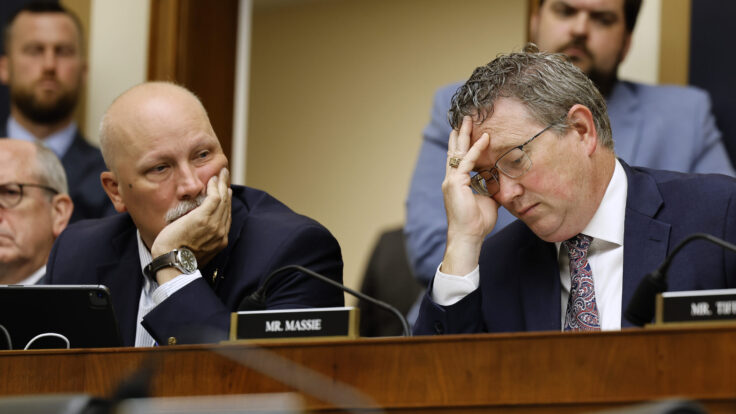
Biden officials of security clearances, threatening to withhold disaster relief after the Los Angeles wildfires, vowing to defeat vocal critic Rep. Thomas Massie, or any number of other high-profile reprisals for slights real or imagined. And when he feels wronged, he doesn’t much care who gets hurt, as long as it hurts.
And yet, few states have felt the president’s wrath quite like Colorado—a blue state where Trump is nonetheless endangering at least one
of four Republican districts that he’ll need in 2026 to retain control of the House and, according to him, avoid a third impeachment. In the past month, Trump has canceled federal grants, rejected federal disaster relief requests, shuttered a key research hub, and vetoed a critical rural water infrastructure bill in the state. Just this week, the administration paused more than $300 million in federal grants for childcare and a temporary cash assistance program for families with children,
part of a $10 billion funding freeze targeting a handful of blue states.
Last year the Trump administration also decided to dismantle the National Center for Atmospheric Research, in Boulder, and declared that the headquarters for U.S. Space Command will be moved to Alabama. (A White House official told me the president was “taking politics out of this decision” by relocating the agency to Huntsville, where NASA also operates.) |
|
|
Giving farmers the tools to succeed What helps farmers? Competition in agriculture and streamlined regulations. Because access to innovative tools means more choices for farmers and stronger food security for Americans. At Bayer, we succeed when farmers succeed. Find out about farming innovation |
|
|
The federal assault has infuriated the state’s Democrats, who are suing to reinstate already appropriated
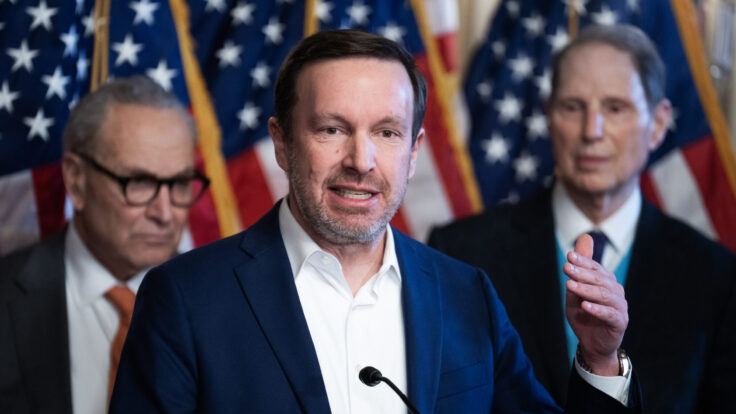
funds. Sens. Michael Bennet and John Hickenlooper have held up government funding bills, demanding the restoration of the state’s climate hub. Rep. Dianna DeGette, a manager in Trump’s last impeachment, has dubbed his campaign of vindictiveness “probably impeachable”—and, I’m told, is close to calling for his impeachment again. But it’s the Colorado Republican delegation that’s perhaps most affected by Trump’s mile-high revenge tour,
from vulnerable districts like that of Rep. Gabe Evans to redder Trump territory represented by Lauren Boebert.
The president has been “really unhelpful” for the reelection prospects of Colorado’s four Republicans, one senior Colorado Republican aide told me. “The administration has let vengeance get in the way of good politics.” Indeed, Colorado could be the state where Trump’s vindictive streak winds up costing him the House. |
Colorado isn’t an obvious target for Trump. It’s a blue state, yes, but it’s not one led by an outsize Trump
critic in the mold of Gavin Newsom or JB Pritzker. Colorado Gov. Jared Polis, in fact, has sided with the president on some issues, including supporting MAHA priorities like banning soda from food assistance and celebrating what Polis called “the ouster of the brutal socialist dictator of Venezuela” (though he did express the
requisite Democratic concerns about congressional oversight). But the reasons for Trump’s particular fury here date back to before his current go-round in the presidency.
You may recall that, in 2023, the state’s Supreme Court disqualified Trump from the presidential primary ballot over his role in the insurrection of
January 6. The U.S. Supreme Court unanimously overturned the ruling the following spring. On the campaign trail, Trump frequently claimed that one apartment building in Aurora, a Denver suburb, was filled with Venezuelan gang members. Shortly after his inauguration, Trump ramped up his attacks against Polis over an allegedly unflattering portrait of the president that hung in the state capitol. (The governor actually had nothing to do with the portrait, which state Republicans commissioned in
2019—and even raised funds to do so.)
And, in Trump’s eyes, the state continues to be a troublemaker. Now he’s irate over the prosecution of Tina Peters, a Mesa County election clerk and 2020 election denier sentenced to nine years in prison for tampering with voting machines. Last month, Trump pardoned her—a gesture that has no legal effect since she was convicted under state, not federal, law. “I wish them only the worst,” Trump posted, on New Year’s Eve, of Polis and
the Republican district attorney who prosecuted Peters. “May they rot in Hell.”
Many of the president’s harshest retaliatory actions are hitting Republicans. Rep. Evans, for instance, is one of the most vulnerable G.O.P. members this cycle in one of the swingiest districts in the country. In 2024, he flipped his district, north of Denver, from a Democrat by less than 2,500 votes. But the administration’s actions against the state, starting with cuts to renewable energy tax credits in the
One Big Beautiful Bill, are making it that much more difficult for him to hold on.
Republican Rep. Jeff Hurd, who won his Western Colorado district by five points last cycle and was not considered a top Democratic target, may also become vulnerable this year. For one thing, the administration canceled over $100 million
in grants to Colorado for electric vehicle infrastructure, transit hubs, and light rail they labeled as “woke” and said doesn’t “align” with Trump’s agenda—a move that disproportionately impacted Hurd’s district, costing it tens of millions. The district also got hit by two major national disasters last year—fires in the north and floods in the
south—and Trump denied relief requests for both. (White House spokeswoman Abigail Jackson said the president takes “great care and consideration” when determining relief aid. “There is no politicization to the president’s decisions on disaster relief,” she told me.) The Space Command move, too, has devastated a Republican-held district, where Rep. Jeff Crank won his first term last cycle by a comfortable 14 points but may now have to defend his seat in a blue
wave as his district loses jobs and industry.
The political consequences could be significant. All three Republican lawmakers are freshmen, which means they haven’t had time to build up a solid record and robust name ID. Now Trump is putting them in the nearly impossible position of standing up for their districts without going to war with his administration or supporters. The G.O.P. hasn’t yet mastered the art of turning out those voters when Trump isn’t on the ballot, and the job gets a
lot harder when their largely rural districts are hemorrhaging resources and federal assistance. |
|
|
Each of the three are handling their anger somewhat differently. Evans, who has to get through a Republican
primary before facing the onslaught of Democratic cash in the general, has been mostly silent or redirecting blame to Polis. Crank, too, is largely mum—an approach Democrats plan to use against him in his race against Democrat Jessica Killin, who party members insist can win. Hurd has been more vocal, joining with Colorado’s two Democratic senators and Democratic Rep. Joe Neguse, for instance, asking the appropriations committee to restore the funding for the
atmospheric-research center in the upcoming appropriations bill. He has also protested Trump’s denial of disaster funding, declaring that “Western Colorado has long supported the president, and that support comes from communities now facing the real human and economic consequences of recent disasters.” |
Like
M.T.G., but Effective?
|
And then there’s the curious case of Lauren Boebert, the MAGA firebrand and proud member of the far-right
House Freedom Caucus. Boebert represents the reddest district in Colorado, but she won it by only 11 points in 2024, and that was after she moved from a more challenging district. Now she’s facing a serious and well-financed Democratic challenger in former Navy officer Eileen Laubacher, who has raised more than $4 million as of September 30. Boebert remains the heavy favorite, but Trump isn’t making her life easy.
Just before the New Year, Trump issued the first
two vetoes of his second term—one of them targeting Boebert’s drinking-water-pipeline bill for rural Colorado, especially helping her district, a bipartisan measure that had passed unanimously. Boebert, who is known for yelling in private and saying little in public, was uncharacteristically forthcoming about Trump’s action. “I must have missed the rally where [Trump] stood in Colorado and promised to personally derail critical water infrastructure projects,” she said in a statement to a local
reporter. “My bad.” She added, “I sincerely hope this veto has nothing to do with political retaliation.”
Boebert, of course, was one of only four Republicans to sign on to the Jeffrey Epstein discharge petition, a crucial signature in getting it to the magic 218 needed to force a floor vote. For her trouble, she got hauled down to the White House Situation Room, where senior staff tried to persuade her to drop off the petition. (At the time, she
said the meeting involved “no pressure” to remove her name.) Though the White House told Colorado Republicans that Trump’s veto was issued over cost concerns, that claim was met with skepticism, since the Congressional Budget Office had estimated the bill would cost nothing.
In any case, Boebert’s pushback against
Trump is more than rhetorical—she supports overriding Trump’s veto, and the House is set to vote on an override measure as early as Thursday. (It’s a privileged action, so Speaker Mike Johnson can’t prevent it from coming to the floor.) Leadership isn’t expected to vote for it, but they also won’t whip against it, given how important the water pipeline is for rural Colorado—i.e., the Colorado Republicans’ districts.
If the House does override Trump’s veto, it
would be one of Republicans’ biggest major public rebukes yet of the president—yet another slight after the Epstein and A.C.A. discharge petitions. Some Colorado Republicans are now having to go on the record criticizing the president, lest the political consequences at home become paralyzing. “I intend to continue supporting this project when it comes to the floor this week, and look forward to working collaboratively with the administration to deliver for Colorado,” Evans told me in a
statement. A significant number of Western state Republicans are also expected to vote to override—sending a message to the president that access to clean water should not be a political issue. |
|
|
Join Emmy Award-winning journalist Peter Hamby, along with the team of expert journalists at Puck, as they let you in on the
conversations insiders are having across the four corners of power in America: Wall Street, Washington, Silicon Valley, and Hollywood. Presented in partnership with Audacy, new episodes publish daily, Monday through Friday. |
|
|
Unique and privileged insight into the private conversations taking place inside boardrooms and corner offices up and down Wall
Street, relayed by best-selling author, journalist, and former M&A senior banker William D. Cohan. |
|
|
Need help? Review our
FAQ page or contact us for assistance. For brand partnerships, email ads@puck.news.
You received this email because you signed up to receive emails from Puck, or as part of your Puck account associated with {{customer.email}}. To stop receiving this newsletter and/or manage all your email preferences, click here.
|
Puck is published by Heat Media LLC. 107 Greenwich St., New York, NY 10006 |
|
|
|






_01K77C0D9VDDGVNNP1DBKASPB4.jpg "Bayer")