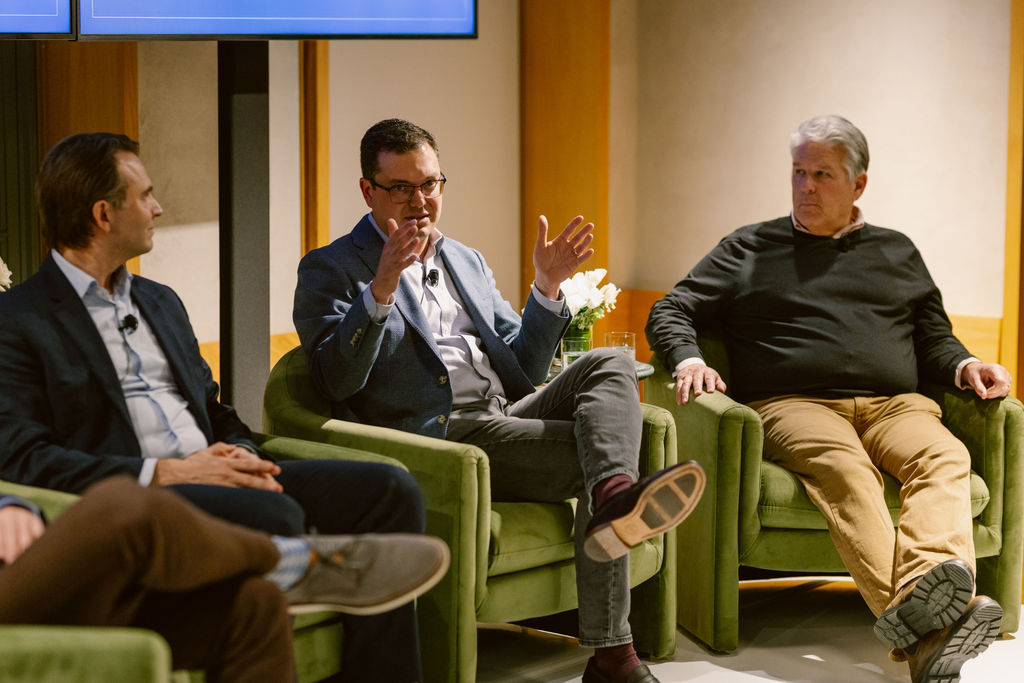
An incisive, wide-ranging conversation on the question bedeviling investors and institutions alike: Are we living through an A.I. bubble—or witnessing the early innings of a transformative economic cycle?
The panel–featuring Puck A.I. expert Ian Krietzberg, Puck’s William D. Cohan, Goldman Sachs economist Joseph Briggs, and Genesys vice president Andrew McInnes—offered a heady mix of Wall Street skepticism, macroeconomic optimism, and sober, clear-eyed debate.
All Photos: Masao Okano
Last week in Boston, in front of a packed room buzzing with curiosity and perhaps a bit of anxiety, Puck’s resident A.I. expert, Ian Krietzberg, moderated a fascinating conversation about the question animating boardrooms and trading floors alike: Are we living through an A.I. bubble—or the early innings of a genuinely transformative economic cycle? The panel offered a heady mix of Wall Street skepticism, macroeconomic optimism, and sober, clear-eyed debate.
Ian was joined by Puck’s Wall Street sage William D. Cohan, Goldman Sachs economist Joseph Briggs, and Genesys vice president Andrew McInnes—three experts grappling with the question from markedly different vantage points. Their wide-ranging discussion also explored how this irrepressible technology has invaded Wall Street’s banks, altered consumer expectations, and much more. As always, this conversation has been lightly edited for length and clarity.
Bubble Trouble?
Ian Krietzberg: When it comes to whether we’re in an A.I. bubble, what indicators are you seeing that might point to either side of that debate?
Bill Cohan: A lot of money is being spent building out data centers—maybe more money than makes any sense at all. That’s point one. And point two is the valuations of the A.I. companies—whether it’s Google or Microsoft, which are now valued in excess of $4 trillion each, or Nvidia, which is valued around $5 trillion. And that’s to say nothing of the potential I.P.O.s that are coming—whether it’s Anthropic or OpenAI, which bankers are salivating over. I’ve seen the hype cycle so many times, and I can recognize all the signals. I think the technology is very important and useful in the same way that the internet was important and useful. But that doesn’t mean that all these valuations are justified.
Is there a feeling on Wall Street that A.I. is exempt from these historical financial trends?
Bill: It all depends on who you ask. If you ask [the famed short seller] Jim Chanos, then he agrees with me; if you ask the head of tech I.P.O.s at Goldman Sachs, he doesn’t agree with me. So it depends on who you’re talking to and their particular biases. But I can say that I’ve seen this movie before—many, many, many times. It just feels that I.P.O.s are coming for Anthropic and OpenAI, so they have to be hyped up. The pre-I.P.O. valuations are so high that you have to get them higher, so that the institutional investors have a return. And then, unfortunately, it’s mostly the retail investors who get scalded every time. We’ll see, maybe this time is different. But I don’t think it is.
Joseph, I know you’ve talked about the money being spent on data centers. Are you concerned about some of these issues, like the massive valuations, as we head toward possible I.P.O.s? Are you seeing red flags?
Joseph Briggs: I’ll take the other side of this debate and say that we’re not in a bubble. And there’s two real reasons for this. The first is that, yes, we’re spending a lot in nominal dollar terms, but this isn’t historically unprecedented by any means. If you actually look at the spending amount as a share of G.D.P., we’re only tracking at a bit less than 1 percent of G.D.P. spending today. Tech spending in the late ’90s and early 2000s peaked at around 1 to 2 percent.
The second reason why I think we’re not in a bubble—and why I think the spending boom is not too big—is if we look at the value that’s going to be created, our baseline estimate is that we’re going to see a 15 percent uplift to labor productivity in the U.S. following full adoption of A.I. This would be $4.5 trillion a year in value creation. With that type of value creation, you can easily justify a multitrillion-dollar capex cycle. So in that sense, a spending boom doesn’t look too big.
Is there an indication that the infrastructure builds will ever stop happening? And if it doesn’t, how are the calculations distinct from buildouts that have happened in the past?
Briggs: The depreciation on the capex that’s being deployed today is around 20 percent per year, and that’s very different from what we’ve seen in past capex cycles. There have been a lot of calculations that show you need to have a pretty quick ramp-up period to justify this investment. If you don’t see A.I. monetized at some point in the next several years, the investment thesis will come under increasing pressure. At the same time, I think the companies that are making the large capital expenditures today are taking a long-run view—they’re recognizing that if you’re going to be the company that captures a large share of the labor automation that drives a lot of the productivity gains we’ll see over a 10-, 20-, or 30-year horizon, you probably do need to be spending today to capture that.
Andrew, from where you sit, how much does it matter whether or not we’re in a bubble? How does it impact the work you’re doing?
Andrew McInnes: I operate in the customer experience domain, where customers are interacting with organizations, brands, and companies. This question of a bubble—for my customers, it doesn’t change the fact that A.I. is driving substantial value now. Companies are getting a return on investment now. There’s a lot of value being had, based on large language models, and based on other sort of foundational things that exist in the market.
When you talk about the value that you’re seeing, where is it coming from?
McInnes: Most of the investments where I’ve seen return value for a company are in the realm of efficiency. There’s automating customer interactions so that a person doesn’t need to handle them. There’s the area of augmentation, where we’re providing information that’s more curated and guiding people through their workflows. Those are the kind of areas I see driving value.
Now, I think the greater portion of value is in improving the customer experience so that customers stay longer and spend more. I think there’s a lot more to be gained there, and there’s a lot more potential value there that’s unrealized right now. You can’t grow your company purely on efficiency. Eventually, it has a stopping point.
Dawn of the A.I. Analyst
Bill, how is Wall Street looking at A.I. as a tool they can use? How concerned are they about some of the limitations when it comes to large language models?
Cohan: I was actually surprised at how quickly Wall Street banks writ large seem to be adopting this technology. From a banker’s perspective, there are so many things that bankers have to do, especially junior bankers, that are really mundane, and painful, and time consuming, and destructive of the work-life balance. It’s almost like a rite of passage on Wall Street. But now, we’re seeing banks adopt this technology to speed it up. So does that get you to higher-value-added work and better work-life balance? Or does it make a place like Goldman say, ‘We don’t need to hire 250 analysts out of Harvard, Stanford, and Yale—we only need 100 now”?
I’m curious, Joseph, being from Goldman, is the idea of the eventual death of the junior analyst something you guys are talking about?
Briggs: When I think about all of these issues that you’re raising, which are valid, it speaks to the importance of organizational change to adapt to an A.I. world. This is one of the reasons why I’m skeptical that we are going to see A.I. adoption and widespread disruption occur over a two- to three-year period. Businesses know they have to get the A.I. transition right, and they need to manage their company in a way where they’re ensuring continuity and also positioning themselves for the future. So I think the change-management aspects of A.I. development and adoption support our view that the timeline for impacts on the economy is probably going to be 10 years rather than three.
Andrew, do you think a part of this shift feels like it might be happening too fast? When you get back to the customer, do people actually want this? Is there a desire on the customer side for the enterprises and businesses that serve them to become more artificial?
McInnes: Particularly for low-emotion, fairly routine interactions with organizations, customers are happy with automation, provided that it’s not terrible. Automation in these basic scenarios is often better than what you would get by waiting for a person who’s potentially not very good at their job. When it gets into situations that a customer might perceive as complex, I think it’s a different scenario. In those [complex] situations, the value of having a human being engaged is heightened.
Joseph, you’re bullish on A.I. and its potential impact on the economy. In many ways, this feels like an inflection point for humanity, especially with social media and the way A.I. has tied to social media. Are you bullish on humanity as well?
Briggs: Most of our work has focused on an extension of the current models, where you can automate a lot of things that humans do at work, but not necessarily become more dominant than humans in all aspects of what we do. There’s an active debate around whether or not we get to that point. That’s more of a technology question. As long as we are at a point where humans have a comparative advantage—whether it’s in innovation, whether it’s in physical labor—I think that society and the economy are going to be okay.
This event was presented in partnership with Tishman Speyer.
Didn't get an email? Check your spam folder and confirm the spelling of your email, and try again. If you continue to have trouble, reach out to fritz@puck.news.
Didn't get an email? Check your spam folder and confirm the spelling of your email, and try again. If you continue to have trouble, reach out to fritz@puck.news.
Member Exclusive
Get access to this story
Create a free account to preview Puck’s full offering, including exclusive articles, private emails from authors, and more.