
Join Puck to listen to this article
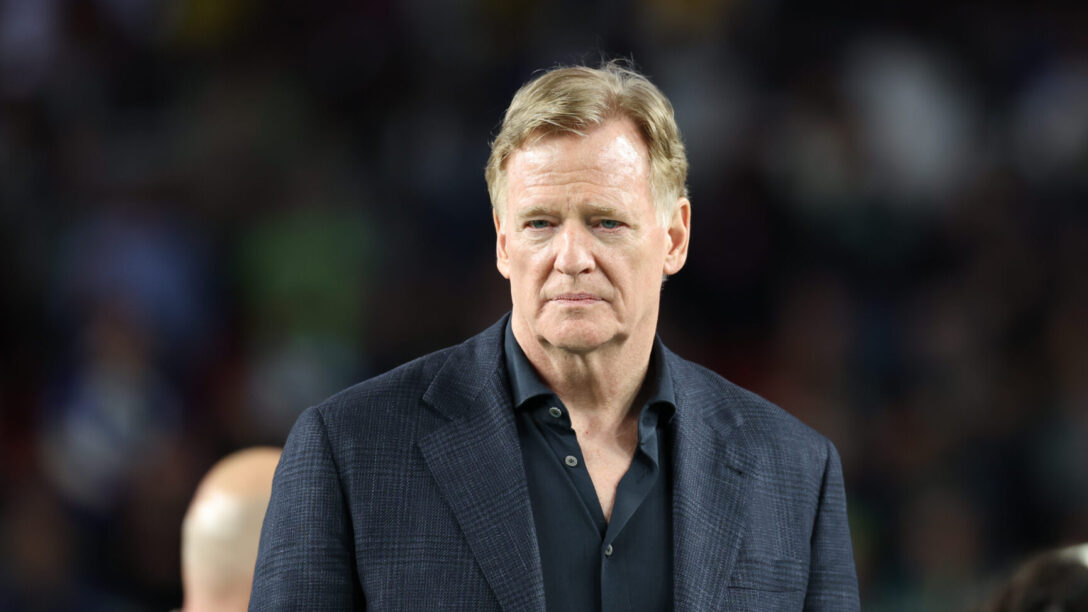
Just before kickoff on Sunday night, NFL commissioner Roger Goodell made a bit of news. “I don’t take international expansion off the table,” he told Scott Graham of Westwood One in a pre-Super Bowl interview. “I think that’s very possible someday.” A few hours later, as if to underscore his international ambitions, Goodell appeared in his box at Levi’s Stadium alongside some of the most powerful media C.E.O.s in the world: Google’s Sundar Pichai, YouTube’s Neal Mohan, and Netflix’s Ted Sarandos, alongside incoming Disney C.E.O. Josh D’Amaro, Paramount Skydance’s David Ellison, and German media baron Mathias Döpfner, who is also a Netflix board member.
Goodell, of course, has been working to expand the NFL’s global reach for some time. Over the past week, he’s been hyping up having nine international games next season, with an eventual goal of 16 regular-season games around the world—including, possibly, Abu Dhabi and Japan. Ultimately, Goodell would love for the NFL to attain the same international profile as the NBA, which has more than 75 percent of its audience outside the U.S., according to deputy commissioner Mark Tatum.
Things are headed in the right direction. In 2025, international games on NFL Network, which are distributed between DAZN and other local partners, averaged about 6.2 million viewers across linear TV and digital, making them the most-watched international slate in league history—up 32 percent year over year, per the league. And Super Bowl LVIII, in 2024, drew more than 62.5 million viewers outside the U.S.—a 10 percent increase over the previous year.
But despite all that, football remains a very American sport. In 2017, the NFL formed the International Player Pathway program to scout players with transferable skills. Yet as of 2025, just 3 percent of NFL players were foreign-born, per George Mason University. By comparison, more than 100 NBA players hail from other countries—about a quarter of the league. MLB is also way ahead of the NFL; As of Opening Day last year, about 30 percent of players were born outside the U.S. Indeed, the NHL’s 4 Nations Face-Off tournament and MLB’s World Baseball Classic have inspired Adam Silver to reimagine the upcoming NBA All-Star Game as a “United States vs. The World” three-team tournament.
There are also hardly any serious youth football leagues outside the U.S., which limits the international talent pipeline. Unlike its global counterpart, American football isn’t a sport you can just gather up a few neighborhood kids and play. Sure, flag is becoming an Olympic sport, but real football programs are capital-intensive—a real impediment to growth in countries without the requisite organizational infrastructure. As Gerrit Meier, the head of NFL International, told reporters last year, “Games and media reach are key catalysts, but they need the support of many other tactics, including dedicated local teams.” Alas, it’s hard to get around the fact that people simply aren’t playing football outside of the United States.
Still, there are some foreign-born players in the NFL, and the sport’s international appeal is growing. Canadians make up 26 percent of imported NFL talent—the largest foreign contingent—followed by Nigerians (19 percent) and Australians (10 percent), George Mason’s report found. In fact, Aussies are getting more interested in the NFL, with 1.7 million adults now calling themselves fans, according to Deakin University—2 percent more than in 2023 and roughly on par with the number of NBA fans Down Under. Australia also has the Australian Football League, a sort of rugby–American football hybrid that’s similar enough to the NFL to plausibly serve as a talent and audience pipeline. (Australian punters Matthew Hayball and Tory Taylor played for the Saints and the Bears, respectively.)
Of all the international games that Goodell has planned for next season, Melbourne’s may be the most important to watch. It should actually be a good game, pitting Brock Purdy’s 49ers against Matthew Stafford’s Rams. There’s already a baseline familiarity with the game that the league can further lean on to try and create more regular-season fans. Then there’s the learning opportunity—an important facet that shouldn’t be underplayed as the league tries to better understand what works, what doesn’t, and who these games actually work for. Unlike Paris, which is arguably just another Western European city (and will likely have to suffer a terrible game between the Saints and the Browns), Australia represents an entirely new continent and time zone: It’s exactly the kind of data the league’s analytics wizards may want to pore over while trying to figure out which Asian country to expand to next.
Event Horizon
For all his successes as commissioner, Goodell also faces a more philosophical challenge in turning an American sport into a global phenomenon. After all, you can’t simply put NFL games on YouTube and hope to mint new fans. During last September’s Week 1 opener in São Paulo, YouTube delivered just 1 million of the game’s 18 million international viewers. Yes, yes, that game was played at 8 p.m. on a Friday—not ideal for audiences in the U.K. and Germany—but even when the timing is better, such as with Amazon’s first-ever global Black Friday game, international viewership wasn’t groundbreaking: 5.3 million tuned in, per the company.
Goodell will need to determine whether that’s an audience or a partner problem. He might want to study the success of the English Premier League, which is widely regarded as one of the only genuinely global sports leagues, and which focused early on securing robust international broadcast deals. Fox Sports held the league’s U.S. rights for years before losing out to NBCUniversal in 2013. Since then, Comcast has used the Premier League as a cornerstone of its carriage agreements with other cable distributors and its Peacock offering. Peacock recently scored the third-most-watched Premier League game for streaming audiences in the U.S., with just over a million viewers. In fact, two of the six most-streamed Premier League games during the last four years aired just this past year.
But while Americans have come to view soccer as a routine, high-tonnage sport, the NFL positions its international games in foreign markets like mini Super Bowls: Yes, the marketing is great: Teams and fans spend days before the actual game participating in events thrown by the league. But eventizing every international game as a one-off spectacle risks turning them into gimmicks rather than a sustained habit. Likewise, relying on YouTube, Amazon, and Netflix may sound like a globalist hack, but it likely won’t be enough to jumpstart NFL fandom in these markets. Instead, Goodell may need to find new, large-scale broadcast partners in emerging regions like Japan and China that can complement DAZN.
Even then, accessibility is only one part of the problem. The NFL can’t grow internationally if the strategy is simply to broadcast a random game in hopes that the spectacle alone is enough to generate enthusiasm. To really get off the ground abroad, the league needs to cultivate deep connections and real local roots—not just ephemeral attention. And that takes time.
