Executive compensation in media has exploded in the past 30 years, even in a period of steady decline for the industry and a generally stagnant stock market. An eye-opening new study ranks the boom’s victors and their jaw-dropping spoils.
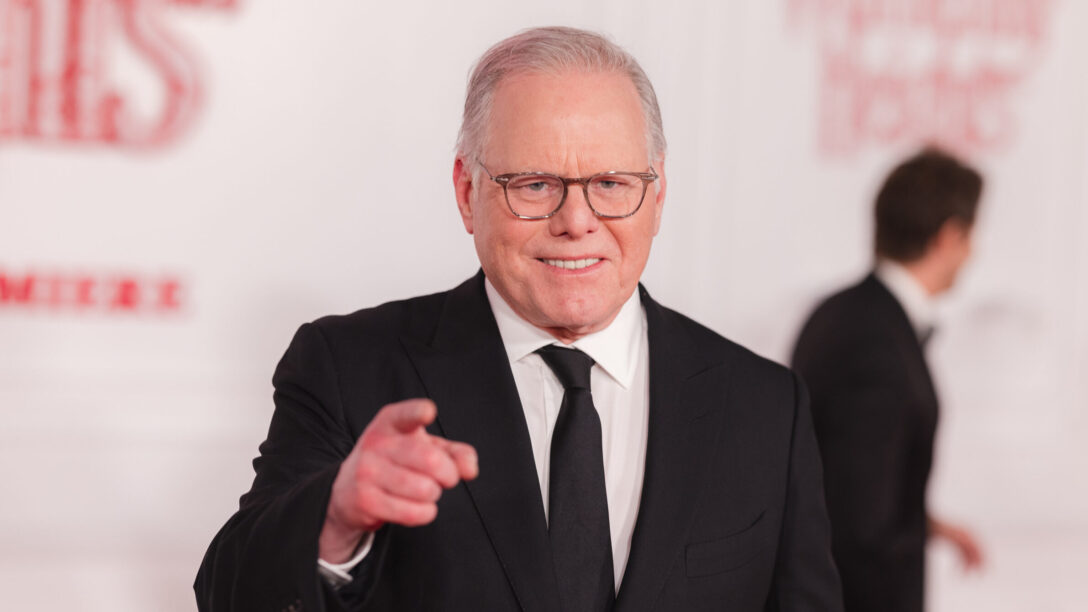
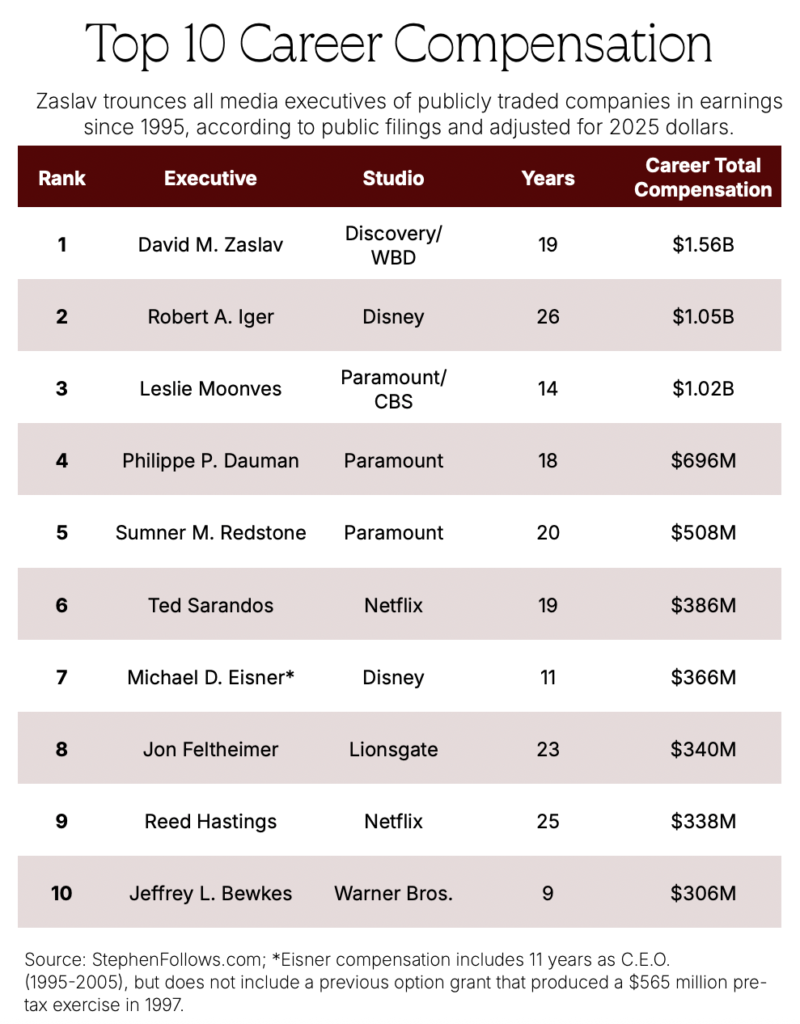
No shock here: Zaslav takes the top spot, and this doesn’t even account for his upcoming golden parachute if Warner Discovery completes its sale to Paramount, which could bestow upon him between $500 million and nearly $900 million in go-away money.
Photo: David Jon/Getty Images to Warner Bros. Pictures
How the hell do these guys make so much money? That’s usually among the first questions in any discussion of the leadership at the Hollywood studio conglomerates—or the media industry in general. The answer, at least in my experience, has always been some version of a shoulder shrug or a, Welp, media people are just insanely overpaid.
At this point, C.E.O. gluttony is viewed as a baked-in industry custom—a quirk of showbiz we all accept, like how TV stars can renegotiate their contracts in success despite beichng locked in for seven years, or how a Jason Statham movie will invariably hit theaters each January, and nobody really knows why. The outsize pay kinda made sense during the cable TV and DVD boom eras, when the growth trajectories in Hollywood were generally strong and guys like Les Moonves and Michael Eisner were considered masters of the universe for presiding over the sexiest companies in corporate America. But why, we all ask, have the compensation packages for entertainment C.E.O.s and C-suite executives continued to soar as “legacy” entertainment has been vanquished by the tech monopolies—sorry, the fully integrated advertising platforms—and the Disney stock has been flat for the past decade, and Comcast is hemorrhaging cable and internet subscribers, and Warner Bros. Discovery and Paramount continue to shrink, etcetera?
That question became even more pressing during the just-concluded earnings season, when the major media companies revealed that C.E.O. pay spiked again in 2025 despite languishing share prices and the content recession. ISS, the proxy advisory, charted a median rise of 117 percent in media and entertainment C.E.O. pay last year among large S&P 500 companies, while their median total shareholder return was down 28.6 percent. Bob Iger, who didn’t grow Disney’s share price at all in 2025, earned an 11 percent raise, to $45.8 million. Paramount Skydance’s lawyer, Makan Delrahim, earned nearly $64 million for just three months of work, thanks to a generous stock award that will accrue over five years. Our guy David Zaslav, the most grotesquely overpaid of them all, whose Warner Discovery was in such bad shape that he’s offloading it to Paramount, tripled his pay package, to $165 million.
Those numbers come with caveats, of course. Stock options are just that—options that may or may not vest in the money. (They also sometimes provide far more value than the initial contract indicates.) And boards consider more than just overall earnings when determining the value of a top executive. Still, my jaw dropped a little when I saw a new chart of C.E.O. pay put together by the researcher Stephen Follows, who crunched every public proxy filing from 1992 to 2025 and came to some fascinating (and alarming) conclusions about media executive pay over the past three decades.
The Top 10
A few select executives have extracted more than $1 billion in comp packages from their companies. No shock here: Zaslav takes the top spot, and this doesn’t even account for his upcoming golden parachute if Warner Discovery completes its sale to Paramount, which could bestow upon him between $500 million and nearly $900 million in go-away money. (Usual disclosure: Through our acquisition of Air Mail, Zaslav is a de minimis investor in Puck.) Among the top 10, there are a couple founders (Reed Hastings, Sumner Redstone), respected managers (Ted Sarandos, Moonves… until he wasn’t), a guy whose company is much smaller than the others yet has somehow been paid like a major C.E.O. (Jon Feltheimer), and one straight-up value destroyer (Philippe Dauman, Redstone’s personal lawyer turned Viacom chief executive).
Remember, this chart measures only publicly disclosed compensation, usually of the top five executives at a company, and the Eisner comp at Disney is skewed by only showing 1995 through 2005. All pay earned in other roles or at other companies is excluded. According to Follows, top executive compensation is up 131 percent in real terms since 2003. And it’s not just the C.E.O.s: Comp for the so-called “N.E.O.s”—named executive officers, the other C-suite execs whose pay must be disclosed publicly—is up 62 percent over that period. “Two things have happened to the studio C-suite over 30 years,” Follows wrote. “The cost of running it has fallen sharply. The pay of the people running it has more than doubled in real terms.”
The Rest of Hollywood
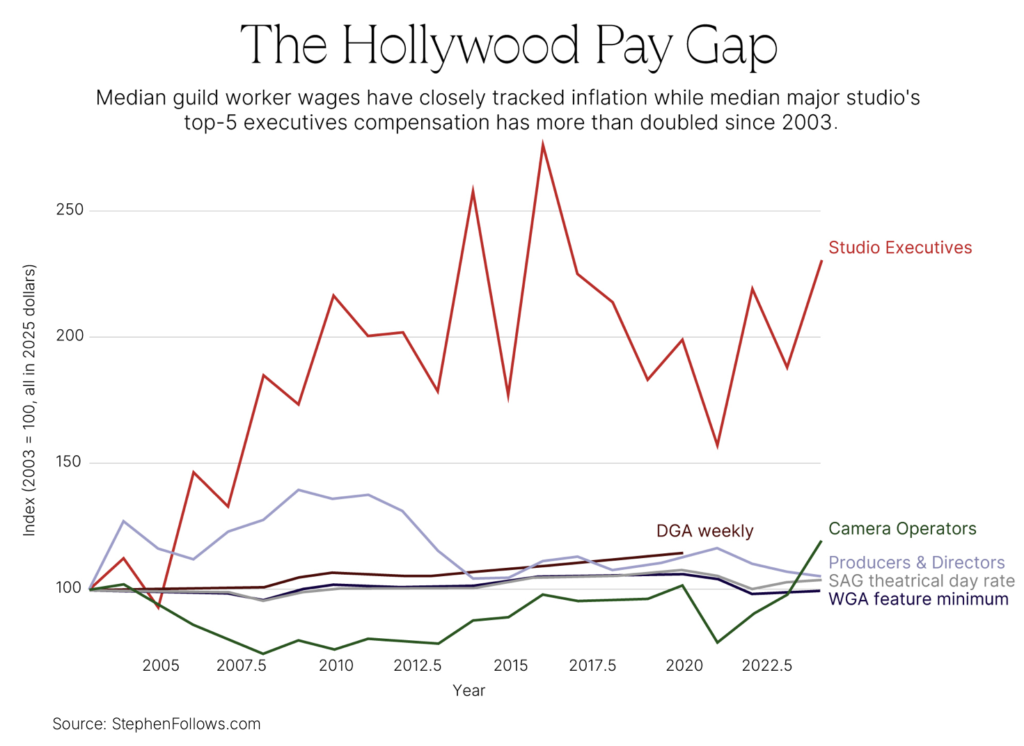
And before you wag your finger, yes, elite movie stars and top TV creators can also make a lot more today than they used to, at least up front. (I’d argue that the demise of backends has eliminated much of that long-tail wealth generated by the biggest hits.) But that rise in C.E.O. pay has coincided with stagnant wages throughout most of the rest of the industry. During that same time period, the Bureau of Labor Statistics reports that inflation-adjusted wage growth in the entertainment industry was just 6 percent. Writers Guild minimums are up 0 percent above inflation, and SAG-AFTRA day-player rates are up 4 percent. Not great.
More caveats: This chart is based on guild minimums, and most working members have agents who negotiate for more. If we’re being totally fair, we’d need to compare the inflation-adjusted growth in compensation for the top five stars/creators at each studio to the pay for the highest-level executives, which isn’t possible. But this chart is a useful expression of how wage growth for the basic rank-and-file Hollywood community has been flat or only slightly above inflation while the C-suite has enjoyed fabulous gains. If, for instance, top executive pay had grown at the rate of WGA minimums since 2003, the median studio’s top five would today earn about $43 million between them. According to the study, they earn $99 million.
Yes, the System Is Rigged
So back to the initial question: Why? After all, the ingrained compensation system in all of corporate America does not explain the outsize pay in the media industry specifically. We can say that John Malone, a powerful media mogul for decades now, has always overpaid his C.E.O.s, including Zaslav. And that purely self-interested executives like Zaslav must be massively incentivized to pursue strategic moves like generating cashflow to pay down debt, rather than simply because it’s the right thing to do. But the task technically falls to the compensation committees of the boards of these companies, and one by one, the proxy statements usually offer some kind of vague justification for overpaying. Disney, for instance, wrote in its recent filing that “there is a limited pool of talent with the set of creative, technological and organizational skills needed to run a global creative organization” and that such executives “have career options with compensation opportunities that normally exceed those available in most other industries.”
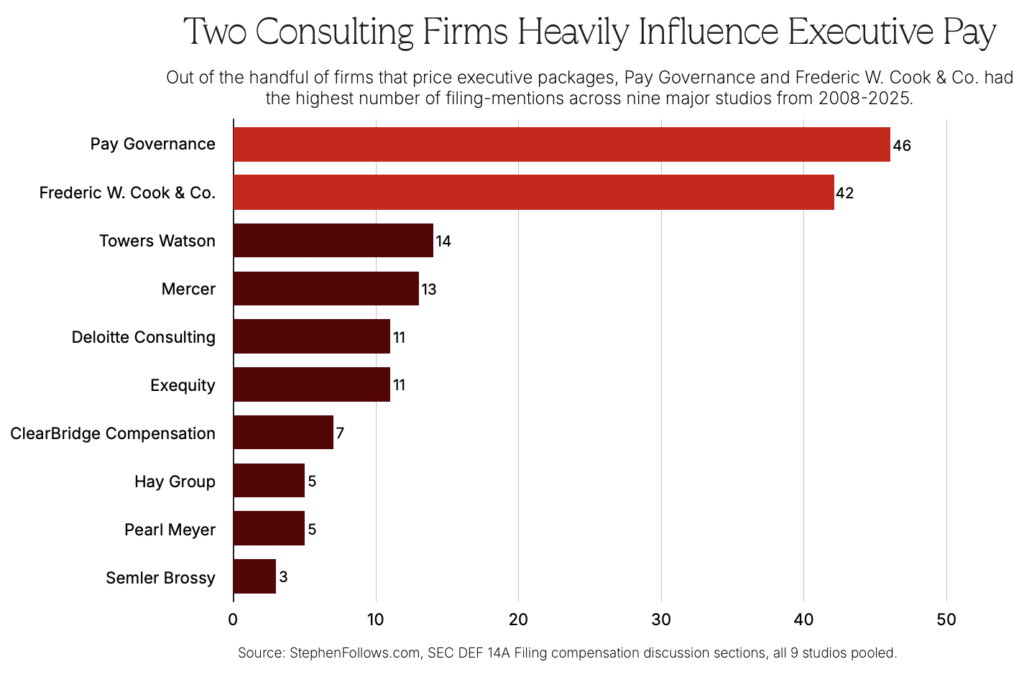
From there, they adhere to comps and benchmarks that perpetuate the upward trajectory, taking their cues from specialized consultants that are engaged specifically for this purpose. I’ve given some shit to the Warner Discovery comp committee for the ongoing Zaslav grift, but they’re following the advice of consultancies like Pearl Meyer. Follows’ study looked at these firms, too…
As in other industries, these consultants benchmark to “peer-group” medians, including a subset of “media industry peers,” and then try to aim for the 50th to 75th percentile of those peers. (The explanation/excuse is usually that the company risks losing the executive if he or she is offered less than the median.) This means the pay packages are heavily influenced by whatever is deemed a “peer” company—and these days, those “peers” are often high-flying tech powerhouses, not other legacy studio conglomerates struggling to future-proof their business models.
In 2025, for instance, Disney’s “media peer group” included Alphabet, Amazon, Apple, Meta, and Netflix, along with Comcast, Paramount Skydance, and Warner Bros. Discovery. Many of those are companies with market caps and overall businesses far bigger than Disney’s. So no wonder Iger’s pay package for that year totaled more than $40 million—about the same as Andy Jassy’s at Amazon, which generated$59.2 billion in net profit that year, compared to about $5 billion for Disney.
Warner Discovery dropped Apple and Amazon but included as “peers” Meta and Netflix (I know… don’t laugh), in addition to Comcast, Electronic Arts, Activision Blizzard, Paramount, Fox, Liberty, and yes, Disney. So if Iger’s peers include the most celebrated tech titans in the world, and Warner Discovery’s peers include Disney, then Zaslav, by extension, should basically be paid like Jassy, right? Despite the fact that Warner Bros. Discovery is a fraction of the size and actually lost money that year?
The comps seem off, but the system is set up to steer the committees there. And remember, while shareholders can vote to reject those pay packages—as happened at Disney in 2018, Netflix four times, and Warner Discovery three times, including 82 percent thumbs-down on Zaslav in April—those are nonbinding votes. The potential conflicts become even worse if these consultancies perform other services for the companies whose executive pay they are influencing, as critics have long contended. Though Warner Discovery’s proxy filing this year was careful to note that Pearl Meyer “performed no other services” for the company in 2025 beyond the independent comp consulting work.
Depressed yet? Coming Monday: The Golden Parachutes.
Didn't get an email? Check your spam folder and confirm the spelling of your email, and try again. If you continue to have trouble, reach out to fritz@puck.news.
Didn't get an email? Check your spam folder and confirm the spelling of your email, and try again. If you continue to have trouble, reach out to fritz@puck.news.
Member Exclusive
Get access to this story
Create a free account to preview Puck’s full offering, including exclusive articles, private emails from authors, and more.