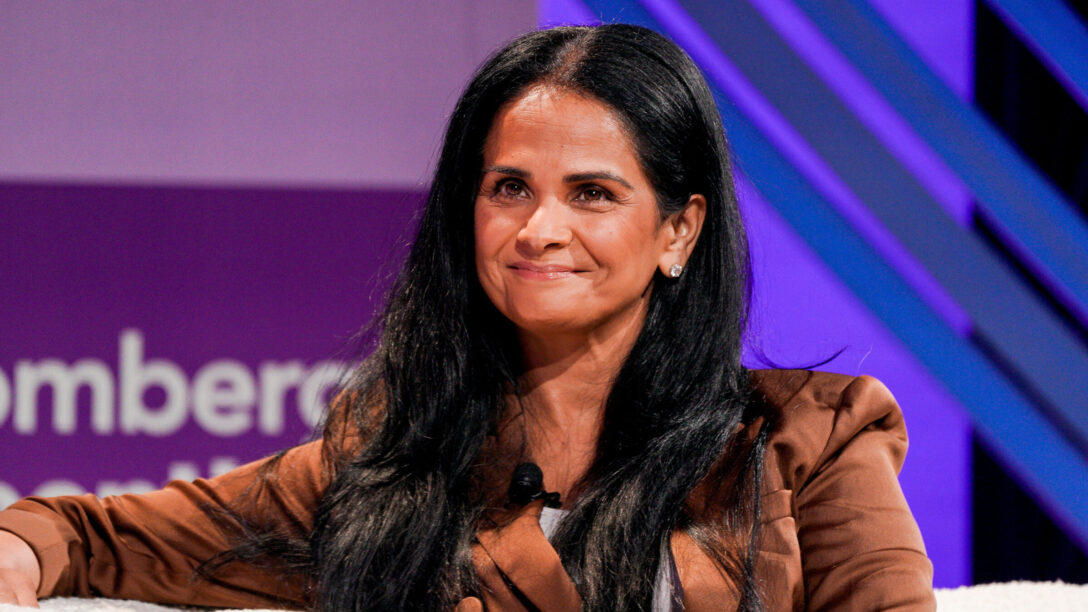

Despite its global lead in subscription streaming, and a stock price that recently topped $1,000 after bottoming out at $190 in 2022, Netflix executives often complain that the company is misunderstood. Bela Bajaria, who replaced Netflix’s now-co-C.E.O. Ted Sarandos as chief content officer in early 2023, echoed that concern during a January presentation to the media at its Egyptian Theatre in Hollywood. It made me scratch my head a bit. How could the most celebrated pure-play entertainment company somehow be underappreciated?
Given that disconnect, and the company’s recent milestone of 300 million subscribers worldwide, I figured it was time for an on-the-record chat with Bajaria. She came on The Town today, and we discussed the 2025 slate, how she’s spending her $18 billion annual content budget, the impact of giving Greta Gerwig an Imax release for Narnia, the Emilia Pérez scandal, and much more. I’ve edited that conversation down to the highlights below…
The Oscar Scandal
Matt Belloni: I have to start with Emilia Pérez, because nobody at Netflix has commented on this situation. What did you think when you saw those Karla Sofía Gascón tweets, and what would you like to say to her right now?
Bela Bajaria: It’s really a bummer for 100 very incredibly talented people who made an amazing movie. So, for me, it’s really about that.
Are you gonna vet your talent more closely now for their social media activity?
Yeah, I think we’re having conversations about that. Are we going to actually look at the personal social media of the tens of thousands of people every single day around the world, [given] the amount of original film and TV that we make? And licensing and co-productions? It raises a lot of questions. What should that process look like? If you asked me today, with everything I know, we would still buy the movie.
Even knowing the tweets were out there.
That movie is incredible. You want to take those big swings.
I go to a lot of your presentations, and you often say Netflix is misunderstood by the media, sometimes by the business community. Why is that?
There has been a certain way of [making film and TV] for many, many decades. And I’ve worked at a lot of the legacy media companies, right? I understand that. I think sometimes when people look at us, it’s always through the lens of, “Wait, are you a linear network? Are you premium cable? Are you this or that? Why don’t you do weekly [episode drops]? Why don’t you do theatrical? Like, why don’t you just do it like how everybody else does it?”
You also have to remember we have 300 million accounts, 700 million people around the world watch Netflix. We also make things in 50 different countries, 50 different languages. We make local film and TV all around the world. So we are doing something with an aspiration and ambition that has not been done before.
I think you guys want to emphasize the “prestige” stuff because you don’t like the perception that Netflix is a fire hose of content—that nothing really matters, it’s all just engagement, and that, per capita, you don’t do as much of the elevated projects that some of your competitors do. I think you mentioned the Oscar nominations three separate times in your recent presentation, but you also said you don’t really know what prestige TV means. What did you mean by that?
It wasn’t that I didn’t know what prestige TV was. I was saying there’s lots of different definitions of what that is. And my point was, What is prestige TV? Is it awards? For me, it’s incredible craft in writing, acting, directing a vision of something, authorship, and when you put all those pieces together, it transcends.
You mentioned engagement. The real competitors for Netflix now are TikTok and YouTube, right? Do you agree? And if so, does that inform the content mix on the service?
We’re always competing for an audience’s time. I look at Netflix and say, “We’re the home for premium, professionally made film and TV.” We can reach 700 million people around the world. And a lot of creators like working with us because we take the financial risk, which is different from what YouTube does.
But YouTube is also very complementary to us. A lot of our trailers get lots of viewing on YouTube, which drives people back to Netflix. We’re the biggest entertainment brand on TikTok. Obviously, a lot of young people on TikTok have an affinity and connection to Netflix. People will watch One Day and then ugly cry and share that on TikTok, and that creates a whole conversation.
But how much does that relationship influence the content you make? For instance, there were reports this week that you are looking into potentially making deals with video podcasters for Pat McAfee–style shows where a podcast would come to Netflix and be produced as a TV show. To me, that would be a sign of Netflix competing with YouTube, which has become a premier home for these video pods.
That’s not what that means. Our job is to make sure we know the creators out there doing really cool, interesting things, and what makes sense for Netflix. Some of them may be on YouTube, some of them may be in film school right now, some of them may be at a festival that we’re gonna find.
But are you looking to do a big deal with a podcaster or YouTuber?
Anytime we have a meeting or a conversation, it’s written about like we’re changing our strategy. So that’s very overstated.
But you did go after the MrBeast game show. Amazon ultimately, in my opinion, overpaid for it.
You said it, I didn’t. (Laughs.) We did [bid for it]! Look, MrBeast is a great talent on YouTube and was making a big unscripted show very much like Squid Game. But he, you know, that was the show that he made. We met with him, as did lots of other people.
The Greta Deal
The Greta Gerwig Narnia deal: You have been downplaying and saying, It’s not a big change for us. It is a big change. You gave a major filmmaker a worldwide Imax release, a four-week window of exclusivity in theaters, and a marketing campaign that has to be commensurate with a tentpole theatrical release. Are you prepared to do this for other filmmakers for the right project?
First of all, it’s a two-week window on Imax.
No, it’s two weeks of guaranteed global theatrical exhibition, but it’s a four-week window. Thanksgiving in theaters, Christmas on Netflix.
I think you want to extrapolate more out of this than it is, but that’s fine. For lots of other filmmakers, we always do bespoke qualifying runs [Ed. note: in a much smaller number of theaters with little promotion]. Everybody wants to feel like this changed something that it didn’t.
But it did. I’ve talked to people who have talked to Ted, and Ted has said this is a setback. The goal of Netflix is to train movie lovers to watch movies on Netflix and not in theaters. Now they’re going to have to wait a month to watch Narnia on Netflix. It’s going to be available in theaters first with heavy promotion. Not great for the overall Netflix mission. Do you agree with that?
I think that having the option for audiences to go watch Narnia in Imax for those two weeks is great. For that movie, for Greta, this totally makes sense.
Will you do the same thing for Guillermo del Toro on Frankenstein this fall?
We’re working with Guillermo and Noah Baumbach, two filmmakers coming back and working at Netflix. They know that they’re going to get a bespoke qualifying run. You have to look at all these incredible filmmakers that we are working with. You want to make a great movie that gets the qualifying run, that gets the bespoke treatment, and you want to reach that many people around the world? If you want to make a movie that you want a lot, a lot, a lot of people to watch, which a lot of filmmakers do care about, then we are a great place for that.
Does it bother you that Netflix has not had the kind of global cultural moment in movies that you see regularly with theatrical releases? What lasting I.P. has Netflix created? Because there ain’t gonna be a Carry-On theme park ride or merchandise or restaurant or even probably a sequel.
So your point is that because the 15 highest-grossing movies last year were sequels and reboots, that’s I.P. After 100 years of making film, you can actually name those, and they’re not regular. You can name Barbie, Oppenheimer, Wicked.
But would Oppenheimer have been Oppenheimer had it aired on Netflix? That’s a perfect example.
Yes.
You think so?
Yes. We would have done an amazing qualifying run. So many people obviously would have watched it. It was a great movie. And I think it would have had that.
We’re going to just need to disagree here.
We’re going to totally disagree about this. And here’s the thing: There’s a lot of people who love going to the movies. I love going to the movies. It’s just, we want to make great movies on Netflix. This idea of, Everything theatrical is bigger and lasting, you have to think about all those other movies except for the four or five we just talked about.
Okay, but look at the movies that perform on Netflix. Five of the top 10 recently were Warner Bros. movies that Netflix licensed and that got theatrical releases with marketing campaigns in 2024. It’s not that they’re better movies, but they are marketed like events. And when they ultimately go to streaming, it boosts interest. That’s what all the other companies have recognized and have promoted. Netflix has gone the other direction. And I just wonder if there are concerns internally about the ability to create big franchises without that big marketing campaign and without that theatrical moment.
So Red One [released by Amazon], that had a big theatrical campaign and then had 50 million viewers in the first four days [on Prime Video, according to Amazon]. We don’t exactly know the definition of “viewers” on Amazon because I’m not sure they’ve told us. But Red Notice [a 2021 Netflix film] in four days got 90 million viewers. [Both had] The Rock. Theatrical versus streaming… I think it’s more nuanced than, This equals this, this makes it more relevant. If it’s theatrical, then it’s this…
The $18 Billion Question
Let’s move to your content goals for ’25. What percentage of your $18 billion budget is now gonna go to live programming? English versus foreign language? Movies versus TV? Give us a little breakdown of where you are focusing your money.
I’m definitely not going to give you the specific breakdown.
Why not? We’re among friends.
Here’s what I will say: First, between countries and different categories [of content], there’s definitely a target of what they’re spending between film and TV, and licensing, and co-productions. But the global budget is very fluid. So when things come up like WWE, where we had an opportunity to have 52 weeks of live [programming]…
So you’re saying, Pitch me great stuff?
Pitch me great stuff! I’m pretty sure this time last year, NFL on Christmas Day wasn’t even a thing, right?
Are you a bidder for UFC? Those rights are coming up.
I keep reading about that, actually. You know, every time we meet with somebody, or we even have a conversation, or somebody may have gone to a UFC fight because her son likes it, people start writing about it.
So that’s a yes?
Here’s the thing: Our jobs are to understand what is out there in every single way.
You’re being polite. So… it’s a yes. What about Formula One?
I’m not being polite! I didn’t say it was a yes. I’m saying that we’re gonna meet with leagues, we’re gonna understand what the marketplace is, we’re gonna look at what’s opportunistic for us. By the way, if you imagine how many things people think we’re buying, that’d be out of my content budget.
As you know, I had been harping on you guys for years about not releasing data. You now release general viewership numbers, which all of us appreciate. What has been the most surprising impact of revealing this data?
It hasn’t changed anything and it really hasn’t had an impact. Probably for two reasons: Other [streamers] don’t release their numbers, so it didn’t drive some bigger comparison; and before we publicly released all of this data, we had already been giving creators and filmmakers the data on their shows and movies.
You still don’t release completion-rate data, and that is the metric you rely on the most. Why not?
“Completion” has a very strong correlation to our viewership numbers. They’re very comparable.
So why not just release it?
Do you ever ask anybody else to release their numbers?
Oh, constantly. You guys are better than everybody else, but we still want more. And here’s the reason: We all assume the reason you started releasing this stuff was because you wanted to pay people less. You wanted people to know, when their agent is clamoring for a huge deal, “Actually, your show’s not really watched by that many people. And not only are we going to share that with you, we’re going to make it public so everybody knows.”
(Laughs.) That’s just very cynical. We spend $18 billion in film and TV.
Any movement on doing more backend deals? There’s this Ben Affleck movie, RIP, that you guys did do a backend deal on.
That’s because [Affleck’s company] Artists Equity was interested in it. I can count on one hand, actually half of one hand, the [backend] deals we’ve done.
I was talking about backends with a source at Amazon and he said, “We’re trying desperately to do more, but nobody wants them because the second you talk about a backend, you talk about less money upfront—and nobody wants less money upfront.” Is that the case at Netflix as well?
For us, the way that we’ve been paying people has worked for a long time. Talent likes it. We take all the financial risks. They get paid well. It is upfront.
A lot of doubles. The home runs are gone.
Jason Blum wrote that op-ed saying, Why don’t you just let all these people bet on themselves? But I think what Amazon is experiencing is true. People just aren’t willing to go, Oh, let me take less and I’ll bet on myself. That’s not really happening.
But do you agree with Blum that movies would be better if you shared revenue with the producers of the movies?
I don’t think so. But we are always open to that.
How much do you view quality control as a problem? That’s the knock on Netflix, of course: How can they make it great if they’re making so much?
Some of those knocks come from people who are like, Oh, we’re used to the hierarchy. There’s one person on the top and they greenlight everything. That is not how we work as a business, as a culture.
Yeah, John Landgraf has been talking about that forever. If you go to FX, he is working on your show.
I don’t have John’s job. I don’t want to make it about me, because I’d rather make it about the creators. That’s actually who’s making the great shows. It’s their vision, it’s their story, it’s their work, it’s their livelihood.
You can do quality at scale. Elisabetta [Zenatti], who runs Brazil, is in charge of just her originals. And under her, she has somebody who’s just making dramas and somebody who’s just making a handful of movies. If you take the U.S., the way the films are organized, each person is just in charge of their own thing.
The Lightning Round
Let’s do a lightning round. Name the show on another service that you are most jealous of.
Yellowstone.
Chris Nolan brings you The Odyssey, his next movie. He wants the Greta Gerwig deal. Do you say yes?
Chris Nolan, Odyssey, Imax, two weeks. Yes.
You get to take one franchise from another studio for Netflix, which do you pick?
I’m going to say Jurassic Park.
In five years, will Netflix air a weekly NFL game? And because the answer is obviously yes, which NFL package will you steal from a rival?
I say the answer is no, because the rights are already tied up.
No, there are opt-outs in less than five years.
If the answer is yes, then I definitely want the Sunday afternoon games.
Can you commit right now to making more shows and movies in L.A. to help the industry recover from the fires?
We already make a lot of things in L.A.
I knew you would say that. But can you commit to making more?
We’re always going to make things everywhere. Can we get a commitment for other people to make as many things as we make in L.A.?
You get to take one executive from anywhere else in town. Who is it?
Oh, I already hired Nora Skinner [a TV drama executive from HBO]. That was the executive I wanted.
You just killed the Prince documentary from Ezra Edelman after the Prince estate complained about it and revoked approval. Did the estate pay Netflix to kill this project?
No comment, because it’s a more complicated thing than that.
Would you have greenlit The Electric State, the Russo brothers’ new $300 million robot movie?
Yes. Millie Bobby Brown, Chris Pratt, the Russos? Yes.
Are you a bidder for the Oscars when that TV deal comes up with ABC and Disney?
I have had no conversations with them.
Excluding your family and your assistant, who is the last person you texted, and why
Oh, I have to look. David Fincher.
That’s pretty good! About what?
About a new project. That’s all I can tell you because it’s new. You’ll figure it out eventually.