
“All these guys are running toward the cliff. You know, My capex is bigger than your capex, and, If I don’t keep spending, you’re going to keep spending. I don’t want to lose out to you, so I have to keep spending,” the legendary investor George Noble told me earlier this week, describing the madness surrounding this A.I. moment in the market. As a seasoned investor, it’s difficult to know what to do, he conceded. “You just sit there, and it’s like, you want to blow your brains out,” he said.
Noble has been considered a market guru for more than four decades—from his apprenticeship to Fidelity wizard Peter Lynch to his tenure running the Fidelity Overseas Fund starting in 1984, when he was just 28 years old. In 1985, the Overseas Fund returned nearly 80 percent, making it among the best-performing mutual funds in the country. Since leaving Fidelity in 1991, he has started and closed two hedge funds, and now manages his own investments at Noble-Impact Capital. (Next Wednesday, July 22, George is hosting the Best Stock Ideas Online Summit, a virtual investor conference, from 10 a.m. to 6 p.m.…)
I check in with George from time to time about the state of the markets—particularly as a way to gut-check my own premonitions that the equity markets are overpriced, valuations and hype are out of control, and we’re on the precipice of a major correction. (This is not investment advice.) Alas, George largely agreed with my assessment in a couple conversations earlier this week that focused on the deluge of money still flowing into artificial intelligence, and the forthcoming I.P.O.s of Anthropic and OpenAI. “I call this the Britney Spears market,” he told me. “Oops! I did it again.” He was referring obliquely to John Kenneth Galbraith’s A Short History of Financial Euphoria, in which the author memorably wrote, “There can be few fields of human endeavor in which history counts for so little as in the world of finance.”
Indeed, George told me that he thinks the current A.I. mania and rash of inflated technology stocks could foment a crisis “far worse” than the dot-com bubble of a generation ago. “The sheer size of this in terms of dollars involved, and therefore the impact on the economy when the fallout comes, is going to be much more significant, and there’s this sort of existential imperative,” he said.
In addition to runaway spending on A.I. and data centers, he sees other worrisome signs. A projected federal deficit of around $2 trillion in fiscal 2026 is starting to look like it could be closer to $2.5 trillion. And since interest rates are likely going up, borrowings to cover the growing deficits will become much more expensive. He’s also noticed that the credit-default spreads on the debt of the hyperscalers and their data centers have widened of late. The SpaceX debt, as Bloomberg TV’s Tom Keene noted recently in a conversation with George, “can’t find a bid.”
George is intently focused on Oracle in particular. While many of the Magnificent Seven and hyperscalers have been rewarded by the markets for their infrastructure investment, Oracle stock is down 42 percent during the last year and now has a market capitalization of $382 billion. The spreads have widened on Oracle’s debt, too. George is awaiting the next quarterly earnings report to learn whether the company has pulled back on capex. If so, he said, that will be “a warning sign” that it’s “game over” for the “whole A.I. complex.”
Elon Economics
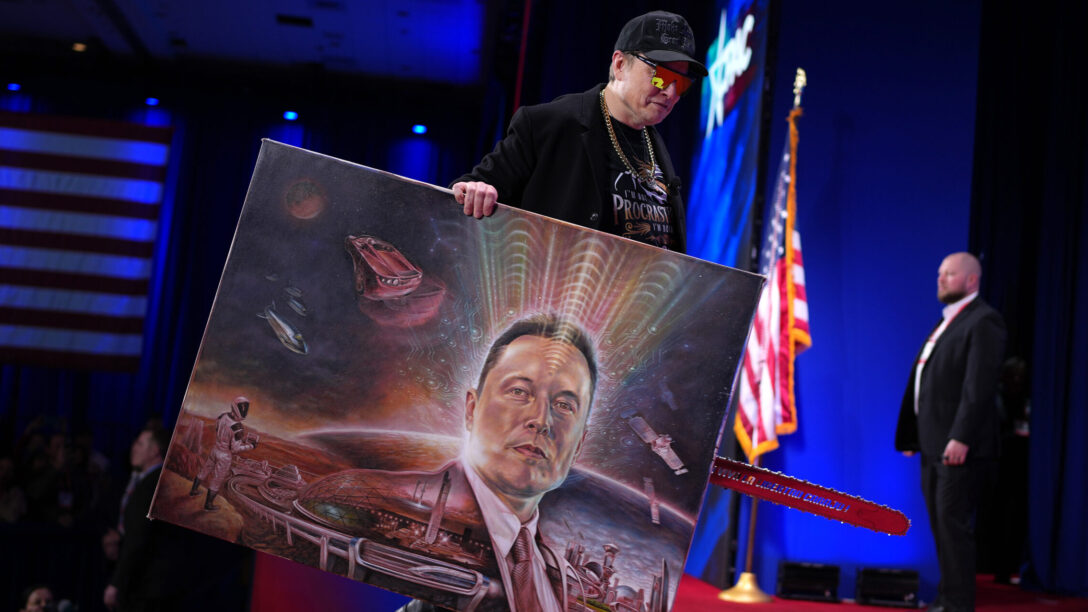
For Noble, SpaceX remains another critical harbinger. During his recent Bloomberg interview, George went on a rant about the structure of the company’s initial public offering: Not only was a large portion of the issuance directed to retail investors, but the Nasdaq 100 decided to fast-track the stock into its index just 15 days after the I.P.O., which allowed E.T.F.s and passive funds to buy wantonly. “SpaceX went public at more than 90x revenue, and the insiders who bought in at a fraction of today’s price are about to start selling their shares,” George warned.
He explained that 20 percent of the locked-up shares will come free in early August, and another 10 percent will unlock early if the stock trades at 30 percent above the $135 I.P.O. price going into the company’s second-quarter earnings report, to be released around the same time. More stock frees up after 70 days, and 90 days, and 105, 120, and 135 days. After the third-quarter earnings release, another 1.3 billion shares, or 28 percent of the outstanding stock, will become sellable. On December 8, the 180-day lockup expires in its entirety. Our buddy Elon gets to sell his own 6.4 billion shares, or 42 percent of the whole enchilada, in June 2027.
But what happens if professional investors determine that SpaceX is a multitrillion-dollar facade built atop the profitable Starlink entity, and that its true market value instead lies in the hundreds of billions? More specifically, what happens to those retail investors who bought at the peak $2 trillion valuation? “First, they keep the float tiny,” George continued. “Then they let the index rules force the world to buy at the top. Then they release a flood of insider stock into a crowd of retail buyers who were handed the shares up high. When the price finally breaks the offering level, the people who got in years ago at pennies on today’s dollar will hit the bid, and the exit liquidity is your retirement account.” He called it “one of the great wealth transfers of my lifetime packed into a fancy narrative.”
George confirmed to me that he is shorting the company—“the most grossly overpriced stock at scale that I have ever seen,” as he put it. He predicted a “crash landing” for SpaceX stock, which he thinks is worth around $30 a share. (Nota bene: Today, for the first time, SpaceX shares traded down below the I.P.O. price of $135. To quote Britney: Oops.) In a new video, George also called out the C.E.O.s of the three banks that underwrote the offering—Morgan Stanley’s Ted Pick, Goldman’s David Solomon, and JPM’s King Jamie—for their role in the I.P.O. That shouldn’t matter much, however, since their institutions collectively reaped some $555 million in underwriting fees.
As we approach September and October, a time when markets often correct themselves, I pressed George on his predictions for the next few months. “You and I both know we’re coming into the time of year—August, September, October—it’s the worst time of the year, right?” he said. “But seasonality is not a prediction. It’s a condition.”
He is worried, though. Bond yields are rising. More supply is coming to market in the form of huge I.P.O.s. He then poked some fun at Abby Joseph Cohen, the former Goldman market strategist, who used to say things like, “The return on equities in the next six months is unlikely to be competitive with a cash alternative.” He said he thinks markets “would do well to be flat over the next six to 12 months. In my opinion—and I could be wrong—we’re not going up, and therefore, door number two and door number three are either flat or down.”
“Keep in mind, we have not had price discovery on the way up on a lot of this crap,” he added. “It’s forced buying because of the index funds, and it’s retail idiots, right? We’re just chasing momentum. Valuation was not a thing on the way up. Nobody cared, right? And therefore, on the way down, valuation is not going to stop these momentum idiots from selling. It’s not going to stop.”
In the end, I’m worried too that we’re about to go through another rinse cycle. Retail investors who bought into the hype are especially ripe for getting burned. This is nothing new, of course, as Galbraith reminded us in his Short History: “For practical purposes, the financial memory should be assumed to last, at a maximum, no more than twenty years. This is normally the time it takes for the recollection of one disaster to be erased and for some variant on previous dementia to come forward to capture the financial mind. It is also the time generally required for a new generation to come on the scene, impressed, as had been its predecessors, with its own innovative genius.” So it’s been, what, about 18 years since the last financial meltdown? Right on cue, it seems to me.