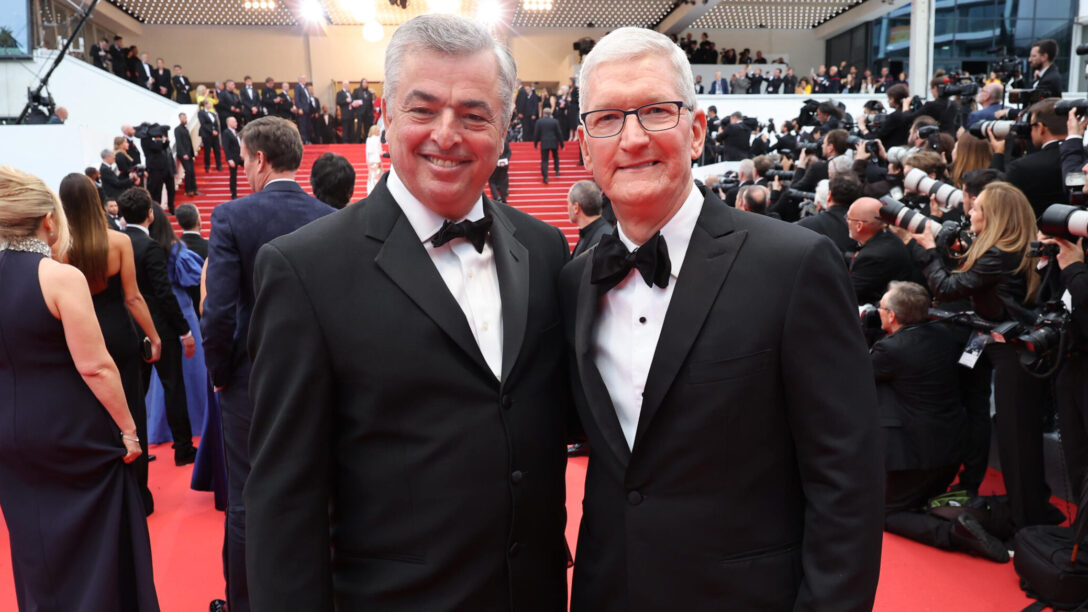
As the $3 trillion company’s stock drops and its leadership scrutinizes the money-losing Apple TV+ service, some around town are asking whether the streaming ambitions become expendable if the share price or overall financials grow more challenged.
More than five years into the Apple TV+ experiment, it’s never been entirely clear what C.E.O. Tim Cook and services chief Eddy Cue are up to in Hollywood.
Photo: Eric Charbonneau/Getty Images for AppleTV+
At lunch with an agent last week, the first question he asked wasn’t about Disney succession, or the mysteriously ongoing employment of the Russo brothers, or even whether David Zaslav has soured on Mike and Pam at Warner Bros. Instead: “What are you hearing about Apple?”
His nerves were understandable. The news from Cupertino these past few weeks has been… concerning. Not just the stock drop—about 13 percent this past month, part of an overall market selloff amid the Trump tariff talk. Worse, new A.I. features for iPhones were pushed until at least 2026, and a key executive admitted the delays were “ugly and embarrassing”—especially since A.I. innovations had been advertised in a splashy campaign before they actually existed. Ooof. Apple was sued today over the alleged deception, it reorganized its A.I. executives, and superfans have been freaking. “When mediocrity, excuses, and bullshit take root, they take over,” wroteJohn Gruber, the influential Apple blogger, adding that the world’s largest company “will quickly collapse upon itself with the acceptance of all three.”
That may be a bit much, especially considering Apple’s core business is elegant hardware, not A.I., and it generated a ridiculous-sounding $70 billion in iPhone sales just last quarter. But the term “vaporware” isn’t often associated with Apple, and the perceived weakness in the next tech revolution, combined with overall economic uncertainty associated with a Trump trade war, raises the specter of a prolonged slowdown. Maybe that’s why Warren Buffett has been offloading his Apple stock lately.
All of which fed into the self-centered fears of my lunch date. What, if anything, does the current state of Apple mean for its entertainment business? After all, more than five years into the Apple TV+ experiment, it’s never been entirely clear what C.E.O. Tim Cook and services chief Eddy Cue are up to in Hollywood. Certainly not making money, at least not in the traditional sense. The Information reported today that Apple lost $1 billion on Apple TV+ last year, following a Bloomberg report that more than $20 billion has been shoveled into making original shows and movies since 2019. That’s not nothing, even for a company worth $3 trillion.
The “loss” number is a bit misleading, of course, considering Apple has always said that a key goal is to leverage Leo DiCaprio and Reese Witherspoon to thicken its brand halo and the device “ecosystem,” ultimately boosting its other businesses. But still… for all its billions, Apple TV+ has accumulated only about 45 million subscribers worldwide, according to today’s Information report and other estimates.
That’s far less than Disney+, Max, and Paramount+, all of which launched around the same time. Those rival services are attached to legacy studios with rich libraries, but they’re not attached to a company with $65 billion in cash on hand and a device in the pockets of 1 billion people that also delivers bundle-friendly music, news, and games. Apple declined to confirm or comment on any numbers, but a source there suggested the subscriber number is higher than 45 million and that the global nature of the sub base is being undercounted by U.S.-oriented research firms. Maybe. The company reveals zero performance data beyond B.S. “biggest weekend ever!” press releases that the trades accept without skepticism and producers like Ben Stiller and David Ellison post with “blessed” emojis on their social media. No one outside the company really knows how the Apple TV+ business is performing.
The “Disaster” Scenario
Despite its size and capabilities, Apple still pushes the whole boutique-y, We’re the new HBO angle… to which the HBO people next door in Culver City often joke, Yeah, but people actually watch HBO. Indeed, the Nielsen Gauge report continues to omit Apple TV+, meaning that the service generates less than its reporting threshold of 1 percent of viewership on connected TVs. Hugely expensive, movie star–driven TV shows regularly land with little awareness or, presumably, viewers. Did you know Natalie Portman, Colin Farrell, Michael Douglas, Billy Crystal, and Warren Beatty all made shows for Apple this past year? They did! Well, except Warren Beatty… I made that one up, but you believed it because it sounds like someone Apple would work with.
For that reason, I wasn’t shocked to report last May that Cook and Cue had summoned the unit’s content chiefs, Zack Van Amburg and Jamie Erlicht, to Cupertino for a come-to-Jesus discussion about how to reduce costs. Today’s report revealed Apple TV+ spent $500 million less last year after the admonitions. We all know from the Wolfs blowup with George Clooney and Brad Pitt that they’re backing away from releasing movies theatrically. Cook also cracked down on private jet use by talent, according to the report. (I know. Outrageous.)
Against that backdrop, it’s worth asking whether the streaming service becomes a target if Apple’s share price or overall financials grow more challenged. Maybe the fears of every agent and producer in town—that Cue will one day see an upcoming L.A. trip on his calendar, shrug and ask, “Why, again, are we doing this?”—will finally be realized. In that case, $4 billion or $5 billion a year would simply disappear from Hollywood. A “disaster” scenario, another agent texted.
That seems unlikely, at least for now. It’s still early days, and other than the cost controls, Apple hasn’t indicated that it’s soured on making originals for streaming, which presents other business opportunities. It’s a boost to its services business, and if Apple ultimately wants to compete with Amazon, Google, Roku, and others to become the “front door” for all digital video consumption—an aspiration that took a hit when it agreed to create an AppleTV+ channel on Prime Video to boost subs—it needs a platform to build out.
And the funny thing is that, despite the losses, Apple TV+—once known only as the obscure app to find Ted Lasso and maybe The Morning Show—seems to be gaining at least a little traction these days. Severance cost a fortune and Stiller remains a bully, but the show is an old-fashioned, HBO-style hit, appearing on the Nielsen top 10 list for six consecutive weeks and entering the larger cultural conversation. Between January and February, more than 5.8 million customers signed up for Apple TV+ in the U.S. alone, according to Antenna, behind only Paramount+ in share of gross adds in the period.
A Severance bump, sure, but Silo, the expensive sci-fi drama, also made the Nielsen list. Also on the movie side, both Wolfs and The Gorge were ravaged by critics but have popped up in the top 10. Apple TV+ becoming available on Prime drove strong sign-ups as well. And F1, Apple’s $300 million-plus car-racing movie, has decent buzz ahead of its June release in theaters.
Plus, after getting shut out at this year’s Oscars and watching execs from Disney, Max, and Netflix clean up at last year’s Emmys, Zack and Jamie should be big players in TV this year with Severance, Shrinking, Seth Rogen’s The Studio (Disclosure: I appear briefly in that show), maybe Jon Hamm’s Your Friends and Neighbors, and Cate Blanchett’s Disclaimer, among other contenders. Emmys don’t appear on a P&L, but when you’re trying to be HBO and lure big stars and projects to a smaller-reach service, they do matter.
Still, the Apple TV+ churn rate, meaning how many people cancel every month, is still around 6 to 7 percent—well above the weighted average of all platforms in the past year. We’re about to see a big test of churn now that Severance is ending. “Apple has some of the fewest committed subscribers of all the major services,” the streaming analyst and my Puck colleague Julia Alexander told me today. “Fewer than 35 percent of all subscribers keep the service for longer than six months.”
Not great. And we know why. Sporadic hits. No meaningful library of movies and shows to keep subscribers entertained. No significant family programming. No A-level sports rights, despite multiple opportunities to outbid rivals. (F1 rights are coming up, will Apple even try? If it doesn’t, we will kinda know how serious Cue is about sports.) No experienced film executive greenlighting and shepherding major movies. A possible full retreat from theatrical releases if F1 doesn’t work. And a corporate structure that divides the creative units from some of the business and marketing aspects of the service. The result is a platform filled almost exclusively with high-end original TV shows, mostly featuring movie stars, and mostly watched by very few people. Is that a long-term strategy?
In short, Apple is still dabbling. Sure, Zack and Jamie overpay when they want something (like, say a fourth season of Ted Lasso). But one producer I recently spoke to questioned whether he would take an in-demand project to Apple. He simply wondered whether Apple TV+ will still be around in a few years. Pressure at the parent company could make that decision a lot easier…
Or not. Challenged companies looking for growth often turn to acquisitions, which maybe could lead Apple to the often-speculated purchase of Netflix or Warner Bros. Discovery or even Disney—once-impossibilities that might be possible in the supposedly deregulation-friendly Trump administration. Services, the division that houses Apple TV+, is a growth spot for Apple, with revenue up to $26.3 billion in the past quarter, about a 14 percent year-over-year increase, though that’s mostly from its cloud business, not media. Investing in the Hollywood project could help juice those numbers. Plus, while a full-service video platform will never replace iPhone sales, a new season of Ted Lasso or Severance serves as a nice smokescreen for other problems. Cook got good press for his Severance ad, and Cue’s SXSW panel with Stiller was better than having to talk about supply chain issues or the businesses that actually matter to Apple.
Apple wouldn’t be the first tech powerhouse to dabble in professionally produced content only to retreat. Google tried a couple times to make scripted and unscripted originals for YouTube. (It’s still weird that Cobra Kai, one of Netflix’s biggest comedies, began there.) Facebook jerked around producers and news publishers with the whole “pivot to video.” Neither Cook nor Cue has suggested anything like that, and Apple, in just over five years, has become a reliable partner and a high-quality buyer for Hollywood shows and movies. In some ways, it’s remarkable how fast Apple TV+ became part of the entertainment community. Whether that lasts is the question.
Shared with you by a Puck member
Enjoy this free article thanks to a friend. You can keep exploring Puck with a free account or enjoy a 14 day free trial.
Didn't get an email? Check your spam folder and confirm the spelling of your email, and try again. If you continue to have trouble, reach out to fritz@puck.news.
Didn't get an email? Check your spam folder and confirm the spelling of your email, and try again. If you continue to have trouble, reach out to fritz@puck.news.
Member Exclusive
Get access to this story
Create a free account to preview Puck’s full offering, including exclusive articles, private emails from authors, and more.