
Join Puck to listen to this article
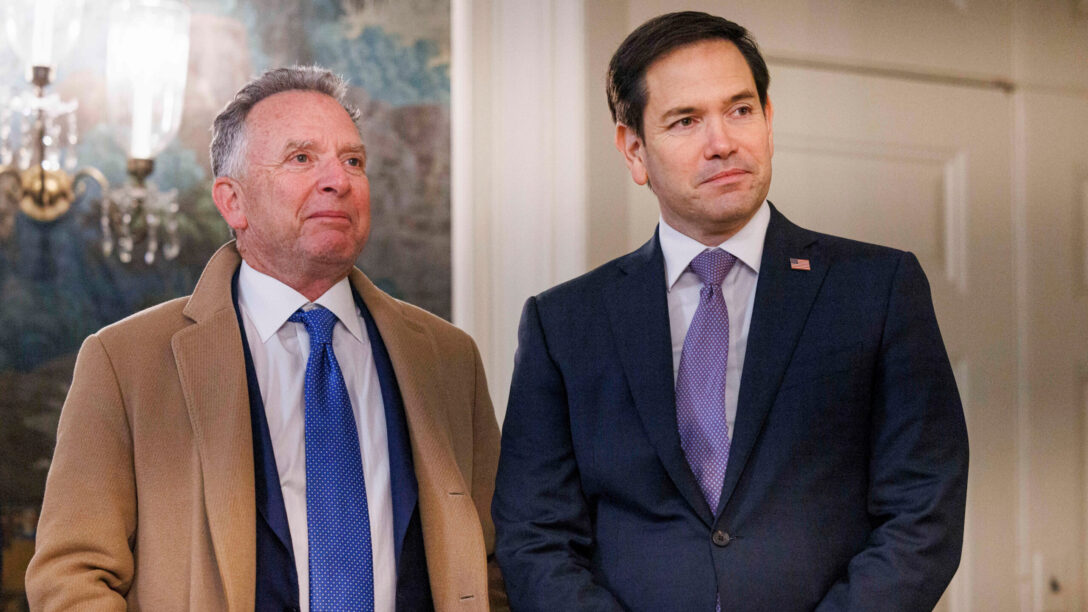
Earlier this week, when Secretary of State Marco Rubio sat down with his Russian counterparts in Saudi Arabia to discuss terms to end the war in Ukraine—excluding the Ukrainians from the summit, enraging Volodymyr Zelensky, and undermining longstanding European alliances—it didn’t escape the notice of anyone at the State Department that Steve Witkoff was also seated at the table. Witkoff, a billionaire real estate investor and longtime Trump pal, has gained extraordinary power over U.S. foreign policy since his anointment as special envoy to the Middle East—a title that understates the extent of his influence.
While the secretary of state is formally the nation’s chief diplomat, conversations with Trump officials suggest that the president has effectively layered Rubio, instead empowering a small number of “special envoys”—diehard Trump loyalists, past administration officials, and longtime friends who are not subject to Senate confirmation, are not required to quit their day jobs or divest their portfolios, and have more or less unfettered access in the West Wing. Along with Witkoff, there’s Ric Grenell, Trump’s former ambassador to Germany (and, briefly, director of national intelligence), who is in charge of “special missions.” There’s Keith Kellogg, the former Pence national security advisor who is special envoy for Ukraine and Russia. And, of course, there’s Apprentice producer Mark Burnett, who was granted a special envoyship to the U.K.
Naturally, this reordering of the diplomatic universe—placing trusted allies ahead of Senate-confirmed officials—has elicited some consternation in Foggy Bottom. “You’re giving fiefdoms to all of these envoys—so how does that work with Rubio over them?” said one person with knowledge of the confusion inside State. “Are they more powerful than Rubio?” Another source, an official in the State Department, described the situation more bluntly. “It’s like having two secretaries of state,” the official said. “It looks like [Trump] doesn’t trust Rubio. That was a tough lesson from the first go-around; he was burned by both [Rex] Tillerson and [Mike] Pompeo—enough for him to have a vindictive streak.” (A Rubio spokesperson declined to comment.)
Unlike Trump’s first term, when national security advisor John Bolton and Pompeo were constantly at loggerheads, I’m told there’s no obvious power struggle between Witkoff and Rubio, and that Witkoff is privately deferential to Rubio. And technically, of course, special envoys don’t outrank ambassadors, let alone the secretary of state. But if you can walk into the Oval Office and have the president’s ear, your authority is hard to contest. And Witkoff—who has seemingly added Ukraine and Russia to his Middle East portfolio—is the envoy with the most potential to overshadow his nominal boss. “No one is saying, ‘What does the secretary of state think?’” said the department official. “In terms of setting direction, Witkoff outranks Rubio.”
“One Big Real Estate Deal”
Trump’s friendship with Witkoff goes back decades, to when they first met in the cutthroat world of 1980s New York real estate. Since then, he’s donated millions of dollars to Trump’s political groups, co-founded the president’s World Liberty Financial cryptocurrency platform, and was, as I reported at the time, the key negotiator of the Trump-DeSantis detente, brokered at Witkoff’s golf club in Miami.
Trump refers to Witkoff as a modern-day Henry Kissinger, and credits him for the Israel-Hamas ceasefire negotiated, with Witkoff’s participation, during the latter days of the Biden administration. Another State Department source offered a similarly lofty comparison, equating Witkoff’s diplomatic skills to those of James Baker, Bush I’s legendary tennis buddy who became his secretary of state. “Steve is also the president’s best friend,” said a former Trump official. (Notably, Witkoff flew down to meet with Trump at Mar-a-Lago after the January 6 Capitol riot; Marco Rubio did not.)
Witkoff also shares Trump’s might-makes-right, realpolitik worldview to a degree that Rubio—a more traditional foreign policy thinker, at least until recently—may not. Like Trump, Witkoff views Middle East geopolitics as “one big real estate deal,” according to a Wall Street Journal profile. His financial dealings suggest as much: The Qatar Investment Authority bought his Park Lane Hotel for $623 million in 2023, and Abu Dhabi’s investment fund was also a stakeholder.
As Witkoff’s star has risen, so have those of his deputy, Morgan Ortagus, a former Treasury Department official, Fox News contributor, and State Department spokeswoman during Trump’s first term; and Juan Varela, his 28-year-old chief of staff and family friend. Both have accrued visibility and influence through proximity.
Rubio, meanwhile, is clearly trying to shake off MAGA suspicion of his more hawkish principles, which he swallowed this week when he hoped aloud for a “pretty unique, potentially historic economic partnership” with Vladimir Putin, a man he called a “gangster and a thug” in 2016. “It’s odd to see Rubio out there trying to find his footing,” said a former State Department official. “He’s doing his best to carry out the president’s wishes on Ukraine and Russia. It’s follow-the-leader, but it makes it more difficult when there’s so many envoys flying around. If you’re anywhere in foreign policy circles, you’re trying to get access to Witkoff and his team.”
Elon Falls to Earth
Elsewhere in the world of palace politics, Republicans in Trump’s orbit are keeping a close eye on the slumping favorability of Elon Musk, another “senior advisor” whose title fails to capture his unprecedented remit. While the president’s approval rating has softened to 44 percent, according to a new Reuters/Ipsos poll, Musk’s favorability is in free fall as his DOGE team blindly slashes government budgets, dismantles federal agencies, and lays off tens of thousands of government employees, around 30 percent of whom are veterans.
Echelon Insights, a polling outfit that partners with Puck, reports that Musk’s numbers have dropped by 7 points since January. “If you just look at austerity programs in the past, they normally don’t end well politically,” said Patrick Ruffini, a Republican strategist with Echelon. On the other hand, he allowed that Trump, and Elon by extension, are less focused on attacking the major cost drivers for the federal government (Trump has vowed no cuts to Social Security or Medicaid, for instance), than popular cultural targets of the right. “These weird D.E.I. grant programs and NGOs are assumed to be organs of the left,” Ruffini said.
Meanwhile, new polling conducted by the Progressive Change Campaign Committee shows that since September 2024, Musk’s favorables have dropped 15 points, with a loss of 19 points among independents. “The more people learn about Elon Musk and the cuts to very popular programs, the lower his popularity is,” said P.C.C.C. co-founder Adam Green. (The left-leaning group has launched a campaign against Musk featuring posters of the billionaire’s face and the words “I Am Stealing From You.”) “He’s become a political target, an Achilles’ heel for Trump,” Green continued. “And he definitely does not have the cult of personality that Trump has.”
For now, of course, Musk remains instrumental to Trump—both as a blunt instrument and a heat shield, absorbing mounting criticism over painful budget cutbacks while the administration monitors the fallout. Musk, for his part, clearly relishes the chaos. And for Democrats, who are still calibrating how much to go after Trump directly as they try to win back Trump voters, Musk offers the type of soft target that they know how to attack.