Netflix’s Invincible Era Ends and More Burning Questions in Hollywood
Did Quinta Brunson balk at the prospect of the Ellisons? Where are we on a Wasserman deal? Is Tom Hardy really trying to get back into ‘MobLand’? And more of readers’ hottest queries answered.
It’s been a while since I answered reader questions, so let’s get to it…
Why was Netflix even considering buying Roku? How desperate are they for some kind of splashy deal?
First off, that interest was way early in the process, and Netflix never ended up bidding. Remember, Netflix helped incubate Roku, and co-C.E.O.s Ted Sarandos and Greg Peters are familiar with the company and its leadership. They would also argue that they should be diligent and look at anything on the market—even if Roku isn’t worth to Netflix anywhere close to the $22 billion it was to Fox to join the streaming wars in earnest. (Also, those rumors of Netflix pursuing Lionsgate are B.S., at least for now.)
But… the Netflix stock is still down a third from early November, when Wall Street’s favorite entertainment company decided it should blow up its pristine narrative and go after Warner Bros. Even after the momentary rebound when Netflix lost Warner Discovery to the Ellisons and their totally hands-off, barely even involved partners in the Middle East, Netflix hasn’t been able to shake the impression that its about-face on major M&A signaled weakness at the company.
And indeed, growth has slowed. The company’s most recent Engagement Report revealed total hours viewed in the second half of 2025 increased by just 2 percent while MoffettNathanson estimated that the global user base grew by 10 percent, “which translates to an 8 percent decline in daily engagement per subscriber.” On the recently released list of the biggest shows of the season, Netflix had only Stranger Things, which ended; Bridgerton; and His & Hers, a limited series. All eyes are on the company’s next Engagement Report for the first half of 2026, which will include the recent push into video podcasts.
To date, no video podcast has charted on Nielsen’s weekly top 10, which Netflix tends to dominate, and multiple company sources have told me that the podcast engagement numbers on the whole are low. Looking forward to the second half of ’26, Netflix has fewer marquee titles in the pipeline and tough comps because of last year’s KPop Demon Hunters and Stranger Things and Wednesday, though no single title skews Netflix’s numbers that much. All of which is to say that Netflix, which squandered its aura of invincibility, now needs to find its next growth engine—whether that’s a splashy deal or simply strong fundamentals, neither seems easy.
I’m hearing UTA is out of the running for Wasserman. True?
Yes, true, UTA and its private equity backer, EQT, were removed yesterday from the auction for the sports agency/management company formerly known as Wasserman. They balked at the price, I’m told, which included the fee that founder Casey Wasserman is demanding to sign noncompete and nonsolicitation agreements with his soon-to-be-former company. Other bidders are still in the mix, including New Mountain Capital, founded by Steven Klinsky, a former partner of the late IMG chief Teddy Forstmann.
Zero chance Quinta Brunson was going to stay at a Warner Bros. Television owned by Larry Ellison’s Paramount, right?
Depends who you talk to. I’m told politics wasn’t the guiding principle behind the outspoken Abbot Elementary creator moving her overall deal today from WBTV to Disney. It was more about the uncertainty of Warners’ impending acquisition by the Ellisons’ Paramount Skydance than their fealty to Trump. Brunson is said to have a great relationship with WBTV’s Channing Dungey, but will Dungey and her team survive the merger? Brunson’s new deal is five years, and there’s a pretty decent chance that Disney’s Dana Walden and Deb OConnell will still be wearing mouse ears for the bulk of that tenure. Since the money was pretty much the same in both offers, that’s the bet Brunson is making.
But obviously it’s hard to escape the political issues, and separate sources are telling my colleague Kim Masters that Warners execs believe they lost Brunson due to the politically driven overhaul of CBS News and the continued rightward pivot of the incoming parent company. That’s been the fear of many in the WarnerMount empire—that Ellison’s Trumpy turn will alienate the talent they need to make the merger work. I’m betting it’s a mix of both—a familiar team at Disney, which already airs Abbott Elementary, with the added bonus of not becoming a colleague of Bari Weiss. (A rep for Brunson declined to comment.)
What happens if California succeeds and the WarnerMount merger is either blocked or abandoned?
A doubtful scenario, given the federal government already signed off on the $110 billion deal. But let’s say California’s attorney general, Rob Bonta, files suit, as expected, and a judge either enjoins the deal, the state is able to undo it, or the saga drags into 2027 and the Ellisons get tired of paying the roughly $650 million-per-quarter ticking fee and walk away. (I highly doubt that last part.) This would leave David Zaslav and the Warner Discovery team to execute Plan B, the split, which was actually Plan A before the Ellison overtures put the whole company in play. The Warners studio and HBO Max would be separated from the TV networks and auctioned to the highest bidder, likely Netflix or Comcast, the two jilted suitors the first time around.
Netflix would probably bid less this time, given that the company wouldn’t be up against one of the world’s wealthiest families, and it’s unclear whether Comcast could put a deal together at all, given its share price is now hovering around decade lows. Warners would likely get a $7 billion breakup fee from Paramount (on top of the $2.8 billion that Paramount had to pay Netflix for spoiling that closed deal), so the spinoff might be on more-solid financial ground, or at least have less debt to deal with.
Would that be better for the Hollywood coalition pushing to block the merger? Maybe. (It would certainly be awesome for Gunnar Wiedenfels, the Zaslav hatchet man and Warner Discovery C.F.O., who would finally get to run his own company in the spun-off Discovery Global.) Netflix, in particular, might keep more of the Warners workforce than Paramount, which is expected to slash and burn its way to $6 billion in synergies. And maybe some other white knight would emerge. But those thinking a blocked merger would somehow “save” Warners from being sold don’t know how this stuff works, or the lengths to which Zaslav will go to get his massive payout. “There is no scenario in which this company is an ongoing entity like it is today,” analyst Rich Greenfield told me today. “It is getting sold, the only question is to whom.”
What’s going on at Jordan Peele’s company?
Peele’s Monkeypaw Productions had some layoffs lately, another victim of the content recession. He’s not alone amid the well-documented troubles at the once high-flying outfits of everyone from J.J. Abrams to LeBron James to Reese Witherspoon to Kevin Hart. Candle Media, the Blackstone-backed roll-up of talent-driven producers, is openly shopping its pieces. Byron Allen is spinning his recent acquisition of BuzzFeed—yes, BuzzFeed—as a pillar of some great YouTube rival, but it’s pretty well known in the banking world that he has some scary debt obligations on the horizon.
As for Peele, his pared-down film deal at Universal doesn’t expire until 2030. And while his directorial follow-up to 2022’s Nope was once dated for 2024, it’s currently not scheduled—so that’s at least five and likely six or seven years between films. I’m told there’s a script, and Universal is on board, but news of a release date or casting isn’t expected for a few months. Monkeypaw has no other greenlit movies after the sports horror pic Him flopped last year.
Ellison’s J6 Quandary
If Paramount, which is buying WBD, now exists to please Trump, why is Warner Bros. making a Sean Penn movie about January 6?
I’m told Penn first raised his interest in directing a personal story of a man caught up in the Capitol riot to Zaslav, who is friendly with Penn through their shared buddy Vivi Nevo. (Nevo, the media investor/Malibu mystery man, sat between Penn and Zaslav at the Globes in January.) Warners soon agreed to distribute Penn’s movie, which will be independently financed via a consortium that CAA put together, with a budget in the $20 million to $30 million range, and they want Bradley Cooper, though he’s booked until he finishes making the Ocean’s 11 prequel later this year.
Is David Ellison thrilled to get a J6 movie that Trump will presumably hate? Probably not. Are Warners studio heads Mike De Luca and Pam Abdy possibly testing Ellison while simultaneously auditioning for a job running another studio? Maybe. But it’s worth noting that the film, even in the best case scenario, probably won’t be released until after the November 2028 election, when Ellison won’t have to care as much about what Trump thinks.
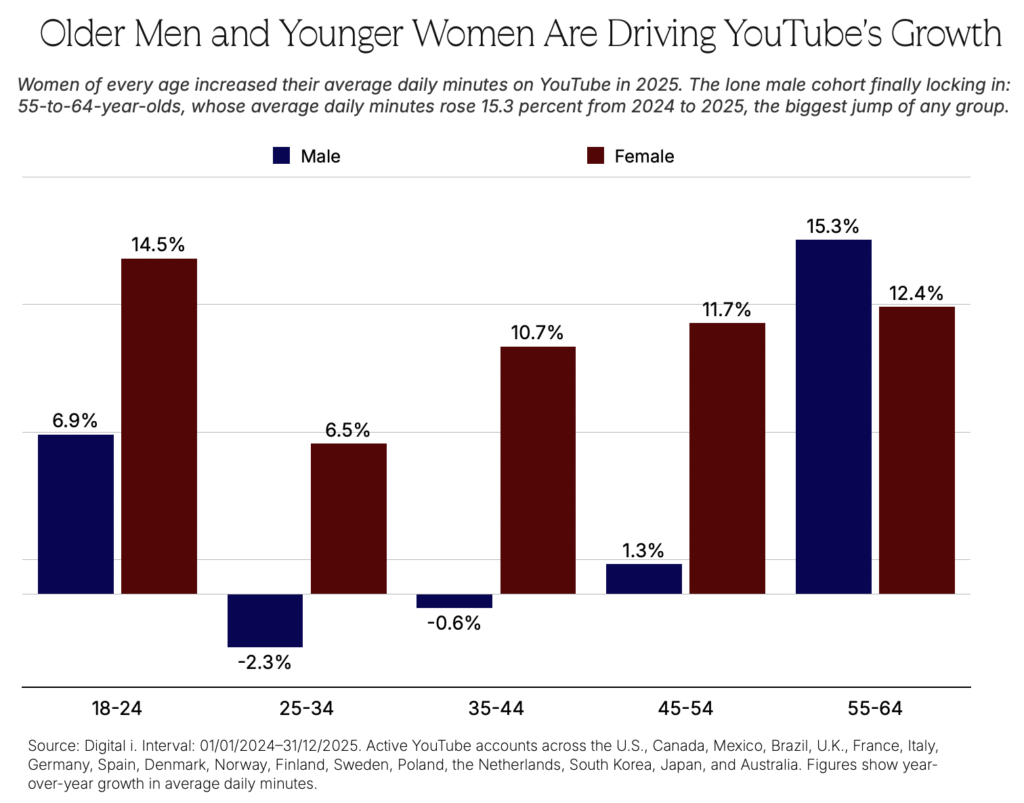
I keep reading about how YouTube is growing faster than any other platform. Who, exactly, is driving this growth?
You sound skeptical, but indeed YouTube is the fastest-growing platform when it comes to time spent. Its average daily minutes per user grew from 87.2 to 99.1 from 2024 to 2025, per analytics firm Digital i. Netflix, by contrast, dropped from 100.5 minutes to 93.4 during the same period.
But all demos are not driving YouTube equally. Women, and specifically younger women, are overindexing, while men 55-64 are finally discovering the joys of scrolling, generating a 15.3 percent increase year over year.
Any update on Tom Hardy’s firing off MobLand?
There’s a meeting tomorrow in London. He wants back in, so we’ll see if the charm offensive works.
Who pays for the stylists and glam teams when an actor or filmmaker is on a festival jury like at Cannes? That’s two weeks of red carpets!
I asked some top publicists about this after the Jam Session podcast was talking about it—yes, I’m doing the Lord’s work here—and with exceptions, when you’re a juror at a major film festival, the fest will offer styling and hair and makeup people from their own sponsors for both men and women. That’s the base, but for most movie stars or prominent filmmakers, that’s not acceptable. If you don’t have brand deals already—most do, especially Ruth Negga and Demi Moore from this year’s Cannes jury, even if they’re not an official “ambassador”—your agency or your publicist will either get those deals for the run of the festival, or piece together a styling plan by agreeing to wear specific brands on certain nights.
And the cost of all this? A day of personal styling can run anywhere from $1,000 per look on the very low end to $10,000 per day for the stylists you’ve heard of (it’s all a negotiation… maybe a big name takes $5,000 per day to work with someone cool). A mid-tier stylist will run $1,200 to $1,600 per look, and a decent glam team can run $2,000 to $5,000 per day, depending on how many artists you require (extra costs if wigs are involved). That’s why hair, makeup, and styling teams are often written into studio contracts, with top actors negotiating as much as $20,000 per day in glam perks, including travel (business class) and accommodations for the team.
But festivals are not studios, so the move is to either line up those brand deals in advance, take what you’re offered, or—god help you—pay out of pocket to look presentable.
What do you make of Jay Penske buying Vox Media brands like Eater and The Dodo?
Seemed like a no-brainer after the “good” parts of Vox, like New York magazine and the Vox podcast network shows such as Pivot, were sold to James Murdoch. Penske Media already owned 20 percent of Vox, along with his Hollywood trade media borg (Variety, Hollywood Reporter, Billboard, etcetera) and other specialty pubs. Jay is basically turning his media division into the Alden Capital of web traffic–era publishers, taking legacy brands like Alden did with print newspapers and paring them down, streamlining their backend operations, and milking the brands and their remaining traffic.
Diminishing returns, of course, hence more layoffs recently across the company. But building up scale can slow that decline. The fact that Penske Media is suing Google says everything about how A.I. scrapers have impacted its business. Hopefully they’ll figure out a path for the sake of the hundreds of journalists who still work there.
Who’s still paying for Hollywood Walk of Fame stars?
That one’s easy. The studio or network behind whatever the star or producer is promoting will usually hold their nose and cough up the $85,000 required to buy the star—sorry, support the Hollywood Chamber of Commerce and pay for the installation and maintenance ofit. All in the service of the honoree’s ego—and, of course, the important promotional value of the ceremony. But if there’s no studio involved, the talent or his or her fans will sometimes pony up themselves, which makes for a very Hollywood scene when the honoree is brought to tears by a ceremony that he or she paid for themselves.
The five-person Walk of Famer selection committee makes the 25 or so picks each year. (Yes, if you’ve got enough juice, you can negotiate where your star is located, lest you fear staring forever at Hustler Hollywood.) And before the star is anointed, the honoree has to agree to attend the ceremony in person—and let the vultures at Variety, the media sponsor, try to sell their friends and associates those tacky congratulatory ads that have thankfully disappeared for all but the least self-aware people in town. (Scooter Braun comes to mind… how does he not have a star?).
The hand-and-foot cement ceremony outside the TCL Chinese Theatre is a bit more expensive, about $120,000, and while it’s positioned as an even more exclusive honor, it’s really just a pure pay-to-play negotiation with the owners of that property. (Jonas Brothers? Jo Koy?) A studio will often agree to split that cost or pay for it outright, depending on how much they care about you.
Shared with you by a Puck member
Enjoy this free article thanks to a friend. You can keep exploring Puck with a free account or enjoy a 14 day free trial.
Didn't get an email? Check your spam folder and confirm the spelling of your email, and try again. If you continue to have trouble, reach out to fritz@puck.news.
Didn't get an email? Check your spam folder and confirm the spelling of your email, and try again. If you continue to have trouble, reach out to fritz@puck.news.
Member Exclusive
Get access to this story
Create a free account to preview Puck’s full offering, including exclusive articles, private emails from authors, and more.