{{ 'now' | timezone: 'America/New_York' | date: '%b %d, %Y' }} |
|
|
Welcome to The Hidden Layer. I’m Ian Krietzberg.
Surprising almost nobody,
OpenAI is bringing ads to ChatGPT—an inevitability, really, for a consumer-facing company that’s losing tens of billions of dollars a year. It’s an inflection point for the business and, possibly, for the whole industry. Will users care? That’s the subject of tonight’s issue. Plus, above the fold: an exclusive update about Harmonic, the A.I.-for-math startup that I profiled
in October, and why you should keep your kids away from A.I. toys.
Still not a Puck subscriber? Consider signing up today—you’ll get full access not just to The Hidden Layer, but to all of Puck’s stellar reporting. (It’s really a bargain, if I may say so myself.)
Mentioned in this issue: Sam Altman, OpenAI, Harmonic, Pedr
Howard, Gil Luria, OpenEvidence, Jihoon Kim, Nic Baird, Paddy Harrington, Tudor Achim, Jensen Huang, Daniel Nadler, Robbie Torney, Dario Amodei, Jamie Dimon, Chris Shilney, Demis Hassabis, Maria Sukhareva, and many more… |
Three Things You
Should Know…
|
- Exclusive:
Harmonic’s mathletes: Intent on achieving what it refers to as “mathematical superintelligence,” the math-oriented A.I. startup Harmonic plans to announce $1 million worth of research sponsorships today for academics and students to test the limits of mathematical A.I., with a focus on tackling “ambitious research problems.” The winners of the cash awards will also get special access
to Aristotle, Harmonic’s core model.
Harmonic’s push to get its model into more hands comes amid growing attention on the mathematical capabilities of generative A.I. systems. In recent weeks, C.E.O. Tudor Achim told me, Aristotle has been used to help solve some famously difficult (and long-unsolved) Erdos
problems—marking the beginning, perhaps, of an evolution in the field. “The ultimate goal of our sponsorship program is to scale up the progress we have already seen from Aristotle in the spirit of academics and research,” Achim said. “Our hope is that Aristotle becomes a tool that not only accelerates these mathematical discoveries but also sparks breakthroughs in any field that relies on rigorous logical reasoning.”
Harmonic’s
unique approach of combining L.L.M.s with automatic, formal mathematical verification seems to have caught the attention of Jensen Huang, too. Nvidia participated in Harmonic’s recently completed $120 million Series C, which valued the startup at $1.45 billion. - A.I. for doctors: OpenEvidence, a medical
A.I. search platform used by more than 10,000 hospitals in the U.S., completed a $250 million Series D this week, valuing the startup at $12 billion. Its investors include Google Ventures, Nvidia, the Mayo Clinic, and Thrive Capital, which led the round. The company, which has now raised a total of $700 million, said a portion of the money will go toward the (likely staggering) compute costs related to its multi-model system.
Despite its niche focus, OpenEvidence—which claims to be “one
of the fastest companies in history of any kind to reach $100 million in annual revenue”—doesn’t rely on a subscription model. Instead, the service is free for doctors (with ads, of course). The company has said that more than 100 million Americans were treated last year by a doctor who used OpenEvidence. “If a doctor tried to stay current by reading only the new evidence in the top 10 medical journals and only the most recent changes to their specialty guidelines, it would take nine hours of
their day, each day,” C.E.O. Daniel Nadler said in a statement. “Without a technology like OpenEvidence, doctors may miss critical new findings or guidelines simply because they lack the time to find them.” - Put the A.I. doll down!: I’m sure this will shock everyone reading, but A.I. toys are apparently not the kind of thing you want near your kid. A recent
analysis from Jim Steyer’s Common Sense Media—which tested toys from Grem, Bondu, and Miko—found that A.I.-powered plushies tend to do a whole bunch of weird things. According to the report, 27 percent of the information they spit out isn’t “appropriate for children” (i.e., pertaining to drugs or self-harm); they masquerade as educational tools,
but provide factually incorrect information; they’re “always listening in children’s bedrooms and playrooms,” collecting data that’s often shared with third parties; and they’re “deliberately designed to form emotional bonds with young, vulnerable children.”
The report comes in the wake of a poll, also
from Common Sense, which found that roughly half of the surveyed parents have purchased, or are considering purchasing, A.I.-powered toys for their children. “These products aren’t safe for kids under 5, with serious concerns for older kids as well,” Robbie Torney, head of A.I. at Common Sense, said in a statement.
|
Quote of the Week:
Davos Edition
|
“We’ve seen a lot of stuff around ads from some of the other players. Anthropic is not a
player that works like, or needs to work like, that. We just sell things to businesses, and those things directly have value. We don’t need to monetize a billion free users. We don’t need to maximize engagement for a billion free users because we’re in some death race with some other large player.”
—Dario Amodei, the C.E.O. of Anthropic, taking a shot at OpenAI during an interview in Davos earlier this week.
Runner-up: “We’re not going to
kill all our employees tomorrow because of A.I.” —Jamie Dimon, the C.E.O. of JPMorgan Chase, also at Davos. And now for the main event… |
|
|
It was inevitable that OpenAI, a massive consumer-facing company racking up historic losses,
would enter the advertising business. Will this become the new normal for the industry? Or will ChatGPT users revolt? |
|
|
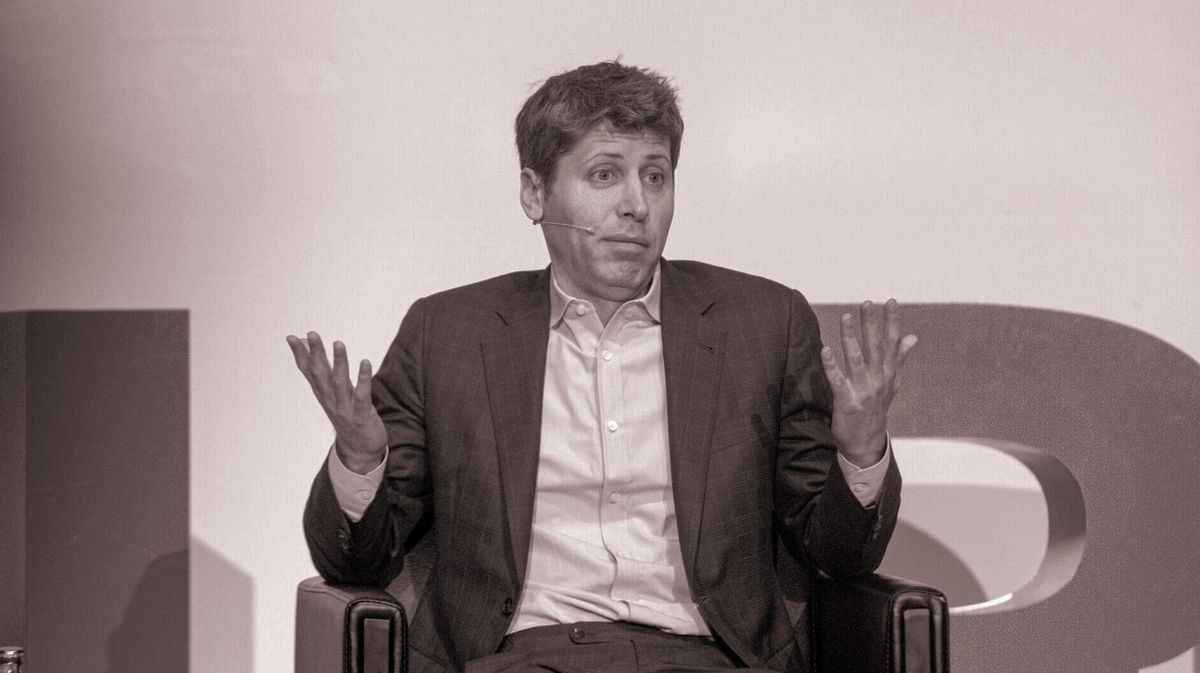
Two years ago, while speaking at Harvard, OpenAI C.E.O. Sam Altman confidently declared that advertising was “a last resort for us as a business model.” At the time, OpenAI was on track to lose something like $5 billion—and the company’s annual cash burn has only accelerated in the intervening years. By the end of 2025, analysts projected that it could lose double that amount, with total capex forecasted to rise above $100 billion per year through the end of
the decade. Other analysts have been even more bearish: HSBC expects OpenAI to face a $207 billion funding gap by 2030; in December, an analyst at Deutsche Bank said that “no start-up in history has operated with expected losses on anything approaching this scale.”
In retrospect, it was probably inevitable that OpenAI, which claims to have roughly 800 million weekly users, would eventually start selling ads. Google and Meta generate hundreds of billions of dollars every year from their advertising businesses. So it was hardly shocking when the company announced, last week, that advertising was officially
coming to ChatGPT. In my conversations with industry sources, most began with some variation of, “I’m not surprised at all.”
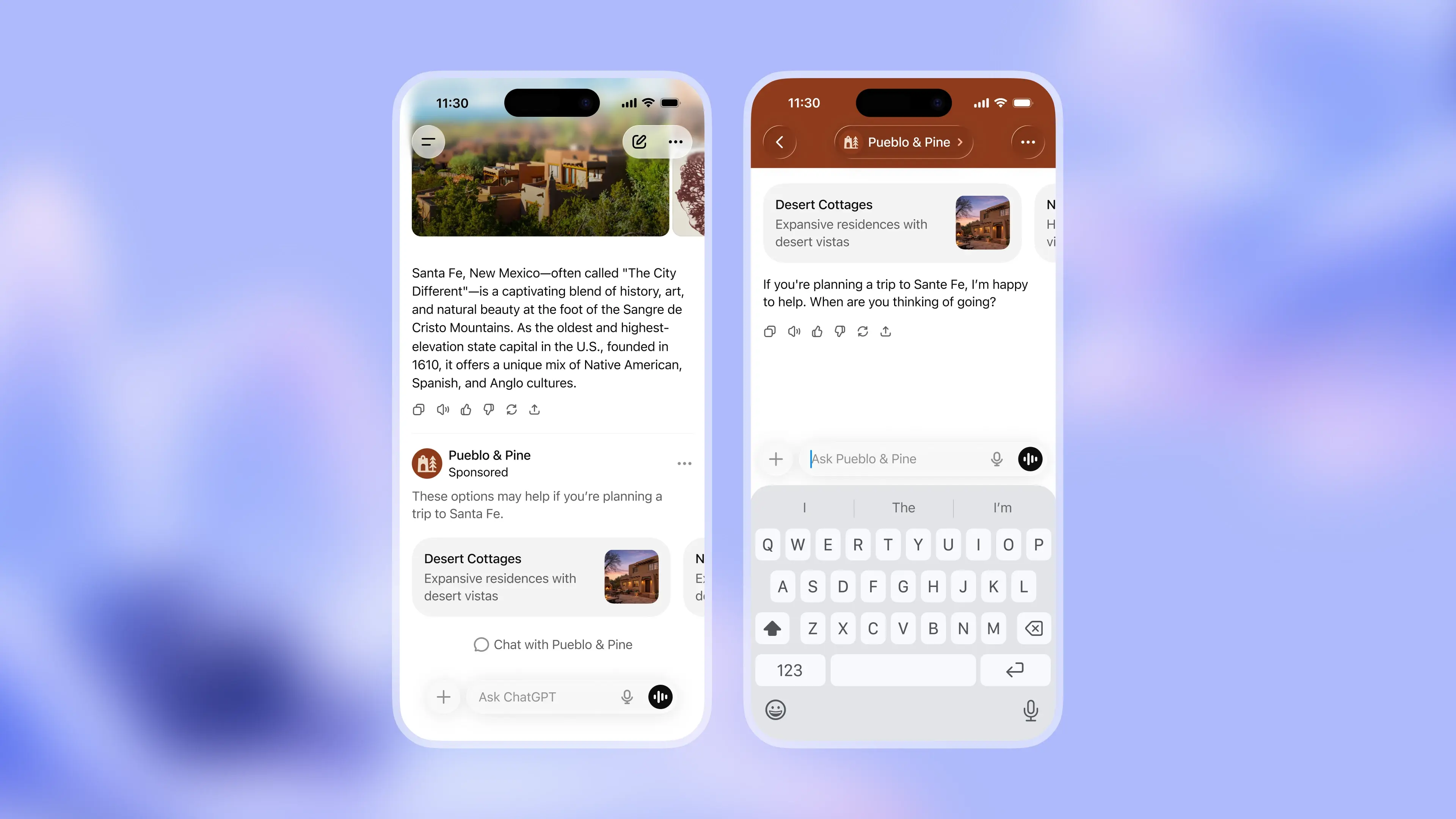
Here’s what we know about the ad rollout so far: Beginning in February, OpenAI will start testing ads for adults using the free product, as well as the Go tier—ChatGPT’s lowest-cost subscription. When the ads start appearing, OpenAI says they’ll look like a pop-up at the bottom of the screen—clearly marked as an ad and separated from the A.I.-generated output above
it. In its announcement, OpenAI also assured users that ads would not influence output; that the company would “always offer a way to not see ads in ChatGPT” (presumably by paying for a more expensive tier); and that it would not sell user data to advertisers. We’ll see how long that lasts. |
A sample of what this might look like. Courtesy of OpenAI |
An OpenAI spokesperson told me that this promise covers all types of user data, though this person
also said that advertisers will have access to analytics that show aggregated performance. But it’s hard to imagine that the company, having cracked open this particular Pandora’s box, won’t eventually pull most available levers. OpenAI knows a lot about its users, which it can use to optimize ad targeting. And Altman has burned through a lot of capital from investors who will eventually require a return. “Beyond charging for subscriptions, the only other way to monetize
ChatGPT is through advertising,” D.A. Davidson analyst Gil Luria told me.
Obviously, launching an advertising business doesn’t mean that OpenAI is going to abandon its pursuit of subscription revenue—even though, as of July, only about 5 percent of its users were on a paid tier. The
Information recently reported that OpenAI plans to increase its average revenue per user from $2 this year to $15 in 2030. But observers like Pedr Howard, an executive V.P. at Ipsos—which works with OpenAI on brand strategy—are
skeptical that individual (as opposed to enterprise) subscriptions will ever become a meaningful revenue driver for the consumer-facing company. “We’ve tested a lot of ads for L.L.M.s over the years—there’s going to be plenty of A.I. ads in the Super Bowl—and haven’t seen one yet where people have really been convinced by the proposition,” he said. |
A digital platform serving contextually relevant ads based on data analytics is nothing new. But the OpenAI
pivot feels different, given the particular dynamics of ChatGPT. Unlike the passive scrolling experience on Instagram, Google, or YouTube, chatbots offer a much more active, anthropomorphic experience—engendering a sense of trust that is easy to betray. “What’s happening here isn’t just advertising inside a product, but advertising embedded inside interaction, advice, and decision support,” advertising scholar Dr. Jihoon Kim told me. “In search or social media, ads
respond to inferred interests. In ChatGPT, ads could respond to expressed intent, people explaining problems, asking for guidance, and thinking out loud in natural language. That shift toward contextual intimacy is where both the opportunity and the risk come from.
The opportunity, according to Chris Shilney, a vice president at marketing firm Walker Sands, is “highly contextual, intent-rich” advertising, the impact of which depends on maintaining user trust (a
fine line). The risk is that the rollout will “erode trust in a system users increasingly treat as a cognitive partner rather than a media platform,” said Kim. “It is this psychological closeness that makes the shift both powerful and delicate from a design and trust perspective.”
Decades of observing consumer behavior on the internet give us a decent idea of how users might respond. Paddy Harrington, a security and risk analyst at Forrester, told me that roughly
a third of online users seem to accept advertising as a cost of admission to a service; another third hate advertisements but decide to use services with them anyway; and another (growing) third tend to abandon these platforms for ad-free alternatives. How this shakes out may come down partly to design. “If they put it outside of the chat flow, it’s annoying, but it’s tolerable,” Harrington said. “But at the end of a chat line, especially for people who use it as that emotional connection at
some level, it feels a little slimy.”
Granted, OpenAI said that ads won’t initially appear next to “sensitive or regulated topics like health, mental health, or politics.” But a quick scan through OpenAI’s subreddit indicates that some users, at least, are already thinking about switching to alternatives like Gemini and Claude. To that end, Google
DeepMind C.E.O. Demis Hassabis said this week that Google doesn’t plan on bringing ads to Gemini. “It’s interesting they’ve gone for that so early,” Hassabis told journalist Alex Heath. “Maybe they feel they need to make more revenue.” (It’s worth pointing out that while Gemini doesn’t serve ads inside Gemini, it does
collect user data to serve ads elsewhere.)
No matter how this goes for OpenAI, it seems likely to open the A.I. advertising market across the board. Nic Baird, a co-founder of Koah, a startup focused on bringing advertising to A.I. applications, told me that the biggest objection he gets from publishers is that they don’t want to be first.
But now that OpenAI is starting to embrace ads, the game has changed. Computational linguist Maria Sukhareva, for one, expects many A.I. developers will eventually resort to ads, whether they’re hyperscalers or not. “Google has already been considering for a while to introduce ads to the bot,” she told me. “The difference is that for OpenAI, it might eventually be the question of surviving longer; for Google, it will just be another source of income.” |
That’s all for today. I’ll see you next week.
Ian |
|
|
Join Emmy Award-winning journalist Peter Hamby, along with the team of expert journalists at Puck, as they let you in on the
conversations insiders are having across the four corners of power in America: Wall Street, Washington, Silicon Valley, and Hollywood. Presented in partnership with Audacy, new episodes publish daily, Monday through Friday. |
|
|
Puck’s daily political newsletter from Washington on what’s really happening in this town, from the White House to the Pentagon
to Capitol Hill, K Street, and the campaign trail. |
|
|
Need help? Review our
FAQ page or contact us for assistance. For brand partnerships, email ads@puck.news.
You received this email because you signed up to receive emails from Puck, or as part of your Puck account associated with {{customer.email}}. To stop receiving this newsletter and/or manage all your email preferences, click here. |
Puck is published by Heat Media LLC. 107 Greenwich St., New York, NY 10006 |
|
|
|