Welcome to The Hidden Layer. I’m Ian Krietzberg. Did anyone else catch Google’s
new Independence Day–themed ad that reimagines the drafting of the Declaration of Independence with assistance from Gemini and Google Workspace? I’m sure Lin-Manuel Miranda supports that message wholeheartedly…
Speaking of politics: Last week, Democratic Senate candidate Abdul El-Sayed published a lengthy and thorough manifesto on A.I. For today’s issue, I
called up the Michigander to chat about his position on the technology amid his primary contest against Rep. Haley Stevens to replace the retiring Gary Peters. Plus, news and notes on Washington’s shapeless regulatory posture, Illinois’ own approach, and the F.T.C.’s latest target. (And yes, I saw the news that Meta might try to become a cloud company. More on that later this week.)
Also mentioned in this issue: Donald Trump,
JB Pritzker, Howard Lutnick, Andreas Kirsch, Bernie Sanders, Susie Wiles, Andrew Ferguson, and more.
Let’s get into it… |
Three Things You Should Know…
|
-
Trump drops Fable export controls: Last week, the Trump administration lifted its infamous export controls on Anthropic’s Fable and Mythos models. But while Fable 5 is back online, Mythos 5 remains accessible only to a limited group of organizations, similar to OpenAI’s new GPT-5.6 model family. White House chief of staff Susie Wiles and Commerce Secretary Howard Lutnick
each posted statements on X acknowledging their coordination with Anthropic to, as Lutnick put it, “ensure alignment across the U.S. Government and strengthen America’s leadership in A.I.” On Monday, Trump told a gaggle of reporters: “We have guardrails. You saw
that a couple of weeks ago. We were able to stop something that we didn’t like. And by the way, the company was very good. They were very good, you know that. But it can be used for tremendous good.”
Of course, concerns around the White House’s haphazard attempts to regulate frontier A.I. models are far from settled. As Anthropic itself acknowledged in its blog, “These events have made clear that the industry needs a consistent way to assess and fix potential ‘jailbreaks’ of A.I. models.”
The sentiment reflects the broader recognition that there remains no consistent framework for frontier model cybersecurity safety. - A.I. for the people: That same week, the F.T.C. proposed its own new regulatory action, ostensibly seeking to ensure the accuracy of chatbot responses—a hedge against what the agency has branded
as the potential for willful, ideologically motivated distortions of information. A company, the proposal states, “could be tempted, for example, to abuse consumer trust by training a model surreptitiously to produce ideologically motivated distortions,” or “be pressured by a state law to alter its technology’s outputs.” You get the gist.
Interestingly, the
proposed policy statement makes no mention of the tendency for A.I. systems to hallucinate—a core fixture of the L.L.M. architecture. But the commission is currently seeking public comment. “The F.T.C. wants to hear from businesses and consumers about their experiences and concerns regarding the subversion of A.I. systems for ideological ends,” chairman Andrew Ferguson said in a
statement. - Illinois takes action: Meanwhile, Illinois governor and likely presidential candidate JB Pritzker signed SB 315, the state’s new landmark A.I. bill, into law on Monday, officially enacting a regulatory
standard—third-party audits—that goes one step beyond the foundation established by New York and California. “As A.I. systems become more powerful and the federal government is unwilling to step in, states have a responsibility to protect our people from the dangers of A.I. while still harnessing the unique potential of the technology,” Pritzker said in a
statement.
The bill was supported by A.I. safety groups including Encode, which called it “the strongest A.I. safety law in the country.” And it’s the latest reminder that anyone thinking of running for president is going to have to present not only a chiseled perspective on the technology, but likely some bona fides,
too.
|
“When we sign such contracts without binding governance, abstract excuses such as ‘I’m just doing research’
start to ring hollow. At least this is the case for me. … Regardless of whether we eventually lead the A.G.I. race, my contributions helped improve our models, and I cannot stop wondering how these models will be used in the end, and what, if anything, will constrain them.”
—Andreas Kirsch, a research scientist at Google DeepMind, expressing his concerns in a recent X post
over the company’s Pentagon contract. |
And now for the main event… |
|
|
|
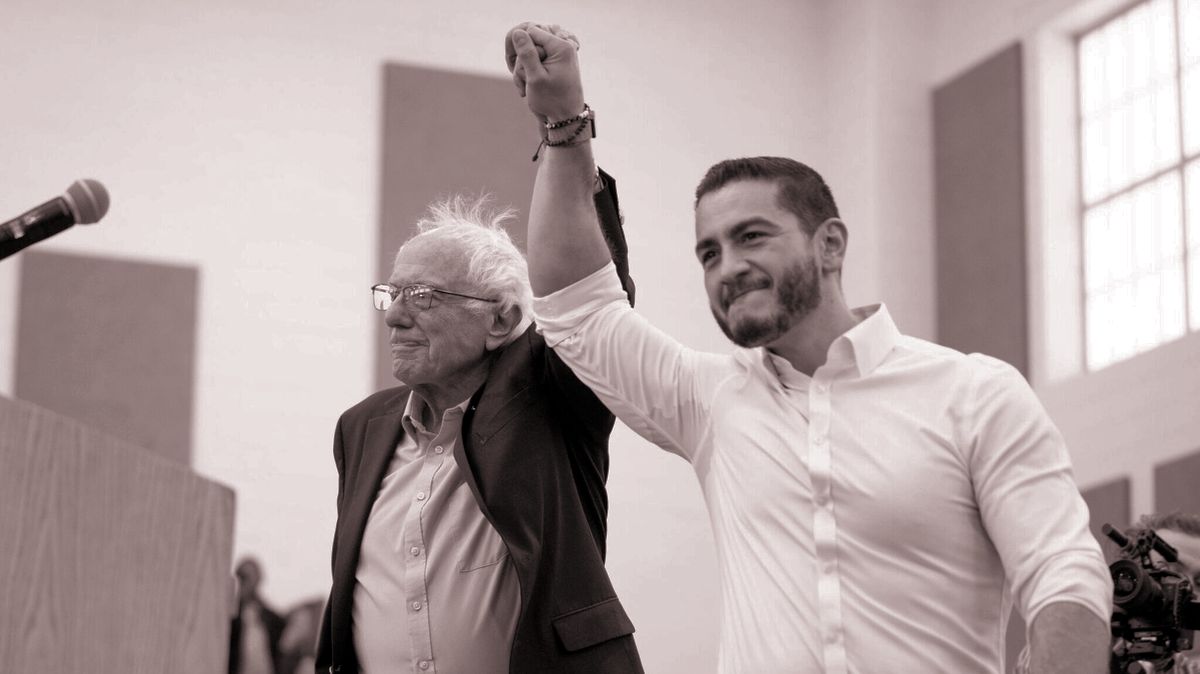
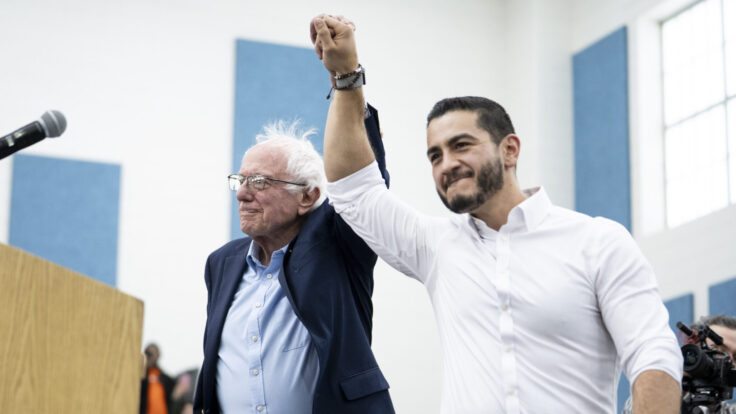
Abdul El-Sayed, Michigan’s Bernie-endorsed Senate candidate, has released an aggressive
A.I.-regulation plan that includes Big Tech divestiture (you heard that right) and a series of “no-goes.” Here, he talks about A.I. as an affordability issue, the myth of Chinese domination, and the inaction of the U.S. Senate. |
|
|
|
Dr. Abdul El-Sayed, the Bernie Sanders–endorsed progressive Michigan Senate
candidate, was no latecomer to that thorny political rose that has recently blossomed around A.I. data centers. In January, he published a “terms of engagement” for data centers, harvesting all the low-hanging fruit that’s had so many people in such an uproar: no rate hikes, community transparency requirements, job guarantees, energy-reliability guarantees, water protection,
etcetera.
In the intervening months since, of course, A.I. has grown into one of the more salient issues of the midterms: Both incumbents and challengers have directly addressed broader concerns around the tech with bills and legislative proposals, even as Congress remains inactive. Last week, El-Sayed inserted himself further into the A.I. political discourse by publishing his “A.I. Under Democracy”
plan—a quixotic proposal that, among other things, calls for all frontier A.I. labs to become public benefit corporations; demands Big Tech to divest from their A.I. businesses; proposes 50 percent public ownership of these companies, complete with annual dividends; and requires that more than half of each company’s board consist of publicly elected
officials.
The plan, which ostensibly traces its roots to a fair bit of Bernie-style economic populism, goes further still in a few of its details. To wit: “A.I. Under Democracy” argues for a tax on corporations that automate work, a breadth of safety requirements, enforceable international cooperation, and a list of so-called “no-goes.” For instance, “A.I. may not deny medical care, autonomously fire weapons, conduct warrantless surveillance, replace human oversight in
life-or-death decisions, or make hiring or firing decisions.”
According to recent polling, El-Sayed has a healthy but surmountable lead over his competition in the Democratic primary, Rep. Haley Stevens. (State Sen. Mallory McMorrow, whom I
spoke to a few weeks ago about her own A.I. plan, dropped out of the race on Sunday.) The primary has attracted around $30 million in outside PAC spending, though it has yet to draw the interest of the major A.I. PACs.
The following conversation has, as always, been lightly edited for clarity. |
“A.I. Is an Affordability Issue”
|
Ian Krietzberg: What have you been seeing and hearing that compelled you to
respond with this plan?
Abdul El-Sayed: There’s not a campaign event that I do where the question of either data centers or A.I. itself doesn’t come up. From young people, it’s the existential risk of not being able to sell your intellectual capital for money on the labor market; for others, it’s what happens when Big Tech comes and pushes a data center onto their existence. Regardless, this is the biggest question facing humanity and our country in the coming decade,
and you’re seeing startlingly little from the U.S. Senate at all, and I want to be able to demonstrate what leadership looks like.
Among voters, is there an issue within A.I. that feels most salient?
Future possibility of work, and then data centers. For folks who’ve been watching this, thinking about how fast this technology has developed over the past three years, there is an existential doom question, but that one feels further off than, I don’t know if I’ll
be able to have a job in the future. I also hear a lot about A.I. for very particular uses—like, I don’t want to be rejected for a job via A.I.; I don’t want A.I. to tell me what healthcare I can’t have via prior authorization; I don’t want A.I. firing weapons. That’s kind of how it shows up.
How do you think this issue stacks up to the major issues that draw voters and swing elections?
A.I. is an affordability issue, full stop. If
you’re worried that a data center is coming to town and there’s no safety around your utility rates, you’re worried your utility rates are going to skyrocket. If you’re worried that there’s no safety around how they use water, you’re worried that your water rates are going to skyrocket, or whether you can get clean water at all. If A.I. is coming for 50 percent of the white-collar jobs, as Anthropic’s C.E.O. suggests it might, then that’s going to be a really big problem for you. If you’re under
40 and you’re worried that you might never be able to afford a home, and now you can’t get a job—again, it’s a massive affordability issue.
It all really comes back to who the economy is stacked up for. A.I. is the expression of economic inequality in technological terms. It’s big billionaires being able to borrow from other billionaires to buy compute from other billionaires to create a technology that is going to take the rest of our jobs to accrue more capital for billionaires.
|
“Democracy Is Old Technology”
|
You have certain “no-goes” listed in the plan. I’m curious how much you’ve encountered a desire among
ordinary people to find a way to turn A.I. off completely, rather than do it responsibly.
I hear a lot of that, and I honestly have a whole lot of empathy for it. For most of us, all we’ve ever seen with new technology is that it gets used to monetize against us, and A.I. feels like the endgame of that. Now, if folks saw responsible A.I.—i.e., we’re using A.I. to cure cancer, or to design the next generation of medications, or to take on the climate crisis, or to address
our energy issues—I think a lot of people would feel differently about it.
But the experience of having A.I. in our lives now is you hear about a data center being moved into your backyard so you can get bombarded with slop videos, and maybe you might have access to a $20-a-month ChatGPT that hallucinates anyway, and then they tell you this thing’s going to take your job. I understand why people are pissed off. I understand the technology has real incredible use cases.
I also
understand the incentives that are driving the technology into its worst-possible use cases, and I want to address the incentives. While A.I. is new technology, democracy is old technology, and for a long time we’ve trusted democracy to be able to govern the approach we take to technology and the ways we think about where we allocate our scarce resources. And so I want to put A.I. under democracy, so that we get the best outcomes and not the worst.
Regarding China and the A.G.I.
race—
That race we’re being told we’re running.
Yeah, that race. It’s been leveraged by some technologists and politicians as a reason for not regulating A.I.—we’ll “fall behind” if we regulate, and we can’t afford to do so.
To what end, though? We have to feed all our jobs to A.I., and our security to A.I., and risk existential doom so that we don’t lose to China, so that China doesn’t take our jobs and yield existential doom?
How many times
are we going to watch our public policy get eroded, broken? How much are we going to lose at the risk of losing some existential battle to China that they’ve been selling to us in some way or another for the past 70 years? I would much rather make sure that we have good jobs; that people who are graduating can get those jobs; that we don’t inadvertently create a technology that can create existential doom for humanity, for fear of losing some theoretical war to China that China doesn’t even
appear to be fighting.
Are you worried that the A.I. PACs will enter the race?
If you look at the ad spend against me, I’m already at $30 million. How many more attack ads are you going to throw at me? I think people are sick and tired of being told that they ought to believe in the 30-second attack ad on television, and I would much rather be in a situation where I’m fighting for the truth. I want people to know what I want to do when I’m a U.S. senator. If I
don’t succeed in becoming a U.S. senator, that will not have been the worst outcome. The worst outcome is you succeed in [becoming] a U.S. senator, and then you fail the responsibilities over which you were supposed to actually govern, and I am not willing to do that.
People’s lives are hard, and if you’re not addressing both the challenges that make their lives hard right now and the ones that are going to make their lives harder, then you’re missing the boat. Every leader needs
to be super focused on this question of A.I. because it’s barreling down on us faster than we can even know. |
That’s all for today. I’ll see you on Thursday.
Ian |
|
|
|
Puck sports correspondent John Ourand and a rotating cast of industry insiders take you inside the executive suites and owners
boxes where the decisions that shape the entire sports business are made. You’ll hear interviews with players, network execs, and everyone in between. The Varsity is an extension of John’s private email for Puck by the same name. New episodes publish every Wednesday and Sunday. |
|
|
|
Puck’s daily political newsletter from Washington on what’s really happening in this town, from the White House to the Pentagon
to Capitol Hill, K Street, the campaign trail, and beyond. |
|
|
|
Need help? Review our
FAQ page or contact us for assistance. For brand partnerships, email ads@puck.news.
You received this email because you signed up to receive emails from Puck, or as part of your Puck account associated with {{customer.email}}. To stop receiving this newsletter and/or manage all your email preferences, click here. |
Puck is published by Heat Media LLC. 107 Greenwich St., New York, NY 10006 |
|
|
|
|