 |
|
Welcome back to The Best & The Brightest, I’m Peter Hamby.
In tonight’s edition, a corrective to the predictably facile analysis coalescing around the notion that banning TikTok will trigger a Gen Z revolt in the fall. Democrats are worried (what else is new?) but a closer look at the polling shows Biden’s real problem with young voters is his messaging, not his policies.
But first… here’s Abby Livingston with an update on the Senate map as viewed from Capitol Hill…
|
|
|
Yet another week begins with Congress scrambling to avoid a shutdown. But compared with recent weeks, the anxiety in Washington is relatively muted. Instead, the Hill’s attention is focused on the Ohio Senate primary, where Republicans are hoping to nominate someone who will finally defeat Sherrod Brown, who has proven over the last three cycles to be one of the most formidable candidates on the Democratic roster. Here’s what’s going on in the Buckeye State:
- MAGA vs. The Old Guard: Like so many Republican state primaries dating back to 2010, this Ohio Republican primary has devolved into yet another G.O.P. civil war. While it’s currently an ugly, three-man race, the MAGA New Guard (Trump, J.D. Vance, Jim Jordan, Kari Lake et al.) is backing Bernie Moreno, while the historic Ohio Republican establishment (Mike DeWine and Rob Portman, among others) has consolidated behind Matt Dolan. Frank LaRosa, the third candidate in this battle royale, has lagged the others in fundraising.
- The race of Brown’s life: Meanwhile, Brown has been doing what any good incumbent ought to be doing: cashing checks. Granted, he’s got a high burn rate, with $21 million spent so far. But he had a healthy amount of cash on hand in his pre-primary report ($13 million), out of $33.5 million raised since 2019. Much of that money went to consulting firms focused on digital outreach and direct mail, along with a few dozen donations to down-ballot Ohio Democratic candidates.
All that said, this will be the race of Brown’s life. Over the last two decades, as Ohio has shifted from pinkish to deep crimson, he has repeatedly outperformed every other statewide Democrat. But this will be the first time he has appeared on the ballot at the same time as Trump (Jon Tester’s Montana race features this same quirk), and the first time he has shared a ballot with a presidential election since 2012, when Brown and Obama had symbiotic G.O.T.V. operations. Nonetheless, there are few candidates who inspire more confidence in party leaders than Brown.
- Mischief managed: It’s also noteworthy that, with this race, the debate surrounding Democratic mischief-making in Republican primaries seems to be over. Recall that in 2022, Democrats started boosting candidates in Republican primaries that they viewed as potentially weak general election candidates. The tactic unnerved many, many Democrats, who worried some of these more outlandish candidates might eventually make it to the House and Senate. But the strategy seems to work, and there’s been comparatively little second-guessing in Ohio this cycle.
|
 |
| Teenage Riot |
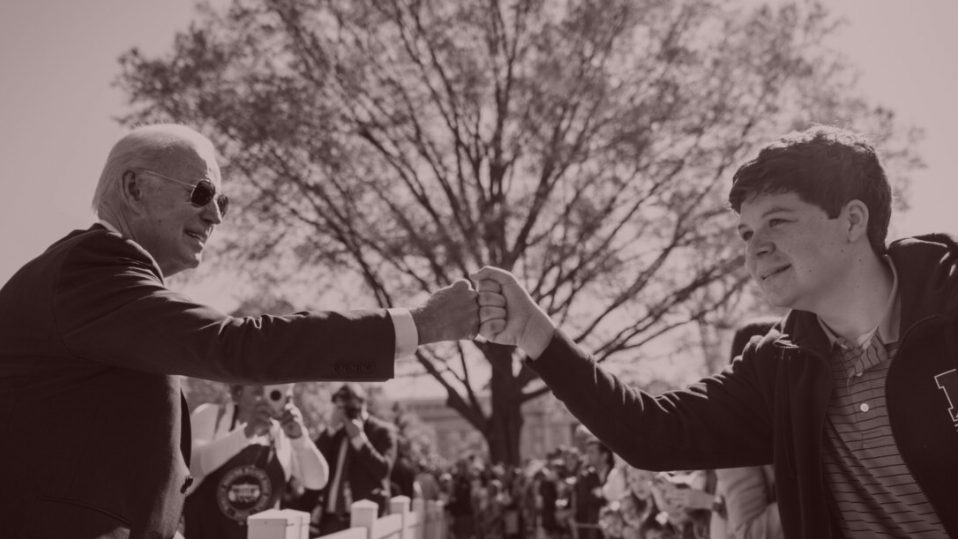
| The usual suspects in Washington fear that young voters could protest the 2024 election if Biden bans TikTok—a supposition accepted at face value by pundits, despite the available evidence. Yes, there are polls showing young people oppose a ban. But that’s not predictive of how Gen Z will vote. |
|
|
|
| Among the many known unknowns swirling around the TikTok legislation racing through Congress is whether young people—socially isolated, digitally overstimulated, easily outraged but politically disengaged—will revolt against President Biden in November if he signs legislation banning the popular social media app from the United States.
You hear this sentiment often from the dozens of younger, progressive Democrats on Capitol Hill who oppose a ban, like New York Rep. Jamaal Bowman, a putative member of the Squad and former high school principal who has become one of TikTok’s loudest defenders in Congress. “TikTok is actually a platform where young voters have found community with each other,” Bowman said on MSNBC last week, after the House passed legislation that would force TikTok’s Chinese-owned parent company, ByteDance, to sell the app or face a ban in the U.S. “What I’ve seen on TikTok is the depth of content, the depth of scholarship, that I haven’t seen on other platforms,” Bowman said, not mentioning the disinformation, conspiracy theories, A.I. fakery, and context-free “news” clips that continue to generate millions of views on the platform.
Rep. Maxwell Frost of Florida, a 27-year-old progressive who likewise opposes the ban, spoke out against the House bill last week, calling the app an important source of information for young people. About a third of Americans between 18-29 say they get news on TikTok, according to a Pew Research Center study last year. “I hear from students all the time that get their information, the truth of what has happened in this country, from content creators on TikTok,” he said on the Capitol steps—at a press conference organized by TikTok lobbyists.
Alas, the left is in a strange place if they’re hailing “content creators” for telling “the truth” about America, broadcasting on a massive for-profit technology platform owned by a foreign corporation with almost no transparency into how it operates. Less than eight years ago, liberals were practically hysterical over reports that Facebook and Twitter had been weaponized by Russian agents laundering 2016 election memes. Now, their fears about disinformation have evaporated. Maybe the depth of the scholarship on TikTok is too important to pass up.
But it wasn’t a Squad member who said most directly that young voters will punish Democrats if TikTok is banned: It was Biden’s own commerce secretary, Gina Raimondo. She told Bloomberg last year that if Democrats ban TikTok, “the politician in me thinks you’re going to literally lose every voter under 35, forever.” Donald Trump, who recently changed his position and came out in opposition of a ban, apparently agrees. |
| Extraordinary Claims, Extraordinary Evidence |
|
| There are rightful criticisms of the current TikTok legislation, which may not even survive the Senate. Does it violate the First Amendment? Would it give the federal government too much power over private enterprise? Will other American-owned tech companies face the same kind of questions about privacy and data? And would a “ban” ultimately just get tangled up in the federal courts, just like Trump’s push to expel TikTok in 2020?
Nevertheless, Raimondo’s suggestion that young voters will revolt against Democrats continues to be taken at face value by pundits, with little evidence to support it. Yes, there are polls showing young people oppose a ban. A poll from AP/NORC in February found that 46 percent of adults under 30 oppose a TikTok ban. But that’s just what people are telling pollsters—it’s not predictive of voting behavior.
“This is where extraordinary claims demand extraordinary evidence,” said Lakshya Jain, an elections analyst with SplitTicket. “If your claim is that a TikTok ban would cost Dems dearly with new and younger voters, what you are essentially saying is that the demographic that is hardest to turn out will suddenly get activated and show up in droves to vote against Joe Biden. That is something that has no historical precedent.”
While youth turnout reached new highs during the Trump years, voters under 30 show up to the polls much less frequently than older generations do. They also make up the smallest percentage of the electorate. Jain pointed out that among the registered voters in that demographic, you have some high-propensity voters who consistently show up to the polls, and a larger pool of low-propensity voters who are harder to motivate. Jain said he has a hard time imagining that young, high-propensity voters in the Trump era—who skew heavily Democratic—would ever change their votes or sit out the election because they could no longer scroll TikTok. “It’s a group that is liberal and more engaged. Those are just not the kinds of people who are likely to change their minds over TikTok,” he told me. It’s worth noting, too, that the top issues for young voters in every poll are the economy, the cost of living, gun control, climate, and abortion—nothing about smartphones or their For You Page.
If there were to be marginal losses for Biden in November over TikTok, Jain told me, they would theoretically come from the larger group of low-propensity, less engaged young voters. But, he said, there’s no guarantee those people were voting in the first place. “It’s just a really flaky group,” Jain said. “It’s hard to get those people registered to vote—or to vote—on anything.”
Even if younger Americans register concerns about banning TikTok, the notion of a ban is popular overall. A YouGov poll last week found that 47 percent of Americans support a TikTok ban, while only 34 percent oppose the idea. Among people under 30, roughly the same amount supported a TikTok ban as opposed it. “Banning TikTok has consistently been a net-popular policy, and if you were to make a single-cycle electoral tradeoff, catering to boomers who love nothing more than voting is the best possible thing to do, even if you anger young voters who rarely vote in the process,” Jain said. |
|
|
| It’s worth pressure testing what Raimondo and other Democrats are claiming about the political impact of messing with TikTok. Who is the precise voter they have in mind? Who is the hypothetical 18-year-old first-time voter in Michigan who loves TikTok so much that he or she will stay home or vote for a third-party candidate to send an angry message to Biden about their favorite app—even if it means electing Trump?
TikTok claims to have 170 million users in the U.S. We can assume many of them—a majority?—are under 30. Plenty of those users have spent the past several weeks, in comments sections on TikTok, complaining about a possible ban and attacking members of Congress as brain-dead and out-of-touch. Credulous reporters—who give TikTok a benefit-of-the-doubt they would never bestow on less-cool U.S. social media platforms—have written about their concerns. (And here is where I should say, yes, I also work for Snapchat.)
But if Raimondo was actually thinking like a politician, she might have asked a few more probing questions. How many TikTok users in the U.S. are over 18? How many of them that are eligible to vote are actually registered to vote? And if they are registered to vote, did they vote in 2020 or 2022? If they did vote in 2020 or 2022, how many of them live in a battleground state? And on top of all that, how likely are they to vote against Biden, or sit out the election, based solely on the matter of TikTok?
Keep in mind, too, that TikTok is just one of the most popular apps used by Americans under the age of 30. Roughly the same amount of young people use Instagram and Snapchat every day. And YouTube—not TikTok—remains the dominant platform with Gen Z. And those platforms have their own short-form products that look a lot like TikTok—Reels, Spotlight, and Shorts —each with hundreds of millions of daily users.
Over the weekend, a digital creator named Leon Ondieki appeared on CNN to talk about the tens of thousands dollars he makes monthly by posting his content on platforms like TikTok, Instagram, YouTube, and Snapchat. The host, Amara Walker, asked if he was worried about TikTok disappearing. “When the first threat of a ban came to the United States, I only had TikTok, and I was super scared because if TikTok was gone, I’d lose everything.” Ondieki said. “So immediately after that, I started posting content on other platforms such as Instagram and YouTube. And now I have 1.3 million followers on Instagram and 1.6 million subs on YouTube.”
Walker interjected. “So it wouldn't be devastating for you if TikTok were to go away?” Ondieki shrugged. “It would still be a big loss,” he replied, “but now TikTok isn't everything I’m relying on. I do have other platforms which I could fall back on.”
America, in other words, would survive the demise of TikTok, just as we endured the harrowing loss of MySpace and the death of Vine. The Democratic Party probably will, too.
There is only one real political concern, several Democrats told me, as I took their temperature on all the TikTok news in recent days. Come November, they said, a TikTok ban could play into pre-existing critiques of Biden from the youths—that he’s old, ignorant of their concerns, not willing to listen. “The actual policy impact of a ban would be way less important than the vibe,” said one Democratic strategist who has worked in youth politics. “Like, Biden signing a bill that they think is a ‘TikTok ban’ makes it that much harder to say, ‘Hey, you might not agree with him on everything, but at least he’s willing to listen to you and what you care about.’”
Jain, the elections analyst, agreed. “The overall bad vibes argument is more compelling to me than the TikTok one,” he said.
That sentiment—and the challenge for Biden with young voters—was echoed in The Wall Street Journal’s report on Gen Z’s increasing disillusionment about the future and skepticism of politics. They quoted a 25-year-old in Atlanta named Kali Gaddie, who loves TikTok. She complained that the House bill was a distraction from more salient issues confronting her generation. “It’s funny how they quickly pass this bill about this TikTok situation,” she told the Journal. “What about schools that are getting shot up? We’re not going to pass a bill about that? No, we’re going to worry about TikTok and that just shows you where their head is. … I feel like they don’t really care about what’s going on with humanity.”
Here was Biden’s problem in a nutshell: A possible Gen Z voter in maybe the tightest swing state in the nation, complaining about her beloved TikTok, but also totally unaware that Biden and Congress passed the largest gun reform legislation in decades after the mass shooting in Uvalde, Texas. Or that Biden has canceled more than $100 billion in student loan debt (it would have been several times more had the Supreme Court not ruled against his original relief plan). Or that Biden signed the largest green energy investment in American history. Or that her state of Georgia drastically curtailed abortion rights after the end of Roe v. Wade.
If a TikTok ban—or a forced sale—does make it to the Resolute Desk before November, Biden just might sign it, starting a 180-day countdown that will end just before the election. Will it unleash the wrath of Gen Z voters in November? The question might be irrelevant, unless Biden can do a better job explaining what else he’s done for them lately. |
|
|
|
| FOUR STORIES WE’RE TALKING ABOUT |
 |
|
 |
|
 |
|
 |
| Lemon’s Next Act |
| What’s next for Don Lemon after the Musk imbroglio? |
| DYLAN BYERS |
|
|
|

|
 |
|
|
|
Need help? Review our FAQs
page or contact
us for assistance. For brand partnerships, email ads@puck.news.
|
|
You received this email because you signed up to receive emails from Puck, or as part of your Puck account associated with . To stop receiving this newsletter and/or manage all your email preferences, click here.
|
|
Puck is published by Heat Media LLC. 227 W 17th St New York, NY 10011.
|
|
|
|