 |
|
Welcome back to The Best & The Brightest, I’m Peter Hamby.
|
|
Greetings from my Delta seat 30,000 miles somewhere above Nebraska. I’m on the way to Iowa to gorge myself on deep-fried Oreos, ogle the Butter Cow, and figure out if Donald Trump’s support among Republicans in Iowa is softening as his legal challenges grow deeper. But today’s edition is about the man currently occupying the Oval Office, Joe Biden, and his souring relationship with the White House press corps, which has been venting about their lack of access to the president and Biden’s tendency to ignore their pesky questions—even as he grants interviews to influencers and celebrities.
But first…
|
| The Capitol Hill Cafeteria Report |
|
| An utterly indispensable, high-minded, and, yes, occasionally dishy readout of what our lawmakers are really legislating behind closed doors.
By Abby Livingston
- Goat Rodeo: It’s never good when a news outlet has to put an explicit language warning before quotes from a congressman. Nor when a congressman’s office releases a statement that completely contrasts with police reports. But that’s where we are in the Texas Panhandle with Ronny Jackson, who reportedly threatened to “beat that motherfucker’s ass” after he was detained by a state trooper who was alarmed by his attempts to render aid to a collapsed teenager at a July 29 rodeo. Jackson, a former White House physician to Barack Obama and Donald Trump, apparently became enraged when law enforcement and health responders attempted to intervene.
The Texas Tribune also reports that, despite the unsolicited assertions from Jackson’s office that he had not been drinking that night, a deputy stated “the G.O.P. congressman was seen drinking backstage of the rodeo event.” (“He was asked to help the teenager when no other uniformed medics were present,” spokesperson Kate Lair told the Tribune. “Congressman Jackson, as a trained ER physician, will not apologize for sparing no effort to help in a medical emergency, especially when the circumstances were chaotic and the local authorities refused to help the situation.”) The Dallas Morning News has confirmed the widespread speculation that there is trooper body camera footage of the incident, so hopefully we’ll all know the truth soon enough.
- Straight Outta Otisville: Michael Cohen, the reformed ex-Trump fixer-turned-inmate-turned podcast host told Semafor on Friday that he is considering challenging Rep. Jerry Nadler in New York’s 12th District. Should Cohen follow through, it would set up another West Side vs. East Side Manhattan rumble after Nadler defeated Carolyn Maloney in a member-member race created by redistricting last year. The district’s political battle lines remain uncertain after the map was redrawn to include parts of the Upper West Side, but Nadler proved last year he can get out the vote.
- New Jersey’s Finest: Senator Robert Menendez is the subject of yet another federal probe, this time “looking into any connections to a company that secured an exclusive contract to certify meat exports to Egypt,” according to Politico. Nevertheless, Menendez appears safe from a competitive primary: Few Democrats in the Garden State seem eager to challenge him, despite frustrations over his continued legal issues.
Three key things to remember about New Jersey: One, voter tolerance for investigations into politicians is high, much like in Illinois and Louisiana, where some light (alleged) corruption is a way of life. Two, New Jersey’s way of designing ballots heavily favors the establishment-endorsed candidate in Democratic primaries. And three, the exorbitant cost to advertise across the New York/Philadelphia media markets regularly inoculates Democratic candidates statewide. Republicans are often tempted to play in New Jersey, but more often than not rule it out due to those costs.
|
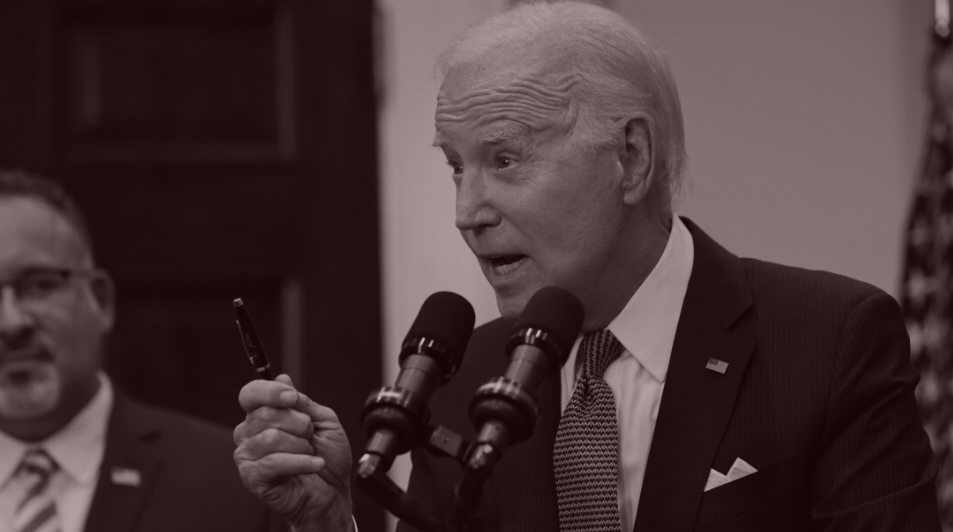 |
| Biden’s Orchestra Pit Paradox |
| For Biden to win again, he must reach people who aren’t just news junkies, and his advisers are unapologetic about the importance of going around the Washington press to do it, their egos be damned. |
|
|
|
| Last week, after a “Bidenomics” event in New Mexico, Peter Doocy of Fox News approached the president to ask about the latest kernel of intrigue in the ongoing Hunter Biden scandal—the allegation that Hunter would sometimes put his powerful father on speakerphone to talk business with clients. “I never talked business with anyone,” Biden retorted. “I knew you had a lousy question.” Biden walked off with a scowl on his face, while Doocy landed another spicy sound bite that Fox could air over and over, on television, YouTube, and beyond.
Doocy said that Biden had actually waved him over to talk, a departure from the president’s usual habit of avoiding shouted questions from reporters. What jumped out at me from Doocy’s on-air recap, though, was that he also uttered a bit of self-own—not about himself or Fox News necessarily, but about the broader impulses of the White House press corps. “He wanted to talk about the transition to the green economy, he did not want to talk about [Hunter],” Doocy explained.
Has there ever been a more succinct description of how the press covers a president? The president wants to control his message and talk about his accomplishments. Reporters don’t want to play by those rules. Doocy’s remark about the New Mexico event fits nicely into The Orchestra Pit Theory, Roger Ailes’ timeless summation of how the media covers politics. “If you have two guys on a stage and one guy says, ‘I have a solution to the Middle East problem,’ and the other guy falls into the orchestra pit, who do you think is going to be on the evening news?” Ailes said, back in 1988. We all know the answer. The nature of media has changed dramatically since then, but the fundamental behaviors of political reporters have not. This was the main thrust of my study about modern political journalism published by the Shorenstein Center at Harvard, back in 2013.
When it comes to day-to-day coverage of the White House, tidbit journalism prevails. Policies are rarely examined or explained, only conveyed when they occur. Scandals, leaks, scooplets and indiscretions are the topics that “drive the conversation” and get attention. Topics like, say, a bag of cocaine found at the White House—which was the subject of seven different NBC News packages on Today and Nightly News during a two-week period in July, aired around the same time Biden was attending the high stakes NATO Summit in Lithuania. The incrementalism of White House coverage might, in fact, be compared to doing a bump of coke: A fleeting high, forgotten a few moments later. This is, of course, an endless source of annoyance for the Biden White House.
For reporters, the willingness to chase that high and “make news,” perhaps by sparring with the president in full view of the television cameras, remains the best way to rise from obscurity and become a pseudo-celebrity. This explains Doocy’s frosty relationship with Biden, and also that of so many White House reporters during the Trump years who became household names. This posture led to book deals, late night-appearances, and fatter TV contracts—not to mention a titillating rush of vanity. The sugar high of Trump coverage, though, was staving off an obvious decline in the power of the establishment press.
Of course, ratings and traffic are down across the board in the Biden era, accompanied by a growing disinterest in journalism generally. News organizations are losing their place in the attention economy. Only 26 percent of Americans have a favorable opinion of the news media these days, according to recent polling from Gallup and the Knight Foundation. Even fewer people believe the news media cares about the best interests of their readers, viewers, and listeners, the poll found. Americans are also now retreating from news as a part of their media diet. A growing number of Americans now practice “news avoidance,” another study from the Reuters Institute of Journalism found, with the number of people “extremely” or “very interested” in the news plummeting rapidly. Opinions of the mainstream press are even worse among millennials and Gen Z, who in a few years will become the largest voting age demographic in the country. |
|
|
| Lately, reporters covering Biden have been complaining that the president doesn’t take their questions. In the past, an administration might have been sympathetic to their concerns. It used to be that the press and the White House needed each other. At the height of the TV news era, the relationship was almost symbiotic. After the late NBC News correspondent Cassie Mackin ran a point-by-point fact check of a Richard Nixon speech, pointing out each and every falsehood on the nightly news, in 1972, White House Communications Director Herb Klein rang up NBC and screamed about it. Mackin never did it again.
It’s tough to imagine such deference happening in newsrooms today, but it’s also tough to imagine the Biden White House caring that much about a single television news package. Today, the interests of the news media and the interests of a president have never been more misaligned. Both are scraping for relevance as the public tunes them out—but a president no longer needs the press in the same way the press needs a president. No surprise, the press is big mad about it.
The aggravation is obvious at this point, at least if you follow daily coverage emanating from the White House. Trump might have attacked reporters every day, calling them “the enemy of the people” and creating an atmosphere of violence that literally threatened the lives of journalists. But Biden seems to have wounded the sensibilities of the Beltway media, too, who believe he hasn’t treated them with the appropriate respect. A Washington Post editorial from a few months back—“Biden No Longer Does Press Conferences. That’s Not Acceptable.”—summed up the mood. The editorial said Biden isn’t doing enough “solo” press conferences, even though he has actually done more of them in his first three years than Trump, but whatever. “Taking questions from the media promotes public accountability,” the editorial read. “It also shows that the president is willing to defend his positions and instills confidence that he can do the job.”
The writers didn’t bother to mention that Trump’s press conferences were riddled with falsehoods that went out unfiltered to the American public in real-time. They also went out of their way to point out that joint press conferences with other world leaders “don’t count” for some reason, and nor do one-on-one interviews with reporters, even though Biden has done plenty of those, too. On top of that, according to the presidential scholar Martha Joynt Kumar, Biden has actually done more than 450 informal question-and-answer sessions with reporters, usually coming and going from Air Force One or Marine One. That’s more than Trump did during his four years in office. I assume those interactions with the free press don’t count either?
There are a few subtexts to these complaints. One is a legitimate concern: Biden is old, heading into his re-election campaign at the age of 80 and looking every bit of his age. The White House wants him to avoid as many unscripted moments as possible, and perhaps to campaign much like he did in 2020 during the pandemic—by screen rather than podium. This would not be good news for reporters, who, like Doocy, advance their careers by creating their own content. Yes, Biden should talk to reporters, but the idea that he needs to do more solo press conferences to “instill confidence” in his ability to lead? That seems like a complaint from another time, when reporters smoked Pall Malls and filed their stories from pay phones.
Does any voter care if Biden does a solo press conference versus a joint one? Those distinctions are lost on normal people, who already have questions about Biden’s fitness for office. We’ve all seen the clips of Biden seeming confused, wandering off stages in the wrong direction, or stumbling over his words—but we saw them in our social media feeds, not in the White House briefing room. Biden didn’t fall into the orchestra pit, but he literally fell off his bike in Delaware in front of the press pool. |
|
|
| Another element of the finger-wagging: Biden is simply boring, compared to Trump, and also compared to Barack Obama. Yes, there are enormous macro-stories going on at all times that involve the White House—the war in Ukraine, the creeping threat of climate change, the fraying of the country’s social fabric. But those aren’t the kinds of topics that get blood flowing for day-to-day political reporters following Biden around. They want leaks from inside the West Wing, personality clashes between senior advisers, scoops on who is joining the re-elect and who isn’t. Biden has been around Washington for almost half a century, and his inner circle just doesn’t offer the same juicy leaks that drove so much press coverage with other first-term presidents. The bag of cocaine and the Hunter Biden saga are filling that void.
But the deepest cut of all for the press, I suspect, is that Biden understands he doesn’t need them as much as they think he does. As Harvard’s Thom Patterson explained in his book Informing The News, the media believes it is much more relevant with the public than it actually is. “Journalists’ sense of their audience is wrong side up,” he wrote. Biden’s predecessors, Trump and Obama, aided by new platforms, both came to understand that dynamic, even if they still cared what reporters wrote about them. They worked to get their messages out by avoiding the D.C. press and using new platforms and content formats to reach audiences that don’t really care about news. (Obama’s 2015 sit-down with YouTube star GloZell Green was particularly galling for the White House press corps.) But despite his old-media DNA, Biden has taken modern audience outreach to a new level. His advisers are unabashed about their strategy of reaching the news avoiders. “Government is always going to be behind where culture is,” one White House strategist told me. “Our job is to help the president get into the culture, so people can learn about the president’s accomplishments… We’re going to keep our foot on the gas pedal, because it’s critical for Americans to know who he is.”
A good example: In late July, Biden announced a rule to strengthen access to mental health care for about 150 million Americans. Network nightly news broadcasts are the most-watched news format in the country, garnering anywhere from 4 to 7 million viewers each night, and not a single broadcast covered the mental health news. But Biden did sit down for a lengthy on-camera interview with the life coach and wellness influencer Jay Shetty, who is currently one of the most famous people on the planet. The White House adviser told me that “leasing space in high reach environments” like Shetty’s is a key part of strategy as Biden heads into 2024.
Shetty’s podcast gets 21 million monthly downloads, and he has almost 19 million followers on Instagram. Biden didn’t “make news,” but he did reach millions of people who don’t even watch the news in the first place. This sort of strategy was akin to the White House bringing Olivia Rodrigo into the briefing room to promote Covid vaccinations, or Jason Sudeikis and the cast of Ted Lasso to talk about mental health. These celebrities and influencers, whether we like it or not, are often more trusted among their audiences than journalists are.
The news is no longer at the center of American life. It is now, fundamentally, a product created by college-educated people for other college-educated people, as the academic Nikki Usher convincingly explained in her book, News For The Rich, White and Blue. Most Americans did not go to college, and most don’t pay attention to even some of the biggest events coming out of Washington, like The State of the Union address. If Biden wants to win again, he must find a way to communicate to people who aren’t just news junkies and political addicts, and his advisers are unapologetic about the importance of going around the Washington press to do it, their egos be damned. This has been a grudge of the Biden team going back to 2019, when reporters and pundits on Twitter dismissed Biden’s chances of winning the Democratic nomination, only to reveal themselves as fundamentally out of touch with the very voters they were covering once he won.
When I talked to White House Communications Director Ben LaBolt about all this, he reminded me that back in 2020, the top show to reach persuadable voters was not any news program. It was The Bachelor. “In a fractured media environment and an era where it’s easy to get overloaded with information, we need to be creative about how we reach people in simple and memorable ways to let them know about the president’s accomplishments and agenda,” LaBolt told me. “And that means showing up in unexpected places.” |
|
|
|
| FOUR STORIES WE’RE TALKING ABOUT |
|
|
|

|
 |
|
|
|
Need help? Review our FAQs
page or contact
us for assistance. For brand partnerships, email ads@puck.news.
|
|
You received this email because you signed up to receive emails from Puck, or as part of your Puck account associated with . To stop receiving this newsletter and/or manage all your email preferences, click here.
|
|
Puck is published by Heat Media LLC. 227 W 17th St New York, NY 10011.
|
|
|
|