 |
|
Welcome back to The Best & The Brightest, I’m Peter Hamby. Today, my thoughts on the misplaced hope emerging among DeSantis allies that the candidate can follow the McCain ’08 playbook to get his campaign back on track. As someone who was often the only reporter on the bus with McCain in South Carolina back then, I can tell you that the comeback is only as good as the candidate. Plus, below the fold, a few thoughts on Trump’s new digital media strategy, with input from one of his closest advisers.
But first, the latest from my colleague Abby Livingston with the word from Capitol Hill…
|
| The Capitol Hill Cafeteria Report |
|
| An utterly indispensable, high-minded, and, yes, occasionally dishy readout of what our lawmakers are really legislating behind closed doors.
By Abby Livingston
- G.O.P. impeachment fears: Over the weekend, South Carolina Rep. Nancy Mace took a break from her fiancé to warn her fellow Republicans that impeaching Joe Biden could be political suicide for members whose districts Biden carried in 2020. “Every time we walk the plank,” she said on Fox News Sunday, “we are putting our majority at risk.” Mace herself is probably safe from any backlash, but her district does have the potential to turn competitive in the wrong environment.
That concern hasn’t kept certain House Republicans from invoking the same grave diction that Democrats used during the first Trump impeachment, in 2019, but Mace’s comments show why these are apples-to-oranges political comparisons. Prior to September 2019, a Trump impeachment was mostly the advocacy work of Democratic gadflies: leadership wasn’t enthusiastic, and neither was most of the rank and file. It was only after news broke of a whistleblower’s allegations against Trump that a clique of Democratic members with national security experience wrote a Washington Post op-ed effectively organizing the broader impeachment effort.
Because those on the byline mostly represented competitive districts, the op-ed’s message was implicit but clear: vulnerable Democrats weren’t just ready to walk the plank for impeachment, they were willing to lead it. Mace, like many of her colleagues, isn’t there yet.
- D.C.C.C. Churn: Rep. Abigail Spanberger is reportedly considering retiring from Congress this term to run for governor of Virginia in 2025. Retiring so far ahead of a statewide run is unusual, but also likely a symptom of Virginia’s odd, off-year election cycle. But being out of office may complicate fundraising. Either way, Spanberger would likely face a competitive Democratic primary, beginning the day after the 2024 election ends.
Should Spanberger retire, she would be the fifth Democratic member of the class of 2018 this term to vacate their seat to run for statewide office, joining Colin Allred, Katie Porter, Elissa Slotkin and David Trone. While farm team talent is a good thing for any party, these ambitions do present headaches for the D.C.C.C.: All of these House districts, save for Allred’s, are at least mildly competitive and will be harder for Democrats to defend without their current incumbents.
- Paging Chip: Senate heavyweights Mitch McConnell, Chuck Schumer, and Patty Murray lined up to defend the honor of the Senate pages who were allegedly on the receiving end of an obscenity-filled tirade from Wisconsin Republican Derrick Van Orden last week. In a fit of freshman pique, Van Orden didn’t just throw around f-bombs—he threw his title as a congressman at the teenagers, per NBC News. Van Orden’s colleague (and a former Senate chief of staff) Chip Roy posted his winking solidarity to the pages by tweeting a photo of himself laying on the ground and photographing the famed inside-the-dome frieze of George Washington’s ascent into heaven. Roy wrote: “TGIF after a rough week, Senate Pages? I got a great photo, how about you?”
|
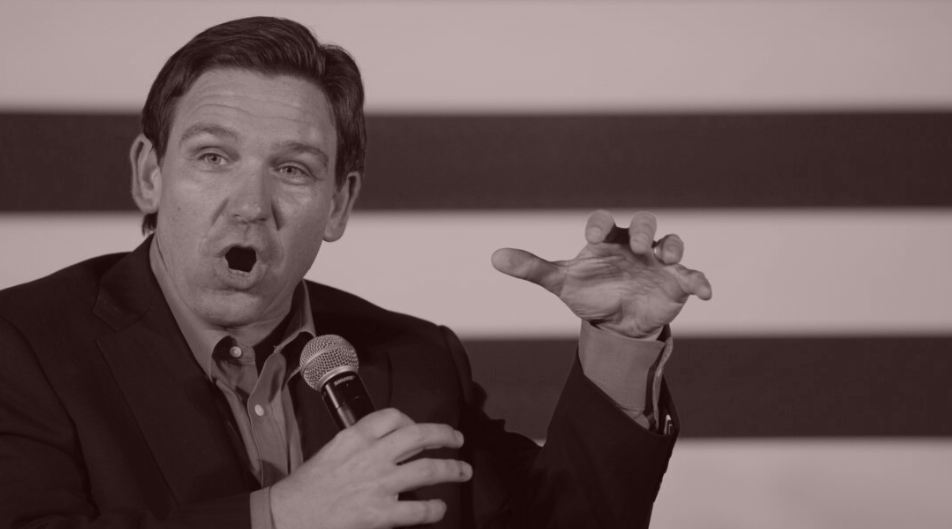 |
| DeSantis’s Zombie Comeback Tour |
| Allies have pointed to McCain’s 2007 campaign comeback as the “perfect example” of why DeSantis shouldn’t be written off. But, as someone who rode the bus with McCain during those bleak days, I can tell you the comparison is perfectly imperfect. |
|
|
|
| News of a campaign “reset” is often accompanied by the smell of death, and over the last two weeks, the conversation around Ron DeSantis has felt downright funereal. His much-hyped campaign, barely two months old and slipping in the polls, has laid off staffers in an effort to make up for sky-high spending, promised a new shift in tone and performance, and tiptoed into the mainstream media waters DeSantis has shunned for so long, even doing an interview with Jake Tapper on the dreaded CNN.
DeSantis’s campaign manager, Generra Peck, has fired off a dizzying array of quotes to the press vowing that DeSantis the candidate will march on as a scrappy underdog, ignoring the national noise and going all in on Iowa, New Hampshire, and South Carolina. “Going forward, expect fewer podiums and stages and more stops at Pizza Ranches, churches and VFW halls where DeSantis can speak directly to voters with no big platforms or barricades blocking close contact,” Peck told NBC News. DeSantis haters—liberals and Trump supporters, alike—have been chuckling at that concept. The shrill and awkward DeSantis needs to be kept away from voters, not shoved in their faces, they say. “Problem is, they can’t fire their candidate,” a senior Trump adviser told me a few weeks back, basking in schadenfreude.
My Puck partner Tina Nguyen, who has better sources in conservative Florida politics than most, explored the DeSantis reset last week in authoritative detail. She pointed out, rightly, that the candidate and his wife, Casey, are notorious micromanagers who don’t trust many aides beyond a small inner sanctum of loyalists. As Kamala Harris learned during her flameout presidential bid back in 2019, that kind of management style doesn’t scale up. You have to trust your team and delegate with discipline.
DeSantis swaggered into the race with a big state arrogance that also reminded me of Texas governor Rick Perry in 2012. Perry thought the G.O.P. nomination was his for the taking—that he was the only guy who could take out Mitt Romney—until he failed to develop an actual message for his candidacy beyond “look at what I did in Texas!” The endless demands of the campaign wore him out and forced him to slash operating expenses. Like DeSantis, Perry had a mix of state and national advisers, many of whom were fired, “layered,” or forced to work for free until the governor could figure out a graceful exit from the stage. There’s a reason a lot of presidents and party nominees—Romney, Ronald Reagan, George H.W. Bush, Hillary Clinton and Joe Biden among them—were second time candidates. Experience and patience count for a lot. Rookies get cocky.
That’s one reason I’m amused by the insinuation that Tina unearthed from DeSantisworld that their candidate can mount a comeback like John McCain did in 2008. “DeSantis boosters have frequently invoked McCain’s come-from-behind, early-primary-state-targeting, momentum-slingshotting strategy as their new lodestar after his national polling faltered,” she wrote. Maybe! As I wrote last month, campaign obsessives—donors, reporters, anonymous staffers talking to reporters—should be exercising a modicum of patience right now. Candidates must have some time to grow.
After all, there hasn’t been a single televised debate. Polls show that most of the G.O.P. candidates are still unknown entities to most voters, including Tim Scott and Vivek Ramaswamy, who are the current focus of media buzz. Polls, too, indicate that DeSantis continues to have higher favorable ratings among Republican primary voters than any candidate not named Trump. And while Trump’s indictments have been a steroid shot for his poll numbers, the criminal charges add a degree of uncertainty that we’ve never seen before in a presidential race.
So can DeSantis pivot to the scrappy town hall strategy, fix his sagging poll numbers, and come back from the dead like McCain? DeSantis allies, according to Tina, called it the “perfect example” of why their man shouldn’t be written off. But, as someone who was often the only reporter on the bus with McCain in South Carolina during those bleak days of late 2007, as he popped into VFW halls in places like Moncks Corner and Goose Creek along the South Carolina lowcountry, I can tell you the comparison is perfectly imperfect: Ron DeSantis, as Lloyd Bentsen might have surmised, is no John McCain. |
|
|
| The dynamics and the candidates are just so different. In this race, DeSantis is running in a campaign and media environment dominated by a singular figure in Trump, a former president. To beat Trump, DeSantis needs to consolidate almost all of the anti-Trump vote and score a few more points on top of that, somehow getting to 50 percent by next spring.
The 2008 campaign was more fractured, a totally open field with multiple candidates polling in the upper teens or low 20s. Anybody could win the nomination. A plurality victory in an early primary state would be enough to keep going, because the Republican Party was different back then. Every candidate brought something to the table, but there were genuine “lanes”: McCain was the military guy, Romney the business guy, Mike Huckabee the Christian guy, Ron Paul the libertarian guy. Each primary state had its own issue set and character, too. Today? Not so much. It’s MAGA all the way down, whether you have a Bible by your bedside or not.
DeSantis remains a relatively unknown figure nationally, still defining himself and being defined by his enemies. McCain, though, was already a known entity when he joined the 2008 race, thanks to his decades in the Senate, his military heroism, and his insurgent 2000 campaign against George W. Bush. The media loved him, and he loved them (on most days). Unlike DeSantis, McCain was also a good hang, always available to reporters on or off the record, able to talk about sports and swap gossip about his colleagues. He could be cranky but he was also funny. Like President Biden, he would slap you on the back and admit that his temper could get the better of him sometimes.
I have a hunch that’s not part of the DeSantis charm. McCain wasn’t beloved by all Republicans—conservatives saw him as a squish on social issues and an apostate on immigration—but he was at least respected by enough Republican voters who never abandoned him as their second or third choice in that race even as they shopped around.
Most importantly, McCain’s prisoner of war experience in Vietnam was fully his brand. Unlike his rivals who had never enlisted—or DeSantis, who was a Navy JAG but never saw combat—McCain was a war hero. He was running for president at a time when the prevailing issues weren’t drag shows or “the woke mind virus.” The only issue was the war in Iraq, which in 2007 was spiraling into mayhem and civil war. Even when he was polling in single digits, McCain had credibility in those VFW halls when he was making the case that more troops were needed in Iraq. Romney, Huckabee, Rudy Giuliani? They could never. Calling for a troop surge was an unpopular position nationally—but McCain had a consistent and passionate point of view that eventually made him the logical nominee against an inexperienced Barack Obama.
The other day, I talked to Trey Walker, a Republican strategist in South Carolina who worked on both of McCain’s presidential campaigns. Walker is now a Trump supporter, but he laughed at the idea that anyone could make the kind of comeback McCain did, going from low single digits in December 2007 to winning New Hampshire and South Carolina literally one month later. “As bad as it got, there were always veterans who showed up at town halls with their USS or Forrestal yearbooks, Purple Hearts, Hanoi Hilton memories, and all of that that energized McCain to continue,” Walker told me. “It allowed us to have events that sustained the campaign during lean times, and allowed McCain to catch a second wind in New Hampshire in late fall 2007. We kept the team together in South Carolina during the lean times, which allowed us to flip a switch once we got to South Carolina after winning New Hampshire.” McCain won South Carolina by three points, the money started coming back in, and then he was on his way to the nomination.
Walker also told me an amusing story that the DeSantis campaign can put in their back pocket. When McCain was doomed, just as DeSantis supposedly is now, Walker said the campaign spent weeks pitching reporters with a comparison to a past campaign, urging them not to write off the candidate. McCain wasn’t toast, they said, because Ronald Reagan had re-tooled his campaign way back in 1980—and he made a comeback, too. |
|
|
| Speaking of the Republican frontrunner, whatever happened to the Poster-in-Chief? The Democratic consultant Kyle Tharp, who pens a must-read newsletter about digital campaign spending and strategy, wrote last week about something odd that we’ve apparently come to take for granted: Trump doesn’t post on mainstream social media platforms at all anymore. “So far in 2023, the Trump campaign has posted on Facebook just 51 times, but at this same point in 2019, Trump had already shared 1,359 posts,” Tharp noted. “The picture is the same on Instagram, where the president has only shared 60 feed posts this year compared to 565 at this same point in the 2020 election.”
Nor has Trump posted to Twitter, once his favorite platform, despite being reinstated by owner Elon Musk. Trump has only posted on YouTube 31 times this year. And Trump isn’t bothering with TikTok or Snapchat, the dominant platforms with young people. At the same time, Tharp tabulated that Trump posted on his home platform, Truth Social, almost 340 times in the last week alone—an average of 48 posts per day.
This is a separate conversation from paid advertising. Trump has spent about $1 million on Facebook and Google ads this year, compared to about $4 million for Joe Biden. Trump, though, doesn’t need to spend on digital ads right now—or any ads for that matter. He has universal name recognition, and he’s cruising in his nomination fight at the moment, so it’s better to sit on his money until he needs to deploy it.
But Trump’s biggest strategic asset in a campaign has always been his ability to get media attention on his own, with or without paid media, just by opening his mouth and posting relentlessly—his tweets in 2016 being the unforgettable example of wagging the media dog. He did the same in 2020, with even more resources, and more platforms.
What’s going on this time around? Tharp’s take (as a Democrat) is that it’s “one of the most underreported dynamics of this campaign thus far”—especially as his Republican rivals are trying to flood social media channels with their organic content. “It’s still very early in the cycle, but choosing not to use these massive online megaphones that he possesses seems like political malpractice,” Tharp told me. “Donald Trump possesses a massive audience of tens of millions of supporters across his Facebook, Instagram, and Twitter accounts, yet his campaign is choosing not to reach them on a daily basis with content and messaging. It’s bizarre.”
Maybe Trump is just deeply invested in the success of Truth Social, despite its tiny user base. Or maybe he’s still pissed at the big platforms for banning or downranking him back in 2020 and 2021 for inciting violence and posting falsehoods. At the very least, it’s strange that Trump hasn’t re-embraced Twitter, or X, now that there’s a more sympathetic C.E.O. running the service.
So I asked the Trump campaign why their boss isn’t posting. Their point of view? He doesn’t really need to. Other people do it for him. “President Trump and his campaign have various accounts across all social media platforms that post multiple times a day and amplify his message,” Trump adviser Steven Cheung told me. “From TrumpWarRoom to TeamTrump to other official profiles, we have exponentially more engagement than any other candidate. And along with our surrogates and influencers—including news outlets—regularly reposting our content, we remain on the cutting edge of social media engagement.”
Whether that’s cutting edge or not, Cheung does have a point. Trump’s megaphone is more distributed than ever—a microcosm of the broader niche-ification of the social media environment. His supporters are so motivated that they share Trump’s point of view on every platform to their own networks of followers, whether the big guy is using them or not. And while the mainstream press doesn’t amplify Trump in Jeff Zucker-like fashion like they once did—a welcome development—many reporters still do his bidding for him, screen-grabbing his Truth Social posts and reposting them on Twitter and television news for the rest of us to see, whether we like it or not. |
|
|
|
| FOUR STORIES WE’RE TALKING ABOUT |
|
|
|

|
 |
|
|
|
Need help? Review our FAQs
page or contact
us for assistance. For brand partnerships, email ads@puck.news.
|
|
You received this email because you signed up to receive emails from Puck, or as part of your Puck account associated with . To stop receiving this newsletter and/or manage all your email preferences, click here.
|
|
Puck is published by Heat Media LLC. 227 W 17th St New York, NY 10011.
|
|
|
|