{{ 'now' | timezone: 'America/New_York' | date: '%b %d, %Y' }} |
|
|
Hello and welcome back to The Best & The Brightest. It’s foreign policy Wednesday and I’m
your host, Julia Ioffe.
Leigh Ann will be in your inbox tomorrow evening after hosting our next Puck Power Breakfast, presented by Solana Policy Institute, where she’ll sit down with House Republican Whip Tom Emmer, an early crypto champion on the Hill, to talk about digital currencies, market structure and regulation, etcetera. They’ll also discuss the news of the day, including the government funding showdown, political violence, and
more.
Tonight, we return to Foggy Bottom, where the D.O.J.’s report on “eradicating anti-Christian bias” across the U.S. government is causing confusion, consternation, and concern—especially among officials who identify as Christian themselves. |
|
|
A MESSAGE FROM OUR SPONSOR |
Hospitals are here when you need us most – but hospitals across America are at risk of closure. |
|
|
But first, here’s Abby from the Hill… |
|
|

| Abby Livingston
|
|
- Monarez strikes back:
Susan Monarez returned to the Hill today, just a few weeks after being fired as C.D.C. director, to testify before the Senate HELP Committee about her experience working under H.H.S. Secretary Robert F. Kennedy Jr. She did not hold back. Among other things, she testified that when her former boss learned she was in touch with members of Congress, he told her she “was never to do it again”; that he had described C.D.C. officials as “horrible people”; and that he
also called the organization the “most corrupt federal agency in the world.” She said, too, that Kennedy demanded she fire agency employees until the workforce was, essentially, filled with yes-men. She attributed her own firing to her refusal to pre-approve vaccine recommendations from a panel of his anti-vaccine allies. “He just wanted blanket approval,” she said. “Even under pressure, I could not replace evidence with ideology.”
- Kashing out: On the
House side, Kash Patel faced the wrath of Congress (well, mostly Democrats) in a second day of hearings. After a combative performance in the Senate yesterday, Patel once again took credit for the capture of Charlie Kirk’s assassin (the suspect’s father turned him in) and mostly stonewalled demands to release more Epstein files or to meet with his victims. He also didn’t seem to recognize the name of Dylann Roof, the mass
murderer who killed nine Black congregants in a Charleston, South Carolina, church in 2015.
- A Massachusetts dark horse: It was widely anticipated that Rep. Jake Auchincloss would challenge Sen. Ed Markey in next year’s Massachusetts Democratic primary, but the third-term congressman announced today that he would not run for Senate. Markey, at 79, remains highly engaged in Massachusetts Democratic politics, but it seems
unlikely, amid the push for generational leadership change, that his path to renomination is entirely cleared. Keep an eye on Seth Moulton.
|
|
|
A Trump administration report claims that anti-Christian bias is pervasive inside the State
Department. But multiple Christian employees say they never felt targeted—and now they worry members of other faiths are being targeted instead. |
|
|
Earlier this month, the official State Department X account tweeted out a declaration that alarmed much of
what’s left of Foggy Bottom. “Our nation was founded on the recognition that moral virtue and a steadfast faith in God are necessary preconditions of freedom,” it proclaimed. “Yet under the Biden Administration, U.S. foreign policy belittled Christianity and weaponized government against faith. That era has ended. Under @POTUS’s leadership, the State Department
will eradicate practices that devalue and demean the Christian faith.”
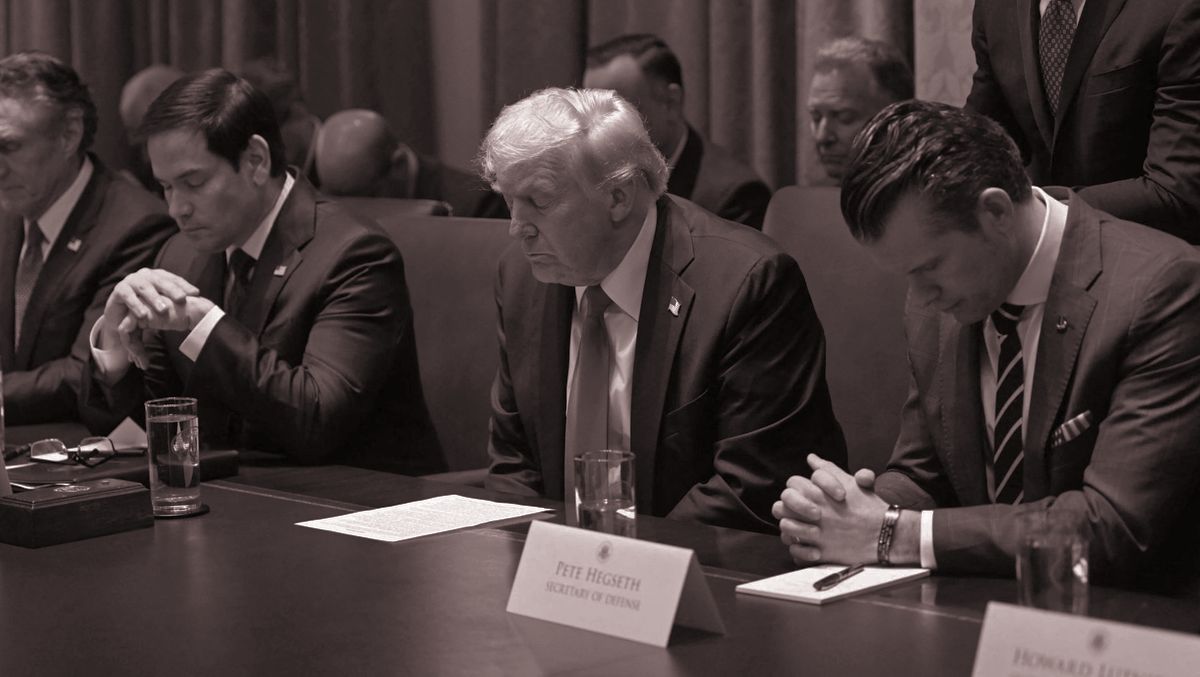
The post was timed to coincide with the Justice Department’s release—via Fox News, naturally—of a report from the Task Force to
Eradicate Anti-Christian Bias, which Trump created by executive order three weeks into his term. The task force was charged with reviewing every federal agency for “anti-Christian bias,” and at the State Department, a call went out in April to submit related complaints through a dedicated portal. The person
soliciting and reviewing those complaints was the acting head of the civil rights office, Heather Olowski, a pastor at a local evangelical church who also happens to be the wife of State’s colorful H.R. chief, Lew. “This was handled very fairly,” one senior State Department official told me. “Heather is a career civil service officer
who tried to collect the information in a really solid way. She solicited from everyone at State.”
Within the first two weeks the portal was open, according to the report, 133 complaints of religion-based discrimination were submitted, including 83 allegations of anti-Christian bias. According to a message Secretary of State Marco Rubio sent to the entire workforce (and that was shared with me), these ranged from alleged “discriminatory limits on religious expression,
speech, and participation in groups; to retaliation of religious accommodation relating to the COVID-19 vaccine mandate; to bias in foreign policy; and religious-based harassment, such as targeting individuals who homeschool their children for religious reasons.” |
|
|
A MESSAGE FROM OUR SPONSOR |
Hospitals need your help to stay. Protect 24/7 care—because when the doors close, it is too late |
|
|
The final report was even more incendiary. “The Department of State empowered employees to publicly shame and
demean their colleagues with religious objections [to Covid vaccination], even calling them ‘plague rats’ and ‘murderers,’” it read, in part. “In one instance, an ambassador directly accused an unvaccinated subordinate of ‘wanting to kill’ the ambassador’s mother.” Others complained about overseas policies that disfavored Christians, including cases where employees got leave for Muslim holidays but not Good Friday or Easter. The report even claimed that under Joe Biden, a practicing Catholic,
the State Department “provided limited humanitarian relief to Christians relative to other populations.”
Yet there were some pretty massive caveats to this portrait of a pervasive culture of anti-Christian discrimination at Foggy Bottom. For one thing, “the allegations require further vetting and investigation,” the report’s authors wrote in passing at the end, as if noting a barely significant detail. Moreover, the responses were voluntary. “You have to self-select in,” the senior State
Department official conceded. “133 people took the time to fill this out—out of 25,000.”
“It’s a small percentage, but they’re very, very loud,” another State Department official told me. “If you felt persecuted in any way as a white person, this is your moment.” |
The MAGA stereotype of the State Department is that it is a bastion of secular liberalism. But neither this
image, nor the anti-Christian culture alleged in the report, was recognizable to any one of the half-dozen State Department officials I spoke to. On the contrary, one of the places State has traditionally recruited from most intensively is Brigham Young University, which is run by the Church of Jesus Christ of Latter-day Saints. The senior State Department official explained that Mormons are excellent candidates for the foreign service because their church strongly encourages missionary work, so
they often have extensive experience living and traveling abroad. “They tend to be more conservative,” this person said. A second official said the squeaky-clean lifestyle required by their faith also means they tend to have an easy time getting security clearances.
There has always been a strong contingent of other Christians at Foggy Bottom as well. The first religious affinity group at State, in fact, was Christian—a group called Grace, which hosted regular book talks and other activities for anyone who wished to join. During the Biden years, the foreign service union’s magazine published a flattering editorial about the group, religious liberty, and faith accommodations written by a foreign service
officer who was also a deacon at his church. Prominent State Department officials, including Allison Hooker, now the undersecretary for political affairs, hosted Bible studies for their colleagues outside of work, even under the supposedly anti-Christian administrations of Obama and Biden.
Diplomats I spoke to recounted how they would sometimes share pews with colleagues when they attended church in D.C., and how they would commiserate about working in
politics across the city. “We would talk about how difficult it was to be a Christian on the Hill, and we said that it was easier at State,” one senior foreign service officer who identifies as an evangelical told me. “There were never any restrictions,” the officer continued. “Folks were freely able to form prayer groups. We would meet at lunch and pray.”
This person noted that in every foreign post they’ve served, there were people who openly wore crosses or displayed them in their
offices. Local staff in Latin America had the Virgin Mary on their desks. The officer told me that they regularly prayed for colleagues who found themselves in difficult situations, and that even non-Christians usually welcomed prayer as a gesture of caring and meaningful interfaith connection. “I’ve never been the recipient of hostile attacks,” this officer insisted. “There is no attack on Christians. I feel my faith is completely free.” Another senior State Department official also told me
they never felt persecuted as a Christian. “I didn’t think that I should express that [faith] in the office,” this person told me, “but that was out of common courtesy to other people, not because it wasn’t allowed.”
Several more officials I spoke to took issue with the claim that there was a lack of religious accommodation for Christians. “As of right now, you already have all these rights” under the law and the rules regulating the foreign service—including a prayer room on the
department’s second floor—said one State Department official who has worked on religious issues. Complaints that Muslim holidays were days off most likely referred to postings in Muslim countries where Sunday, the Christian Sabbath, is the first day of the week rather than a day of rest. (The same, incidentally, is true of Israel.) “You know that going in,” noted yet another senior State Department official, who said they were raised Christian. The common solution for those who would find such a
schedule objectionable is to simply not bid on those jobs. “There are over 200 other posts” where you can have Sunday off, this official noted. “Part of being in the foreign service is you adapt. That’s part of the deal.”
As for the complaints about homeschooling, the official who worked on religious issues said, State has always tried to find accommodations, even though it’s not protected under foreign or domestic law. But the State Department official who identified as Christian, and
who helped families navigate the reimbursement process for home educational materials, pointed out that there were also people who abused the system. Because the State Department pays for the children of foreign service officers to attend some of the most exclusive and expensive schools abroad, some foreign service officers demanded the same level of funding for homeschooling. As a result, the official recalled, “people were charging the department for all different kinds of things. There got to
be a time when there were whole businesses dedicated to skimming the State Department.” For instance, there was the woman whose business sold an American history curriculum for $3,000, with an American Girl doll provided as a sweetener. (The business was later shut down, the official said.)
What some have claimed as anti-Christian bias, in other words, was the State Department trying to root out waste, fraud, and abuse—watchwords of the first months of the Trump presidency. Others had
their expenses rejected simply because books they claimed as expenses did not meet educational standards. “We’re not discriminating against you because we won’t buy your fundamentalist textbook,” said the official who identifies as Christian. “It’s just not an approved textbook!” |
|
|
The State Department, for its part, maintains that discrimination against Christians was both real and
widespread before Trump’s return to office. “The State Department is abiding by all laws to ensure employees’ individual rights, including freedom of religion, are protected,” Tommy Pigott, a department spokesperson, told me in a statement. “Under the previous administration, there was an anti-Christian bias that had permeated throughout the federal government and we are working to undo the damage that caused across this department.” |
Not every Christian at State feels persecuted, and the task force’s own numbers bear that out: 83 complaints
of “anti-Christian bias” out of a staff of 25,000 clearly indicates that those who do are a tiny minority. According to the Staties I spoke with, the majority of complaints seemed to have come from a set of familiar malcontents: the same people who were whining the loudest about vaccine mandates and D.E.I. initiatives before January 20, and who have risen to the top ranks of the department in the months since. Lew Olowski, for instance, was well known for opposing vaccine mandates as a violation
of religious liberty—a stance he made clear in his first major speech after taking over as the department’s head of H.R.
Others resented Biden-era pressures regarding preferred pronouns—including, at one point, having to specify them on a version of Microsoft Office, according to the senior State Department official who worked on religious issues. Still others chafed at the role
of Desirée Cormier Smith, Biden’s special representative for racial equality and justice. “There was a lot of performative wokeness that made a certain amount of religious people in the department feel uncomfortable and targeted because they didn’t want to do that,” the official said. At the same time, according to this official, they felt prohibited from “being performatively Christian in the execution of official functions” (because it is literally prohibited under the
Establishment Clause).
The State Department officials I spoke to worried that this aggrieved minority now clearly felt empowered to help Trump bring the culture wars to Foggy Bottom. One former State Department official who has worked with the new Trump appointees told me they’ve made a
point not just of wearing their Christianity on their sleeves, but of making it central to U.S. foreign policy. This person described discussions of prioritizing Christians for receiving aid, emphasizing “protecting” rather than “empowering” women and girls around the world, standing up for the “Christian country” of Hungary, etcetera. “It all has a very
Christian feel to it,” the former employee said. “The question is how much will they be incorporating Christianness into the global human rights effort?”
Others noted that the minority Trump has empowered, as well as his political appointees, don’t just want to have their views respected and accommodated, they want them to be dominant. “If you pick that one group off, that’s not equality,” the first senior official said. “That’s a favored group.”
Which seems to be the point.
“There’s a segment of folks that only want to talk about Christian persecution and are unwilling to understand that these rights are for everyone,” the official who worked on religious issues said. In fact, now that Laura Loomer has singled out Wardah Khalid, a State Department employee who is a practicing Muslim and wears a hijab, Staties are
concerned that Rubio and the rest of State Department leadership aren’t doing enough to combat anti-Muslim bias. “The attacks on Muslims at State have really increased,” said the senior foreign service officer who identifies as an evangelical Christian. “There is a strong anti-Muslim contingent,” said another senior State Department official.
It is deeply ironic that the Christian State Department officials I spoke to, the very ones whom this presidential task force ostensibly wants to
protect, feel incredibly alienated by it. They had intentionally picked a career that was global in scope and meant working alongside different kinds of people all over the world. That was the point of the job, not a drawback. And they didn’t see it as being in conflict with their Christianity.
Now, they feel excluded and attacked by the administration’s current fight against anti-Christian bias because their version of Christianity is at odds with the Christian nationalism they see Trump
and MAGA as trying to enshrine and elevate. “It has felt really pointed,” said the State Department official who identifies as Christian. “Instead of it feeling like they’re protecting all people, they’re just protecting Christians. It hasn’t felt really nice.” |
That’s all from me, friends. I’ll see you back here next week. Until then, good night. Tomorrow will be
worse.
Julia |
|
|
Join Emmy Award-winning journalist Peter Hamby, along with the team of expert journalists at Puck, as they let you in on the
conversations insiders are having across the four corners of power in America: Wall Street, Washington, Silicon Valley, and Hollywood. Presented in partnership with Audacy, new episodes publish daily, Monday through Friday. |
|
|
Unique and privileged insight into the private conversations taking place inside boardrooms and corner offices up and down Wall
Street, relayed by best-selling author, journalist, and former M&A senior banker William D. Cohan. |
|
|
Need help? Review our FAQ page or contact us for assistance. For brand partnerships, email ads@puck.news. You received this email because you signed up to receive emails from Puck, or as part of your Puck account associated with {{customer.email}}. To stop receiving this newsletter and/or manage all your email preferences,
click here. |
Puck is published by Heat Media LLC. 107 Greenwich St, New York, NY 10006 |
|
|
|