Welcome back to Wall Power’s Inner Circle. I’m Marion Maneker, not far off the
coast of Long Island and making my way toward New York Harbor.
In tonight’s issue, a close look at the numbers from London’s confidence-building sales, featuring works from both the Joe Lewis and Zabludowicz collections. The sales ended up totaling more than $615 million—not bad for a prohibitively hot June in Europe. Up top, news and notes on the Helen Frankenthaler market, which has been remarkably strong in private but not necessarily
overheating at auction—despite, or maybe because of, substantial demand and a big museum show in Basel.
🚨 Just a reminder…: Puck’s Inner Circle subscribers get a discount on ARTDAI’s auction database and market intelligence platform, ArtQ One. If you sign up here for the monthly package using promo code INNERCIRCLE, you’ll get the first month of ARTDAI for $26, then pay $95 a month
thereafter. Or just sign up for the yearly rate, which works out to only $79 per month. It’s an even better deal. (You just won’t get a discount from us.) I use ARTDAI. It’s the best tool available.
Also mentioned in this issue: Anne Bass, Claude Monet, Lucian Freud, Sue Tilley, René Magritte, Gustave Caillebotte, Jethro Buck, Megan
Rooney, Jim Ede, Yu Nishimura, Francis Bacon, Michael Clark, Henri Matisse, Leon Kossoff, Fernand Léger, Hsiao Chin, Edgar Degas, Egon Schiele, Max Beckmann, Mark Rothko, and more. |
- On the Helen Frankenthaler beat: I wasn’t in Basel this year and I regret it. Not so much because I missed the fair, but because I didn’t get a chance to see the Kunstmuseum Basel’s Helen Frankenthaler retrospective. The FT’s Jackie Wullschläger called the show “engrossing, thoughtful,
[and] winningly persuasive.” Sure, you would’ve thought I’d already had my fill of Frankenthaler after eight vivid works by the artist were offered in the May sales, and Gagosian gallery held its own retrospective-ish show of large works from the artist’s foundation. But who wouldn’t want to see more?
I’ve written about the strong collector
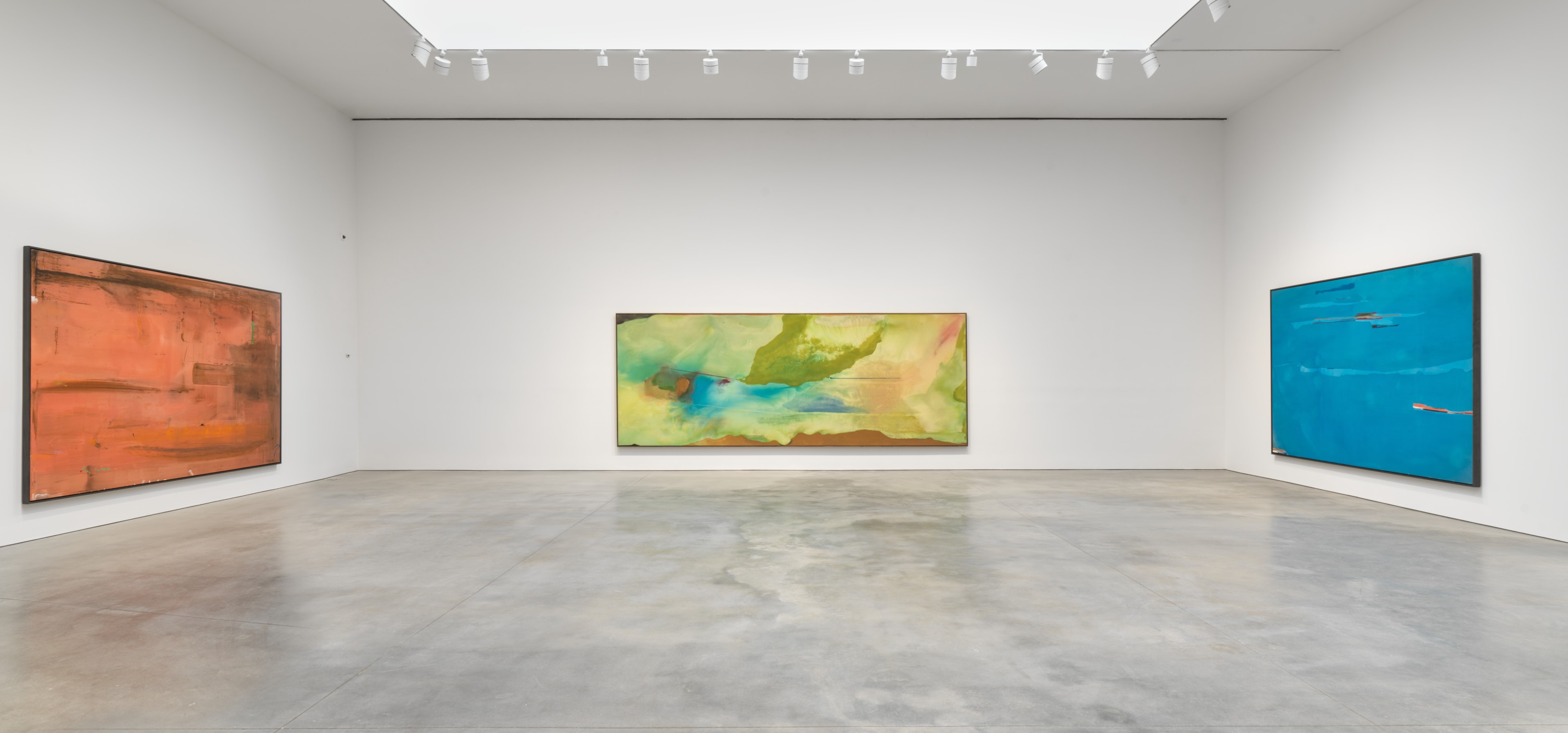
interest in Frankenthaler’s paintings, with buyers searching for works from specific eras. The Basel show offered a chance to survey that theme, but the museum’s placards also revealed that some of the art-hoovering skylords of finance have been buying the artist—and the buying has been pronounced. Gagosian sold one of the largest works in their show—a green, brown, and blue painting that reads like a large landscape—to a collector for a price twice that of the auction records. And
that’s not the only work they’ve been able to sell above that range.
|
Helen Frankenthaler, “The Moment and the Distance” at Gagosian, New York. Photo: Maris
Hutchinson/Courtesy of Gagosian |
- On the auction market, Frankenthaler is on pace to have one of her best years yet. After a pronounced pop in 2015, the artist’s auction totals climbed steadily to their peak of $34 million in 2022. You might’ve thought that number was the product of a record price, but her auction high of nearly $7.9 million, for Royal Fireworks, from 1975, came in 2020. The wave came two years later, when the number of Frankenthaler works at auction doubled. Sales have
already reached more than $22 million this year, with the bulk having arrived just last month, when a 1964 painting, Cape Orange, made $7.25 million—a number tantalizingly close to the previous high. Perhaps more impressively, the market was able to absorb almost all of the eight works offered in New York. And yet, the Frankenthaler market doesn’t feel like it’s overheating. That may be a comment on the variable quality of her output, or it might show the depth of patient demand. In
either case, it can’t hurt that May’s full-court press was followed by serious collectors encountering the best of her work in Basel.
|
Now, let’s get to the main event… |
|
|
|
Sotheby’s parlayed its blockbuster Joe Lewis collection into an
unlikely June success—a London auction that defied expectations and further amplified the heat on a slowly rising market. |
|
|
|
It’s been many years since London’s June sales were considered a high point of the auction
calendar. But this week, Sotheby’s was able to pull out all of the stops—accounting for 92 percent of the city’s total auction revenue, thanks in part to the strength of its $412 million Joe Lewis collection. But even without the Lewis lots, Sotheby’s was able to generate two-thirds of the sales for the week. I’m not sure many in the auction trade saw that coming.
What that means for the future of London’s art-selling seasons remains to be seen. Three sales cycles still
seems like more than the market wants, especially with the October sales now split between London and Paris, but which season will drop out?
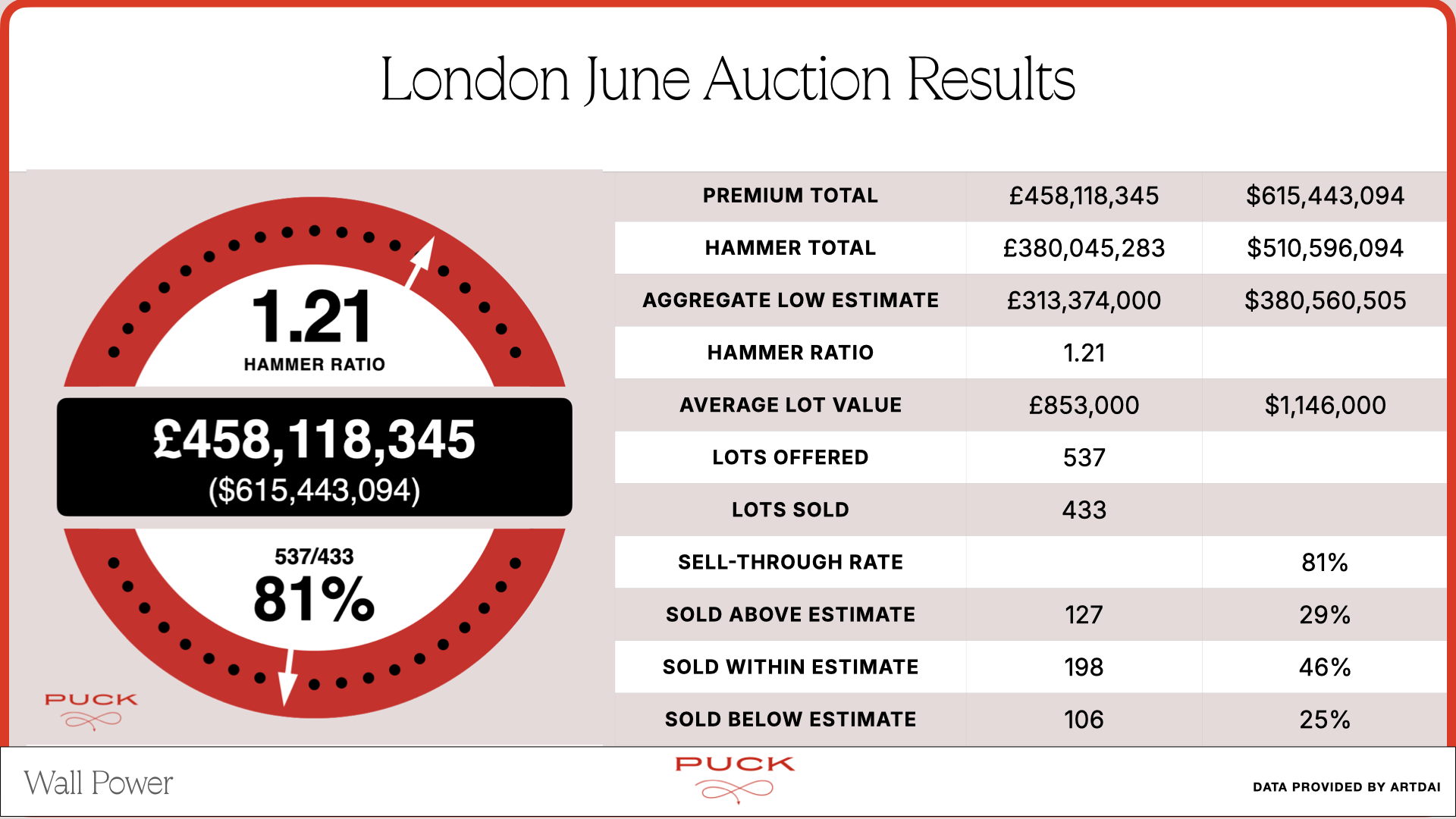
While we ponder that question, let’s look at the results from last week’s auctions, where some $615 million was spent. The overall hammer ratio for the sales—as a reminder, that’s the aggregate hammer price divided by the aggregate auction estimate—was a strong 1.21, but that comes with the caveat that the Lewis collection was intentionally estimated
below market expectations. Still, one cannot argue with the numbers. Lower estimates produce stronger results. And as I have said more times than I care to admit, the overall estimate level has come down significantly in the past three years, helping to revive market momentum. |
These numbers show that the high hammer ratio created by the low estimates for the
expensive Lewis lots is not the sign of a particularly strong market. Nearly half of the lots sold within the estimate range, while another quarter sold for prices below the estimates and a relatively—but not exceptionally—strong 29 percent of lots were subject to aggressive bidding. In short, business is getting done. And cooler heads are prevailing. |
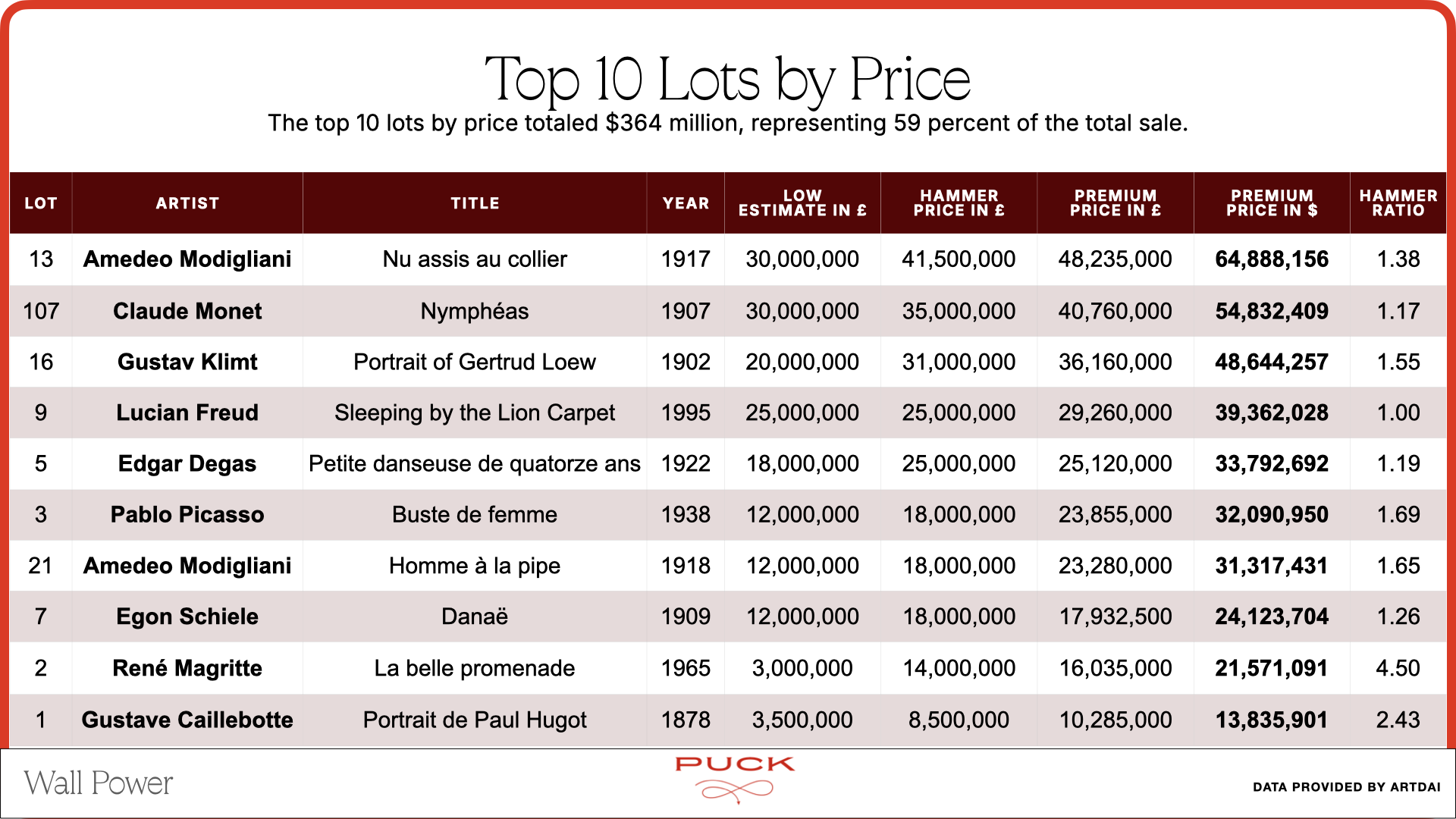
It’s not a surprise that the top 10 lots by price are almost entirely from the Lewis collection.
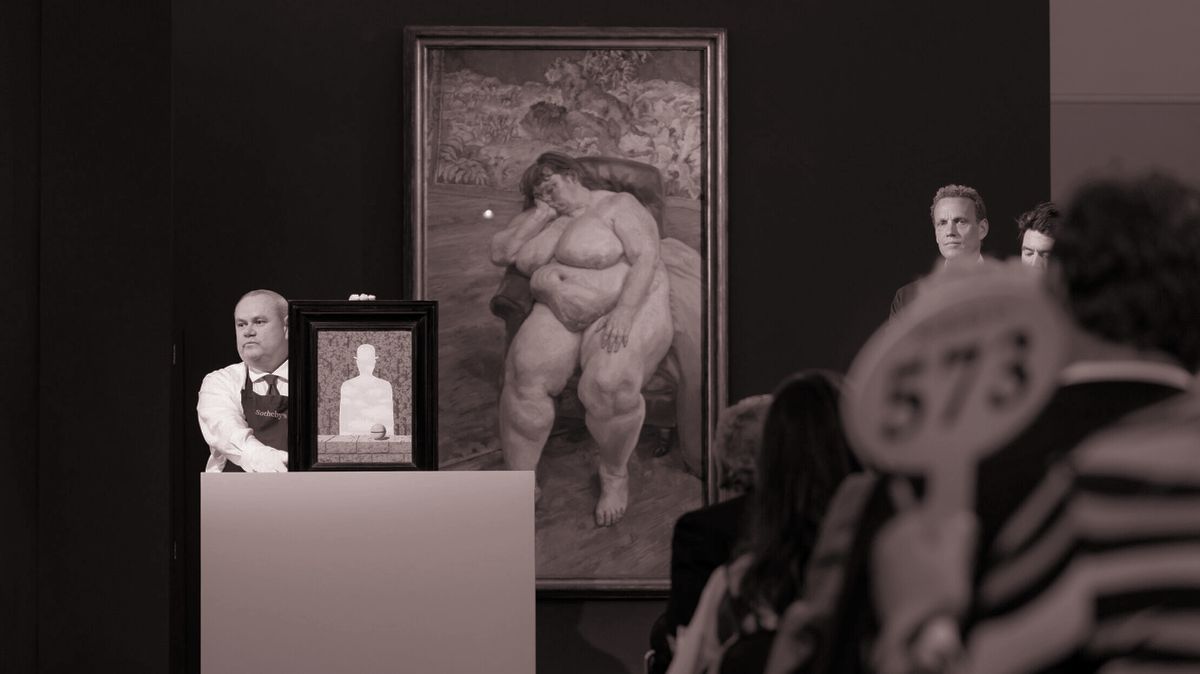
The exception was Anne Bass’s Nymphéas Monet, which was being resold after a short holding period. The seller was able to get most of their money out of the work, but took a haircut in fees. Lucian Freud’s large portrait of Sue Tilley failed to go beyond the attractive estimate, but that was the only work that seemed to leave bidders cold. As has been noted by many, a small Magritte gouache was bid to a
new record price more than four times the estimate. And a Gustave Caillebotte portrait that had been featured prominently in a large show of the artist’s work sold for almost two and a half times the estimate. |
Overall, the top 10 accounted for 59 percent of the sales total, a high figure and the sign of a
top-heavy market. But of course, this isn’t reflective of a normal auction season where sellers have only a specific window to sell their wares; this particular auction season was created for the Lewis collection. So I’m not sure we want to draw a conclusion from these top-heavy numbers. And yet, strong performance at the top of the market is often what leads the auction market forward. |
Six-Figure
Recovery Signs
|
The list of works with the highest hammer ratio is a fascinating mix of young artists, selections
from a charity fundraiser, and isolated works that provoked strong interest from bidders across categories. Jethro Buck and Megan Rooney both donated work to raise money for Kettle’s Yard, a gallery and exhibition space in Cambridge created from the home of collector Jim Ede.
Yu Nishimura’s work has been attracting bidders for some time since the artist joined David Zwirner gallery. His Man in a
Forest, from 2018, sold for a price six and a half times its estimate. A portrait of the 72-year-old Francis Bacon by Michael Clark, from the Lewis collection, attracted the punters. It was one of the few five-figure works on this list, which is noteworthy. Previous lists have focused on lower-value works, but the art market’s recovery can be seen in the higher six-figure lots and one seven-figure lot on this list.
A Henri
Matisse selfie drawing far outran the estimates. Leon Kossoff’s small but heavily impastoed work from the Lewis collection also attracted strong bids. A Gilbert & George paneled work drew a surprisingly strong level of bidding, as did Fernand Léger’s watercolor. A small work that Monet made when he was 24 years old was the only lot on the list to crack $1 million. The nearly $690,000 paid for a 1966 work by Hsiao Chin
follows another strong sale for the artist in Hong Kong, of $600,000 at the end of May for a 1965 work. |
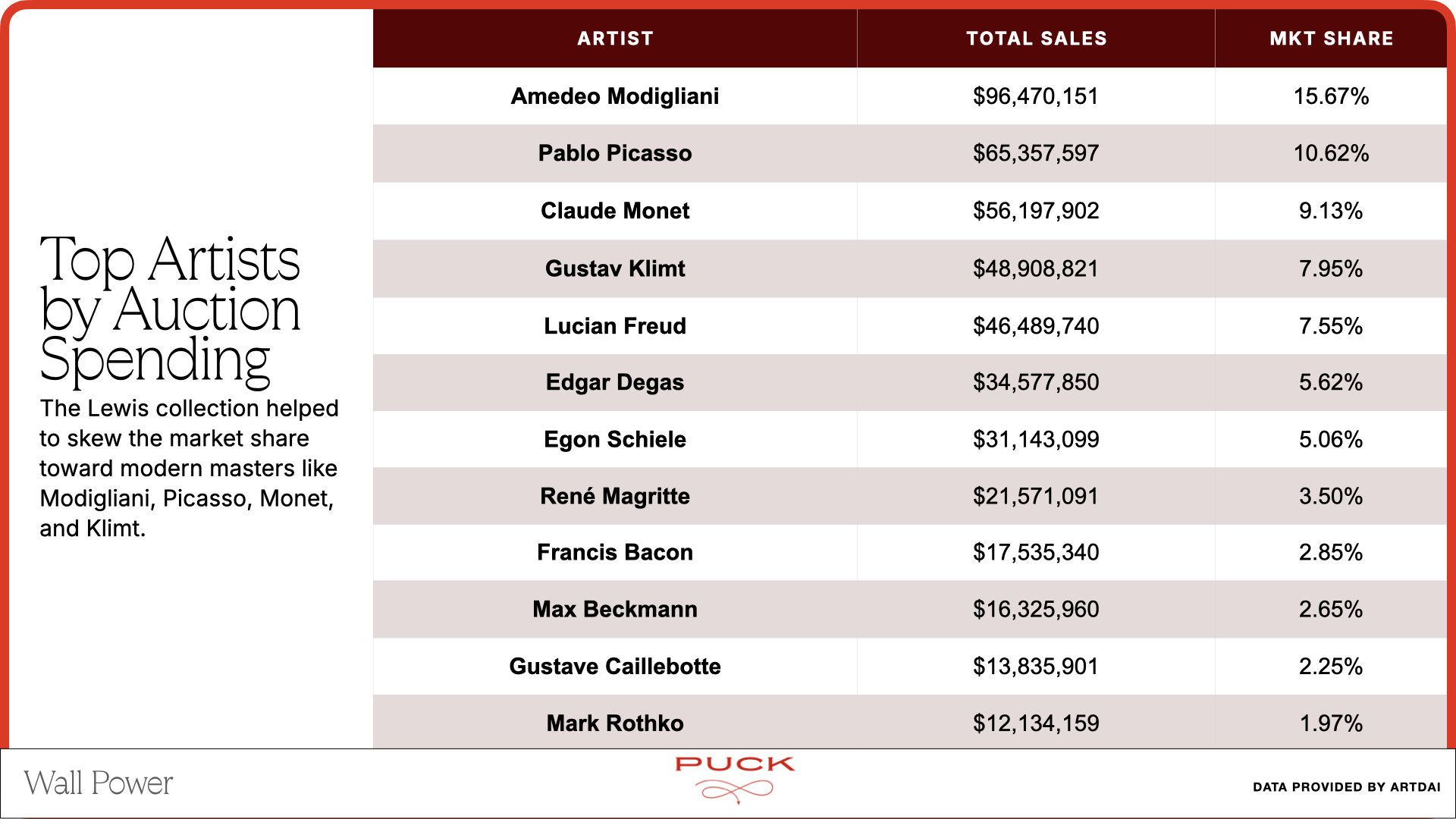
Please don’t be disheartened by the fact that the list of the top 12 artists by market share does
not contain a single woman. The Lewis collection’s focus on modern artists doesn’t explain the absence of women, either. It’s a choice that reflects the interests of the collector himself. |
Amedeo Modigliani accounted for more than 15 percent of the total sale.
Pablo Picasso followed with more than 10 percent. Both artists commonly appear at the top of these market-share charts based on a handful of sales considering the concentration of value in their works. Monet is third in these rankings, at just above 9 percent. Klimt follows with just under 8 percent of the total sale.
Despite limited interest from bidders, Freud came in at just over 7.5 percent. Edgar Degas and Egon Schiele both notched
in the 5 percent range. Magritte came in at 3.5 percent, with Bacon, Max Beckmann, and Caillebotte accounting for somewhere in the 2 percent range each. A single yellow Mark Rothko painting on paper mounted on linen that sold for a robust $12 million put the artist in the final spot on the list, with just under 2 percent of the total sale. |
That’s it for the London data. We’re off this Friday and Sunday for the holiday. But I will be back
in your inbox on July 7 as we start looking toward the second half of the year. Until then, enjoy the long weekend.
M |
|
|
|
Puck founding partner Matt Belloni takes you inside the business of Hollywood, using exclusive reporting and insight to explain
the backstories on everything from Marvel movies to the streaming wars. |
|
|
|
The ultimate fashion industry bible, offering incisive reportage on all aspects of the business and its biggest players.
Anchored by preeminent fashion journalist Lauren Sherman, Line Sheet also features Rachel Strugatz, who delivers unparalleled intel on what’s happening in the beauty industry, as well as Malique Morris on retail, D.T.C., and more. |
|
|
|
Need help? Review our
FAQ page or contact us for assistance. For brand partnerships, email ads@puck.news.
You received this email because you signed up to receive emails from Puck, or as part of your Puck account associated with {{customer.email}}. To stop receiving this newsletter and/or manage all your email preferences, click here. |
Puck is published by Heat Media LLC. 107 Greenwich St., New York, NY 10006 |
|
|
|
|