{{ 'now' | timezone: 'America/New_York' | date: '%b %d, %Y' }} |
|
|
Hello, and welcome to yet another special Friday edition of The Best & The Brightest. I’m
Peter Hamby, back in your inboxes with a look at the emerging fissures in the Republican Party’s House majority.
In today’s issue: My deep-dive conversation with Leigh Ann Caldwell about what a lethargic House G.O.P. majority portends for next year’s midterms. Republican members are bored, frustrated by a legislative drought, and bracing for the real possibility of losing their gavels in 2026. As a result, many of them are already promising to retire in
the next few months. Leigh Ann walks through the implications, and considers whether it’s too late for Trump to resuscitate Republicans’ excitement on Capitol Hill.
Mentioned in this issue: Donald Trump, Pete Hegseth, Missy Cummings, Heidy Khlaaf, Sarah Myers West, Hernan Lopez, D. John Sauer, Marjorie Taylor Greene, Mike Johnson, Hakeem Jeffries, Elon Musk, and more…
But first… |
|
|

| Ian Krietzberg
|
|
- Hegseth goes all in on
A.I.: This week, in keeping with Trump’s desire to incorporate artificial intelligence across the federal government, the Department of War announced that it would launch a generative A.I. platform, GenAI.mil. This new offering will allow members of the military to securely access frontier A.I. models, beginning with Google’s Gemini. “At the click of a button, A.I. models can be used to conduct deep research,
format documents, and even analyze video or imagery at unprecedented speed,” Secretary of War Pete Hegseth said.
The department’s official statement is short on details, but Drop Site News published
leaked images of the website. An “About” section notes, “By integrating A.I. with our operational capabilities, we will compress the OODA loop (Observe, Orient, Decide, Act) at all echelons, ensuring the Department of War can out-think, out-decide, and out-pace any adversary.”
Of course, the military’s use of A.I.
isn’t new. But according to a number of A.I. safety engineers, the use of L.L.M.-based generative A.I. in this context is vastly premature. One recent paper,
written by safety engineer Dr. Missy Cummings, argued that generative A.I. should not be used in relation to weaponry until model hallucinations can be successfully modeled and predicted; Drs. Heidy Khlaaf and Sarah Myers West at the A.I. Now Institute have likewise argued that, based on traditional engineering and military standards, these models
pose significant national security threats—a contention that echoes a 2022 analysis published by West Point, itself. Still, according to Hegseth, the department is “pushing all of our chips in on artificial intelligence as a fighting force.”
|
|
|
A MESSAGE FROM OUR SPONSOR |
Usually, Big Pharma diverts blame from the industry, calling others “bad actors” and cost drivers of healthcare.
But a recent bidding
war for a weight-loss company showed they’ll tear each other down for the sake of their own profits. The war may have ended, but the carnage revealed that these companies know that
unethical, anti-competitive practices are rampant in the pharmaceutical industry. Big Pharma understands their anti-competitive practices drive up prescription drug prices, and so do Americans. It’s time for Congress and the Administration to hold the real bad actors accountable with commonsense reforms. |
|
|

| Eriq Gardner
|
|
- Red card rescinded:
Looks like I was right to suspect that President Trump might feel some sympathy for Hernan Lopez, as the Department of Justice is backing away from the conviction of the former C.E.O. of Fox International Channels. Lopez, you’ll recall, was swept up in the sprawling FIFA corruption probe, accused of bribing
South American soccer officials to secure lucrative broadcasting rights. He was convicted and faced decades behind bars until the trial judge tossed the verdict, citing recent Supreme Court precedent that narrowed the scope of “honest services fraud.” Then, in July, the Second Circuit reinstated the conviction, teeing up a potential showdown at the Supreme Court.
Lopez’s legal team seized the moment, asking the justices to weigh in on whether the honest services statute really extends to
foreign bribes in private-sector deals. That put the Trump administration in a tricky spot, as it has lately been pulling back on many white-collar fraud fronts. On Wednesday, Solicitor General D. John Sauer told the justices that the government was exercising its prosecutorial discretion to pursue dismissal of the case, saying it was no longer in the public interest. Translation: The conviction that once looked like a trophy from the D.O.J.’s FIFA probe may soon vanish from the
books altogether. Lopez, who is now a media analyst—and occasional guest on The Town—said he was “gratified” the ordeal is over.
|
|
|
And now, my conversation with Leigh Ann… |
|
|
It’s no fun serving in the House these days, even (or perhaps especially) in the G.O.P.
majority. A wide-ranging conversation with Leigh Ann Caldwell about the red team’s congressional blues. |
|
|
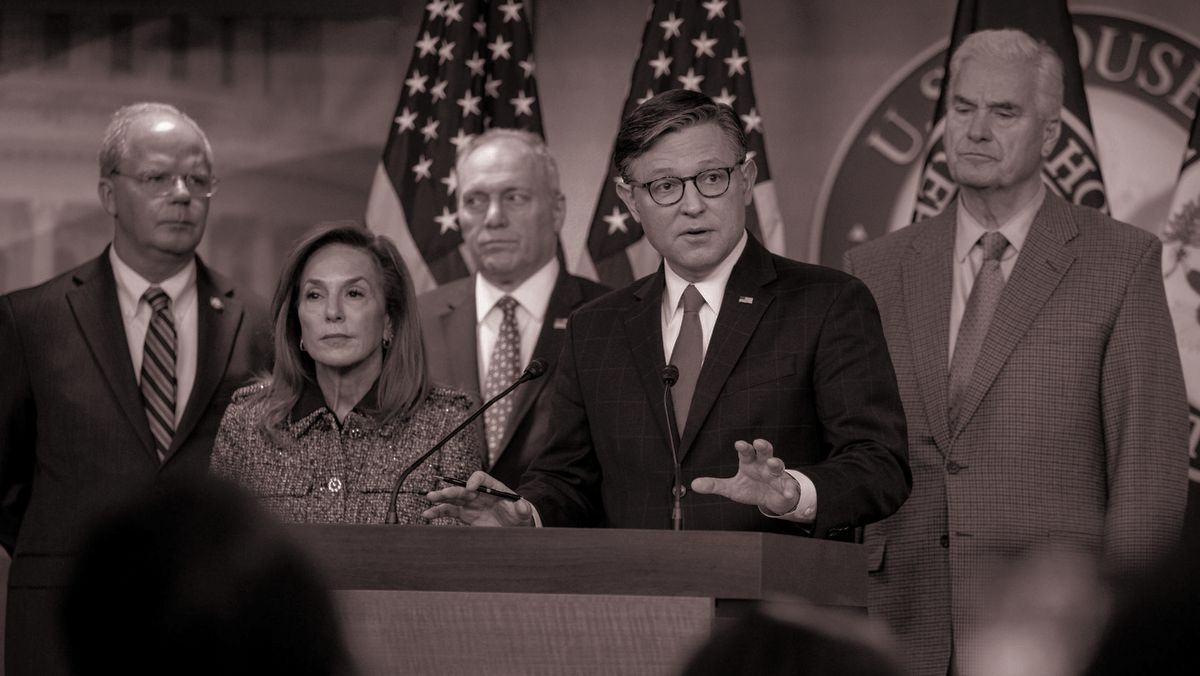
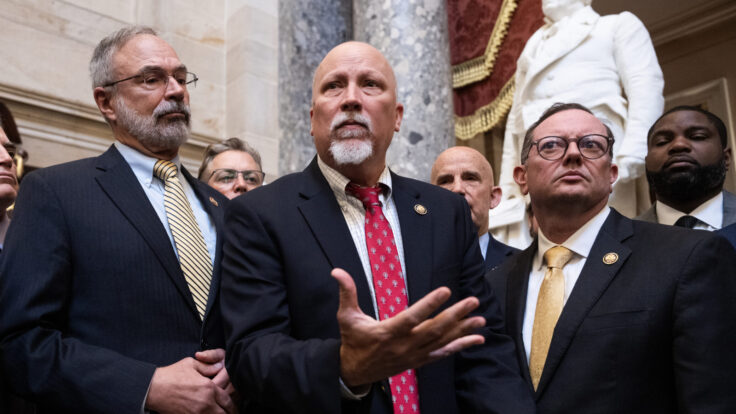
The House G.O.P. is staring down a slow-motion crack-up, and the people inside the Capitol Building know it.
With as many as 20 Republicans expected to call it quits in the coming weeks—not flame-outs like Marjorie Taylor Greene, but planned retirements at the end of their terms—the party’s governing majority seems to be breaking under the pressures of dysfunction, infighting, and, of course, Donald Trump. Even in power, Republicans feel powerless: They have no agenda, little to legislate, and no independence from a White House that treats the preeminent branch of
government as a nuisance.
Earlier this week, Leigh Ann Caldwell joined me for an episode of The Powers That Be to help make sense of why governing has gotten so miserable for House Republicans, how Speaker Mike Johnson has effectively outsourced his power to the president, and what a Democratic majority under Hakeem
Jeffries might look like in 2027. We also explored where Democrats might actually legislate, how much Trump’s political calculations would shape a divided government, and more. This conversation has been slightly edited for length and clarity. |
Peter Hamby: You reported that several Republican lawmakers and aides
expect a wave of House G.O.P. retirements in the coming weeks—as many as 20. We’re talking about formal retirements, not Marjorie Taylor Greene–style resignations, correct?
Leigh Ann Caldwell: Yes, that’s correct. It’s the people who are just kind of done with Congress. Of course, some have family issues and health things going on, but it’s more of an indictment of serving in Congress as a Republican in these times. It’s not fun, not
fulfilling. When you see the writing on the wall that Republicans are very unlikely to be in the majority after the midterms, Republicans are asking, Why do I want to do this? Being in the minority in the House is the absolute worst. So it’s an indictment of what it’s like to be a member of Congress, but it’s also an indictment of the political environment—a clear sign that it’s not looking good for Republicans maintaining their majority. |
|
|
A MESSAGE FROM OUR SPONSOR |
Usually, Big Pharma diverts blame from the industry, calling others “bad actors” and cost drivers of healthcare.
But a recent bidding
war for a weight-loss company showed they’ll tear each other down for the sake of their own profits. The war may have ended, but the carnage revealed that these companies know that
unethical, anti-competitive practices are rampant in the pharmaceutical industry. Big Pharma understands their anti-competitive practices drive up prescription drug prices, and so do Americans. It’s time for Congress and the Administration to hold the real bad actors accountable with commonsense reforms. |
|
|
Please explain why life would suck for a Republican member right now in the majority. Is it just that
they passed the Big Beautiful Bill and now there’s nothing left to do on the horizon?
That’s one of many things. They can’t agree on how to address healthcare. They can’t even agree on whether affordability is an issue that they should discuss. They literally have no agenda right now. There are lots of complaints that leadership has to appease and deal with people who make a lot of demands on the right, like the Freedom Caucus. Then there’s the
critique that leadership isn’t letting people legislate. Discharge petitions—typically used by the minority to push a piece of legislation because they don’t have any other way to get it onto the House floor—are increasingly being used by Republican members, who are in the majority, because Speaker Johnson will not allow legislation to go through committee. People are spending all their time fundraising. Redistricting has been hugely annoying to a lot of these members, especially the Texas and
California members.
It’s just a lot of headaches, and people are asking whether it’s worth it—especially heading into what they think will be the minority after the midterms, given the November and Tennessee electoral results. People are like, Why do I want to be in the minority and have to defend the president on investigations and subpoenas and potential impeachment? Oh, and there’s also the issue that Donald Trump cares very little about Congress. He’s trying to take away a
lot of powers of Congress. They feel a lack of independence—even though they’re allowing him to do this—because they’re afraid to speak out. It’s just a very unfulfilling job right now.
Can you speak to the leadership dynamics here? I feel like in the past, if people were unhappy with leadership, rather than retire en masse, they would just oust the speaker and try to put someone new in. Or is that impossible when Donald Trump is in the
White House?
As long as Donald Trump has confidence in the speaker, nothing is going to happen—and that is still the case. Senior leadership aides and other Republicans tell me that the White House knows what Mike Johnson is, and that is someone who will do what the White House wants. Speaker Johnson made the choice to defend the president at all costs. He made the decision that it was going to be much easier to manage a narrow majority if he had
the president on his side, versus trying to assert an independent legislature.
So they’re standing by him for now. Meanwhile, you have an unproductive Congress because the president is doing things he wants to do through executive order and bypassing the legislature. This Congress has passed 45 bills this year that have been signed into law. The last Congress, with the Republican majority, was the least productive Congress since at least 1972, and over two years they had 274 bills signed
into law. We’re halfway through. So this is going to be by far the least productive Congress unless something dramatically changes—a really bad sign for convincing people to stick it out and continue doing these jobs. |
Say Democrats win the midterms and you have Speaker Jeffries. What do you think Washington looks like
the following two years? Are we in for a repeat of 2019 and 2020, when Republicans held the White House and the Senate, and the Democrats were throwing bombs from the House?
Yeah, I think so. There are going to be so many investigations, a lot of subpoenas, a lot of inquiries. This is actually what Donald Trump fears and why he wants to keep the House majority. It’s not because he has some big legislative agenda—frankly, there is no legislative
agenda. It’s because he doesn’t want to be investigated. People have told me this from days after he was inaugurated. |
|
|
Is there going to be an impeachment? I’m actually super skeptical. It didn’t prove to be politically
fructuous for Democrats last time, but who knows what happens between now and then? Regardless, it will be very uncomfortable for Republicans if they have to defend a president who could be a very unpopular lame duck president in a year or so, especially if it’s a divided Congress. That’s where Democrats are going to put their focus.
Where would they investigate? Are we talking foreign gifts and family enrichment? Are we talking DOGE, and getting to the bottom of what the
president and Elon Musk did at that time? Where would the president be vulnerable to investigations, subpoenas, or rowdy Oversight hearings on C-SPAN?
We still have a year before the midterms, but I think it’s going to be a lot of the corruption, the crypto, the taking gifts from foreign governments. We’ll see what sort of investigation or inquiry is launched with the Venezuela boat strikes.
Let’s not presume
Democrats won’t win back the Senate. They might, but they’d have to do really well in places they might not expect. But if they just capture the House, what will Democrats proactively do when it comes to legislation? It doesn’t sound like they’d be able to do much beyond holding hearings.
Maybe there’s something in the housing space; that’s something that Republicans are becoming more interested in. Healthcare is the issue of the day right now.
But I have zero belief that Republicans are going to be able to come to support anything regarding healthcare. Maybe that’ll continue to be an issue. Maybe they’ll do some stuff around the edges. When it’s a completely divided government, that’s where you can tinker with small but perhaps impactful reforms.
But then it’s really up to Trump—and this president and the current Congress have been adamant that Democrats be cut out of everything. He has repeatedly said not to work with
Democrats, so it would be really interesting to see whether his calculation changes with Republicans in the minority. I suspect it will because he really cares about his legacy. But Donald Trump is still going to control and steer what’s possible. |
|
|
Join Puck’s chief political columnist, John Heilemann, as he roams the corridors of power and influence in America on this
twice-weekly interview show, taking you beyond the headlines with the people who shape our culture: icons and up-and-comers, incumbents and insurgents, moguls and machers in the overlapping worlds of politics, entertainment, tech, business, sports, media, and beyond. The conversations are rich and revealing, unrehearsed and unexpected… and reliably impolitic. A Puck-Audacy joint, new episodes drop every Wednesday and Friday. |
|
|
The industry’s go-to source for unflinching reporting on the trillion-dollar business of artificial intelligence - perhaps the
single most important technology of our time. Ian Krietzberg, the powerhouse journalist behind The Deep View, delivers twice-weekly insights into the latest dealmaking and breakthroughs in A.I., and how the intersecting worlds of finance, entertainment, media, and politics are being transformed in its wake. |
|
|
Need help? Review our
FAQ page or contact us for assistance. For brand partnerships, email ads@puck.news.
You received this email because you signed up to receive emails from Puck, or as part of your Puck account associated with {{customer.email}}. To stop receiving this newsletter and/or manage all your email preferences, click here.
|
Puck is published by Heat Media LLC. 107 Greenwich St., New York, NY 10006 |
|
|
|