 |
|
Welcome back to The Best & The Brightest. I’m Peter Hamby. I’ll be in D.C. this week for the White House Correspondents’ Dinner party circuit, including Puck’s event with WME and Snap, where my colleague Matt Belloni and I will interview Aaron Sorkin over a few cocktails.
In tonight’s edition, the campus protests over Gaza have thrust youth politics back into the spotlight in an election year. But new polling shows that despite frustration with Biden’s support for Israel, the president is still in the driver’s seat when it comes to winning Gen Z voters.
But first, here’s Abby Livingston with the readout from the Hill…
|
| Johnson’s Stones & Leadership Tea Leaves |
|
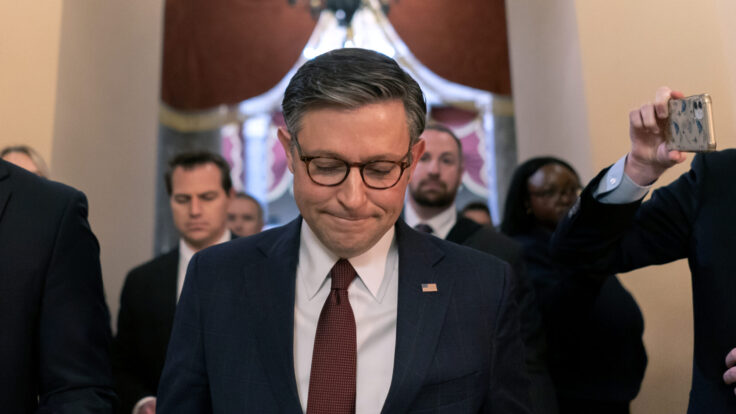
| For months, the conventional wisdom on the Hill had been that any legislation to provide more funds or materiel to Ukraine was basically a dead letter: Mike Johnson, the newish speaker, had previously opposed more foreign aid, and his right flank was threatening to throw him out of office if he wavered. Then, on Saturday night, Johnson did the unthinkable. With Democrats offering him support, he decided to roll the dice, ushering the $61 billion aid bill through the House and on to the Senate and White House.
There will likely be a price to pay, but either way Johnson deserves credit not only for what the vote could mean for Ukraine, but also because it’s still depressingly rare to see a Washington politician put principles above politics. A few notes on his wager…
- Johnson’s gamble pays off: The bill passed 311-112 with unanimous Democratic support, but it’s worth noting that given the House Republican margin, 101-112, the vote was in full violation of the once-sacred Hastert Rule. Marjorie Taylor Greene and her ilk are making plenty of noise about a motion to vacate, but the growing consensus among my sources is that Johnson is probably safe for the rest of the term. Republicans understand that their conference is capable of devolving into the Lord of the Flies should another speaker defenestration occur. (Requisite disclaimer that any and all predictions regarding the House these days can become stale within mere hours of publication…)
- Dems’ badge of honor: Democrats seem to be walking away from this episode with a genuine, newfound respect for Johnson. “I think he reached a crossroads,” a senior House Democratic member told me. “Do I want to be remembered as a craven political hack who only cared about holding on to power, or a statesman who reinforced the worldwide democratic force field?” This member then referenced the scene in Indiana Jones and the Last Crusade where Indy selects the correct goblet and quoted the Grail Knight, who acknowledges Indy has found the Holy Grail: “You have chosen wisely.”
Alas, there’s a reason that coalition governments are so contentious. Johnson will again fundraise to help defeat Democrats, and Democrats, in turn, will do their damnedest to ensure he will not preside over a Republican majority next year. I’ve also heard rumblings from Republicans that the Democrats who paraded the Ukrainian flag around the House floor did Johnson no favors.
- Leadership tea leaves: The House’s future is as uncertain as it’s ever been. When Congress returns next week, there is not much to do beyond funding the government in the fall. Perhaps there might be some surprises, but nearly all of the must-pass legislation has already gone through, and there’s little hope that the beleaguered 118th Congress is capable of doing much else. The next question on the minds of many in Republican politics is how this all plays out in the leadership elections in November—which everyone reminds themselves is many political lifetimes away from now.
|
 |
| The Great Biden Israel Gamble |
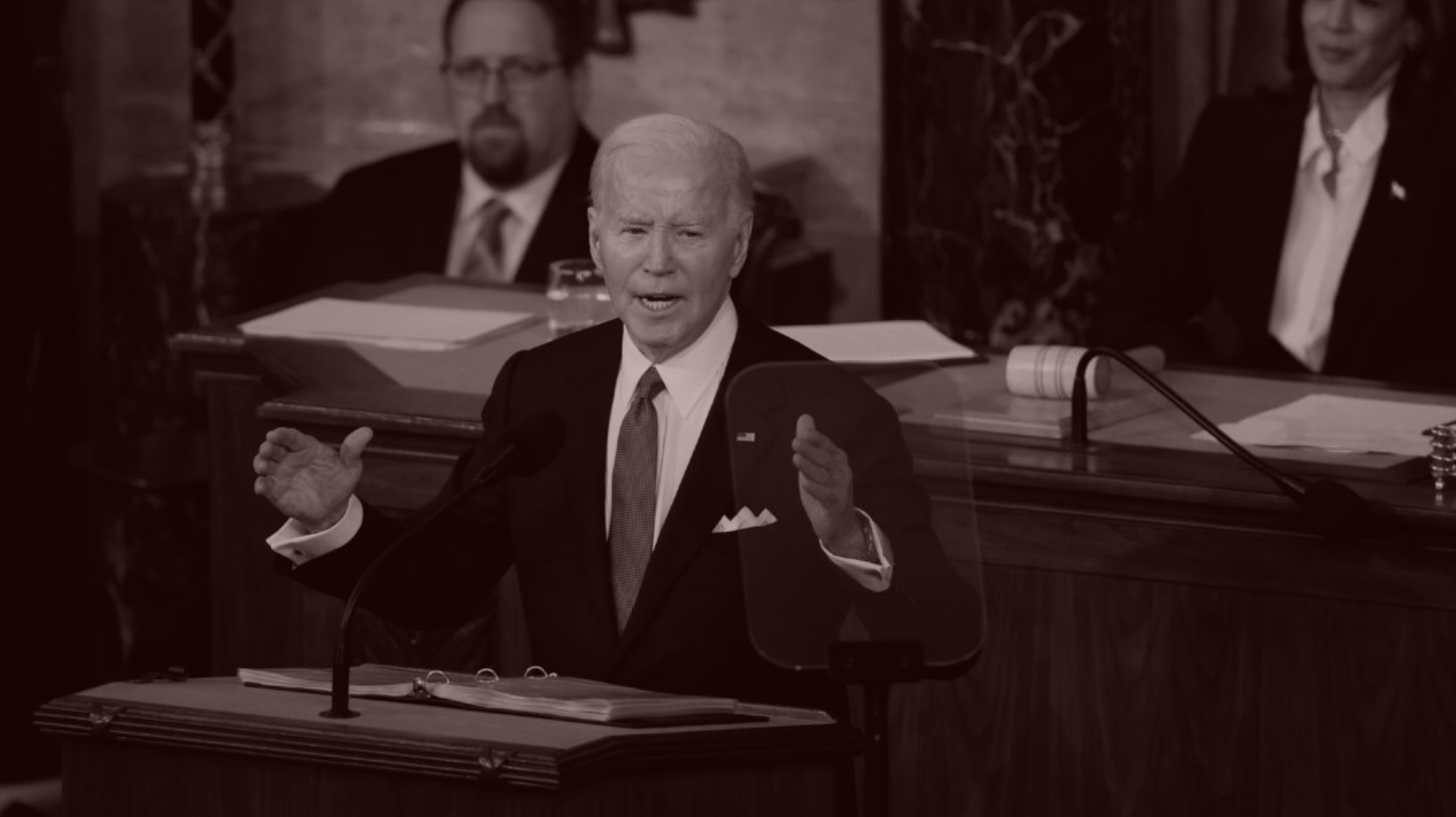
| With protests flaring across college campuses, catastrophizing pundits are predicting Biden’s weakness with younger voters could put Trump in the White House. Last week’s Harvard Youth Poll provided a useful corrective suggesting young voters are fairly aligned with the president. |
|
|
|
| I woke up this morning, like many of you, to yet another series of striking images from the Palestinian solidarity protests that have swamped American college campuses in recent days. One photo had already gone viral by the time I had my first sip of coffee: An outraged Jewish student at the University of Michigan named Josh Brown posted a photo of a pamphlet being distributed at a “Gaza Solidarity Encampment,” or a tent village erected in Ann Arbor, on Monday. It read, in part, “Freedom for Palestine means Death to America.” Like a lot of politically engaged Gen Z kids, Brown was media savvy. He posted his photo to X and immediately tagged @JakeTapper.
“Death to America” is probably a distraction from the protestors’ stated push to get their university to divest from companies doing business with the state of Israel—but then again, student activists have never been known for disciplined political messaging. Whatever the case, that single photo ensured that the University of Michigan would be the latest school to endure the campus wars over the war in Gaza.
The match for the widespread student unrest was struck at Columbia University over the weekend, after Gaza protests in Morningside Heights became so boastfully antisemitic that the administration told students they would have to attend classes remotely this week, during Passover. The fact that the mayhem was going down at Columbia gave it a ’68 feel: There were police sweeps, talk of “outside agitators,” a university president under siege, pungent clouds of marijuana in the air, and conservative politicians pointing to the chaos as proof that anti-American radicalism has overtaken the country’s clueless youth. But of course, this is 2024: On X, Ted Cruz shared a photoshopped version of Columbia’s coat of arms with the school renamed “Hamas University.”
But the only politician I wanted to hear from was Joe Biden. It’s an election year, of course, and Biden’s hopes for a second term are precariously dependent on the volatile nature of youth politics, embodied by the campus fury over Gaza. Voters under 30 helped Biden win the White House in 2020, and the margins they delivered to Democrats helped them keep the Senate in the 2022 midterms. No Democrat in the modern era has won the White House without capturing a baseline of 60 percent of the youth vote. Recent polls, however, have suggested that Biden isn’t close to that number. Some data has even indicated that Donald Trump might be gaining on Biden with younger voters, a dynamic that seems absolutely bonkers.
Biden is well aware of his challenges with younger Americans. He brings it up in his consultations with political advisors, I’m routinely told. But it should be abundantly clear at this point that the president is not interested in finding common cause with young leftists raging about Gaza, even if it puts him on the wrong side of the loudest progressive voices on social media. “Calls for violence and physical intimidation targeting Jewish students and the Jewish community are blatantly antisemitic, unconscionable, and dangerous—they have absolutely no place on any college campus, or anywhere in the U.S.,” said deputy White House press secretary Andrew Bates.
Those talking points are yet another reminder that—despite cries to the contrary from the MAGAverse—Biden remains a staunch supporter of Israel and its right to respond to terrorism, even as he and his national security team have criticized Israeli Prime Minister Benjamin Netanyahu’s indiscriminate bombing and tried to push him toward a negotiated ceasefire. (The State Department is now expected to announce sanctions against at least one I.D.F. battalion for human rights violations.) Sure, he and Bibi don’t get along, but Biden’s guiding light in politics, however naive, remains the possibility of consensus, a sentiment he shared during a symbolic visit to his hometown of Scranton last week: “It’s not about whether or not you’re left, right, or center, … but it matters about whether or not you’re going to abide by the basic rules, you’re going to have a sense of decency.” Biden—literally, folks—believes that. Which is why he was so quick to condemn the campus spectacle at Columbia and reiterated his position to the pool today.
At age 81, the president isn’t going to change his fundamental nature or the “Soul of America” sensibilities that won him the White House in the first place. But the idea of decency and consensus does often put him at odds with the maximalism that tends to define youth politics in the social media era. And it’s enough to make many—operatives, pundits, even his own advisors—wonder whether his moderate tendencies, which have cost him support with the youngs, will also cost him the White House. |
|
|
| The Harvard Youth Poll—the gold standard survey of young voters, run by the estimable pollster John Della Volpe—has been around for a long time, but it has gained more attention in recent years thanks to Biden’s struggles with under-30 voters. The most recent poll, released last week, was highly anticipated due to a recent flurry of conflicting data. Late last year, polls from USA Today and The New York Times contained existentially threatening news for Democrats: Trump was actually leading Biden among voters between the ages of 18 and 29. Not only would that dynamic spell doom for Biden in 2024, but it would shatter a decades-long trend of young voters casting their ballots overwhelmingly for Democrats.
We all knew Biden had problems with Gen Z. But the doomsaying headlines that followed were the result of something called “crosstab-diving”—the practice of extrapolating a sweeping conclusion from a small subsample of voters in a poll, to which the topline margin of error does not apply. Few professional Democrats—and no one in the White House—believed that Trump would actually win young voters. But liberal catastrophizing ensued anyway.
Last week’s poll provided a useful corrective, with a very legit sample size of 2,010 Americans between the ages of 18 and 29. And while the poll confirmed ongoing challenges for Biden—including a noticeable drop in support among young men with rightward-drifting attitudes on gender and identity—the results weren’t nearly as bad as recent commentary has suggested. Among young likely voters, Biden led Trump by 19 points. Biden still has work to do: At the same point in 2020, the same poll had Biden leading Trump by 30 points.
But, for now, Trump isn’t anywhere close to overtaking Biden among young Americans, who, when it comes to values, are firmly aligned with the Democratic Party on almost every issue, with the exception of border security.
The poll also gave ammo to a core argument from the White House about November: Biden may be unpopular—indeed, his approval rating among young voters in the Harvard Poll was an abysmal 31 percent—but given a choice between him and Trump, voters will stand by him. Another silver lining: Despite the press attention being lavished on young voters and the contempt of many of them for Biden’s support for Israel, youth opinions on the war are far more muddled than news coverage suggests. Support for a permanent ceasefire in Gaza is at 51 percent. As Della Volpe wrote in his analysis of the poll, “Asked whether or not they sympathize with various groups involved in the war, we found that majorities of young Americans hold sympathy for the Israeli (52 percent sympathize) and the Palestinian people (56 percent sympathize), while they have far less sympathy for their governments (29 percent sympathize with the Israeli government; 32 percent with the Palestinian government).”
In other words, America’s youth sympathize with both Israelis and Palestinians; they support a ceasefire; and they really don’t like Netanyahu or Hamas. While the students of the Gaza Solidarity Encampments might disagree, there’s not much daylight between the opinions of young Americans on Israel and the official position of the Biden White House. Meanwhile, almost half of young Americans (45 percent) say they don’t know enough about the war to have an opinion at all. For now, Biden’s bet that young voters are more aligned with Scranton values than those of the Ivy League seems safe.
In fact, the poll found that Gaza isn’t even close to the top issue for young voters. It’s 15th on the list, somewhere below crime and taxes. Even among young Democrats, only 37 percent named “Israel/Palestine” as their most important issue. The top issue for all young voters—as it always has been, and as boring as it is for the media—is the economy. Specifically, inflation—the issue imperiling Biden’s reelection chances more than any other. And among young Democrats, the top issue is reproductive rights.
So while Columbia, Yale, NYU, Michigan, and other universities are thrusting the politics of Gaza back into the spotlight—much as they were when Biden was losing some votes to “uncommitted” during the Democratic primaries—it’s important to remember that the political opinions of young Americans are more than just what we see broadcast on social media through the lens of an iPhone. They’re complicated and often unsexy, just like those of the generations preceding them. Like it or not, the interest rate on a car payment will always be more salient to the average voter than a calamitous war abroad. |
|
|
|
| FOUR STORIES WE’RE TALKING ABOUT |
 |
|
 |
| Three Women |
| Six artworks electrifying the May auction season. |
| MARION MANEKER |
|
 |
|
 |
|
|
|

|
 |
|
|
|
Need help? Review our FAQs
page or contact
us for assistance. For brand partnerships, email ads@puck.news.
|
|
You received this email because you signed up to receive emails from Puck, or as part of your Puck account associated with . To stop receiving this newsletter and/or manage all your email preferences, click here.
|
|
Puck is published by Heat Media LLC. 227 W 17th St New York, NY 10011.
|
|
|
|