Welcome back to Wall Power’s Inner Circle. I’m Marion
Maneker.
It’s been a big season, and I’ve got the numbers to prove it. Tonight, I’ll go through the usual auction-season analysis to get a better understanding of the art market’s strong and somewhat surprising recovery this spring. As you may have already heard me say, these May sales doubled in value from last year, with the jump entirely attributable to the top 27 lots sold for $20 million or more. And yet, if we go deeper into the data provided by our friends at ARTDAI, there
are more interesting tales to tell.
Up top, a painting attributed to a follower of Hieronymus Bosch opened Sotheby’s midseason Old Masters sale in New York, selling for more than a dozen times the estimate, and the folks at Christie’s have shared some data on bidders with me that I will now pass on to you.
🚨 Just a reminder…: Since we’re going through data tonight provided by ARTDAI, a useful refresher that Puck’s Inner Circle subscribers get a discount
on access to ARTDAI’s auction database and market intelligence platform, ArtQ One. If you sign up for the monthly package here using promo code INNERCIRCLE, you’ll get the first month for $26, then pay $95 a month thereafter. Or just sign up for the yearly rate, which works out to only $79 per month. It’s an even better deal.
(You just won’t get a discount from us.) As you will see below, I use ARTDAI. It’s the best tool available.
Also mentioned in this issue: David Pollack, Marian Goodman, Alberto Giacometti, Si Newhouse Jr., Jackson Pollock, Joan Miró, Pablo Picasso, Constantin Brancusi, Henri Matisse,
Jasper Johns, Edvard Eriksen, Harald Slott-Møller, El Lissitzky, Bridget Tichenor, Remedios Varo, Leonora Carrington, Margo Hoff, Deborah Butterfield, Robert Henri, and more. |
|
|
|
A MESSAGE FROM OUR SPONSOR |
Inspired by football fandom and Britain’s love of the beautiful game, the campaign captures the anticipation and
camaraderie of match day – come rain or shine – with an all-star cast of familiar faces.
Learn More |
|
|
|
- Bosch, Bosch, Bosch: There are only around 25 works of art attributed to Hieronymus Bosch himself. But as Sotheby’s notes in its catalogue essay for the Bosch-like painting Hell, there are other works, dated to the first half of the 16th century, that are “understood not as direct copies of a lost Bosch original, but rather as compilations of adapted Boschian motifs reimagined by later artists.” Sotheby’s offered Hell, which has shifted
attributions more than once, with an estimate at $30,000, supported with an irrevocable bid. The backer was smart: Ten bidders ended up driving the final price of the work up to $537,000 with fees.
The painting was a good example of what Sotheby’s David Pollack calls an “image-driven market.” It “attracted interest
from all corners of the market, from collectors—including cross-category bidders who typically collect contemporary and modern—to dealers, to curators who were all drawn to the power of the image.” - Christie’s bidders: Christie’s shared with me a list of 32 lots that had 10 or more bidders in last month’s New York auctions, including online sales. Only five of them were estimated at six figures or more—one at $1 million and another at $300,000.
Nearly half of the works with 10 or more bidders came from the collection of dealer Marian Goodman. Nine lots were offered in the impressionist and modern day sale, and another two featured in a sale of Picasso’s ceramics.
|
Now, let’s get to the numbers… |
|
|
|
Lured by the optimistic tailwinds from last fall’s Lauder auction,
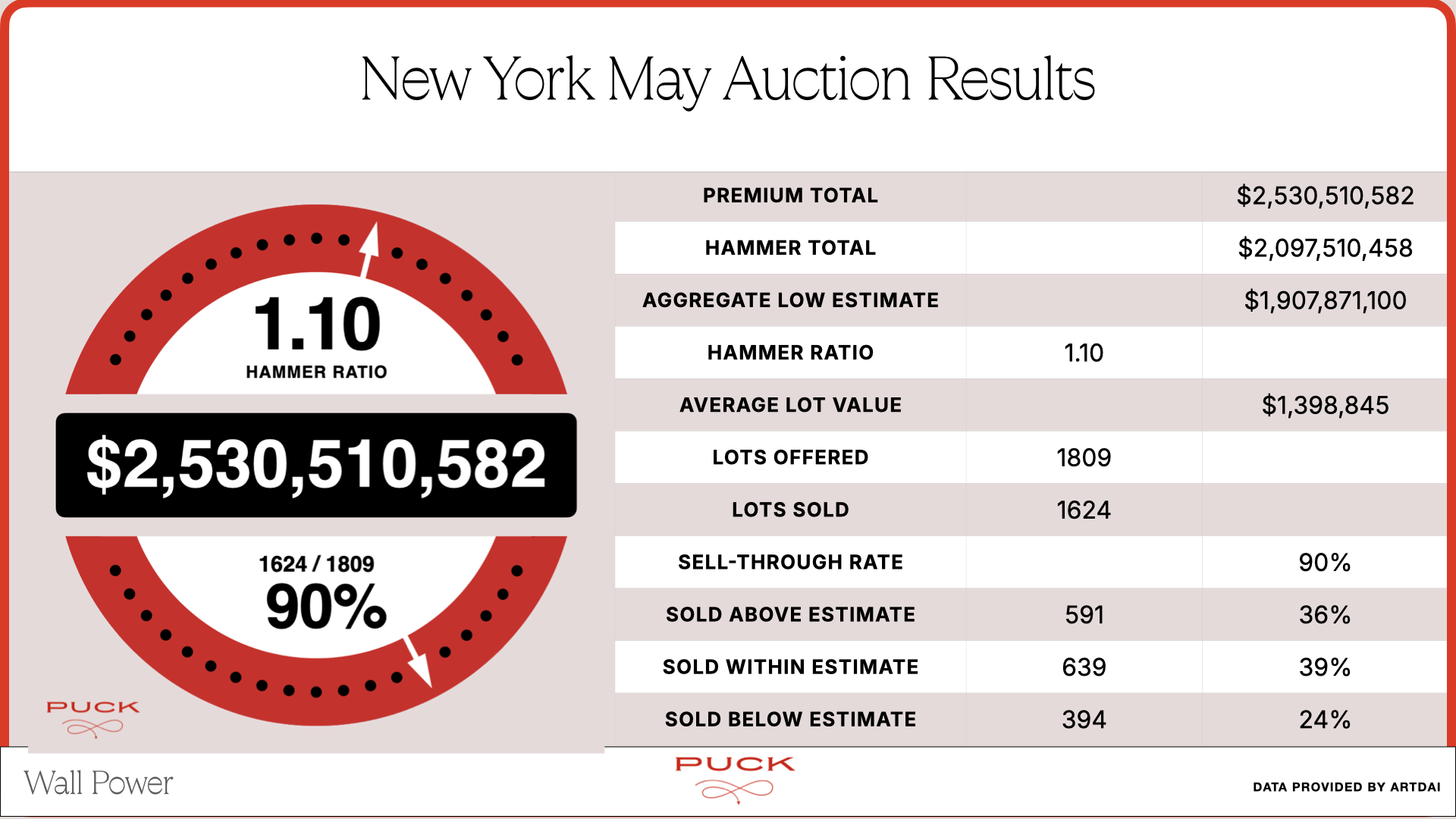
high-value supply came back to the art market in May, with sales totaling $2.5 billion. But the comeback may not be quite as roaring as it appears: Unimpressive hammer ratios reveal buyers’ willingness to pay, but not more than they have to. |
|
|
|
New York’s apex sales event, the May auction cycle, has been fascinating to behold. Over the past
year, the art market has come roaring back—at least in terms of the raw numbers. That caveat isn’t meant to suggest that there’s some hidden weakness in the market. Quite the opposite. As I’ve been telling you for some time, the bottom of the art market has gone from strength to strength, but the missing element—the sex appeal, if you will—has been the big money at the top. And that’s returned in a very big way this season.
In May 2025, eight works were offered with estimates of $20
million or more. Only six of them sold, accounting for $214 million out of a $1.25 billion total for the entire sales cycle. One of the signal failures of that season was an Alberto Giacometti bust, priced at $70 million, that could not generate any interest from bidders. It went back to its consignor unsold, and the public perception was that the art market, already punch-drunk from two years of declining sales, was wobbling. |
|
|
|
A MESSAGE FROM OUR SPONSOR |
Inspired by football fandom and Britain’s love of the beautiful game, the campaign captures the anticipation and
camaraderie of match day – come rain or shine – with an all-star cast of familiar faces.
Learn More |
|
|
|
This season, lured by a healthy dose of optimism from last fall’s Lauder sale at
Sotheby’s, high-value supply returned to the market. A number of collections were on offer, but none bigger than the group of works selected from the late Si Newhouse Jr.’s still-ample holdings. Those 16 works, including two projected at $100 million, had a combined estimate of $462 million and achieved a final hammer total of $540 million. In other words, the collection outperformed the estimates by $78 million, and three-quarters of that performance came from a single lot: the
Jackson Pollock drip painting that was bid to $157 million. The remainder came from a Joan Miró painting estimated at $25 million that hammered at $46 million, and a Pablo Picasso Tête de femme painting that was bid to a $12 million hammer price over an estimate of $6 million. These three lots accounted for the overage that made the Newhouse sale a confidence-building success.
My point here is that the top of the market is
volatile, and these numbers can be hard to predict. That’s why one of the most impressive aspects of the Newhouse sale was how the collection was packaged to entice a large guarantee (first from Christie’s, then from a single third-party backer), but also covered the bases by exceeding expectations. Under slightly different circumstances, the three lots that drove the sale might have been a combination of the Brancusi, Matisse, and one of the
Johns paintings. There really was no way of knowing, considering the very small pool of potential buyers—a few dozen at best.
Keep in mind the difficulty of predicting what will excite a very small number of very rich people when I tell you this: The difference between last May’s $1.25 billion in sales and this year’s $2.5 billion came down to 27 lots—drawn to auction on a new wave of confidence—that sold for more than $20 million apiece, for a total of $1.26
billion. Those 27 very-high-value sales this year, compared to six last year, accounted for the swing in perception between a weak market and a solid one. |
The two main takeaways from the May auctions are the positive hammer ratio and the high
sell-through rate. After multiple years of weak results, when estimates were above where collectors wanted to bid, everyone should breathe a sigh of relief seeing a positive hammer ratio of 1.1. (As always, a useful primer: The hammer ratio is the aggregate hammer price of all sold lots divided by their aggregate estimate.)
Christie’s dominated the season with 57 percent of the value of these sales; Sotheby’s had 36 percent; Phillips nearly 6 percent; and Bonhams got a little more than 1
percent. The overall hammer ratio at Christie’s was 1.12, helped along by the 1.16 hammer ratio for the Newhouse sale. That’s slightly higher than the ratios at the rest of the houses, which came in at 1.08 for Sotheby’s, 1.06 for Phillips, and 1.04 for Bonhams.
But let’s not get carried away—a 1.1 hammer ratio is good but not great. Some of the tempered enthusiasm comes down to the high-value lots mostly selling for prices close to the estimates. This auction cycle showed a volume
increase in high-value lots, but not a step change in pricing. In other words, people are willing to buy very expensive lots, but they’re not eager to pay any more than they have to, or substantially more than anyone else has paid for similar works. The art market remains range-bound. |
|
|
|
The 90 percent sell-through rate is more of a surprise. We’ve come to expect heavily managed
evening sales, but that kind of rate for all 1,800 or so lots requires real demand in the marketplace. At the same time, there’s real discipline among buyers: The breakdown of sold lots shows that 36 percent of them went for prices above their estimate range, 39 percent for prices within, and only 24 percent for prices below expectations. That’s a balance in favor of an advancing market, but it’s still quite restrained. |
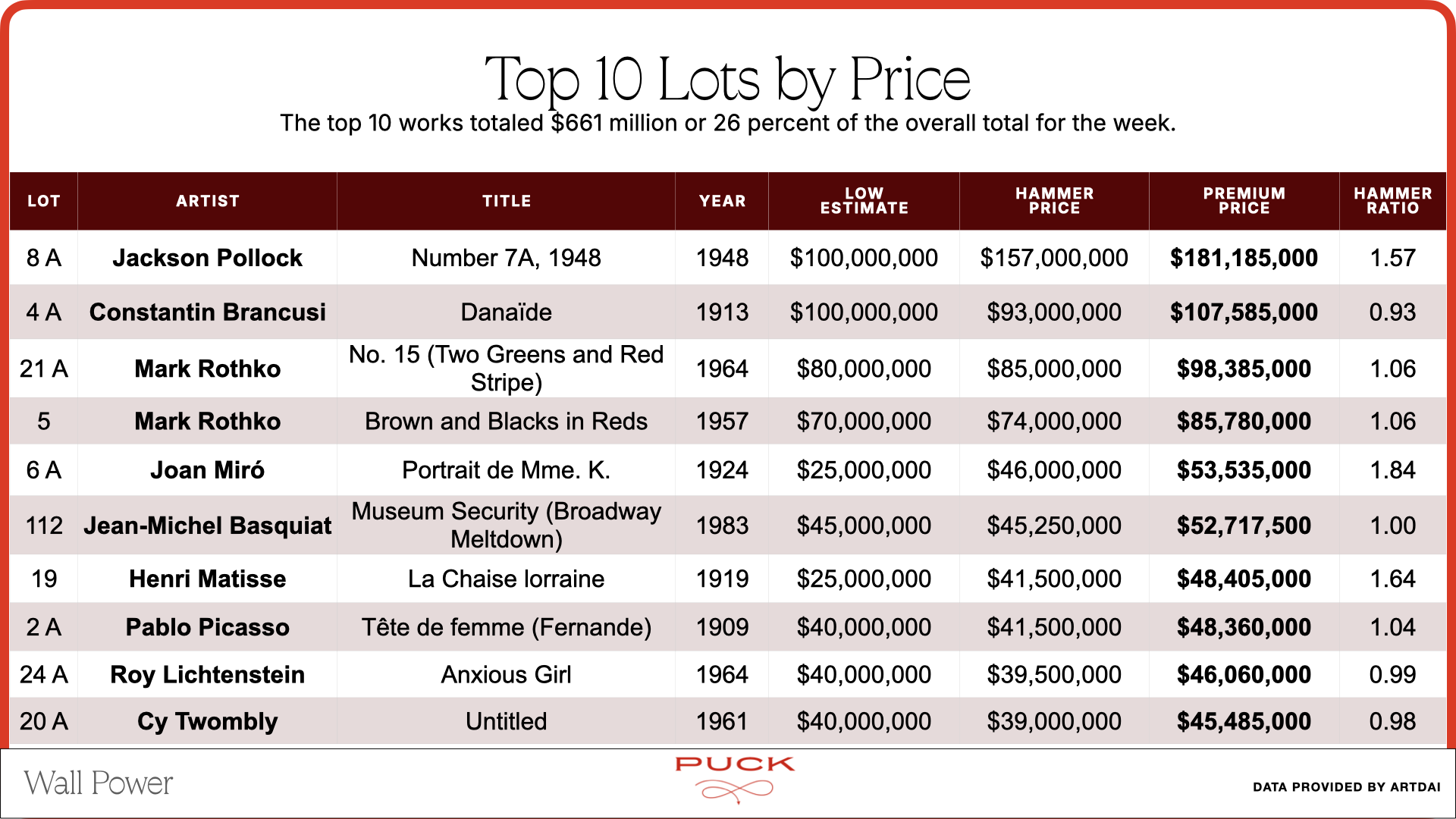
Matisse’s La Chaise lorraine, from 1919, was one of just three lots in the top
10 to see strong bidding, alongside the Pollock and Miró from the Newhouse collection. But the majority of the works sold for prices at or below the estimates. This reflects the presence of third-party guarantees on all the top lots. |
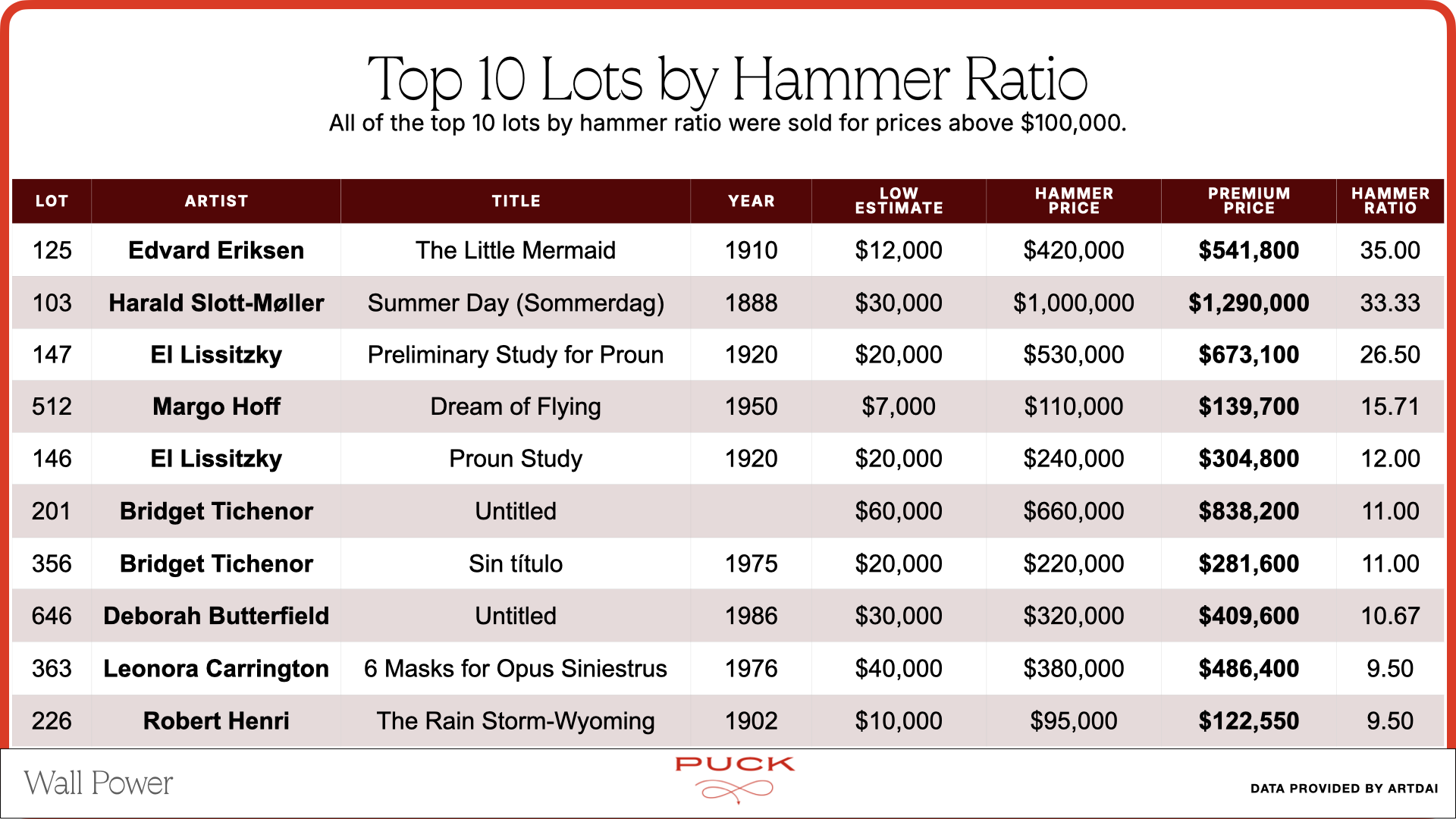
The top 10 list by hammer ratio serves as the best evidence that the market has fully turned toward
historical art. These are the objects that were subject to the most intense bidding and elevated to the highest multiple of the presale estimates. There are works by Danish artists Edvard Eriksen and Harald Slott-Møller from Phillips’s Loeb collection; two pieces by El Lissitzky, a figure from Russian suprematism; and two by Bridget Tichenor, a British surrealist who spent the latter part of her life in Mexico
City, where she was close with Remedios Varo and Leonora Carrington. A third Tichenor sold exceptionally well in these sales, too.
The list was rounded out with a work by Margo Hoff that the consignor had purchased only two years earlier on a whim, for a fraction of the price it sold for; a Deborah Butterfield sculpture; a work by Carrington; and an American painting from Robert Henri. The most recent
work on the list was made 50 years ago.
The prices on the list of works with the most-dynamic bidding are also much higher than they have been in recent years. All of those works were purchased for six-figure sums; one sold above $1 million. Although buyers are cautious about paying too much in general, when they do decide to go all out, they seem willing to spend much more today than they have in the past three years. That’s what drives the art market forward. |
I have some more interesting points from this dataset that I will share with you in another
newsletter. But we have to leave it here for today. I’ll be in touch again on Friday.
Yours,
M |
|
|
|
Puck founding partner Matt Belloni takes you inside the business of Hollywood, using exclusive reporting and insight
to explain the backstories on everything from Marvel movies to the streaming wars. |
|
|
|
Unique and privileged insight into the private conversations taking place inside boardrooms and corner offices up and
down Wall Street, relayed by best-selling author, journalist, and former M&A senior banker William D. Cohan. |
|
|
|
Need help? Review our
FAQ page or contact us for assistance. For brand partnerships, email ads@puck.news.
You received this email because you signed up to receive emails from Puck, or as part of your Puck account associated with {{customer.email}}. To stop receiving this newsletter and/or manage all your email preferences, click here. |
Puck is published by Heat Media LLC. 107 Greenwich St., New York, NY 10006 |
|
|
|
|