 |
|
Welcome to The Best & The Brightest, coming to you a day later than usual thanks to the long weekend. But for Republicans in Washington, the weekend was almost certainly not sleepy. Mitch McConnell’s latest health episode (his second “freeze up” in as many months) has accelerated conversations about his tenure, potential successors, and the true source of his unusual power. My thoughts, below. Plus a conversation with veteran Capitol Hill insider Abby Livingston about the succession timeline and what comes next.
|
|
|
| Congress is back in session today after the summer recess, and the biggest topic of conversation on Capitol Hill isn’t the possibility of a government shutdown, the size of the next Farm Bill, or even a possible House impeachment of Joe Biden. It’s the future of Mitch McConnell, and whether the longest-serving party leader in the history of the Senate can continue to steer his 48 Republican colleagues in the upper chamber after a second unsettling health episode that played out on camera in Kentucky last week.
We’ve all seen the clip by now: McConnell at a press conference in Covington, suddenly going mute, frozen and peering through his signature round spectacles into the middle distance, as his aides and reporters waited nervously for him to say something, anything. The moment looked almost identical to his “freeze up” at a press conference in the Capitol in July. It was also darkly ironic that the 81-year old McConnell seized up just as a reporter asked him for comment on whether he’ll run again in 2026, which would be his eighth term in the Senate.
I stopped trying to predict the future in politics a few years ago, probably around the time I filed my last story for CNN in 2015 about Jeb Bush becoming the likely G.O.P. presidential nominee. But I’ll tiptoe out on a limb here and say with confidence that McConnell won’t run again when his term expires in a few years. With or without the viral on-camera freeze-ups, McConnell is canny enough to know that his age and now-obvious health issues could turn a re-election campaign, at age 84, into an ugly spectacle. And McConnell, who is understandably a guardian of his own legacy, will presumably be more circumspect than egomaniacal.
McConnell, after all, has been the switching yard of Republican politics for decades—an institution, literally, who is one of few politicians alive with a museum already dedicated to himself while he’s still in office. The McConnell Center at the University of Louisville is filled with totems from a career spanning decades, going back to his time as Jefferson County Judge. There’s a TV in the exhibit hall that airs McConnell’s old campaign ads, including the legendary “Bloodhounds” commercial from his first Senate race in 1984. The ad was dreamed up by the media consultant on that race, Roger Ailes—just one of many bold-faced G.O.P. names that have drifted in and out of McConnell’s orbit over the years. His roster of former staffers is familiar to anyone who has ever done business on K Street or scanned the pages of The Washington Post: Steven Law, Josh Holmes, Scott Jennings, Billy Piper, Rohit Kumar, and many more.
To Democrats, of course, he’s evil incarnate, a turtle-faced Darth Vader roadblocking progressive legislation at every turn and spiking judicial appointments, most infamously Merrick Garland’s elevation to the Supreme Court at the end of the Obama administration. He’s a man without principle, willing to cut deals with anyone, even Donald Trump, as long as it serves the goals of the Chamber of Commerce, the NRA, The Federalist Society, Americans for Tax Reform, and whatever other interests hold sway in Republican politics.
But McConnell’s legion of allies are so devoted to him for many of the same reasons: he possesses almost every single skill required to win the entire inside game, and always finds a way to find the deal. McConnell understands the Senate intimately, of course. But he’s also a wise campaign tactician, a student of public opinion, a prolific fundraiser, someone who can cultivate power in every room while also tending to the boring stuff—local press, constituent services—that keeps him powerful back home in Kentucky.
This realpolitik explains why so many Capitol Hill reporters are awestruck and often deferential to the man, as he slyly grins at them while dodging their questions. But they’ll certainly be watching as McConnell works to manage perhaps the most important deal of his career: his own succession. |
|
|
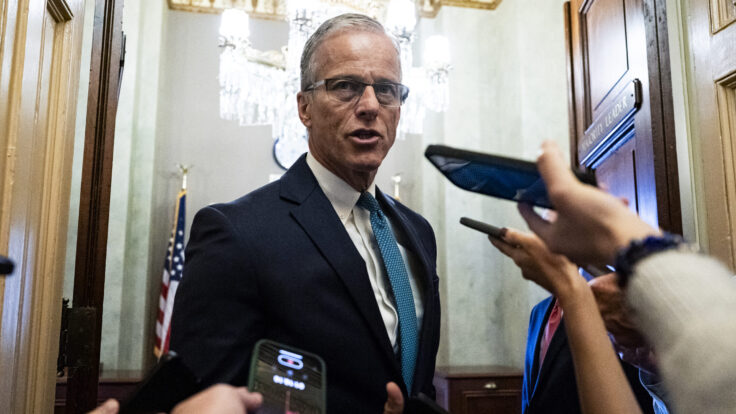
| The main question is whether McConnell—the longest-serving party leader in Senate history—will remain the head of his caucus for the rest of his term. That seems doubtful, given the careful language we’re hearing from his allies (deputies like John Thune) and would-be rivals (Rick Scott). When asked about McConnell’s health, most Senate Republicans are saying roughly the same thing: We’re with McConnell until the 2024 elections, and then we’ll see what happens.
After that, in 2025, it seems likely that McConnell will remain in office but at long last step aside as leader, and spend his final two years in Washington coaching up his successor—much like outgoing Capitol Hill legend Nancy Pelosi is quietly doing right now with Hakeem Jeffries, the new Democratic leader in the House. But I do wonder if McConnell will even make it through 2024 as leader. Capitol Hill physician Brian Monahan wrote in a new letter, released Tuesday, that McConnell is fine to continue working, saying he’s undergone a series of neurological tests and consultations since his first freezing episode earlier this summer. Still, despite those assurances, and whether or not McConnell starts drinking more water, we still have a long way to go until the end of next year.
When McConnell finally retires, his critics will say good riddance. But it’s worth considering that McConnell, unlike so many politicians in the current Republican freak show, is fundamentally an operator, not an attention-seeker. He has long been willing to cut deals with Senate Democrats—and President Biden—to avert government shutdowns and economic crises. Would Senate Republican Leader Ted Cruz do the same?
Two quotes from McConnell are worth keeping in mind as he contemplates his future in the coming months. One of his favorite campaign maxims, according to his biographer John David Dyche, is this: “If someone flicks a pebble at you, hurl a boulder back.” And then there’s something McConnell told me, back in 2014, when he was gearing up to crush a rare primary challenger, the loud-mouthed businessman (and later governor) Matt Bevin. "Winners make policy,” he told me. “Losers go home.”
Both of these quotes define McConnell’s political worldview. The maintenance of power, however cold-blooded or ruthless, is all that matters. Now, as he faces questions about his fitness to lead, it seems obvious that McConnell, more than anyone around him, has to be aware that his power is slipping away. |
| McConnell Succession Odds |
|
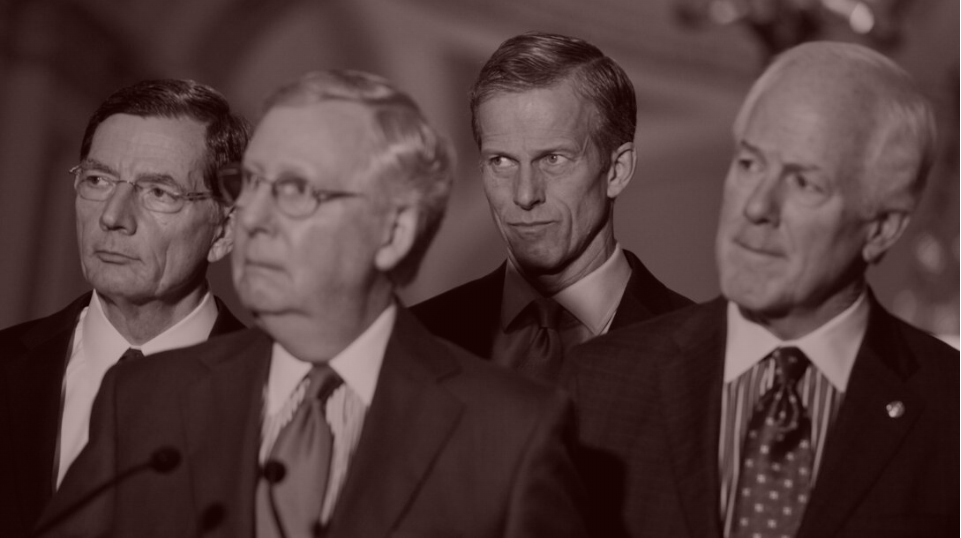
| For more on the McConnell health fallout, I asked my Puck partner Abby Livingston, our veteran Capitol Hill insider, for some fresh insight into what’s going down in the Senate G.O.P. caucus this week—including the latest buzz she’s hearing about the “Three Johns” and which Republican will succeed McConnell when he eventually steps down as leader.
Peter Hamby: Congress is back in Washington today after the summer recess. What are Republicans on the Hill saying about McConnell? Will he step aside, either from leadership or even from his seat?
Abby Livingston: The House (and all its drama) won’t be back in full swing until next week, so all eyes will be on McConnell on Wednesday, when he hosts his weekly news conference outside the Senate chamber.
As for the future of the Senate G.O.P caucus, it feels very much up in the air. There is zero indication that Senate Republicans are prepared to take dramatic action, and zero indication that McConnell is considering stepping down in any capacity in the near term. But this is feeling less sustainable each time there is an incident.
What is most immediately on people’s minds is the fact that McConnell will be entering one of the most chaotic legislative seasons in decades. The House and Senate Republicans will be at loggerheads over a potential government shutdown and a whole bunch of other bills that will cause upheaval in daily American life if they don’t get passed. And the House appears determined to impeach Joe Biden and/or other government officials. Should they do so, the Senate will be tasked with dealing with a trial. In this context, it seems the second freezing incident has unnerved a number of people on the Hill.
We’ve talked in the past on The Powers That Be podcast about the “Three Johns” who might succeed McConnell as Republican leader: John Barrasso, John Thune, and John Cornyn. Which of them, in your mind, seems like McConnell’s most likely successor?
John Thune is the second-ranking Senate Republican, and appears to have stepped into leading the conference in various ways in McConnell’s absence, beginning this spring after McConnell fell and was hospitalized. Based on my own personal experience with dramatic newsroom transitions—and just common sense—that kind of situation is enormously advantageous for the No. 2 guy. Plus, Thune is a traditional conservative and, interestingly, knocked off a past Senate majority leader in Tom Daschle in 2004.
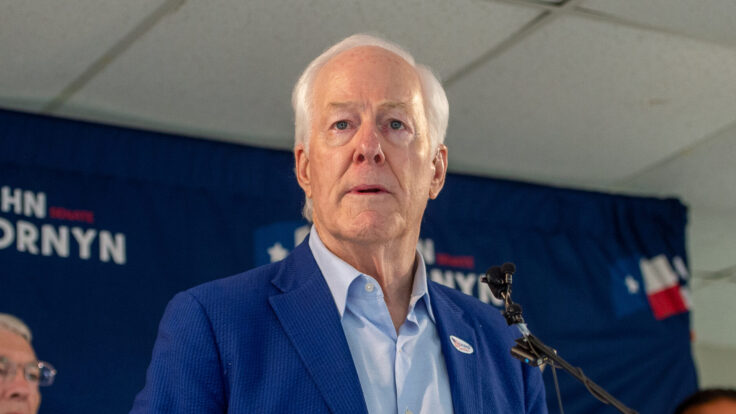
I’m more familiar with Cornyn, having covered his Senate campaigns. Some observers may know him for his edgy tweets—he lets the world know when things get under his skin—but he’s personally beloved within the Senate. He previously served in Thune’s leadership slot (Republican Senate whip) until G.O.P. conference term limit rules forced him to step down. Even so, he’s been McConnell’s right hand and carries profound de facto power.
During his time as whip, Cornyn often had a mantra of “preferring the carrot to the stick.” And Republican senators tell me he’s good with the personal touches—birthdays, anniversaries, that kind of thing. He also ran the N.R.S.C. during nightmare cycles in 2010 and 2012, when Republicans should have won the Senate but lost out on seats because bizarre, unelectable Republican candidates made it through their primaries. But Cornyn’s tenure was well-regarded, and he did help a number of senators win in those cycles who are probably endeared to him.
The central question about his prospects goes back to the 2022 school shooting in Uvalde, Texas. Cornyn sprung into action within hours and managed to push through the most significant gun bill in decades (a low bar, sure). No one thought it was possible, including me. But he pulled it off, which shows he knows how to count votes. That said, I was startled with how angry some Republican senators were about the whole thing at the time. It’s an open question that I don’t know the answer to, whether that bill will help or hurt him.
And then there’s John Barrasso. At this point, the conventional wisdom is that he’s the least likely to win a leadership race among these three. But I have some vehement sources in my ear who insist he’s a dark horse to watch. They argue that Barrasso has more followers among the anti-McConnell faction in the Senate, along with younger, more conservative Republicans who aren’t quite willing to blow the place up but who still identify with him.
Big picture, what does the Senate Republican caucus look like without Mitch at the helm? Are we going to see MAGA chaos creep in, as it has in the House?
MAGA chaos is gonna creep into the Senate with or without McConnell. What started out as a small far-right trio ten years ago—Ted Cruz, Mike Lee, and Rand Paul—has grown over the cycles as senators retired. Every time a Bob Corker leaves, the chances are high that a less-mainstream conservative like Marsha Blackburn is going to replace him. In fact, there’s a fair case to be made that the Blackburns are the mainstream of the conservative movement now.
As for a future without McConnell, it’s a bit unfathomable. He’s been leading the Senate Republicans for my entire journalism career and the careers of many on the Hill. It’s not unlike Pelosi and the House. But there was a soft launch for Jeffries, her successor, because a House minority has almost no power, and has time and space to learn on the job. Republicans could have a sturdy Senate majority after this cycle and, with that, real responsibility. And even if they fall short of winning the Senate, there is a great deal of tactical savvy required of the Senate minority leader, due to the filibuster and confirmations. Whatever happens, though, it seems likely that the Senate will become a much less predictable place in a post-McConnell era. |
|
|
|
| FOUR STORIES WE’RE TALKING ABOUT |
 |
| Summer Strike Finale |
| Fran’s whereabouts, the studios' strategy, and more. |
| MATTHEW BELLONI & JONATHAN HANDEL |
|
 |
|
 |
|
 |
|
|
|

|
 |
|
|
|
Need help? Review our FAQs
page or contact
us for assistance. For brand partnerships, email ads@puck.news.
|
|
You received this email because you signed up to receive emails from Puck, or as part of your Puck account associated with . To stop receiving this newsletter and/or manage all your email preferences, click here.
|
|
Puck is published by Heat Media LLC. 227 W 17th St New York, NY 10011.
|
|
|
|