 |
| Hello, and welcome back to The Best & The Brightest, your Tuesday foreign policy edition.
It’s been a crazy day, with Tucker Carlson copping to the fact that he’s in Moscow to interview Vladimir Putin and Republicans failing to impeach D.H.S. Secretary Alejandro Mayorkas.
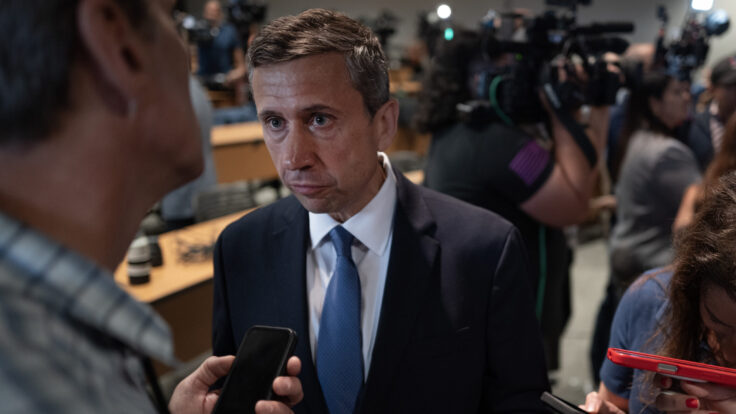
So let’s get right to it: Who’s afraid of Brett McGurk?
But first, Abby Livingston has the latest fallout from the Capitol… |
|
|
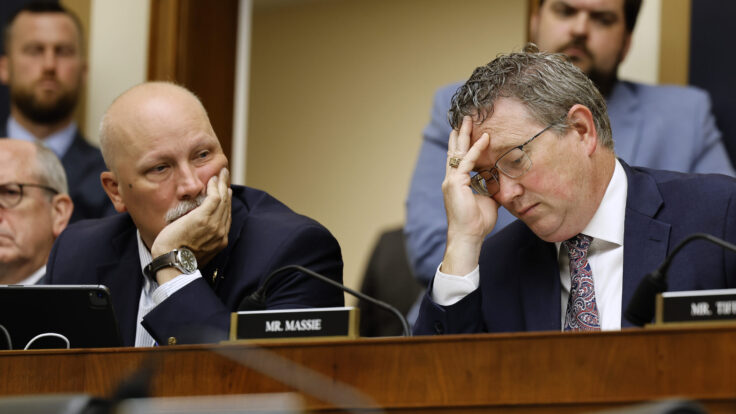
There’s nothing new about mayhem in Congress, but even compared to the most dramatic moments on the Hill during the last 10 years—Boehner’s resignation, the tortured healthcare votes of 2017, the baseball game shooting, the insurrection, the Trump impeachments, the rise and fall of McCarthy—this week still felt different. Perhaps the most profound testament to the insanity of it all is the fact that a failed floor vote to impeach a cabinet official is not even the headline of the week. Many vectors of crazy are now intersecting, and the number of abnormal situations on the Hill are beginning to compound each other. Here’s why:
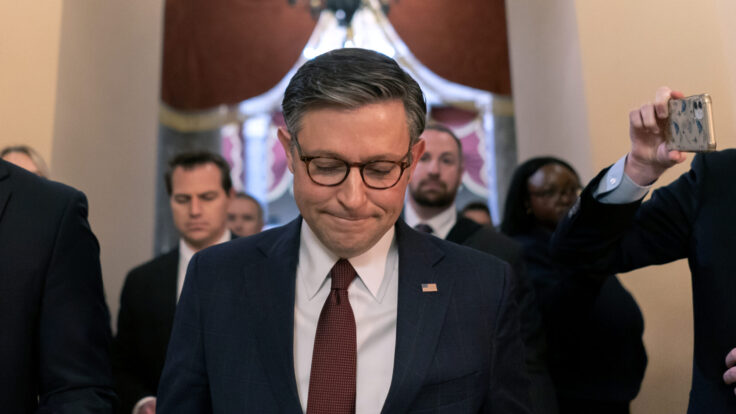
- The Mayorkas embarrassment: Speaker Mike Johnson endured a catastrophe-for-the-ages floor vote on Tuesday evening when he couldn’t marshal enough Republican support to execute the Republicans’ ambitions to impeach somebody, anybody from the Biden administration. After a day of scrambling, the vote to impeach Alejandro Mayorkas failed by 216 to 214. Past dysfunction, of course, haunted the tally—if McCarthy and George Santos had managed to stay in Congress, the impeachment would have succeeded. It’s always a problem when a bill fails on the House floor—most party leaders will pull a bill before it fails, unless they’re trying to make some sort of point or put opposition members on the record on a dicey issue. But on impeachment? Nevertheless, Johnson’s office is already pledging to bring this bill back to the floor on a better day when it comes to the margin—presumably after Steve Scalise returns.
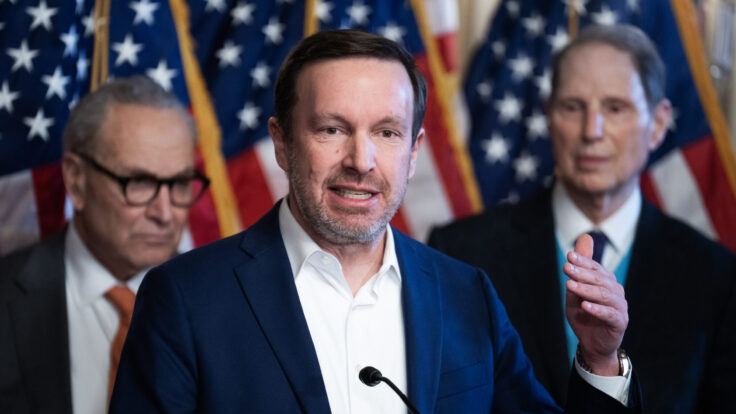
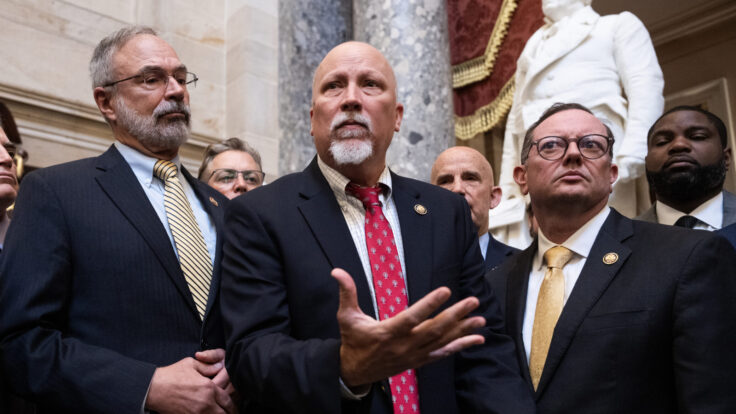
- The Mitch backlash: Meanwhile, over on the Senate side, Rick Scott led a troop of hard right Republicans—Mike Lee, Ted Cruz, Roger Marshall, J.D. Vance, Ron Johnson, and Eric Schmitt—in dumping all over their leadership during a Tuesday news conference. Scott, you’ll remember, unsuccessfully challenged McConnell for the minority leader job after the 2022 midterms, and there is a deep animosity over Scott’s chairmanship of the N.R.S.C. that cycle. But it was that other McConnell antagonist, Cruz, who went for the jugular, flat-out saying it was time for McConnell to step down.
- Even the Dems are pissed!: Everyone on the Hill seems to be enraged with someone else, but Democratic pique is also nearing the high watermark. Senate Democrats are furious with their Republican colleagues for stringing them along for months during the border negotiations, only to pull their support over the course of a few hours on Monday. Wednesday’s vote, of course, is still on, and after placing a few calls I sensed some Democrats are eager to cast their vote, even if the results are a fait accompli. They’re eager to have Republican colleagues on the record voting against conservative border policies, and subsequently use that hypocrisy as a political cudgel.
|
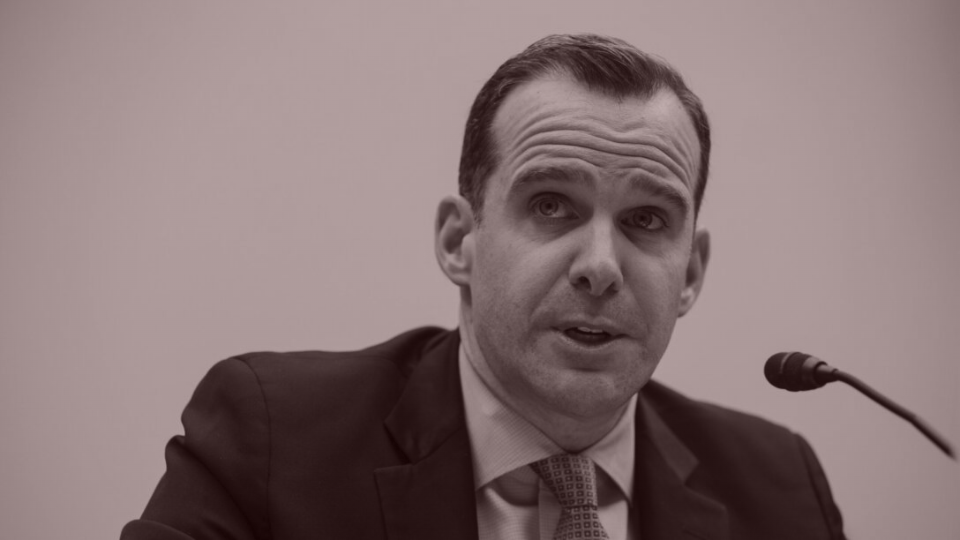 |
| Who’s Afraid of Brett McGurk? |
| Everyone in Washington has an opinion of McGurk, the controversial Blob star, president whisperer, and veteran foreign policy player. But is he a cunning opportunist or simply the best diplomat in a town filled with them? |
|
|
|
| Everyone in Washington, it seems, loves to hate on Brett McGurk. “I don’t think I’ve ever met anyone who likes him,” one former senior State Department official said of the seemingly indestructible D.C. lifer who is currently President Biden’s Middle East coordinator on the National Security Council. “Literally, at the end of my book club the other night, this came up. Every administration, he gets promoted one level up and no one understands why. How did he get here? Everyone in town has the same question, and no one has a good answer for it.”McGurk didn’t set out to be a D.C. lightning rod. He was going to be a lawyer, but 9/11 changed all that. When the plane slammed into the Pentagon, a young McGurk was across the river at the Supreme Court, where he had just begun a clerkship with Chief Justice William Rehnquist. But like so many people of his generation, he became infatuated with the Middle East. People rushed to sign up for Arabic and Middle East history classes; others enlisted in the military. McGurk was pulled in, too, but through a different route. In the fall of 2003, several months after America’s invasion of Iraq, a friend called him and offered him a once-in-a-lifetime opportunity: Did he want to help write the Iraqi constitution? McGurk spoke no Arabic, but it seemed like an interesting and important job. He went.
In the decades since, McGurk has worked for every single U.S. president, influencing every single policy affecting the region, often in deeply influential ways. After joining George W. Bush’s N.S.C., he produced a report in 2006 on the situation in Iraq, which was then spiraling into civil war, which led to the “surge” in 2007. Somehow, Barack Obama, elected on an anti-Iraq War platform, asked McGurk to stay on. Later, after McGurk took a sabbatical from public service at the Council on Foreign Relations, Obama called him up again, in 2010, to help figure out how to get the bulk of American forces out of Iraq while leaving a small presence in the country. In this role, McGurk is said to have advocated for entrusting the country to Nouri al-Maliki, a Shiite politician who had spent years in exile in Iran. McGurk had a relationship with al-Maliki and he had Obama’s ear. Al-Maliki got the nod.
Experts point to this decision as pivotal and disastrous. Al-Maliki cracked down on the Sunni minority, installed his own cronies in key military posts, and inadvertently created the optimal conditions for ISIS to sweep from Syria into Iraq: a soil fertile with Sunni grievance and an incompetent Iraqi military that melted away after ISIS appeared. Later, as the man Obama charged with coordinating the fight against ISIS, McGurk advocated for arming the Kurds, which enraged Turkey. (Erdogan publicly called for his ouster.) Busy as he was, McGurk said he never had time to learn Arabic.
Washington is a small town with a long memory. And because McGurk has spent two decades helping set American Middle East policy, almost everyone in the Blob can point to something they hate him for. Progressives hate him for being soft on Israel, conservatives hate him for being soft on Iran. Staties hate him for not speaking Arabic, the Pentagon hates him for circumventing their bureaucracy. Lefties hate him for cozying up to dictators, the Turkish government hates him for cozying up to terrorists. The policy wonks hate him for not being a true regional expert, the spooks hate him for being a slick D.C. operator. D.C. operators hate him for kissing up and kicking down, while D.C. women hate him for being a white man who keeps failing up—and on and on it goes.
To hear his detractors tell it, McGurk has been responsible for, single-handedly, bringing about the rise of ISIS, ruining America’s relationship with Turkey, enriching Iran with “pallets of cash,” strengthening Iranian proxies while also rehabilitating Bashar al-Assad and M.B.S., throwing the Palestinians under the bus with the Abraham Accords, and—if you can believe it—creating the conditions for Hamas’s October 7 attack. As a former senior C.I.A. officer put it more succinctly, “What a dickhead.”
But it is the left that hates McGurk most of all, casting him as a swashbuckling neocon who sees the Middle East as a laboratory for American policy, with no concern or empathy for the people on the ground and how such policy can make or break their lives. For McGurk, they believe, human rights are not a core mission; they’re a nice-to-have. Muslim and Arab American progressives, meanwhile, think they see shades of Islamophobia and anti-Arab sentiment in his approach, as well as what they perceive as a general, almost colonial arrogance about the region, one that is so deeply personal to them. “People who are progressive on the Middle East have always had an eyebrow up on him,” says a source close to the administration. “He’s been among the most hawkish of the people in the White House.”
As the war in Gaza bleeds into its fifth month, as the death toll rises and emotions continue to boil over, McGurk has become D.C. progressives’ chief antagonist—the incarnation of everything they think the Biden administration has done wrong since October 7. “The situation in Gaza has been a very emotive one for the progressives, and anyone who is seen as the frontman of those policies is going to come in for criticism,” said Charles Lister, who heads the Syria and Countering Terrorism & Extremism programs at the Middle East Institute. “You can’t lay the blame in one person’s lap, but it’s become very popular to do so.”
The White House, for its part, strenuously defended their man. “Brett has dedicated his career to government service at the highest levels, has spent years developing regional expertise in the Middle East, and has seen how U.S. policies impact people up close,” said Kate Waters, deputy spokesperson for the N.S.C. “He has shown unparalleled dedication to his country across four administrations of both parties. Those who work with Brett closely know him to be someone who is respectful, open to being challenged, but always forthright about what he believes. In recent years, Brett’s work has directly resulted in the successful implementation of multiple complex and secret hostage deals and the development of a military and diplomatic campaign to defeat ISIS. He has deep relationships across the Middle East, which have proven essential at times of crisis. We are lucky to have him as a colleague.”
“Brett McGurk has struck up relationships with several presidents and has made himself indispensable,” added Andrew Exum, who served as the deputy assistant secretary of defense for the Middle East in the Obama administration. “Brett has been a part of every major U.S. policy in the region, and if you are a progressive who is unhappy with the current policies of the Biden administration, it’s easy to make Brett some kind of bogeyman.”
“He’s a complicated guy,” a senior State Department official conceded. “In some ways, he’s an easy foil, maybe a deserved foil.” |
|
|
| There’s nothing quite so Washington as finding a gray cardinal to rag on, but the obsession with this particular bureaucrat reveals as much about the city as the bureaucrat, himself. “I think you can make the argument that Brett McGurk is the most important U.S. diplomat in the region since Henry Kissinger,” said Exum. “But because he has been at the center of some controversial policies, and because he has been so effective across several administrations, both Republican and Democrat, because he’s been much defter at advancing his policies, that inspires a lot of petty jealousies from career diplomats and military folks. Let’s just say that there are a lot of people in this town who have lost policy debates with Brett McGurk.”There were some policy debates that McGurk thankfully lost. “He knows a lot about Iraq, but when you get him out of Iraq, he doesn’t know the region as well,” said a former defense official who worked with McGurk. “Sometimes his instincts are a little bit off. Like, in 2016, he was very in favor of sharing intelligence with the Russians to target Islamists in Syria. It was a bad instinct because he just didn’t know the Russians and the Syrians.”
The other major policy that McGurk’s detractors pin on him is the Abraham Accords, the Trump administration project of helping Israel normalize diplomatic relations with Arab countries. The Accords were popular in Israel and among the American right for the same reason they were reviled by progressives: They allowed Israel to ignore the Palestinians and kick the can down the road on a real and durable solution to the issue. “I think it’s certainly fair that he’s always been the champion of normalization at any cost,” said the senior State Department official. “The obvious criticism of it is that we swept the Palestinian problem under the rug, and it’s certainly true that Brett was the leading purveyor of that approach.” After normalization with several states—Morocco, the Emirates, Bahrain—the crown jewel, normalization with Saudi Arabia, the seat of the Muslim world, seemed almost within reach.
From the view of McGurk’s critics, this approach led directly, and inexorably, to October 7. The attack, these critics argue, was a way to preempt any deal with Riyadh and to announce that the Palestinians would not be ignored. The fact that Israeli-Saudi normalization talks are not just back on the agenda after October 7, but that they seem to be the plan to solve decades of Israeli-Palestinian conflict, infuriates progressives even more. Why, they argue, try a policy again when it was already a demonstrable failure once? “Every policy issue that he has worked on over the last decade has been an abject failure and yet somehow he remains the key adviser for multiple presidents,” the former senior State Department official mused. (The White House disputed this vociferously. “There is a deeply embedded view that there was not a Palestinian component to normalization, and that could not be more wrong,” a senior administration official told me. “The N.S.C. and State had finalized the week before October 7 a plan on the Palestinian component, one that included a path to a Palestinian state.”)
People are also baffled by the fact that, after 20 years of focusing on the Middle East, McGurk, as one person who worked with him said, still doesn’t speak “a lick of Arabic.” Some of that is standard, intra-Blob sniping—it exists in the Russia field, too, where rivals’ expertise is called into question if they lack fluency in the local languages—but some of it is legitimate: How well can you really understand a place if you can’t understand its language and rely solely on interpreters? “You can’t be the Lawrence of Arabia if you don’t speak Arabic, you just can’t,” said another former C.I.A. officer who spent decades working in the Middle East. Others disagree. “That’s a little unfair because to be effective in policymaking it’s much more about your judgment and temperament than how many years you spent learning standard Arabic,” said the defense official, who speaks Arabic. “That’s the reality.”
Then there’s the fact that, in 2012, Obama nominated McGurk to be ambassador to Iraq—at the age of 39—only for McGurk to withdraw his nomination after racy correspondence (known in D.C. as the “blue balls emails”) surfaced between McGurk and his wife, Gina Chon. At the time the emails were sent, in 2008, Chon and McGurk were still married to other people, and Chon was a reporter for The Wall Street Journal in Iraq, covering American forces and administration in the country—i.e., people like McGurk. (Chon, who now works for Semafor, had to take a leave of absence from the Journal.)
Some of these gripes are standard and come with the job, but some reflect a frustration that, as much as Washington and America have changed, they haven’t changed all that much. Women and people of color in the foreign policy establishment see McGurk as the embodiment of everything they’re still fighting: a tall, good-looking white guy who, in their view, is judged by a totally different—and much more forgiving—metric. “He’s unconfirmable but the fact that that is widely known and he has been able to rise and remain in these positions is something that would only happen to a white man,” said the former State Department official, a woman. “If you and I had that track record,” another source close to the administration, also a woman, told me, “we wouldn’t have jobs.” |
|
|
| And yet, it’s hard to argue that all of McGurk’s policies were disasters. The decision to arm and partner with the Kurdish militias became one of the keys to defeating ISIS. It’s also hard to dispute that ISIS was, in fact, defeated, all on McGurk’s watch. On Iran, those “pallets of cash” helped bring home imprisoned Americans, like Washington Post reporter Jason Rezaian and his wife, Yeganeh, an Iranian journalist. “He’s an honorary Rezaian, as far as we’re concerned,” Jason told me when I asked him how he sees McGurk. “He was instrumental in making sure that Yegi didn’t get left behind,” he continued. “The IRGC tried really hard to not let her get her on the plane, and Brett wasn’t having any of that. And I don’t know if we’d have ever been reunited if it weren’t for Brett.”McGurk, Rezian said, was there to meet them when their plane landed in Switzerland and, when the Rezaians arrived in Washington, McGurk and Chon helped them get settled and became their close friends. So when I asked Rezaian about the charge that McGurk doesn’t actually care for the people affected by U.S. policy, he said, simply, “Bullshit.”
Others tell me McGurk has been deeply involved in quiet efforts by this administration to get Iranian dissidents to safety. “He’s essential to the most meaningful American efforts to support Iranian civil society in over a decade,” a source familiar with the operation told me.
As for the Saudi normalization efforts, not everyone sees McGurk as the villain in that equation, either. “Normalization can’t be done because of one man and one man only, Benjamin Netanyahu,” said Alon Pinkas, a retired Israeli diplomat and a vicious critic of the Israeli prime minister. “If this was McGurk’s idea, then it’s a good idea. It makes sense. But if you look at the list of protagonists: the U.S., Egypt, Jordan, Qatar, the Emirates, Saudi, Bahrain, Israel, the Palestinians, and if you’re honest, what is the weakest link right now? Israel. Because you have a lunatic government led by a man who has habitually lied to the American president. I can’t fault McGurk for this. What I can fault him for is trying to convince his superiors that he can do it with this government.”
And now, even some of McGurk’s detractors agree that, after everything that’s unfolded in the last four months, the path out of the war in Gaza may very well depend on Riyadh pushing both sides to come to the table. “I know he was discussing the Palestinian component from the very beginning,” said retired ambassador Dennis Ross, who counts himself as one of McGurk’s defenders. “If anything, it probably has a higher profile and has become a more significant part of the deal now.” Most people I speak to agree with Ross.
What’s fascinating about Brett McGurk as Blob Rorschach test, however, is that his critics despise him for the very qualities that his defenders say have made him so appealing to four successive, and very different, presidents. The critics see him as a McKinsey type who thinks every problem has a solution—“the Jared Kushner of the Biden administration,” in the words of the C.I.A. Middle East veteran—while the latter see him as someone who can cut through the red tape and get things done. His critics see him as someone with no moral compass, a realist, while presidents think, Great! A man of action! And in a town where the Trump era fomented its own kind of sectarian war, McGurk’s ability to serve two Republican and two Democratic presidents is seen by some as a sign of cool-headed pragmatism, rather than the stain of a traitor. “He’s the guy that everyone loves to hate because he gets shit done,” said the specialist in the region. “Name another person who’s worked in the last four administrations at senior levels. I don’t think you can.”
When I asked people, including the people who hate him, how McGurk was able to rise so steadily and quickly up the ladder, people had to hand it to him. “He does occupy this space between the namby-pamby diplomats and the buttoned-up generals,” said the former State Department official. “He’s a savvy political operator and has this golden boy persona, as well as what might seem like he just has certainty and answers, whereas the diplomats and the military have to caveat everything. If you’re a high-level policymaker, it’s really tempting when someone brings you these solutions that seem very simple and elegant, while everyone else is telling you, ‘It’s complicated.’” |
|
|
| Part of how McGurk ended up where he is in the Biden administration is personal. McGurk was one of the first Republican-proximate foreign policy hands to endorse Biden, with whom he had worked in the Obama administration. And, according to one source who knows the president well, McGurk is part of a small circle of men in the administration—Jake Sullivan, Jon Finer, Amos Hochstein—who remind Biden of his late son, Beau. They are about the age Beau would be if he hadn’t died of brain cancer at 46. These golden boys, the source said, have the president’s complete trust and can seem to do no wrong.But most of McGurk’s position in the Biden White House has to do with policy. In January 2021, Joe Biden, like other presidents before him, had hoped to park the Middle East and not have to deal with it. He wanted to do the same with Russia. Both problems seemed so gnarly and unfixable, at least with the current variables, that it seemed best to manage and contain them while dealing with something that seemed of far more strategic importance: China. McGurk was a trusted old Middle East hand who had relationships across the region and could reasonably be counted on to maintain them, and the status quo. “The stated mission was, ‘Keep the Middle East off my desk,’” said a D.C. think-tanker. “Everyone knows that phrase by now. And everything Brett did was exactly that.”
But as we know, Russia and the Middle East had other plans. Biden, like Obama before him, had planned a pivot to Asia only to be sucked back into these two yawning vortices. For many progressives and the activist left, Biden’s response—bear-hugging the Israelis—was despicable, and in search of a “real” explanation, they found one in Brett McGurk, the gray cardinal. But people both inside the administration and those who have served before emphasize that’s not how things work. The president—this president—has very strong opinions on Israel, just like he does on Ukraine, and, given his own expertise in geopolitics, he is still very much in the driver’s seat on setting policy. “He’s become the avatar of a policy that’s directed by the president and signed off on by principals,” said the senior administration official.
“I think it’s really easy for Americans to internalize Israeli narratives at the expense of the Palestinians because the Israelis speak better English and have more culturally in common with us,” said the former defense official. “Brett would not be the first American policymaker to be overly sympathetic to Israelis at the expense of the Palestinians. And that’s not a Brett McGurk problem, that’s a U.S.-policy-over-the-past-50-years problem. And by the way, that’s also the president.” Added the former defense official, “It’s not like Joe Biden would be wearing a keffiyeh and marching down 16th Street if it weren’t for Brett McGurk.” |
|
|
| That was a long one, I know, so that’s all from me this week. I’ll see you back here next Tuesday. In the meantime, good night. Tomorrow will be worse.Julia |
|
|
|
| FOUR STORIES WE’RE TALKING ABOUT |
 |
|
 |
|
 |
|
 |
| Capitalist Tools |
| Digging into Forbes’ finances as it re-enters auction mode. |
| DYLAN BYERS |
|
|
|
 |
 |
|
|
| Need help? Review our FAQs
page or contact
us for assistance. For brand partnerships, email ads@puck.news. |
| You received this email because you signed up to receive emails from Puck, or as part of your Puck account associated with . To stop receiving this newsletter and/or manage all your email preferences, click here. |
| Puck is published by Heat Media LLC. 227 W 17th St New York, NY 10011. |
|
|
|