{{ 'now' | timezone: 'America/New_York' | date: '%b %d, %Y' }} |
|
|
Hello, and welcome back to The Best & The Brightest. I’m Leigh Ann Caldwell. A
group of Buddhist monks ended their cross-country walk for peace today at the Capitol, where supporters lined up to greet them on the National Mall.
Inside the Capitol, however, there was little peace. It’s been an extremely busy week—and one that hasn’t been especially good for the president or Republicans. House Democrats grilled Attorney General Pam Bondi today about Jeffrey Epstein, and Bondi mostly responded with insults. (She had a
binder apparently filled with members’ search histories from when they viewed the unredacted files at the Justice Department this week.) Meanwhile, a grand jury declined to indict the six Democratic lawmakers who appeared in a video last year reminding members of the military of their duty not to follow illegal orders. The House also voted to rebuke Trump’s aggressive tariff
agenda. And it’s only Wednesday.
Tonight, I’ll bring you inside the Democratic caucus, which is uncharacteristically united over denying further funding to the Department of Homeland Security without new guardrails for ICE. Even most Democrats who oppose government shutdowns as a matter of principle are on board, and they’re confident the politics are on their side. Plus, news and notes on Nancy Pelosi’s redistricting push, Mike Johnson’s Canada headache,
the future of the SAVE Act, and more.
Also mentioned in this issue: Angus King, Catherine Cortez Masto, Gary Peters, Chuck Schumer, John Thune, Geoff Garin, John Fetterman, Shri Thanedar, Nancy Pelosi, Gavin Newsom, Kevin Kiley, Bill Ferguson, Wes Moore, and many
more… |
|
|
Science fuels farmers ability to grow healthy, abundant food for Americans. That’s why companies like Bayer depend on
rigorous, predictable, science-based standards to bring new tools to market for farmers. Innovation isn’t a buzzword, it’s the lifeline that gives growers more options and keeps America’s food supply secure. At Bayer, we succeed when farmers succeed. Learn more. |
|
|
- Nancy
Pelosi would like a word with Maryland: Speaker emerita Nancy Pelosi provided critical support to her home-state governor Gavin Newsom’s redistricting push in California, which will ultimately net Democrats as many as five seats in the state. Now she’s offering to help a similar initiative in her native state of Maryland, a person familiar confirmed, and as The Baltimore Banner was first to report. It’s unclear how she’d do this—whether by rallying her fellow House members
and donor network behind the effort, as she did in California; lobbying reluctant Democratic state senators; engaging the grassroots; raising money; or all of the above. If successful, the Maryland redraw would give House Democrats one additional seat and eliminate all Republican representation in the state.
Perhaps Pelosi’s target: Maryland State Senate President Bill Ferguson, a Democrat, is adamantly opposed to redistricting and stands as a critical roadblock. Others
in the state are much more amenable, including Gov. Wes Moore, who met with House Democratic leader Hakeem Jeffries about the issue at the Capitol last month. - Congress lifts tariffs on Canada: Congress rebuked Trump’s trade policy today when six Republicans backed a Democratic bill to rescind his tariffs against Canada. Previously, House Speaker Mike Johnson had used House rules to block
members from voting to overturn tariffs, but that provision expired in 2026, and he couldn’t muster the votes to extend it.
Many Republicans, while quietly skeptical of Trump’s tariffs, were initially willing to give them a chance (and perhaps more importantly, unwilling to cross Trump). But as the president’s poll numbers continue to suffer and Republicans look to their own political survival, his legislative grip on the party is loosening. Trump has already effectively ended some of
these Republicans’ careers, and now they have little to gain from remaining loyal to him. G.O.P. Rep. Kevin Kiley of California, for example, provided one of the Republican votes to overturn Trump’s tariffs—his tossup district was redrawn blue by Prop 50, which was a response to the president’s mid-decade gerrymandering push in Texas. (Trump will almost certainly veto the bill.)
|
|
|
Science fuels farmers ability to grow healthy, abundant food for Americans. That’s why companies like Bayer depend on
rigorous, predictable, science-based standards to bring new tools to market for farmers. Innovation isn’t a buzzword, it’s the lifeline that gives growers more options and keeps America’s food supply secure. At Bayer, we succeed when farmers succeed. Learn more. |
|
|
- The
SAVE Act advances to die in the Senate: The House did, however, pass the SAVE America Act, the bill requiring proof of citizenship to register to vote and a valid photo ID to cast a ballot. The bill now heads to the Senate, where it has little chance of passing. No Democrats will support it, and Republican Lisa Murkowski has also come out against the legislation, warning that it would essentially federalize elections—something that Republicans opposed when Democrats tried
to set national standards with the John Lewis Voting Rights Act bill four years ago. Senate Majority Leader John Thune will face a tremendous amount of pressure from conservatives to revive the so-called “standing filibuster” to pass the bill, as I detailed last week, but he doesn’t seem inclined to do so.
|
|
|
With D.H.S. funding set to expire, Democrats—newly unified, and with a favorable polling
wind at their backs—are prepared to risk a shutdown over reforming ICE, betting that Republicans and a politically weakened Trump will absorb the blame. |
|
|
Funding for the Department of Homeland Security expires in just two days, and Democrats, for once, are not
wracked with worry and self-doubt. In fact, for perhaps the first time since Donald Trump returned to the White House, the party is in lockstep on strategy and confident they are on the right side of public opinion—even if that means shutting down a federal agency for the third time since Trump’s second inauguration. Republicans, meanwhile, are on shaky ground, reluctant to defend dismally unpopular ICE operations and unsure whether to knock down or support
Democrats’ demands.
Gone is the Democratic disunity of the Affordable Care Act subsidy standoff last fall, when Republican leadership and the White House slowly peeled off Democratic votes to end the shutdown after 43 days. Indeed, even senators who previously rejected shutdown tactics have changed their tune. Maine independent Sen. Angus King, who voted repeatedly to keep the government open during the A.C.A. fight, is now insisting that D.H.S. not receive another cent
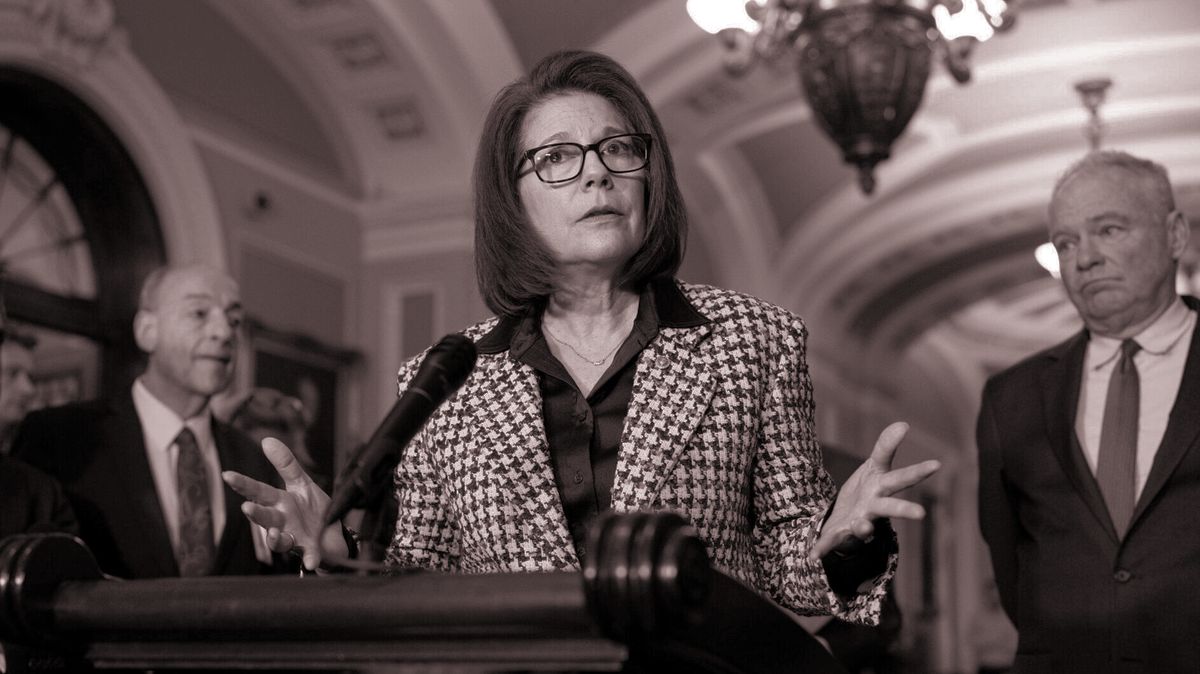
until structural changes are made within ICE. Nevada Democratic Sen. Catherine Cortez Masto, a key past opponent of shutdown brinksmanship, has become the public face of the ICE reform effort, leaning into her background as a criminal prosecutor and Nevada attorney general.
On Tuesday, she stood alongside Senate Democratic leader Chuck Schumer at a news conference, in a deliberate message to Republicans about Democratic unity. “I am not going to support
the [continuing resolutions] if my Republican colleagues can’t come to the table and work with us” on reforms, she said. The potential D.H.S. shutdown, she told me, “is about keeping our community safe, gaining the trust of our communities. What this administration is doing … is not about public safety. It’s just the opposite.”
There’s still one vocal holdout in Sen. John Fetterman, who told me that “if you want a real solution, there’s a better way of having it than
shutting our government down.” But the rest of the caucus firmly believes the political terrain has shifted, and that funding is the only meaningful pressure point available in divided government. ICE and Customs and Border Protection are funded for three years via the One Big Beautiful Bill, but key operations involving the T.S.A., ports of entry, and FEMA will feel the pinch in a shutdown. Still, especially after the killing of two U.S. citizens by federal agents in Minneapolis, Democrats have
no qualms about their position, even if it means the movement of people and goods is disrupted. “I feel very confident we’re with the American people,” Michigan Sen. Gary Peters told me. |
|
|
Democrats also come armed with detailed polling and data that reinforces that confidence. Geoff
Garin, a top-notch Democratic pollster at Hart Research, has been supplying Democrats with numbers on the intricacies of public sentiment. Lawmakers have also been passing around a 29-page deck from the Democratic group Navigator that had recently been sent to Hill offices. It shows that 57 percent of voters (including, crucially, 57 percent of independents) support withholding funding until ICE changes its approach. In a shutdown scenario, 45 percent say they would blame President
Trump and Republicans, compared with 29 percent who would fault Democrats, according to the research, which was shared with me this week.
By contrast, voters are evenly split on actually abolishing ICE, reinforcing leadership’s focus on reform rather than elimination. To Democrats’ relief, the fight over government funding is helping to keep the left flank’s “abolish ICE” rhetoric at bay. Even House Dems are showing unusual message discipline, unlike in 2018, when defunding ICE
became a progressive cause célèbre in response to Trump’s family-separation policy. Notably, Shri Thanedar’s Abolish ICE Act has no co-sponsors. |
Meanwhile, Democratic leadership is engaged in direct negotiations with James Braid, the
director of the White House Office of Legislative Affairs—another notable departure from the last shutdown standoff, when Republicans and the White House refused to negotiate with Democrats at all. On Sunday, he met with the staffs of the four congressional leaders, and the Democratic side presented a list of 10 demands. These include forbidding warrantless searches on private property, mandating that agents check citizenship status to avoid detaining U.S. citizens or legal residents, requiring
visible ID and body cameras on agents, prohibiting face coverings, and placing restrictions on enforcement at “sensitive” locations, such as churches, schools, and polling places. Details of the administration’s counteroffer have been tightly held, an unusual level of discipline on the sieve-like Capitol Hill.
Republicans, for their part, are pushing for a short-term extension of D.H.S. funding to avoid a lapse while talks continue—and to buy time in the face of internal divisions and
concerns about public opinion. They’ve been reluctant to defend ICE tactics or reject the specific reforms the Democrats are proposing, many of which command majority support in polls. Indeed, Republicans are well aware that outrage among Latino and women voters over ICE’s methods could help swing both crucial voting blocs back into the Democratic column in November. One Republican senator said that “our voters who are Hispanic in Texas are unhappy with what they’re seeing,” and noted it’s
“concerning” that Republican women have started calling lawmakers about ICE.
Republicans also argue that the lack of news out of the White House is a sign the negotiations are going well. But on the brink of another shutdown, Democrats’ threat of a funding lapse to force policy concessions is more of a sign that it’s them with the upper hand. Republicans are waiting to see where the White House comes down, and whether Trump, aware of his slumping favorability ratings, really wants to test
the Democrats’ resolve for the sake of a wildly unpopular policy. |
|
|
Join Emmy Award-winning journalist Peter Hamby, along with the team of expert journalists at Puck, as they let you in on the
conversations insiders are having across the four corners of power in America: Wall Street, Washington, Silicon Valley, and Hollywood. Presented in partnership with Audacy, new episodes publish daily, Monday through Friday. |
|
|
Unique and privileged insight into the private conversations taking place inside boardrooms and corner offices up and down Wall
Street, relayed by best-selling author, journalist, and former M&A senior banker William D. Cohan. |
|
|
Need help? Review our
FAQ page or contact us for assistance. For brand partnerships, email ads@puck.news.
You received this email because you signed up to receive emails from Puck, or as part of your Puck account associated with {{customer.email}}. To stop receiving this newsletter and/or manage all your email preferences, click here.
|
Puck is published by Heat Media LLC. 107 Greenwich St., New York, NY 10006 |
|
|
|