Hi, and welcome back to Line Sheet. Today is Inner Circle Day, which means you have to pony up to read up. (If you have any trouble, email Fritz@puck.news and he’ll sort you.)
I’m digging into the implications of a Versace sale to the Prada Group and what it would mean for those two companies, and for the broader industry. I’ve also got news of a P.R. shake-up in London, some crucial legacy media appointments, and the makings of a major blowup at Skky, the Kim Kardashian co-founded private equity firm.
Last night, I stopped by former Spy magazine owner Jean Pigozzi’s house in The Oaks to celebrate Enorme, the blocky 1986 telephone designed by Ettore Sottsass and IDEO founder David Kelley, in partnership with Pigozzi. Sottsass died in 2007, but Pigozzi and Kelley (along with Italian design executive Charley Vezza) will join Puck’s very own art industry expert, Marion Maneker, on Saturday, March 29, at 5 p.m. for a chat about the artist’s life and work. It’s all part of Design.Space LA at the Pacific Design Center, where I’ll be hosting a live taping of Fashion People earlier in the day with special guest Jesse Lee. (Click here for more details or go straight to Designspace.la to RSVP.)
If you’re interested in owning an Enorme phone, there will be at least a few for sale at the fair—including this one and a rarer monochrome version, plus a whole bunch of other great stuff, such as lots of recognizable Memphis Group paraphernalia, Grant Levy-Lucero’s Chanel lipstick sculpture, Keiko Moriuchi brooches, and a Paulin Paulin Paulin couch designed with fabric culled from Christo and Jeanne-Claude’s L’Arc de Triomphe, Wrapped (1961-2021).
Mentioned in this issue: John Idol, Prada, Capri, Versace, Donatella, Jimmy Choo, Lorenzo Bertelli, Miuccia Prada, Patrizio Bertelli, Renzo Rosso, Gucci, Demna, Miu Miu, Elisa Lipsky-Karasz, Salone del Mobile, Sam Schube, Kim Kardashian, Skky, Virginia Norris, Whistles, and many more…
|
|
|
|
A MESSAGE FROM OUR SPONSOR: NOW OPEN
|
|
|
Three Things You Should Know…
|
- Elisa has a new job: Elisa Lipsky-Karasz, who got laid off (in a nice way, amid a restructuring) from WSJ. magazine a few months ago, is back at her old stomping ground Hearst, where she’s been hired by coverline queen (and Town & Country editor-in-chief) Stellene Volandes to oversee editorial at Elle Decor. She replaces Asad Syrkett, who left last September. Lipsky-Karasz will be in charge of both print and digital products. (Volandes reached out to Lipsky-Karasz while at an interior design trade fair in Paris after reading about her WSJ. exit in Line Sheet. See, the truth will set you free.)This is a pretty good outcome for everybody. Lipsky-Karasz has great taste, is knowledgeable across a range of subjects, and is also beloved by many advertisers. “All you have to do is look at the Salone [del Mobile],” Volandes told me, referring to the annual design fair where pretty much every upscale brand—fashion, jewelry, furniture—now works to have a presence. Volandes and Lipsky-Karasz will be heading there together in early April to court advertisers smitten with the idea that “design is the new luxury.”And Volandes, who has been overseeing the pub for several years but recently expanded her role to include brand strategy, is a fun and enthusiastic boss. Anyway, it’s a lovefest all around. Congrats to everyone involved. Let me know if, and when, they start hating each other, of course. Meanwhile, over at the Journal, former GQ guy Sam Schube is the new Jacob Gallagher.
- The Skky is falling: There’s no denying that Skky, the private equity firm co-founded by Kim Kardashian and Jay Sammons, has been a failure. But whose fault is it, really? Sounds like Sammons, the former head of the Carlyle Group’s consumer practice, should be taking some heat. I’m told by multiple sources that much of the investment team has been fired after Skky failed to raise the necessary capital. As I reported months ago, there have been murmurs in the market that traditional investors didn’t cotton to the idea of getting into business with Kardashian, who had a more active role in the fund early on but seemed tied up in various other enterprises. To be honest, though, I have found that excuse a little flimsy. It’s not like she was ever going to be running the fund day-to-day in any scenario, and the bigger issue here seems to be an investment thesis that didn’t align with what L.P.s wanted. To be honest, most investable C.P.G. businesses don’t need or want a Kardashian-adjacent relationship, but rather deep expertise in manufacturing, distribution, and/or market-taking category expansion. Sammons, whose own group was deprecated at Carlyle, should have known this better than anyone. A rep for Kardashian and Skky did not respond to a request for comment.
- The niche P.R. agency news you need: London comms gal Virginia Norris, late of Whistles in the Jane Shepherdson days, has split from her Aisle 8 business partner of more than a decade, Lauren Stevenson, to launch Virginia and Company. At the new agency, she’ll be repping a lot of longtime clients, including Sézane, Mango, Hush, Reiss, Dune London, and Missoma. Norris and Stevenson always sort of operated on parallel paths—and more specialized agencies seem to be what works better these days—so I suppose it’s not shocking that they are finally going their separate ways.
|
|
|
|
The Prada Group is preparing an estimated €1.5 billion bid for Versace (and maybe another €500 million for Jimmy Choo), setting the stage for the luxury brand to win back its obsessive and loyal fans under Italian ownership once again.
|
|
|
|
By the end of the Paris shows, the fashion industry had collectively decided that the Prada Group—which includes Prada, Miu Miu, Church’s, and, of course, Marchesi 1824—was definitely buying Versace, currently owned by the beleaguered Americans at Capri, for an estimated €1.5 billion. It’s not a worst-case scenario for Capri C.E.O. John Idol, following his failed effort to sell the company and its brands, including Michael Kors and Jimmy Choo, to Tapestry last year. Yes, he arguably overpaid in 2018, when Capri acquired Versace from the family and their investment partner, Blackstone, for about €1.8 billion. At the time, even WWD called the price “aggressive.” But not every big bet pays off, and to be able to get the majority of the investment back—minus the millions invested over the past seven years—isn’t the worst outcome. Anyway, this is where we are, as they say in private equity.
The Prada Group is also a formidable, premium buyer. If Idol is worried about P.R. damage control after the year he’s had—with the Tapestry deal falling through and accusations that he mishandled Donatella Versace’s succession—off-loading Versace to a smashingly successful Italian company that deals in pure luxury at least feels like the responsible move.
|
|
|
|
A MESSAGE FROM OUR SPONSOR: NOW OPEN
|
|
|
|
Of course, Idol will move forward only if the price is right—he has a fiduciary duty to his shareholders, the valuation could change, etcetera—but, as far as I know, things are moving in the right direction. According to my sources in Milan and in the banking world, talks are proceeding as planned, and a deal structure could be finalized within the next few weeks. The Italian business journal Il Sole 24 Ore reported that the deadline to end negotiations is April 10. The journal also floated the possibility that the Prada Group could end up buying Jimmy Choo as well, for an additional €500 million or so.
That would be a pretty significant markdown for Jimmy Choo, which Capri bought in 2017 for well over $1 billion. But the deal would put both brands firmly back on the European continent, in the care of operators who know how to make fashion work, at scale, and in an era when not many do. A decade ago, Prada had a real product problem. Yet the company fixed it through smart merchandising and supply chain management, smarter distribution (almost all direct-to-consumer), and even smarter marketing. (The key, in my mind, was putting original, special designs at the center of the plan.) Today, Prada and Miu Miu, the little-sister brand that could, are two of the most well-run, popular fashion labels on the market.
The benefits should run both ways: Versace needs a company like the Prada Group. After all, there are few operators other than LVMH and Kering that could manage such a brand, which has excellent raw ingredients but requires an entire product overhaul. The Prada Group, for its part, needs a new growth narrative as the Hong Kong–traded company contemplates a dual listing in Milan. Sales of Miu Miu will inevitably slow down, as has already occurred at Prada. Versace would provide premium retail real estate—some of which it could use to scale up Miu Miu—and a chance to increase its market share with relative speed and efficiency.
Indeed, there are actually few brands as well poised to succeed in this market as a refurbished Versace: Consumers want strong, distinctive designs that they feel cannot be replicated elsewhere. They want to believe they are part of a secret club obsessed with a brand, even if there are millions of other members. And Versace can provide those things.
|
|
Prada Group’s success here would also provide further indication that heir Lorenzo Bertelli is serious about competing against the big strategics in a way that seemed impossible even a decade ago. Recall that Lorenzo’s father, Patrizio Bertelli, attempted—alongside his wife, designer Miuccia Prada—to build a fashion group at the turn of the century, right at the time of the formation of the Gucci Group and the acceleration of LVMH. In 1999, Prada acquired Helmut Lang and Jil Sander—two of the defining brands of ’90s. But the arrangement was disastrous, and the Bertellis off-loaded the two brands in 2006, seven years into the project. (Jil Sander has gone through multiple owners since, and is now under the watch of Renzo Rosso at OTB. Helmut Lang is owned by Uniqlo’s Fast Retailing; it’s a failure.)
Anyway, the Prada Group is not the same company it was in 1999. It’s not even run by Patrizio, who stepped away from daily operations in 2023, making way for Andrea Guerra, a consummate operator and the former C.E.O. of eyewear conglomerate Luxottica. (Guerra is obviously training Lorenzo, who is 36, to take over the business at some point.) Also, it’s been 26 years since Bertelli bought Jil Sander and Helmut Lang. Not only has the industry changed dramatically, but so has Prada. It’s professionalized.
|
|
|
|
So no, I’m not worried about the Prada Group’s ability to successfully manage Versace. Surveying the landscape, where Kering continues to struggle, my gut is that the balance of power could change. At the moment, Kering—itself once a potential acquirer of Versace—remains in second place, even as its largest brand and profit center, Gucci, shrivels. A Gucci comeback—combined with steady performance at Saint Laurent and Bottega Veneta, and potentially a boost with a new Balenciaga proposal—could reaffirm its place in the ecosystem. But even if Demna’s new idea for Gucci hits, a positive outcome is far from guaranteed. The responsibility is squarely on Francesca Bellettini, whom C.E.O. François-Henri Pinault has deputized to restructure the operations.
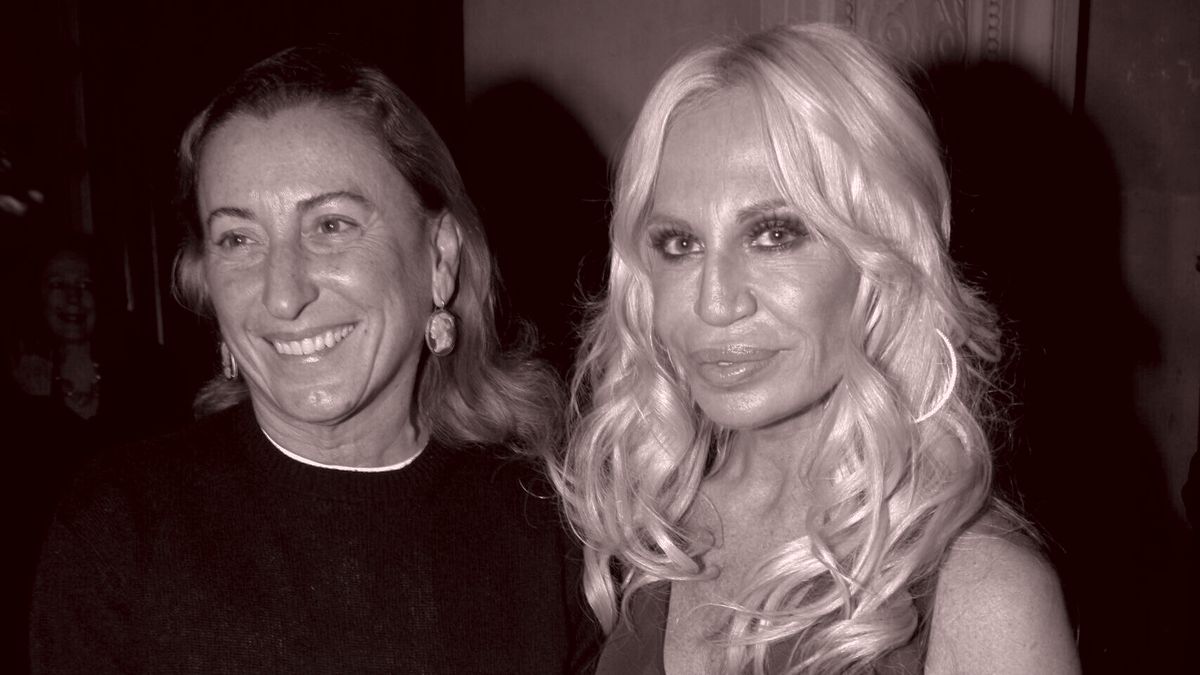
I keep thinking about Donatella Versace sitting next to Bellettini at the latest Saint Laurent show, dressed head-to-toe in Anthony Vaccarello’s designs. Two days later, it was announced that she was stepping down as the designer of the brand she and her brother founded. Back in 2018, Donatella took the deal with Idol because it was the best option for her and her family. But seeing her at Saint Laurent, deep in conversation with Bellettini, you couldn’t help envisioning what might have been. Her decision back then may have been more consequential than she could have ever imagined. If she had sold to Kering, not Capri, there would be no Prada Group play to speak of. And that play could change the dynamics of fashion once again. See you on April 10.
|
Here’s an exclusive report from Graydon Carter’s book party: “It was really awesome, everyone was just so rich.” [ WaPo]
Also, here’s a short index for Line Sheet readers about to dive in: Anderson & Sheppard (74); Anna Wintour (134, 377); Bob Sauerberg (385); D.V.F. (144); Jonathan Newhouse (208); Karl Lagerfeld (147, 333); rules for seating spouses at dinner parties, city by city (236); Si Newhouse (103, 119, 130, 173, 345—actually, maybe skip that section—398); and Michael Carl (408, 398). [ Amazon]
Allure’s content director says that media brands are “grasping for like any little penny they can,” which means the Condé Nast–owned beauty pub’s Substack may not be free forever. [ Embedded]
Chanel may be trying to buy 655 Madison Ave. for $450 million. It all goes back to real estate. [ The Real Deal]
This Burberry trench sponcon is great, well done everyone. [ NYMag’s Instagram]
My favorite character on the new season of The White Lotus is the French-Canadian girl wearing Jacquemus. [ WWD]
L’Oréal-owned Mugler has a new creative director. Maybe we’re in for a Bally-esque surprise? [ WWD]
|
|
And finally… I forgot to say that the only person missing from yesterday’s Vogue World proceedings was… costume designer Jonathan Anderson. Maybe next year?
Until tomorrow,
Lauren
P.S.: We are using affiliate links because we are a business. We may make a couple bucks off them.
|
|
|
|
An essential, insider-friendly Hollywood tip sheet from Matthew Belloni, who spent 14 years in the trenches at The Hollywood Reporter and five before that practicing entertainment law. What I’m Hearing also features veteran Hollywood journalist Kim Masters, as well as a special companion email from Eriq Gardner, focused on entertainment law, and weekly box office analysis from Scott Mendelson.
|
|
|
Need help? Review our FAQ page or contact us for assistance. For brand partnerships, email ads@puck.news.
You received this email because you signed up to receive emails from Puck, or as part of your Puck account associated with . To stop receiving this newsletter and/or manage all your email preferences, click here.
|
|
Puck is published by Heat Media LLC. 107 Greenwich St, New York, NY 10006
|
|
|
|