 |
 |
|
Man plans, and God laughs. Tell God about your book leave plans, and watch him launch the strangest, shortest military coup in Russian history. So here I am, back a week early, to share my thoughts and analysis with you on just what the hell happened over there. Thank you so much to my partners, Peter Hamby, Dylan Byers, Tina Nguyen and Teddy Schleifer for holding down The Best & The Brightest in my absence.
Oh, and if you’re an Inner Circle member, I’ll be doing a private call to talk about what the fuck just happened this Thursday, June 29, at 4 p.m. Eastern. You’ll be receiving an email with an invitation shortly. (And if you’re not an Inner Circle, you can change that right here.) But first...
|
| The Capitol Hill Cafeteria Report |
|
| An utterly indispensable, high-minded, and, yes, occasionally dishy readout of what our lawmakers are really legislating behind closed doors.
By Abby Livingston
- Santos’ Redistricting: George Santos, the fabulist Long Island congressman and New York Post fixture who has been indicted for schemes ranging from wire fraud to money laundering, is normally not permitted to travel anywhere besides New York and Washington, D.C. And yet on a recent congressional visit to El Paso, Santos told reporters that he had crossed state lines in “full compliance” with authorities, and that he “would not violate any conditions set forth [by the court].”
Even so, it was a rough stretch for Santos. When asked on Fox and Friends on Tuesday if the disgraced New Yorker should run for reelection, Kevin McCarthy, normally adroit at disguising his true feelings, laughed and said no. The speaker then said he believed Republicans could hold Santos’ Long Island seat.
- McCarthy in the Dog House: Meanwhile, McCarthy spent the day dealing with his own mess. Earlier today, during an appearance on CNBC, he expressed his doubt that Trump is the “strongest” G.O.P. standard-bearer next year. The comment did not go over well in Mar-a-Lago, per CNN’s Kristen Holmes, who described sources close to Trump as “outraged.” Many of his loyalists, she tweeted, “don’t trust the Speaker.”
Hours later, McCarthy seemed to reverse course in an interview with Brietbart, in which he said Trump was “stronger today than he was in 2016”—a sentiment that doesn’t contradict his previous statement, of course, but offered a conciliatory spin on McCarthy’s contention that the whole flare up was somehow the media’s fault.
Not shocking, perhaps, although it’s worth recalling that it was McCarthy who first welcomed Trump back into the party’s mainstream when he visited Mar-a-Lago three weeks after the insurrection. That was before he was twice indicted, of course, but are his current circumstances any worse?
- Recruitment Season: In his bid to take back control of the Senate, N.R.S.C Chairman Steve Daines scored one of his top recruits—Tim Sheehy—in his own backyard on Tuesday. Sheehy is running in Montana’s competitive Republican primary to take on three-termer Jon Tester, but he will first have to face Republican Matt Rosendale in the nomination fight. This announcement was anticipated, but watch for down-ballot campaign rollouts over the next two weeks in both parties.
Candidates like to formally announce their campaigns at the turn of the campaign finance quarter (the reporting deadline is June 30) in order to maximize the time they can raise money in their debut finance report for the next quarter. Based on campaigns’ behavior and conversations I’ve had, both sides aren’t terribly confident about which way the political winds are blowing. Basically, smart operatives are reluctant to make any sweeping predictions down-ballot until it’s clear whether Trump is the G.O.P. nominee.
What can be gleaned from this coming window is the quality of the candidates that each side is recruiting. Good candidates indicate optimism for the party’s chances in the next election. And a lack thereof indicates pessimism. After all, high-quality candidates don’t want to put themselves through the ringer if it’s already looking like a lost cause. So Sheehy’s entry is a positive signal for Republicans, though wait until mid-July for a fuller accounting of who’s getting in.
|
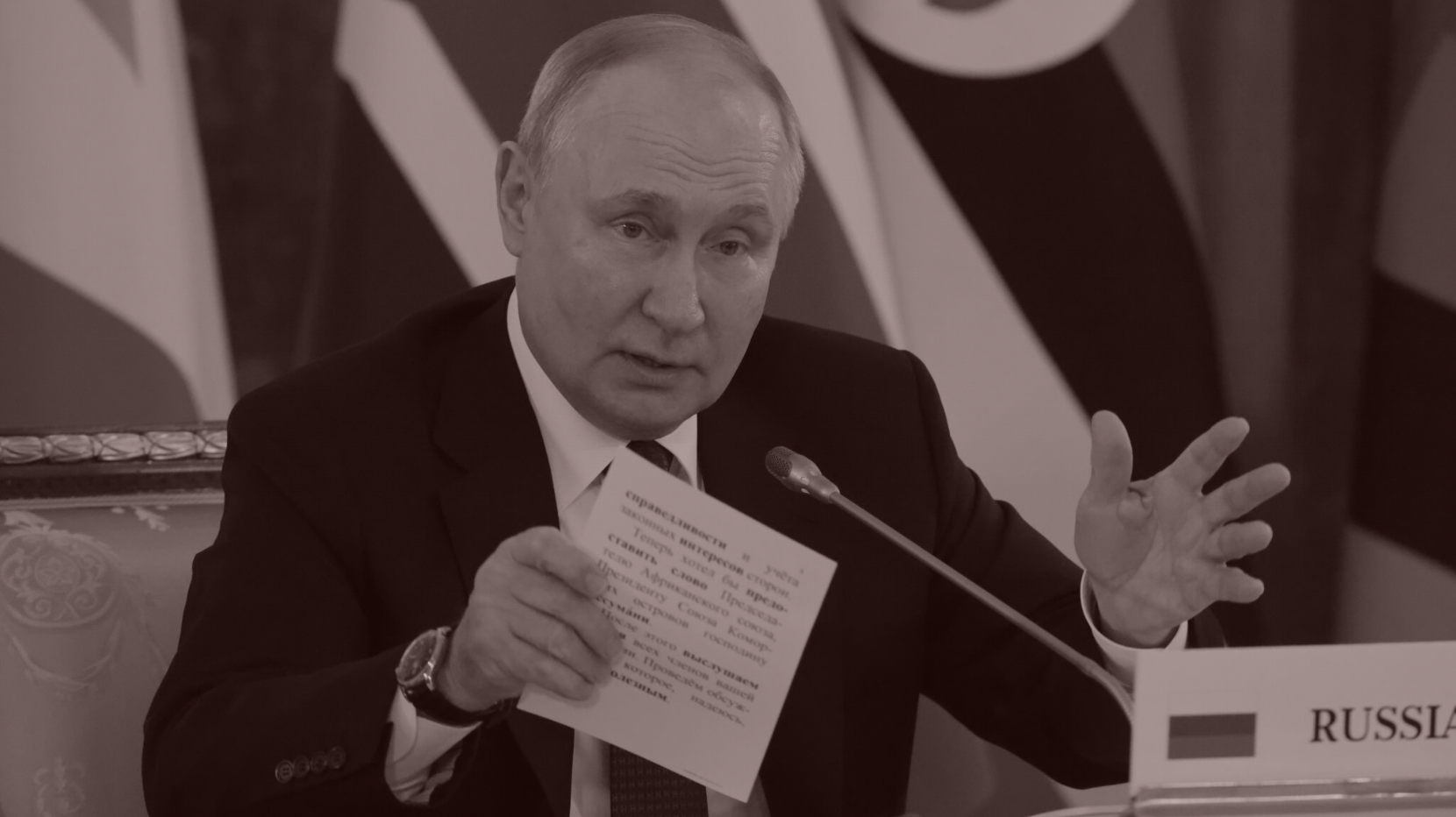 |
| Putin vs. Prigozhin: The Post-Coup Report |
| In the wake of Prigozhin’s attempted coup, there’s been a lot of full-throated certainty in the Western media that Putin has been mortally wounded and that his regime is weaker than ever. Look as I might, I just don’t see it. |
|
|
|
| As Evgeny Prigozhin’s armored convoy of some 25,000 battle-hardened, heavily-armed men made their way to Moscow on their “March of Fairness,” people in the capital were mostly going about their regular lives. The museums were crowded, as were the cafés. People celebrated their weddings. Underneath, of course, was panic. Cash withdrawals, by the Kremlin’s own account, jumped 30 percent. Some people with means, anticipating chaos and bloodshed, tried to get on a plane out of the country—or into a car to get out of the city to the relative safety of their dachas.
But in a society that’s accustomed to unpredictability, where everyone knows that the volcano on whose slopes they live may blow at any moment, it’s easy to hide that panic. You wrap it in silence, you channel it into doom-scrolling and macabre jokes, and you hope the lava never reaches you. It is a sense that is perhaps even more solid among those who have decided to stay when a million of their fellow citizens fled the country after Putin’s full-scale invasion of Ukraine. It is also, as one well-connected Moscow source told me, some classic “Russian fatalism and don’t-give-a-crap-ism.” As one friend in the city put it: “The mood in Moscow is that it’s just a blip in the drama we already have. The mood hasn’t changed.”
Prigozhin’s troops, as we now know, never got to Moscow. Instead, Prigozhin announced that he was turning around, just 125 miles from the capital. A deal had been reached between Vladimir Putin and the man once known as his chef, brokered, apparently, by Belarusian president Alexander Lukashenko. The agreement gave amnesty to Wagner mercenary fighters who had participated in the 24-hour putsch and allowed Prigozhin to go into Belarusian exile with those fighters who had accompanied him. Those who did not follow Prigozhin on his march were magnanimously allowed to sign contracts with the Defense Ministry. Wagner would now be swallowed up by the M.O.D., which is what set this whole thing off to begin with. |
|
A MESSAGE FROM OUR SPONSOR
|
| |
 |
| The U.S. can unleash the power of green hydrogen to achieve our climate goals, grow our economy and accelerate the clean energy transition – even in heavy-emitting industries like transportation and agriculture.
These are the stakes facing the U.S. Treasury Department as it hammers out the details of green hydrogen’s Production Tax Credit.
Everything rests on how renewable energy sources are matched to hydrogen.
Annual matching will catalyze economy-wide decarbonization and jumpstart the green hydrogen industry as the first wave of projects are built through 2028, lowering energy costs and creating good-paying American jobs.
A premature jump to hourly matching will drive up costs, suppress production and jobs, and delay green hydrogen for years.
Treasury needs to incentivize production with an annual matching credit through 2028. Green hydrogen can create millions of American jobs and decarbonize our economy.
Learn More. |
|
|
| There’s a lot we don’t know about what really happened, and what continues to happen in the couloirs of power. In the two days since Prigozhin choked when he was within striking distance of Moscow, the Kremlin has been furiously sweeping up the damage. After a deafening 48-hour silence, Putin can’t seem to stop speaking. He gave a taped, Monday-night address, then spoke on a red carpet in a Kremlin courtyard, then went inside and met with—i.e., talked at—some servicemembers. (Throughout, he refused to acknowledge Prigozhin by name, a vindictive anonymity reserved for Putin’s worst enemies, like Alexey Navalny.)
People who had been quiet during Prigozhin’s march—the defense minister, the heads of various security services, the most prominent propagandists—have resurfaced for some vigorous rewriting of the weekend’s events. Prigozhin, in the meantime, has landed in Belarus where Lukashenko has already started building camps to house his fighters. And even though the F.S.B. dropped its criminal case against him, there were some local media reports that Prigozhin has found the only high-rise hotel where the windows don’t open. “If we’ve learned anything over the last 23 years, it is that Putin goes after people he feels betrayed him,” said Sergey Radchenko, a professor at Johns Hopkins School of Advanced International Studies. “He seems to not tolerate betrayal; he values loyalty over competence.” Personally, I’ve been asking people if they think Prigozhin makes it till his next birthday: June 1, 2024. |
|
|
| For months it was clear that Prigozhin, who gave Russia its only real military advance all year, was accumulating too much power and too much grievance. He regularly and ferociously attacked Sergei Shoigu, the defense minister and Putin hunting buddy, in social media videos calling him a “faggot” and, worse, a woman. He occasionally took veiled swipes at Putin himself, alluding to a certain loony “grandpa” who had lost the plot. (Putin is often referred to as “grandpa” in Russian popular slang.) He accused the government of starving Wagner of artillery and sending them to the slaughter, only to try and disband the mercenary group he led. He apparently broke when, he claimed without evidence, the Russian military attacked Wagner from the air, killing some 30 men.
The fact that this happened should not have been a surprise. Prigozhin was a clear and present danger for a long time. In recent weeks, American intelligence knew he was, too, delivering a specific warning about a potential Wagner uprising to top officials in the U.S. and Congress. And, it seems, the Russian elite was getting wind of something as well. According to the well-connected Moscow source, by the middle of last week there was already buzz among the Russian elite that something was brewing, that “Prigozhin was cooking something up and that top officials had been briefed.”
But then they seemingly did nothing, perhaps not realizing what exactly Prigozhin was cooking up—or not anticipating that he would move through the country so quickly and with so little resistance. “It looked alarming, but it didn’t look like the commander-in-chief should drop everything and take steps to solve this,” said the source.
And so the commander-in-chief was caught off-guard. It showed in the latest example of what has become a hallmark of his regime’s crisis management strategy: do nothing until you get a signal from the top. Often, that takes a while. Authoritarian, cult-of-personality regimes aren’t generally known for their flexibility and adroitness.
After Putin’s morning address on Saturday, in which he accused Prigozhin of “betrayal,” the signal was clear. The F.S.B. opened a criminal case against Prigozhin, charging him with trying to lead an armed uprising. Machine-gun nests and soldiers started appearing in residential neighborhoods of Moscow. Military forces, or what could have been spared during a full-scale war, began pulling in around the city.
This, apparently, is when Prigozhin thought better of it. According to some reports, he had been trying all day to reach Putin, who refused to talk to him. Telegram channels associated with Wagner disseminated the message that Prigozhin had no intention of toppling Putin or the government; he simply wanted to have the defense ministry under his control.
That was obviously unacceptable to Putin. No one dictates their demands to him like that—in public, using threats. It was the surest way not to get what Prigozhin wanted. Moreover, Putin loves playing the remote czar who does not bother with such earthly things, unless it is exactly on his terms. He doesn’t engage in debates while he’s running for reelection, for example, not even with his fake opposition. He reigns above it all, and certainly no one puts Putin in a corner. |
|
|
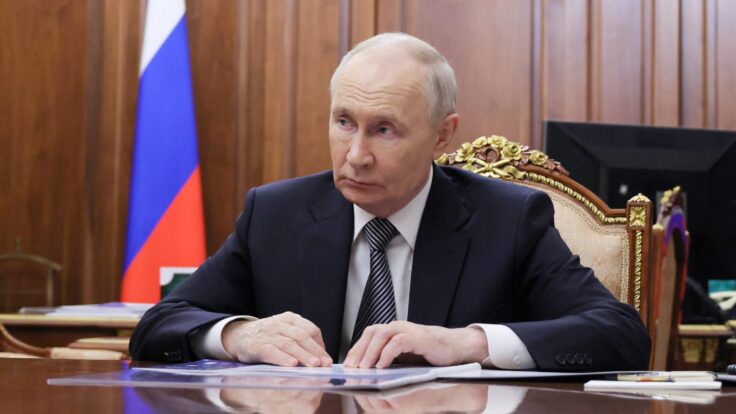
| In the wake of Prigozhin’s attempted coup, there’s been a lot of full-throated certainty in the Western media—and in U.S. media, especially—that Putin has been mortally wounded and that his regime is weaker than ever. Look as I might, I just don’t see it.
Prigozhin was the strongest, most obvious rival Putin had. He had his own private army, tens of thousands of men who had criminal pasts and were loyal to him personally, and who, having been through the gauntlet of the war in Ukraine, were skilled at violence and clearly unafraid. Sure, Prigozhin’s march revealed damning details about the defense of the Russian homeland: as Prigozhin advanced, the Russian military mostly melted away. But Prigozhin, for whatever reason, blinked first. And that means Putin won.
Having survived a coup, Putin is stronger, not weaker. And Putin didn’t even get his hands dirty trying to wrangle Prigozhin. He let everyone else—from Lukashenko, to his negotiating team, to his spokesman—come down to Prigozhin’s level and talk, while he removed himself from the capital and the situation, clearly demonstrating that he didn’t think Prigozhin’s march was worth his time or energy.
I also don’t buy the theory that Prigozhin’s men were scared of a bloodbath in Moscow. All of them had seen worse on the battlefields of Ukraine. Many were hardened criminals who saw the meatgrinder of war as preferable to prison. Moreover, the forces tasked with defending Moscow seemed far better at slamming unarmed urban intellectuals to the floor than fighting real, armed peers. (Also, given the Ukrainian drones that exploded over the Kremlin, Moscow may not be as well-guarded as we think.) Rather, I think that Prigozhin truly didn’t want to unseat Putin. He wanted to talk to his and get his point across, to get what he wanted from the big boss, face to face. But with Putin unwilling to meet with him, the prospect of trying to take Moscow had become not just bloody, but pointless.
But whatever drove Prigozhin to turn around doesn’t quite matter. The appearance does: a dangerous, highly armed opponent backed down instead of going all the way. That speaks volumes to other Russians about Putin’s power, his hold on it, and the sense of fear he instills even in potential rivals, even those that are armed to the teeth. Moreover, in taking the amnesty deal and slinking off to Minsk, in losing Wagner, the very source of his power, Prigozhin has removed himself as a rival to Putin. Now, who else is there? The siloviki, the men of the various security forces, might be the source of future insurrection, but this weekend showed them that their chances of success are slim indeed. It is likely best to lay low—lower, as the Russian saying goes, than the grass, quieter than the water. |
|
|
|
|
| As Putin’s public appearances over the past couple of days indicate, he is clearly going to use this opportunity to turn the screws, to purge, to crack down. A coup, after all, is a great opportunity. Recall, for instance, what his friend Erdogan did after the failed 2016 coup against him. He arrested thousands and drove more into exile, cementing his grip on power for years to come. “Putin won. He’s weak, sure, but he won a coup,” said Nina Khrushcheva, Nikita’s granddaughter, who lives in New York, but arrived in Moscow just before the coup. “Khrushchev won a coup in 1957 and look what happened. He was everything—until he lost it all.” But that didn’t come for another seven years, during which Khrushchev reigned unchallenged.
Here’s another thing that the coup revealed: Even if Moscow isn’t thrilled by Putin or his invasion of Ukraine, the specter of Prigozhin marching into their city and taking over threw certain things into perspective. Prigozhin is a terrifying brute, someone to the far right of Putin. Putin’s rule has been brutal but has become that way gradually, in a way that most Russians have learned to accommodate and accept. It is a familiar brutality whose rules they can now more or less guess. Prigozhin was bearing down on the capital with his mass of hardened criminals, true barbarians at the gate. What would they do when they got there? Would they do things that would make Putin seem soft and gentle by comparison?
When Khrushcheva arrived in Moscow, she told me that she kept hearing Prigozhin referred to as a rapist and a murderer. “Whatever we think of Putin, it’s better than rapists and murderers,” she told me, elaborating on the mindset of people she’s been speaking with in the capital. “I heard it several times on Saturday, especially when Wagner got to Lipetsk [300 miles from Moscow]. We don’t need this.”
Putin had long built his legitimacy on the lack of alternatives, or on the fear of what the alternative might be. He was the thing standing between Russians and revolution, civil war, he argued, the stuff their great-grandparents only miraculously survived. It was hard to make that argument with Navalny, a white-collar democrat. But Prigozhin was that nightmare incarnate, the best advertisement for another 20 years of Putin that Vladimir Vladimirovich could have hoped for. And when it came time to make the choice, when it was banging on the city gates on Saturday, the Moscow elite didn’t hesitate. “Before Saturday, the Russian elite didn’t have the sense that they had to choose between [Putin and Prigozhin],” said the well-connected Moscow source. “Then when one of them started a coup, it turned out that no one supported Prigozhin. I don’t know a single person that supported him.”
As for Prigozhin’s demand to remove Defense minister Shoigu, well, he was just awarded another medal today at a ceremony at the Kremlin. It was a clear sign that not only will Putin not do anything demanded of him, but that he will, in fact, do the opposite, just to show who’s in charge. Still, Putin often makes the inevitable decision, but only after the spotlight has moved on, when the external demands that he do it have waned. A freshly decorated Shoigu might just announce his own retirement in a few months or years, making clear that this was a decision that had nothing to do with Prigozhin. “I think there will be changes in the Ministry of Defense, by the logic of events,” said the Moscow source, who added that few in the elite think highly of the man. “I don’t think they’ll be fired immediately because it will show an admission that the accusations against him were true and it would be seen as a capitulation to Prigozhin. But I don’t think he has a bright future at the head of the armed forces.”
Putin, as I’ve written for over a decade, has never been a good strategist. He was a good tactician and an even better procrastinator. His aim, especially since the pro-democracy protests of a decade ago, has been to survive and stay in power, to deal with the crises as they come and to kick the can down the road when he can’t solve a problem immediately, hoping that, in a few years’ time, the solution will somehow present itself.
Over the last four days, he did just that. He managed to survive and stay in power just a little bit longer. Is he weaker now? Probably. Does it matter in the short term? Probably not. He won and he gets to rule Russia for another day, week, year. That’s all that matters in a contest like this. “Now he’s not even a good tactician anymore, but he’s good enough,” said Khrushcheva. “But for now, he’s staying that’s power. That’s it.” |
|
|
| That’s all for this week, friends. I’ll catch you back here next week. Until then, good night, tomorrow will be worse.
Julia |
|
|
|
| FOUR STORIES WE’RE TALKING ABOUT |
|
|
|

|
 |
|
|
|
Need help? Review our FAQs
page or contact
us for assistance. For brand partnerships, email ads@puck.news.
|
|
You received this email because you signed up to receive emails from Puck, or as part of your Puck account associated with . To stop receiving this newsletter and/or manage all your email preferences, click here.
|
|
Puck is published by Heat Media LLC. 227 W 17th St New York, NY 10011.
|
|
|
|