 |
 |
|
Hello, and welcome back to The Best & The Brightest for your regular Tuesday installment of foreign policy and national security.
I want to start with a bit of a personal note.
Today, Russia celebrated Victory Day with its annual victory parade. (The clocks had already flipped to May 9 when the Allies accepted the total Nazi surrender in Berlin at 11:01 pm on May 8, 1945.) It was a markedly different event than last year’s flamboyant display in the face of a war that had gone catastrophically sideways.
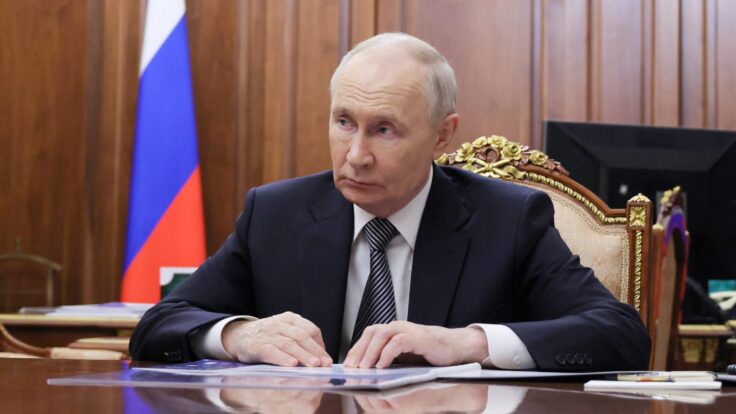
This year, only 26 parade groups marched across Red Square under the watchful eye of Vladimir Putin. Last year, there were 32. Gone was the Immortal Regiment, gone was the aerial show, apparently a casualty of last week’s mysterious drone explosions over the Kremlin. And, much to Ukrainian bloggers’ delight, only one tank chugged across the famous old cobblestones: a T-34 tank, the legend of World War II. None of the new tanks that the Russian military has bragged so much about made an appearance. Given the vintage 1960s models making cameos at the frontlines in Ukraine, it’s not hard to imagine the reason that Russian commanders wouldn’t be trotting out the new ones on Red Square.
While some rejoiced at this display of Russia’s clearly diminished military might, I still found the spectacle terrifying. Here was a fascist, terrorist state usurping the memories of hundreds of millions of people, including Ukrainians, who had beat back the Nazi invasion of 1941. It was a horrible, cruel, and ineptly run war, one in which 27 million people—15 percent of the Soviet Union’s pre-war population—were violently annihilated. Dozens of my family members were among them, which makes me a pretty standard citizen of the U.S.S.R. The war, in our homes, was not a clanging parade. It was a trauma and a tragedy, one we all grew up with deep in our bones, our homes haunted by the ghosts of all the people whose stories we heard and who didn’t get to see the first Victory Day. We had won the war, yes, and we were proud of this, but all of it was cloaked in mourning. It was a real and true thing.
Year by year, as the war’s witnesses died, Putin has been slowly appropriating their memories, turning the war into an increasingly unrecognizable cult, the way Mussolini and Hitler preyed on the tragedy of World War I to turn it into a holy, cleansing fire, the crucible of national identity. The Victory Day parade, just as in Soviet days, had become not about the memory of the war and its unfathomable costs, but about intimidating the West.
But the worst crime Putin ever committed against the memory of World War II was in invading Ukraine, in unleashing such savagery and terror on its people, themselves the descendants of World War II’s victors. All day, I have had the words of the fierce Yevgenia Albats, the grand dame of opposition journalism and the daughter of two World War II veterans, in my head. “Putin, by starting this aggressive war, this wholescale invasion in Ukraine, he totally destroyed who we are,” she told me. “You know, we were defenders, we were people who liberated Europe, at least what we knew from school. We liberated Europe from the Nazis, and now we have been turned into the Nazis. And for me, it is unbearable. It destroys something extremely important inside myself. It is a real destruction of the nation.”
In the first days of the full-scale Russian invasion, my friends and relatives in Russia were horrified—and they used the same analogy. “Now, we will be guilty before the Ukrainians for generations,” one friend in St. Petersburg said, horrified, “the way Germans are before the Jews.” It is why the independent Russian-language publication Meduza ran a long interview with a historian of German complicity, asking her, over and over again, whether any Germans showed any disagreement, any protest to Hitler’s regime, and why the historian spoke about how difficult real resistance is in a regime built on violence, fear, and propaganda. She told the story of a German who remembered their father hoisting a handkerchief on the day everyone was supposed to put up Nazi flags. That act in that context, the historian said, was a brave act of defiance, however small. The analogy to today’s Russia, where playwrights are arrested and people are sentenced to jail for condemning the war in their private phone conversations, did not even have to be made.
For all the Red Army’s crimes in its march westward (about which few of us knew until much, much later), for all the cruelty inflicted even inside the Soviet Army’s ranks, there was still a sense that justice had been on our side, that we had fought evil and won. Putin has fully inverted that moral equation. In creating a regime of terror, both inside Russia and wherever Russia’s military reaches—wherever it sets up, as it did in Kherson, torture chambers for children—he has made any invocation of World War II absolutely stomach-turning. Because now we know whose side justice is on, who is fighting so desperately for their very homes and lives just as our relatives did. And now we know who the Nazis are.
And now, on to other things…
|
 |
| The Debt Ceiling Soap Opera, in Subtitles |
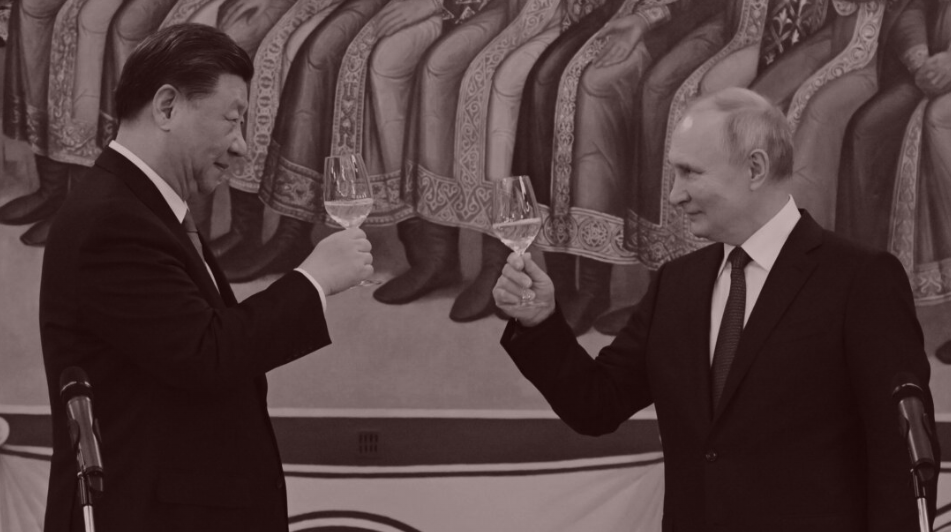
| The Russians and Chinese are loving—just loving—Congress’s latest debt budgetary hostage crisis. But how much can they really leverage it in their long economic war to replace the dollar as the world’s denominator? |
|
|
|
| Last week, when Avril Haines, the Director of National Intelligence, testified in front of Congress, she had something to say about the body’s toying with the debt ceiling. Their little game of chicken, she said, was playing right into the hands of America’s main adversaries, Russia and China. “It would be almost a certainty that they would look to take advantage of the opportunity,” she said, to play up “the chaos within the United States, that we’re not capable of functioning as a democracy.” A debt default, she added, would unquestionably “create global uncertainty about the value of the U.S. dollar and U.S. institutions and leadership, leading to volatility in currency and financial markets and commodity markets that are priced in dollars.”
In fact, both Moscow and Beijing have already been hard at work spinning the debt ceiling standoff into domestic propaganda. Kremlin-owned television has been reveling in every single U.S. bank failure. “The U.S. banking system is shaking like it has a bad fever,” one anchor crowed upon delivering the news of First Republic’s demise. Other reports are predicting that an American default could happen any day now, which would finally usher in the kind of world Vladimir Putin has been pushing for for years: one not denominated in the U.S. dollar.
Chinese state media is on a similar kick, running cartoons about the U.S. drowning in debt alongside various reports about how many Chinese bilateral trade deals are now denominated in the renminbi, rather than the dollar. Russia, Saudi Arabia, and Brazil are willing and eager participants. Others are licking their lips at an impending American financial collapse and the opportunities it would open for China. “A possible U.S. default, which may take place as early as June… will severely damage [an] already shattered U.S. credit and financial system, while push more international investors to shift to other countries’ assets,” declared one article in the Global Times, the C.C.P.’s English-language rag. “It serves as a reminder of the accumulated risks of the U.S. financial system as the result of U.S.’s reckless monetary policy. It will spur the internationalization of the yuan as a more reliable and trustworthy currency… When the U.S. dollar hegemony starts to crumble amid developing economies’ shift to other currencies for settlement to fend off the risks of the reckless U.S. monetary policy, the U.S. may find even harder to peddle its treasury bonds.”
This is a classic Beijing narrative, said Bonnie Glaser, a China specialist at the German Marshall Fund: America is not a trustworthy steward of global financial stability, so why is it in charge, anyway? “The Chinese generally say they would do a better job with governance,” she explained. “It’s one of the reasons they want to reform the global governance system because they think we don’t do a very good job of it.”
Everything coming out of D.C. during the debt talks these days, just as Haines noted, is feeding that line of attack. But it is, in some ways, just the cherry on top of what China already perceives as our dysfunctional sundae. “There’s always so much discussion of how inept the U.S. government is, this may not even stand out,” said Victor Shih, a professor of Chinese politics and the Chinese financial system at the School Global Policy and Strategy at U.C.S.D. “Even educated Chinese readers pay more attention to shootings and homelessness as obvious outward signs of American decay. They’re not paying attention to this.”
The elite, however, are watching quite closely, said Shih. And though their country owns nearly $600 billion in U.S. debt, “Chinese leadership will be extremely happy if the U.S. defaulted,” Shih told me. Sure, it will cost them, but what’s a little volatility in a big game of big power competition? “I think for China, they’re willing to pay that cost,” explained Shih. “Yes, it creates volatility but that’s a small price to pay if the U.S. has less money to pay for its military and if the dollar isn’t seen as the benchmark currency. Both things would be a huge plus for China. That’s a very small price for China to pay.” |
|
A MESSAGE FROM INSTAGRAM
|
| |
 |
| How can parents help teens manage the time they spend on Instagram?
Once Supervision is set up, parents can use daily time limits to manage the amount of time their teen spends on Instagram every day.
As a result, teens can be more intentional about the time they spend online.
Explore 30+ tools. |
|
|
|
|
| Still, of course, most observers tell me things aren’t as dire as Chinese and Russian propaganda—or talk in #thistown—would make it seem. Sure, China and Russia are trying to push for a world where business isn’t just done in the dollar, and sure, they have leaders like Brazil’s Lula calling for the same, but, no matter how much business China does with Russia in the renminbi, it is but a drop in the world financial bucket. “In terms of the place of the dollar as the reserve currency, it has not changed in the last 10 years,” said Ian Bremmer, head of the Eurasia Group. “It went from, what, 92 percent to 90 percent?” To really shake its place atop the reserve currency pile, Bremmer says, there would have to be a total and complete meltdown of the American financial system the likes of which we’ve never seen.
Moreover, what allows the dollar to hold its spot is not just the robustness of the American financial system—and its ability to recover from major crises—it’s also the lack of a feasible alternative. The BRICS countries, Brazil, Russia, India, China, and South Africa are talking about creating their own currency, but even if it happens and even if it beats all expectations—two big ifs—the idea that it would displace the dollar as the world’s reserve currency—and does so any time soon—seems like science fiction. “The renminbi is not convertible, there are too many currency controls and no one trusts that they can get their money out of the Chinese system,” said Bremmer, thinking out loud through the other possible pretenders to the dollar’s throne. “The Eurozone is weaker than the U.S. and also less coordinated. Where else are you going? Crypto? Gold? There just isn’t another option.”
America’s allies, on the other hand, couldn’t care less about this extremely D.C. drama. “Not on our radar,” one senior European official told me. Another shrugged and said that they “don’t see the impact yet.” “For a country that’s as obsessed with the U.S. as Germany is, there’s an element of abstraction here, an idea that something will work itself out in the end,” said Julia Friedlander, the head of the Atlantik-Brücke, a Berlin-based think tank that works to deepen ties between Germany and America. “They’ve come to take for granted that the U.S. always has a government shutdown when there is a divided government in Washington. Sure, maybe this is crazier than things normally are, but they just assume that American politics is crazy, that things happen there that don’t happen in any other developed country.” But, said Friedlander, the Germans essentially think that Americans “always do crazy shit and somehow, reason always prevails.”
At a recent meeting with Bundestag members, Friedlander said, not a single one of them mentioned the possibility that the U.S. might blow through its debt ceiling. “They’ve been through U.S. government shutdowns before,” Bremmer said, summarizing some of the conversations he’s had of late with colleagues who man the levers of Europe’s financial system. “But this is not as bad as Brexit, not even close. You look at the inability of the French government to raise the retirement age to 64—those countries wish they could have the U.S.’s problems now. It’s stupid, it’s embarrassing, but I think, on balance, they’re more concerned about Trump coming back.”
When I asked another source, a Republican foreign policy insider who also has a foot in global finance, they characterized the responses of their counterparts abroad with facepalm and shrug emojis. “I can’t say that I have been getting panicky emails yet,” this insider said. “I think most of the world—or at least the smarter parts of it—realize that the only thing that can truly destroy America and the world order it upholds isn’t Vladimir Putin or the C.C.P. or A.I., but its own capacity for batshit crazy, self-defeating politics. File this as episode 672 of that long running soap opera.” |
|
|
|
|
| That’s all for me, friends. I’ll catch you back here next week, rain or shine. Until then, good night. Tomorrow will be worse.
Julia |
|
|
|
| FOUR STORIES WE’RE TALKING ABOUT |
 |
|
 |
| Aron vs. the Apes |
| Can Adam Aron settle litigation with AMC’s meme stock investor army? |
| ERIQ GARDNER |
|
 |
|
 |
|
|
|

|
 |
|
|
|
Need help? Review our FAQs
page or contact
us for assistance. For brand partnerships, email ads@puck.news.
|
|
|
|
Puck is published by Heat Media LLC. 227 W 17th St New York, NY 10011.
|
|
|
|