 |
 |
|
Welcome back to The Best & The Brightest, I’m Peter Hamby. While you were watching Donald Trump smoke Nikki Haley in South Carolina over the weekend, I spent Saturday with Robert F. Kennedy, Jr. in Orange County, where he showed up at the California Libertarian Party’s state convention to flirt with the idea of becoming their presidential nominee in 2024. But unfortunately for Kennedy’s ballot access prospects this November, the libertarians were not impressed. My dispatch from Costa Mesa, below the fold.
But first, Abby Livingston has the latest drama in the Golden State…
|
|
A MESSAGE FROM OUR SPONSOR
|
 |
| The Federal Reserve’s Basel III Endgame proposal will undermine the U.S. economy – and American competitiveness. That’s why so many companies, organizations and people are speaking out in rare agreement against the proposal and its harmful impact on the U.S. economy and our capital markets, which generate investments, innovation, growth, and jobs. In fact, 97% of the 350+ comment letters submitted to the Federal Reserve express disapproval.
Organizations from across the political and economic spectrum are urging the Fed to reconsider the rule, saying it would have significant negative consequences and would be bad for both consumers and economic stability. Even lawmakers from both sides of the aisle agree that the Fed should carefully consider the proposal’s consequences on capital markets.
America has spoken. Will the Fed listen?
Protect our capital markets. Protect our economy. |
|
|
| Democratic Blame Games & Schiff’s 4D Chess |
|
| The California primary is a week away, and Democrats, as usual, are freaking out. This has become routine in the decade since the Golden State switched to a jungle primary, wherein the top two finishers advance to the general election, no matter their partisan affiliation. That system can spell trouble for Democrats, in particular, especially in open-seat races or when facing a Republican incumbent—both scenarios in which too many primary candidates can sabotage even the best-laid plans.
That being said, things are looking up in at least two critical races this cycle. Here’s a little more on what I’m hearing…
- The CA-22 blame game: Senior House Democratic sources tell me they’re feeling somewhat more bullish about ousting Republican David Valadao in California’s Central Valley. Valadao is possibly the G.O.P.’s best House campaigner, and has defied gravity to win reelection four times (he lost in 2018, but got his seat back in 2020). But Valadao’s also a close ally of now-ousted Kevin McCarthy, and aggravated the Trump base with his 2021 impeachment vote. Democrats smell weakness.
The problem is, Democrats are at risk of getting locked out of the general election in this race. The D.C.C.C. and House Majority PAC have been forced into spending serious money on behalf of their preferred candidate, Rudy Salas, who is bleeding support to another Democratic candidate, Melissa Hurtado. Failing to get either candidate into the general is a legitimate fear—it happened back in 2012 to the now-third-ranking House Democrat, Pete Aguilar, during his unsuccessful first run for Congress.
The Democratic surge for Salas appears to be working: I’m told by two senior party sources that the last round of polling has reassured party officials that it’ll be Valadao vs. Salas in November. But it comes with a cost. Democrats hate wasting money like this, rather than deploying funds in a general election. So, even with this boost, party insiders are furious.
Some Democrats are particularly incensed because they believe that, without Hurtado in the picture, Valadao might have lost his primary to a lesser-known Republican—which would have made winning the seat much easier (and cheaper) for Democrats in the fall. And if you ask almost anyone in Democratic politics (and you don’t have to even ask—I’ve gotten unsolicited calls venting outrage…), the perceived troublemaker here is EMILY’s List. The group has not endorsed Hurtado or helped her financially once the contours of this race became clear. But the group did give her early encouragement. The angst around this single House seat underscores how eight months out from Election Day, the House map is still expected to be a district-by-district fight.
- Schiff’s Garvey train: Until this past December, it was essentially a given that Democratic Reps. Adam Schiff and Katie Porter would face each other in the general election for Dianne Feinstein’s old Senate seat. But then, out of nowhere, former Dodgers and Padres first baseman Steve Garvey—whose stardom peaked in the 1970s—began picking up traction in the polls. Schiff, expecting Garvey to be an easier general election opponent, began spending big earlier this year to boost him ahead of the Tuesday primary.
It’s extraordinary just how well the strategy has worked. Garvey is now polling in a dead heat with Porter, with the support of about 15 percent of likely voters, leaving Schiff with an authoritative 25 percent. Porter could still pull ahead, and put up a real challenge to Schiff. But if Garvey takes the lead, the general election is basically over.
Garvey, after all, has comparatively little money in the bank, and California is an extraordinarily costly state—it has about 14 media markets, including some of the most expensive in the country. Indeed, reviewing Garvey’s finances, his campaign more closely resembles that of a mildly ambitious House member in a safe seat. (He’s raised $2.1 million cycle-to-date, and made no major media buys in a state where the air war is everything.) But what he does have is the support of now-resigned Kevin McCarthy, former Dodgers owner Peter O’Malley, and, of course, Adam Schiff.
|
 |
| R.F.K. Shrugged |
| Trailing in the polls and hoping to get on more ballots, Kennedy journeyed to Costa Mesa to audition for the Libertarian ticket. Alas, it turns out, not all contrarians are the same. |
|
|
|
| Over the weekend, I zipped down to Orange County to check out the California Libertarian Party’s state convention. The vibes were what you’d expect: men in ponytails calling for an end to the war on drugs, people handing out Ron Paul stickers and wearable trinkets honoring the economic views of Ludwig von Mises, the freewheeling use of terms like “statist” and “anarcho-capitalism.” There was a local Christian family, hoping to become delegates to the national Libertarian convention in May, proudly displaying a glass case of old U.S. currency, in praise of the gold standard. As fringey as it all sounds, the convention was still more interesting to me than Saturday’s other events: Nikki Haley’s predictable wipeout in the South Carolina Republican primary, and yet another one of Donald Trump’s tedious rants at CPAC.
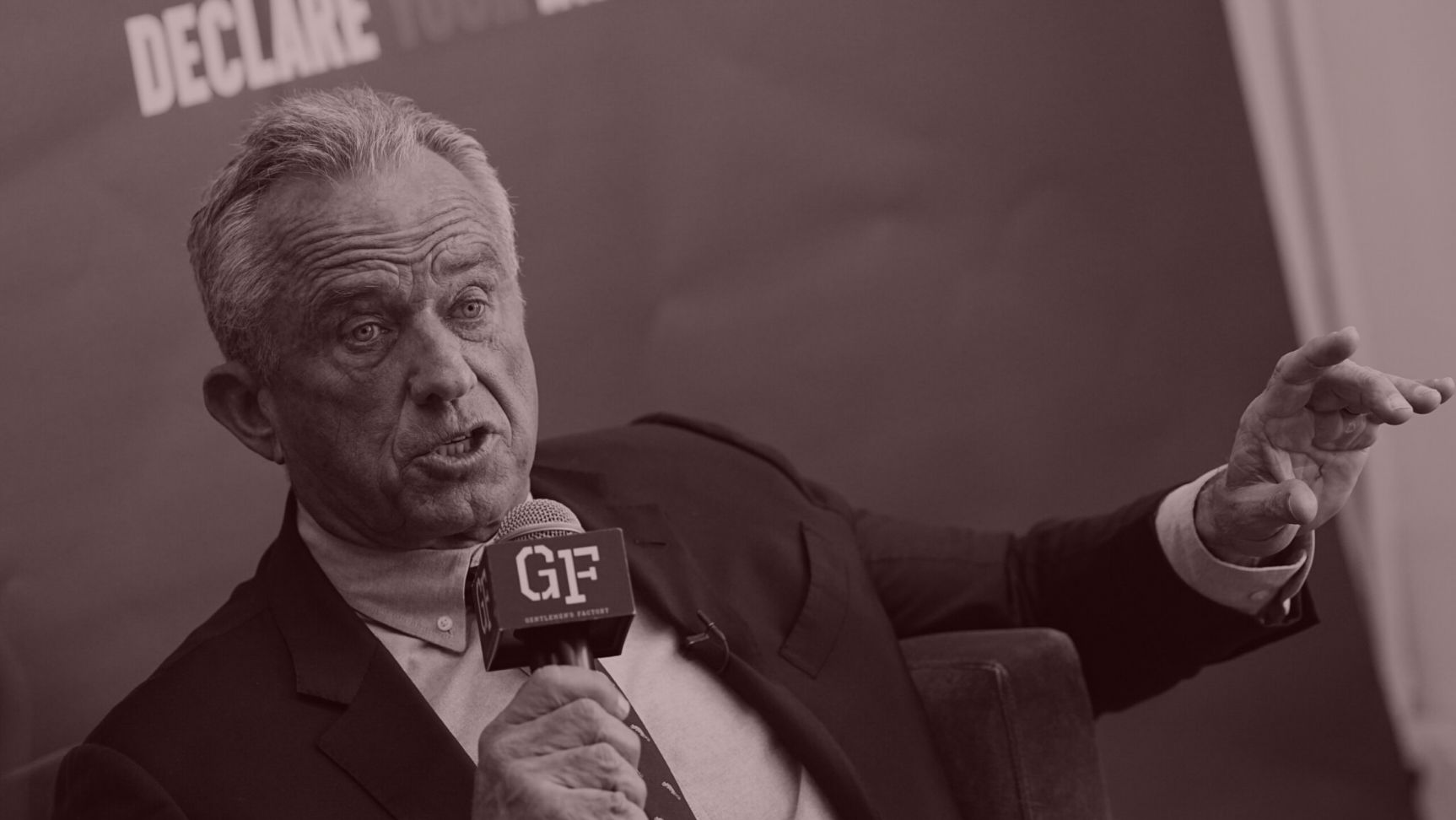
Unlike those stories, the small-government carnival at the Costa Mesa Hilton might actually have an impact on November’s election, because Robert F. Kennedy Jr. was there, flirting with the Libertarian Party about becoming their 2024 presidential nominee, a gambit that could get his name on the fall ballot in 36 states or more. “Our big challenge right now is ballot access,” Kennedy told me on Saturday. “The D.N.C. and the R.N.C. are going to come after us, so we’re looking at all the options, including working with the Libertarian Party or other parties. I feel very aligned with the Libertarians on many issues.”
Polls show Kennedy with impressive support among young people and Black voters in battleground states, a budding problem for Joe Biden. The Trump campaign sees him as a potential headache, too, given Kennedy’s appeal to Joe Rogan-style contrarians and his embrace of conspiracy theories around vaccines and cellphone radiation. But so far, Kennedy is on the fall ballot in only one state: Utah. Kennedy’s campaign told me they have collected enough signatures to secure ballot access in New Hampshire and Hawaii. In six other states, he has filed paperwork to create a political party—“We The People”—that would get him on the ballot. But winning the Libertarian nomination would be the quickest way to fix his biggest logistical headache.
Sitting in a hotel suite above the convention hall, Kennedy outlined why he would be a good fit for the party, although he seemed at times to be shrugging through his pitch. “My approach on environmental issues for 40 years has been a very free market, libertarian approach,” he told me. “There’s issues that we agree on, there’s some areas of divergence, but generally speaking, I feel like our antiwar position, free speech, free markets, individual freedom, opposition to crony capitalism—those are all issues that we’re really compatible on.”
The problem for Kennedy, I found out, is that libertarians don’t want him to be their nominee. When I arrived at the convention on Saturday, I walked in on a round of speechifying from the other candidates seeking the Libertarian nomination, many of whom have been traveling the country lashing Kennedy as a johnny-come-lately whose political views, heterodox as they are, don’t align with theirs at all. |
|
A MESSAGE FROM OUR SPONSOR
|
|
| The Federal Reserve’s Basel III Endgame proposal will undermine the U.S. economy – and American competitiveness. That’s why so many companies, organizations and people are speaking out in rare agreement against the proposal and its harmful impact on the U.S. economy and our capital markets, which generate investments, innovation, growth, and jobs. In fact, 97% of the 350+ comment letters submitted to the Federal Reserve express disapproval.
Organizations from across the political and economic spectrum are urging the Fed to reconsider the rule, saying it would have significant negative consequences and would be bad for both consumers and economic stability. Even lawmakers from both sides of the aisle agree that the Fed should carefully consider the proposal’s consequences on capital markets.
America has spoken. Will the Fed listen?
Protect our capital markets. Protect our economy. |
|
|
|
|
| One of Kennedy’s calling cards is his fierce opposition to foreign conflicts and defense spending. But there onstage, one of the frontrunners for the Libertarian nomination, an author named Michael Rectenwald, was calling Kennedy a “warmonger” over his support for Israel and its war on Hamas. He warned convention-goers not to nominate him. “If we wanted a mere vote-getter, we would vote for R.F.K. Jr., we would nominate him!” Rectenwald said to applause. “But the argument against R.F.K. Jr. is that he is a statist who believes that the state is the solution to all of our problems, where we know the state is the problem itself.”
Rectenwald, whose campaign slogan is “Rec the Regime,” told me that Kennedy is a “shapeshifter” who pretends to be for small government while supporting “government boondoggles,” like Kennedy’s plan to slash mortgage rates to just 3 percent with the help of government-backed bonds. His exasperation with Kennedy’s very presence at the convention was apparent.
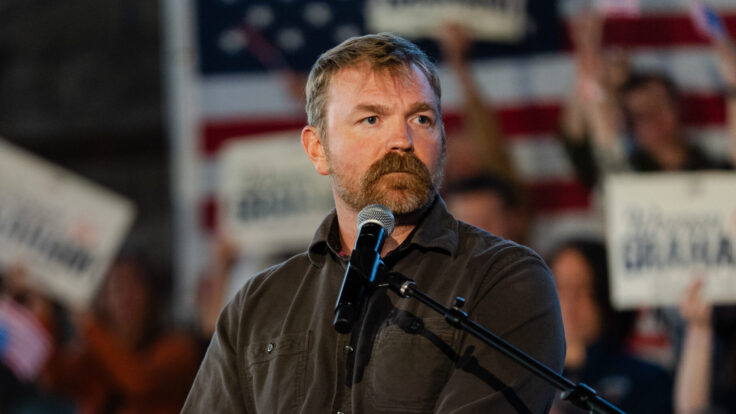
Another would-be nominee, Lars Mapstead, whose name you might recognize from his ubiquitous ads on X, said he appreciated Kennedy’s attacks on the two-party system as “rigged.” Mapstead, a road-racing enthusiast from Big Sur who had a hand in launching the adult dating site AdultFriendFinder, is premising his own campaign on the slogan “Unrig the System.” But he said Kennedy would be a nonstarter for the kind of small-government purists who occupy the rank-and-file of the libertarian movement. “Where we disagree is where he wants more government involvement,” Mapstead told me. “He wants a $15 minimum wage. He wants to tell businesses, ‘You have to pay this amount of money.’ Another issue is guns. Libertarians are very much in favor of the Second Amendment, and he waffles on gun rights a lot.”
As we were talking about guns, Kennedy was about to arrive for a speech at the convention’s Saturday luncheon. His appearance required a security sweep before attendees could enter the room. Guards were checking everyone for weapons. Mapstead chuckled at the scene. “I’ve been to 12 libertarian conventions now, and every one of them had someone carrying a gun,” he said, citing it as one more example of how Kennedy doesn’t fit in. |
|
|
| Kennedy’s pitch to the lunchtime crowd began with a long-winded tribute to “the commons,” the idea that the natural resources of the world belong to everyone—not corporations, not the government. He pivoted to his record as an environmental attorney, suing coal plants for polluting rivers. Kennedy said he believes climate change is man-made, but he would prioritize conservation instead of government action to incentivize the shift to a green economy. Kennedy said that it’s politically toxic to even say the words “climate change.” Government-backed climate efforts, subsidies, tax incentives, carbon capture—they’re all, he said, just a sibling of “corporate crony capitalism.”
“If you want a fistfight, to paralyze the system, talk about climate change,” Kennedy said. There were polite nods all around. The audience, though, seemed skeptical of his presence. Ears perked up when he talked about Silicon Valley companies, their data collection efforts and “control technologies.” It wasn’t until the end of his remarks, however, that Kennedy really grabbed the room. He launched into now-familiar attacks on Anthony Fauci and the various Covid vaccines, which he called “instruments of total control,” a symbiotic “totalitarian” effort by the government and pharmaceutical industries to exert control over the mindless masses. “They have us all trained,” Kennedy said. “We need someone in the White House who understands this. … There are a lot worse things than dying, and one of those is being a slave.” That line sparked loud cheers—and then a standing ovation. Maybe, just maybe, Kennedy would have a shot at the Libertarian nomination after all?
That prospect crashed into reality the following day, when convention organizers ran a presidential straw poll. Out of 95 votes cast, Mapstead won. Rectenwald came in second. Kennedy came in dead last in the straw poll, earning only a single vote.
If that’s an indicator of Kennedy’s chances at the national Libertarian convention over Memorial Day weekend in Washington—where he would have to win over a majority of some 1,100 Mises-quoting delegates—he’s got no shot. “I have been polling the delegates,” Mapstead told me. “There are just so many people that are against him, he has no chance of it happening. It would also just look very bad if he sought the nomination and lost. It’s better if he goes out on his own and gets ballot access.” |
|
|
|
|
| Of course, Kennedy was merely testing the waters in Costa Mesa. He isn’t officially seeking the Libertarian nod. But given the resistance to his candidacy from the convention-goers, his path to get on ballots everywhere has essentially reset to where it was before the weekend. Kennedy’s team is confronting a patchwork of ballot-access laws that are different in every state.
Some states require tens of thousands of validated signatures, which is a heavy lift for even the most well-funded candidates from the two major parties. Kennedy, at least, has money to count on. Thanks to his family name, Los Angeles connections, and small-dollar online support, Kennedy is raising a respectable amount of money for a gadfly candidate. He ended the fourth fundraising quarter last year with $5.4 million in the bank. But the Kennedy campaign continues to burn through cash, spending heavily to collect ballot access signatures. A super PAC backing his campaign is also working to secure ballot access for Kennedy, but that effort is likewise facing a legal challenge from the Democratic National Committee over claims of improper coordination.
When I chatted with Kennedy in his hotel suite, it was clear the Biden administration and the D.N.C. were very much getting under his skin. “There’s challenges, and the challenges are that we have this big infrastructure with tremendous power that is trying to thwart us, particularly the D.N.C.,” Kennedy vented. “Its strategy to get President Biden elected seems to be to try to keep everybody off the ballot, to put hundreds of millions of dollars into an effort to disenfranchise voters who want to vote for somebody other than President Biden.”
One of his biggest ongoing gripes with the Biden administration is that the Department of Homeland Security refuses to provide his campaign with Secret Service protection, even though he says he faces ongoing threats to his safety. Kennedy said one out of every three dollars his campaign raises goes to private security that travels with him everywhere. Kennedy said he’s put in five separate requests with D.H.S. to date, but has received no response. Officially, Secret Service says it provides protection, where needed, to “major presidential and vice presidential candidates and their spouses.” And while Kennedy is polling well for an independent candidate, is he “a major candidate” if he’s only on the ballot in one state? (I reached out to the agency for comment but didn’t receive a response.)
Kennedy, sounding ornery, claimed it’s a deliberate strategy to damage his campaign. “We have a security detail, but it costs us a lot of money. And I think that’s the point,” he told me. “The White House knows that, and they know that the money that I’m spending on security is not going to ballot access and not going to advertising. It seems like a political strategy. In the 50 years since my dad died, which is when they passed the law about Secret Service, I’m the first political candidate to request Secret Service protection and not get it.”
Kennedy was also critical of Trump in our interview, saying the former president failed to “drain the swamp,” that his Covid lockdowns were a tyrannical failure, and that he relied on too many hawkish foreign policy advisers aligned with the military-industrial complex. But it was my sense that Kennedy reserves special contempt for Biden and his campaign advisers, and that contempt is growing by the day. He said Biden is hiding from reporters, mocked his relationship with young voters, and accused him of betraying the Black voters that helped elect him in 2020. And even though Kennedy himself is 70 years old, he gladly took aim at Biden’s advanced age.
“I think it’s not a matter of age,” Kennedy said. “There are plenty of people who are that age who have the acuity and cognitive capacity of much younger people. I think the worries about President Biden is that he’s not in control. We’re not really electing him, we’re electing a bunch of anonymous men in lanyards who are actually running the government. And that’s worrying because you want to have a leader who you’re confident is going to pick up the call at 3 a.m. and make a good judgment call. And President Biden right now seems incapable of having unscripted interviews with voters or with anybody. Even the scripted interactions are difficult.”
Again, these blunt criticisms will matter more if Kennedy’s name is actually on presidential ballots come November. And after the weekend, following his rejection by the skeptical Libertarians, that remains uncertain. “We’re working on every option,” Kennedy assured me. “We’re going to be able to get on every ballot.” |
|
|
|
| FOUR STORIES WE’RE TALKING ABOUT |
 |
|
 |
|
 |
|
 |
| Ackman’s Rebuttal |
| On Bill Ackman’s latest public soliloquy and ongoing B.I. offensive. |
| WILLIAM D. COHAN |
|
|
|

|
 |
|
|
|
Need help? Review our FAQs
page or contact
us for assistance. For brand partnerships, email ads@puck.news.
|
|
You received this email because you signed up to receive emails from Puck, or as part of your Puck account associated with . To stop receiving this newsletter and/or manage all your email preferences, click here.
|
|
Puck is published by Heat Media LLC. 227 W 17th St New York, NY 10011.
|
|
|
|