 |

|
|
Hello, and welcome back to The Best & The Brightest, your Tuesday foreign policy edition.
I watched Alexey Navalny’s remarkably bittersweet funeral from my sickbed last week and wanted to share some thoughts and reporting with you. Personally, I’ll just say that seeing him in a coffin, his face waxy and ashen with death, was absolutely unbearable, a final confirmation that Alexey, with all his warmth, wit, and vigor, was no longer with us in the world. If you want to see what he was really like, please watch Navalny, the documentary that won an Oscar last year. And here’s the interview I did with Christo Grozev, one of Navalny’s colleagues and friends, a year ago.
More on Russia after Navalny, below.
But first, here’s Abby Livingston’s report from the Capitol…
|
|
A MESSAGE FROM META
|

|
|
Cataracts are the primary cause of avoidable blindness.
FundamentalVR and Orbis International created a VR training platform that helps surgeons practice cataract surgery.
As a result, more surgeons have access to the training they need to treat cataracts around the world.
Explore the impact of the metaverse.
|
|
|
| Sinema Exits & Barrasso Bows Out |
|
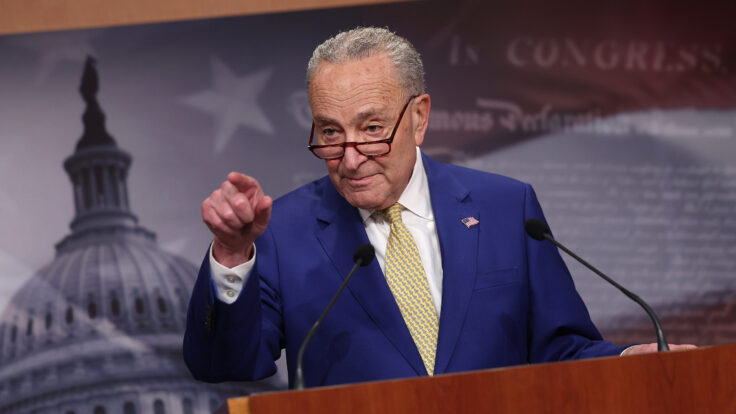
Happy Super Tuesday, which was supposed to be all about presidential and House race politics—until the Senate took center stage, following the double-barreled announcements that John Barrasso will not run to replace Mitch McConnell as leader (he’s running for whip), and that Kyrsten Sinema will not seek reelection. A little more on both of these…
- Sinema’s exit: Yes, yes, this was all widely expected. But I was never entirely convinced that the Arizona independent would retire, given how hard she worked the fundraising circuit through the end of the year. Her quarterly hauls were smaller than your average senator up for reelection, but the amount she was able to fundraise outside of the normal party apparatus, after she went indie, suggested meaningful enthusiasm for her candidacy. (Both Republican and Democratic insiders would often tell me how useful she was in brokering deals, despite all the criticism she received within her former party.) She had $10.5 million in cash on hand in December, which is an enormous pile of money for a future-ex-senator. I wondered if she might be keeping her options open for the future.
For now, it’s hard to say which party will have the edge in the race to replace her. It will be a bare-knuckle fight between Ruben Gallego and Kari Lake, neither of whom are shrinking violets. The polling on a three-way contest has at times been counterintuitive—she seemed to pull votes from both sides, rather than being a spoiler for Gallego—so it’s too early to determine how Arizonans will respond.
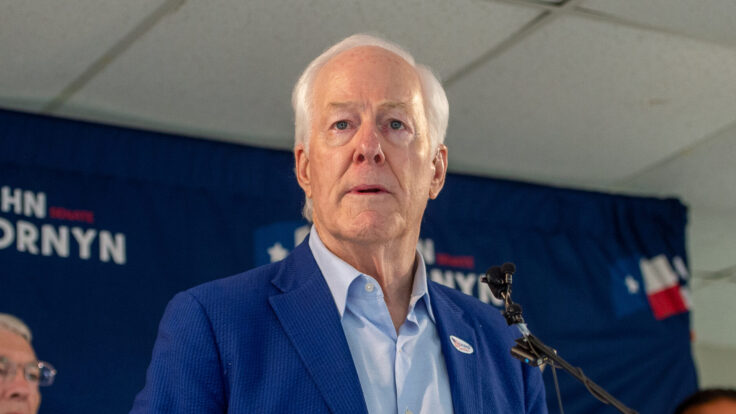
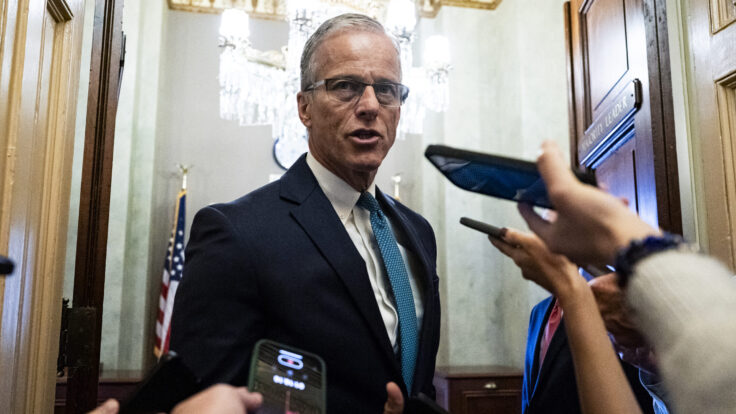
- John vs. John: With Barrasso out, the race to replace McConnell seems to have whittled down (at least for now) to John Cornyn and John Thune. Barrasso’s strength as a contender was his perceived ability to consolidate MAGA senators while expanding his coalition to more establishment-minded colleagues. In the hours after his announcement, several Senate Republican sources suggested that there is still very much an untapped lane for a hardliner.
As for the remaining Johns, Cornyn has been far more aggressive during the first week of this contest. Typically, in a leadership race, the contender who gets out in front can manufacture a sense of momentum which sets the parameters of the contest. But this nascent race has been remarkably slow to take form; my understanding is that it may soon enter a publicly dormant phase, in which much of the politicking occurs between senators and outside the public eye.
One final thing to remember: This is a race among guys who will be in office a year from now, which means retiring senators, like Mitt Romney, will have no official say in picking the new leader. Meanwhile, Republican Senate candidates who win in the fall will have a vote. Cornyn and Thune are longtime campaigners and donors (activity which will likely escalate over the next eight months), and I would expect them to court candidates in the six or so hotly contested races where the G.O.P. has a serious shot at flipping seats.
|
 |
| Moscow After Navalny |
| The fate of the Russian opposition, which was allowed to mourn Alexey Navalny and now faces violence and imprisonment for that small act of protest, feels more unsettled than ever. |
|
|
|
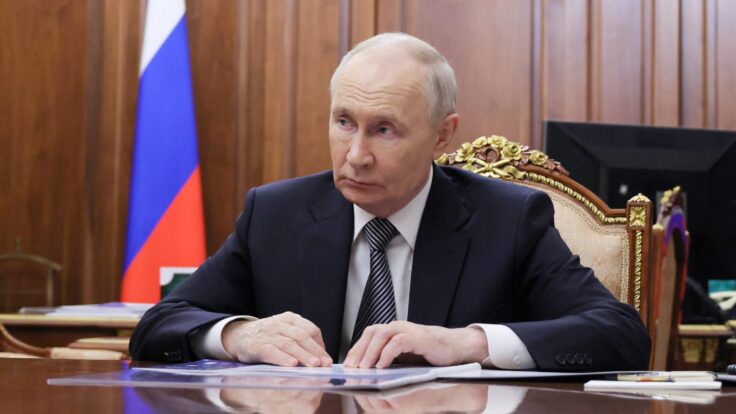
| On Friday, they buried Alexey Navalny, and despite the risk, tens of thousands of people came out to bid him farewell, turning his funeral into the biggest protest Russia had seen since the full-scale invasion of Ukraine two years ago. Many went despite the prospect of arrest. One Muscovite told me his wife packed a bag for jail, assuming she would be detained. “It was scary,” another recalled. “These guys will hit you on the head, lock you up somewhere.” But staying home was not an option for this person. It wasn’t just that Vladimir Putin had killed the leader of the opposition, someone that this Muscovite, a friend of mine, had admired and followed for years. It was that killing Navalny was only the latest thing Putin had done—after eliminating any vestiges of democratic elections and a free press, after invading and destroying Ukraine, after turning Russia into a pariah state—and it was time for my friend to show their discontent. “Let these bastards see that we’re not happy, that we don’t agree,” the friend said, a mood they saw reflected in the crowd. “People weren’t crying anymore. There was more anger, like, what are these bastards doing?”
At the funeral, there were cops everywhere, including the dreaded riot police. There were also plain-clothes operatives watching the perimeter. And there were guardrails and street closures on the road to the church and the cemetery, to control the crowd both literally and figuratively. “They made it very hard to get to,” the friend from Moscow told me. “This is closed, that’s closed. You can’t go here, you can’t go there. It was to show us that you’ll walk in the cage we’ve set up for you—and thank us for it.”
And yet, people in the crowd found that they hadn’t just come to say goodbye to Navalny, but to say hello to one another. There were so many people there: young people, old people, people with “different faces,” as several attendees told me. This is intelligentsia shorthand for “our people,” not the hoi polloi they’ve increasingly become surrounded by after some million Russians fled following the outbreak of the war, many of them urban professionals who despise Putin, the core of the Russian opposition movement. Since their departure, people who have gone back to Moscow have told me that the capital, once Russia’s intellectual and artistic nucleus, had become bydlovataya—from the word bydlo, cattle, the derogatory term for the vast and gullible lower classes who form Putin’s base. There were more and more of them—and their faces—in Moscow now, in the restaurants and the theaters, taking up the places left empty by the more refined and educated émigrés. |
|
A MESSAGE FROM META
|
|
|

|
|
“VR let me practice hundreds of times before I operated on a patient.”
Dr. Baid used FundamentalVR and Orbis International's VR platform for additional training in a hands-on environment.
In the past year, Dr. Baid has performed 300 life-changing surgeries to preserve her patients' vision.
Discover other stories.
|
|
|
| But here, in the crowd lining up for blocks by the Borisovsky cemetery, Muscovites saw their people. They weren’t people they knew personally, but they were people they might like to get to know, people who clearly see the world in a similar way and feel strongly enough to do something, however small, about it. “I’m not the only one,” my friend realized, being in that crowd. “That’s a positive emotion.”
Another friend who’s still in Moscow told me that in the time between Alexey’s death and his burial, the fear was palpable. “It seemed like the number of cops in the streets doubled in those two weeks,” they said. “And then there’s new types appearing all the time. In the Metro, you see these troikas of tall guys in bulletproof vests [on patrol], real robocop types. They make me shake with fear.” But on the day of the funeral, they said, “It was nice. Lots of support, and I felt a kind of release.”
Almost no one was detained on Friday, so more people came on Saturday, bringing still more flowers. No one was detained on Saturday, so more people came on Sunday. By day’s end, Navalny’s grave had become completely covered in flowers, a giant, floral pyre. By Monday, police had arrested the first of the funeral-goers after the fact, and more would follow on Tuesday. The authorities were finding people in videos, tracking and singling out exactly those faces that my friends had been so happy to see.
When I spoke to them on Tuesday morning, though, one friend was undeterred by the post-protest arrests. They were planning on arriving at their polling place at noon next Friday, the first day of the completely predetermined presidential election—though not necessarily to vote. It was a show of force Navalny had called for before his death, and this friend, still high off the camaraderie they felt at the funeral, was determined to show up. “The state doesn’t care—it won’t have any electoral effect,” they said, “but it’s for us, to show us how many of us are still here.” |
|
|
| It all reminded me of the heady days of Bolotnaya, the first of the massive pro-democracy protests that rocked Moscow and other cities in the winter of 2011-12. Back then, white-collar Muscovites had been living in their comfortable, upper-middle-class bubbles, and grumbled in them, too, about eroding democratic norms, metastasizing corruption, about wanting Russia to be a “normal,” Western country. The regime was learning to isolate them from each other, to atomize them and convince them that they were alone, islands of negativity in a sea of materialistic contentment. But then, after crudely falsified parliamentary elections in December 2011, a protest planned for 5,000 people turned out well over 10 times that number. Suddenly, everyone could see that people weren’t apathetic, as the Kremlin wanted them to believe. I wrote at the time: “Today was just the first time that all of these people came out and discovered each other’s existence.”
As a result, the protests of that winter felt more like block parties. People were so happy to learn they weren’t alone and that there were, in fact, so, so many of them. They came out, again and again, with their witty posters and their surging civic optimism, hoping for a better future for their country. The Kremlin, initially caught off guard, quickly regained its balance and began a crackdown that grew ever wider and, eventually, got us to where we are today.
Watching Navalny’s funeral, talking to people who were there, it was hard not to see last weekend as a kind of inversion of Bolotnaya, and of that entire winter when Alexey first emerged as the most credible leader of the anti-Putin movement. But back then, the air was filled with a sense that better days were ahead, if not just around the corner. Russia seemed on the brink of finally, finally fulfilling its potential.
What we saw this weekend was the end of that hopeful arc. First, the protest movement had been killed, and now so too had its leader. And though over 10,000 people in Moscow came out to bid Alexey farewell, what did it change, really? Putin would still be re-elected overwhelmingly for another six-year term, Russian missiles would keep killing Ukrainian children for no discernible reason, and dissent would land hundreds and thousands more Russians behind bars. If we thought the repression of Russian society was bad 15 years ago, it has become Stalinesque now. |
|
|
| One of my friends recalled standing in line to pay respects to Alexey and talking to a younger couple. They stood and talked for a good half hour about everything, their disapproval of the war, their hatred of Putin and the repressive, unjust system he’d built. “And then I had a fleeting thought, ‘Who are these people? Maybe they’re plants, provocateurs?’ The thought did cross my mind,” the friend told me. “In the late Soviet period, I had far fewer thoughts like this. I knew whom not to talk to. Now I don’t.”
When I asked Nina Khrushcheva, Nikita’s granddaughter, about this, she told me, “Russian society is very atomized now.” Khrushcheva had recently come back from a six-month stay in Russia, where she was determined to witness the rapid degradation of Russian society and to document the way it had fallen into the familiar void of totalitarianism. “People are afraid,” she explained. “People are terrified because they don’t know how far it goes, what they can and can’t do.” The rules, after all, are always changing these days. “In the Soviet Union, you knew where the space for dissent was, which kitchen to go to, which theater to go to,” she added. “Now nobody knows whom to trust, who’s going to rat on you.”
One of my sources, someone close to the Kremlin who described themself as not a fan of Navalny, was still saddened by his death. “I was never his supporter, but he became the symbol of a fight of good against evil, so it’s sad,” the source said. The feeling was widespread in his social circle, he added. “A few women I know who were definitely not his fans, even they were crying. Because he became a symbol, and this was the destruction of another hope.” But when I asked him if what we saw this past weekend in Moscow would affect anything, he scoffed. “It’s not the best question,” he said. “What can it affect?”
“These were Alexey Navalny’s supporters, and it was an expression of the pressure under which they live,” said Denis Volkov, a sociologist and the director of the Levada Center, an independent Russian polling organization, when I asked about what we saw over the weekend. “The majority, the people who support the government, everything is great for them. The minority who feel totally differently [toward the government], they feel pressure, that they’re in the minority, that they can’t express their opinion at all, people who don’t feel understood by family, etcetera.” And they’re right to feel this way, Volkov said. If before the full-scale Russian invasion of Ukraine, those who disagreed with Putin made up about a third of Russians, their numbers have since shrunk to about 20 percent, according to Volkov.
I asked Alexey Minyaylo, one of a younger generation of Russian pollsters, if he thought the thousands of people streaming to Navalny’s grave meant Russians, or even Muscovites, were in the mood to protest. “I don’t think the mood to protest matters,” he told me, speaking on the phone from Moscow. “As we know, people protest when they can and don’t protest when they don’t. It’s like that in the whole world. The thing is that Alexey represented the Western choice for Russia. Over 50 percent of Russians want a path for Russia that is completely perpendicular to the current course. The fact that people went all weekend is the embodiment of the demand that Russia be a democratic, peaceful, rule-of-law country.” He went on, “The demand exists. The question is, will it be able to be realized? Because the whole government apparatus is aimed at squashing it.”
Khrushcheva put it differently. The protests this weekend showed what can happen if the Kremlin creates a permissible, slightly safer space in which to show one’s discontent, a kind of permitted protest. “It’s difficult to protest alone because you know they’ll break your legs,” she explained. “But this is a group, this is an official process.” The same was true when the Kremlin briefly flirted with allowing Boris Nadezhdin to run in this month’s presidential “election” as a kind of officially sanctioned steam valve for liberals opposed to the war. The state allowed Nadezhdin (whose last name derives from the Russian word for “hope”) to gather signatures to get a spot on the ballot. As a result, all over Russia, people lined up to sign on for a candidate that was against the war but had been tacitly allowed by the Kremlin to run. The lines stretched for blocks and blocks, and Nadezhdin quickly gathered over 100,000 signatures. The Kremlin panicked and quickly discovered some “technicalities” on which to disqualify him. But when people were told this was a permissible way to protest, they went. “It was the same thing with Navalny,” Khrushcheva explained. “You allowed a funeral, so we’re going. That is a protest.”
“One of the problems is expecting Russians to do Maidan,” Khrushcheva continued. “Russians don’t do Maidan. They don’t have a history of free politics. There’s a lot of protest. There’s a lot of people, and once you start scratching at the surface, you’ll see it everywhere.” She told me about how “half of Moscow” is now walking around carrying tote bags that say “1984” on them. About how, among maudlin exhibits dedicated to Stalin and Putin, you could spot anti-government witticisms of the legendary Soviet actress Faina Ranevskaya. About the omnipresent “middle finger in your pocket,” the quiet, unquantifiable, passive way Russians show their disdain for an oppressive state, even while appearing to go along with it. “That’s how Russia fights,” Khrushcheva shrugged. “It’s sad and it’s not enough, but expecting it to be anything different is pointless.” |
|
|
| That’s all from me this week, friends. I’ll see you back here next week. Until then, good night. Tomorrow will be worse.
Julia |
|
|
|
| FOUR STORIES WE’RE TALKING ABOUT |
 |
| S.B.F. Prison Math |
| On the legal game theory behind Bankman-Fried’s sentencing gamble. |
| ERIQ GARDNER |
|
 |
|
 |
|
 |
|
|
|

|
 |
|
|
|
Need help? Review our FAQs
page or contact
us for assistance. For brand partnerships, email ads@puck.news.
|
|
You received this email because you signed up to receive emails from Puck, or as part of your Puck account associated with . To stop receiving this newsletter and/or manage all your email preferences, click here.
|
|
Puck is published by Heat Media LLC. 227 W 17th St New York, NY 10011.
|
|
|
|