Hello, and welcome back to The Best & The Brightest. I’m Leigh Ann Caldwell,
coming to you from a late Amtrak back to D.C. after spending the weekend in New York to celebrate my son’s 13th birthday. (He saw Hamilton for the first time.) While I was in town, I made sure to stop by the Air Mail shop in the West Village. I wanted to buy everything, but I left with a pack of miso bombs that I’m so excited to try. That said, I could think of a number of people on the Hill desperately in need of some upgrades available at the store, including those $95
Anderson & Sheppard socks.
Technically, part of the government is shut down, but this hasn’t had much of an impact on operations: The House is expected to pass five of the remaining six funding bills when it returns tomorrow night. Meanwhile, negotiations continue over a two-week funding extension for the Department of Homeland Security as Democrats push for new restrictions on ICE. More on that below.
In tonight’s issue, Republican Sen. Thom Tillis opens
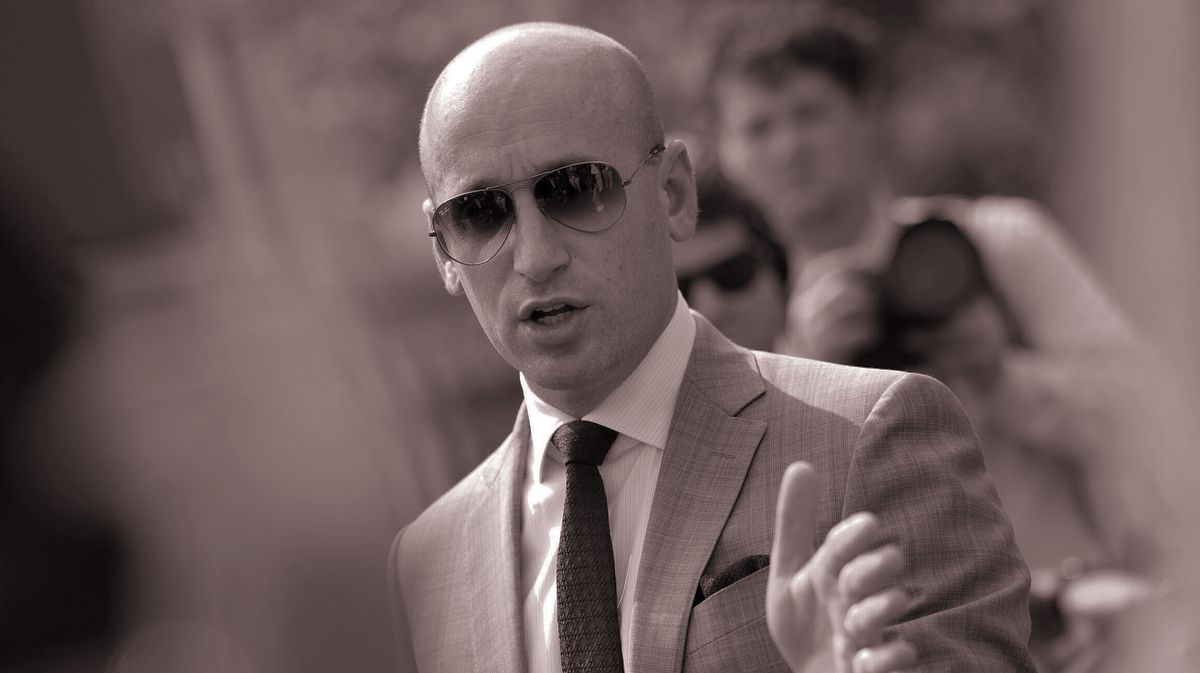
up about his disdain for Stephen Miller, the architect of Trump’s least popular hard-line immigration tactics—and the administration’s emerging Dr. Evil. Tillis, of course, is retiring after this year, which has empowered him to be more vocal. But he’s hardly the only Republican on the Hill who thinks Miller is a real problem for the president, and the party.
Also mentioned in this issue: Rand Paul, Karoline
Leavitt, Lindsey Graham, Steve Bannon, Thomas Massie, Christian Menefee, Chuck Schumer, Greg Abbott, Tom Homan, Ileana Garcia, Markwayne Mullin, Eric Schmitt, Marc Short, Mike Pence, and
more…
But first… |
- Johnson’s
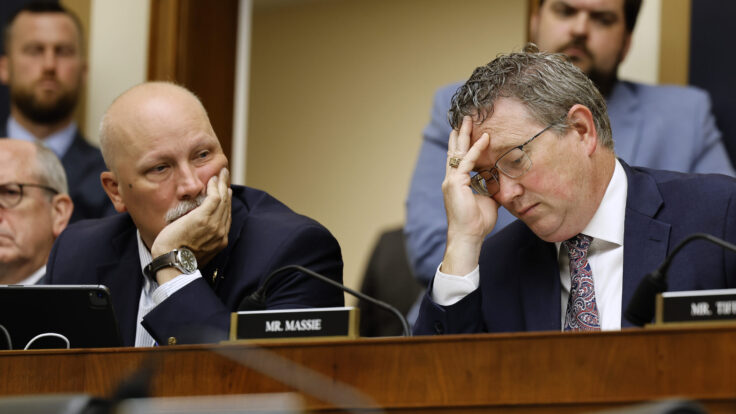
one-seat majority: House dynamics shifted again this weekend after Democrat Christian Menefee won a Texas special election on Saturday—for a seat that had been open nearly a year following the death of Rep. Sylvester Turner, in a race that Gov. Greg Abbott delayed for as long as possible to help preserve the House Republicans’ majority. Menefee’s win narrowed the majority to a one-seat margin, which means Republicans will
have a nearly impossible time passing legislation on their own. Republican Rep. Thomas Massie votes against most legislation, and members have gotten bolder in making demands from leadership in exchange for their votes. On Meet the Press this morning, Speaker Mike Johnson acknowledged that this margin will persist “for the rest of 2026.”
- Honey, I shrunk the shutdown: Johnson
also said on MTP that he’s confident the partial government shutdown will be over by Tuesday. When members return to town tomorrow night, they will vote on five funding bills and a two-week extension of funding for the Department of Homeland Security. (Trump gave Republicans permission to separate the D.H.S. bill and negotiate accountability measures demanded by Democrats.) But the next two weeks of negotiations could be challenging. Democrats are demanding that ICE agents remove their
masks, wear body cameras, and obtain judicial warrants. “Some of these conditions and requests that they’ve made are obviously reasonable and should happen,” Johnson said, “but others are going to require a lot more negotiation.”
Johnson also noted that he was in the Oval Office when the president had Senate Democratic leader Chuck Schumer on one line and border czar Tom Homan on another. He said that the demands around
warrants and masks would involve a “whole other layer” of bureaucracy. But Democrats now find themselves with an enormous amount of leverage due to Johnson’s one-seat margin and the 60-vote requirement in the Senate. We’ll see what happens. - Texas shock: Democrat Taylor Rehmet won a stunning upset in a deep-red Fort Worth State Senate district during a special election on Saturday. Trump carried the same district by 17 points last
November, making the result another flashing warning sign for Republicans, who have consistently underperformed in elections since then. My colleague Abby Livingston will have a lot more on this tomorrow.
|
|
|
Trump’s hard-line immigration restrictionist has become a lightning rod in the culture, and
on Capitol Hill in particular. Republicans are divided among those who support Miller, those who suffer him out of fealty to the president, and an increasingly vocal group that thinks he’s going to cost them the midterms. |
|
|
Sen. Thom Tillis rarely misses an opportunity to trash Donald Trump’s
sidekick and deputy chief of staff, Stephen Miller—a guy he’s previously described as “incompetent,” “stupid,” and “amateur.” Chatting up reporters in Capitol Hill hallways, the retiring North Carolina Republican often finds a way to weave Miller into his answer, always with a dig. During one recent gaggle, Tillis remarked that Miller “never fails to live up to my expectations of incompetence.”
And yet that’s not quite the full story describing Miller. After being one of
the lone survivors of the backstabbing and staff drama that defined Trump’s first term, Miller helped plot the president’s comeback, and reentered 1600 Penn freshly versed in U.S. legal code—prepared to exploit every weakness of the law, and even push beyond it, in support of his immigration agenda. If Trump 1.0 was defined by constant defenestrations, the second tour has been all about the insularity of the true believers. And Trump has made immigration, a central fixation of his base,
his cardinal issue. “He trusts Stephen to know where the voters are,” Marc Short, former Vice President Mike Pence’s chief of staff, told me.
Of course, Miller has run with the topic and interpreted his mandate broadly. As a key architect of Trump’s first-term family separation policy, he’s picked up right where he left off—directing a policy of rounding up immigrants without due process, labeling them criminals, and placing many on
midnight deportation flights. He’s pushed for deploying the military to U.S. cities, instituted deportation quotas for ICE, and greenlit indiscriminate arrests of anyone suspected of being undocumented—including, inevitably, U.S. citizens. He was also the aide behind the U.S. bombing of boats allegedly carrying drugs in the Caribbean, which eventually led to the seizure of Venezuelan leader Nicolás Maduro. Plus, he pushed the harebrained idea that the United States would obtain
Greenland. Whenever judges objected, he’d attack them publicly and suggest they were leading an insurrection.
In the process, Miller became the most effective and influential advisor in the White House—which is now a major problem for a growing number of Republicans who see a winning issue slipping away at the start of a consequential midterm season. As my partner Peter Hamby has reported, recent polls show that support for ICE has fallen 30 points in 12 months, a practically unheard-of political collapse. In another survey last month, only 33 percent of Americans said the country was on the right track—Trump’s worst result since returning to office.
Sen. Rand Paul told me he’s had concerns with Miller since the latter floated in May that the government was considering suspending habeas corpus for detained immigrants. “Discussion by a high-ranking government advisor to get rid of something so fundamental to liberty is concerning to me, and still concerns me,” he said. He also remarked that Miller’s comments “have gone a long way toward elevating the chaos” and creating distrust of ICE.
Per Tillis, it’s Miller who has run the once-popular
border security issue “into the ground.” As he told me recently, “Miller cares about the president, but he cares about Stephen Miller, and he’s looking for his next opportunity. I’ve told the president, if he thinks that Stephen Miller has any commitment to him long-term, I think you ought to talk to Jeff Sessions about it.”
But this advice doesn’t seem to be taking. “Stephen Miller is one of President Trump’s most trusted and longest-serving aides,” said White House
press secretary Karoline Leavitt. “The president loves Stephen. No one would ever question his loyalty to the president or the president’s America First agenda.” As Sen. Lindsey Graham noted on Fox News, “To my colleagues who believe you can convince Donald Trump that Stephen Miller is a liability for him, good luck with that.” |
Before Trump rode down the golden escalator, of course, Miller was Sessions’s communications director. Back
in those days, he was known as an intense, fringe weirdo who used to scream at Republican comms directors in meetings about the scourge of immigrants in the country. Miller eventually saw his vessel in Trump—an ideologically squishy strongman willing to conveniently blame immigrants for the country’s social, economic, and cultural woes. Miller joined Trump’s campaign before the Iowa caucuses, back when it was largely a bootstrapped family affair. Two years after his election, when Trump fired
Sessions from his post as attorney general for recusing himself from the Russia investigation, Miller didn’t utter a word in support of his former longtime boss. “No one—and I mean no one—was more enraged at Sessions than Stephen was for Sessions’s betrayal of the president,” a source familiar with Miller’s thinking said.
Back in October, I started to sense that Republicans were growing concerned with Miller’s aggressive, legally questionable policies. Republicans at the time
told me all would be fine as long as the administration respected pending court decisions. But then came Greenland and Minnesota, and a series of poignant Democratic pickups. Now they’re openly divided on how far immigration enforcement should go. One Republican senator told me that Miller repeatedly wants to take things farther than the president does,
and that now it’s up to Trump how much he wants to empower his loyal aide. “The president’s got to decide how much he’s going to dial it back,” the senator said. Indeed, some are smelling weakness. Ileana Garcia, a Cuban-American Florida state senator who used to work for Trump, told The New York Times, “I do think that he will lose the midterms because of Stephen Miller.”
From the other side of the Republican ideological
spectrum, Steve Bannon attacked Miller on his WarRoom podcast for retreating and potentially scaling back ICE activity in Minnesota. “This is an inflection point. You blink now, you blink forever. If you bend the knee now, you bend the knee forever,” Bannon said. Of course, his comments may amount to score-settling: Bannon and Miller used to be allies before the former was unceremoniously fired, ostensibly for taking too much credit for his influence
over the president.
Miller still has plenty of defenders on the Hill, including many members of the House Freedom Caucus, as well as Oklahoma Sen. Markwayne Mullin and Missouri Sen. Eric Schmitt, who defended Miller this week and has repeatedly endorsed his hard-right immigration strategy. But it’s also notable that many of Miller’s defenders are either not running for reelection or face no risk of losing their seats.
The ones who really need to
worry about him are those in the skittish middle—members who have to face voters in November and will be held accountable for the administration’s policies. The president’s job approval average is at its lowest point of his second term, not far from where it stood after he lost reelection in 2020. Miller may be driving major policy from the White House, but
he may also be helping drive voters away from his own boss, and from the party he represents. |
|
|
Join Emmy Award-winning journalist Peter Hamby, along with the team of expert journalists at Puck, as they let you in on the
conversations insiders are having across the four corners of power in America: Wall Street, Washington, Silicon Valley, and Hollywood. Presented in partnership with Audacy, new episodes publish daily, Monday through Friday. |
|
|
Unique and privileged insight into the private conversations taking place inside boardrooms and corner offices up and down Wall
Street, relayed by best-selling author, journalist, and former M&A senior banker William D. Cohan. |
|
|
Need help? Review our
FAQ page or contact us for assistance. For brand partnerships, email ads@puck.news.
You received this email because you signed up to receive emails from Puck, or as part of your Puck account associated with {{customer.email}}. To stop receiving this newsletter and/or manage all your email preferences, click here.
|
Puck is published by Heat Media LLC. 107 Greenwich St., New York, NY 10006 |
|
|
|