|
Welcome to Wall Power, now featuring an exclusive Wednesday edition only for Puck’s Inner Circle. I’m Marion Maneker. Let’s get down to business.
As we expand our coverage, we need a place where we can focus on the mechanics of how and why art is prized in our culture. In the coming weeks, we’ll bring you interviews with industry decision-makers about what concerns and excites them most—a level of candor you’ll get nowhere else. I
also want to use this Inner Circle platform as a place where I can present and explain the data that underpins what’s actually happening in the art market—and why.
So tonight, we’re going to look at ARTDAI’s data for 2024 to get a better sense of what transpired in the auction market.
But first…
|
- Right-wing Texans protest Sally Mann: That didn’t take long. About a year ago, MoMA director Glenn Lowry predicted that, after taking down three Ivy League university presidents, anti-elite populists would target museums. Now, with less than two weeks to go before Donald Trump is sworn in, political opportunists in Texas have set their sights on the Modern Art Museum of Fort Worth and photographer Sally Mann, claiming that her photographs in the current exhibit Diaries of Home promote “radical perversion” and “degeneracy.” In The Dallas Express, a news website owned by conservative activist and megadonor Monty Bennett, Tarrant County’s chief political executive, Tim O’Hare, called for an investigation by law enforcement. (“Children must be protected, and decency must prevail,” etcetera.) The show features a dozen artists, including Mann, whose well known and widely respected work depicts her children at play, including images where they are not wearing clothes.
Using this manufactured outrage as cover, local officials seem to have coordinated a complaint so that a warrant to seize the photographs could be issued under the pretext of conducting an investigation. And indeed, The Dallas Express—which is unfortunately the source of almost everything known about the situation—reported on Monday that that’s exactly what happened.
How far the local district attorney will pursue the case remains to be seen. The self-interested advocacy of The Dallas Express is being picked up by other outlets which, though ostensibly sympathetic to the museum, end up repeating specious statements about Mann’s photography that buttress the conservative attack. The website has extended its campaign to “major companies” it accuses of funding images that it considers illicit. The ultimate goal, of course, is to get the museum’s supporters to stop donating and attending.
When Lowry predicted populists would pivot to museums, he suggested that programming should be an institution’s best defense. By building a solid constituency through engaging and compelling exhibitions, Lowry said, museums would have deep roots in their communities, which would protect them from moral panic and public witch trials. The question for museums and curators, however, is whether bold, captivating exhibits can build a loyal constituency without leaving the institution vulnerable to opportunistic political attacks.
If this local campaign is successful, we’ll likely see more of the same. It won’t take much for curators and museum directors to think twice in the future, particularly if any director meets the fate of those Ivy League presidents.
|
|
Now, let’s get to the data…
|
|
|
|
New, proprietary data shows a 25 percent drop in art sales last year
across Christie’s, Sotheby’s, and Phillips—a brutal signal, perhaps, that the market has truly hit bottom. Nevertheless, there are encouraging signs within certain market segments, such as more buyers bidding, and a growing number of lots selling above the estimate range. Herewith, an autopsy…
|
|
|
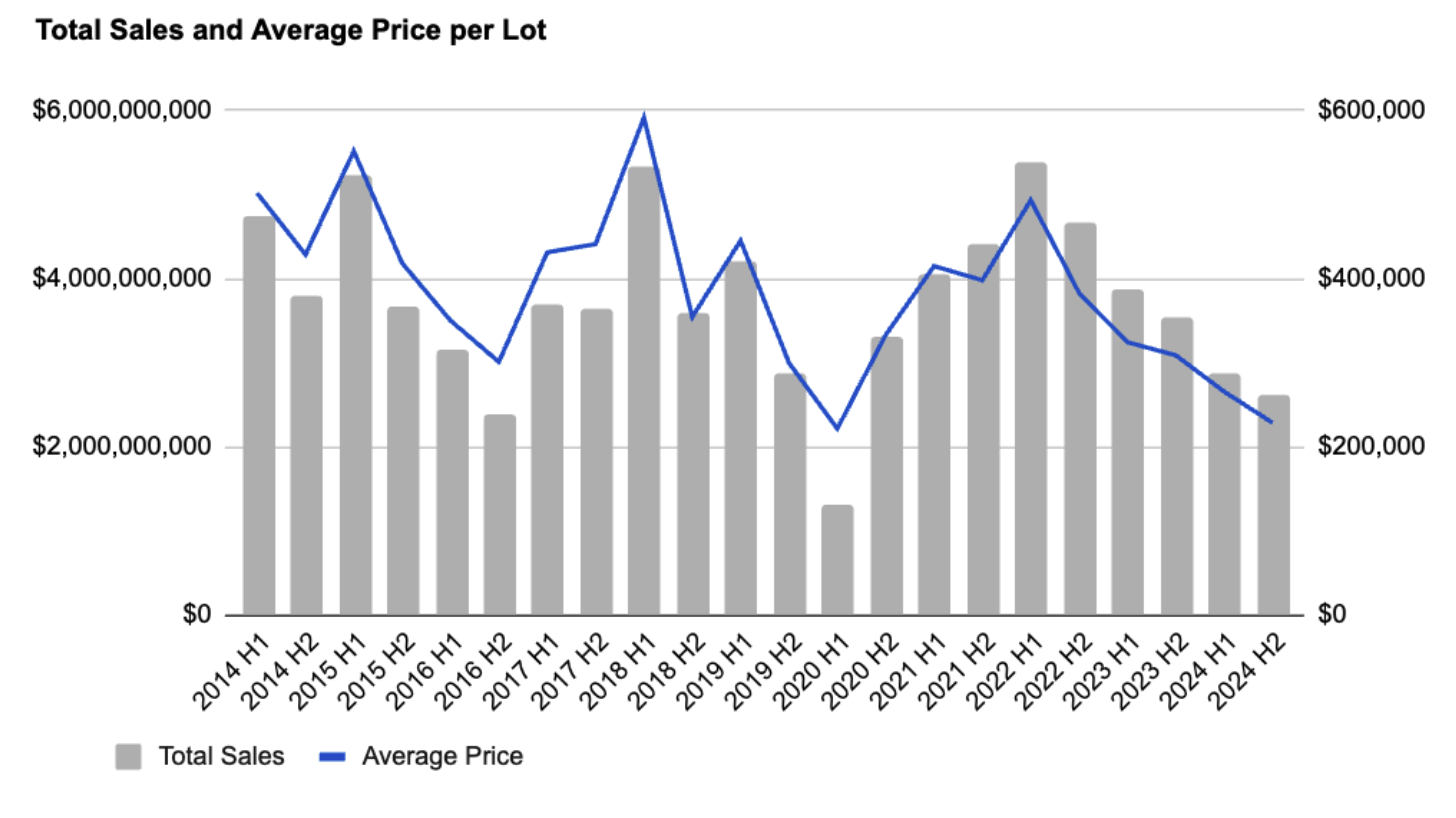
There were reasons to believe that the comparatively successful November auctions signaled that the art market had turned a corner. Christie’s, for instance, reported that its final revenue numbers were only down 6 percent year over year, and that its 2H24 numbers had ticked upward. But new data provided to me exclusively by market insights firm ARTDAI shows that the overall auction performance of art and design objects was lower in the second half of ’24 than during the same period in ’23, continuing a slide that began two and a half years ago after the peak in the first half of 2022. (One reason things seem worse in the auction data is that much of the market has moved to private sales, which are way up.)
Since ARTDAI only follows sales of art across Christie’s, Phillips, and Sotheby’s, its data excludes the transactions of luxury objects that have become increasingly trendy, and that I have written about quite a bit of late. Therefore, its numbers have been more ominous than the broader industry reports, which include substantial non-art property. ARTDAI reported sales of $7.4 billion in 2023. Last year, that number fell 25.6 percent, to $5.5 billion. Let’s hope that we’ve achieved a manageable bottom.
Total sales at auction for the second half of 2024 were $2.6 billion, just above the $2.3 billion achieved in the second half of 2016 and well above the $1.3 billion in the first half of pandemic-plagued 2020. The average price per lot that ARTDAI tracks was also down in 2024, to $229,000—slightly above the decade’s nadir, during the first half of 2020, when the auction house shuttered along with the rest of the world.
|
|
|
|
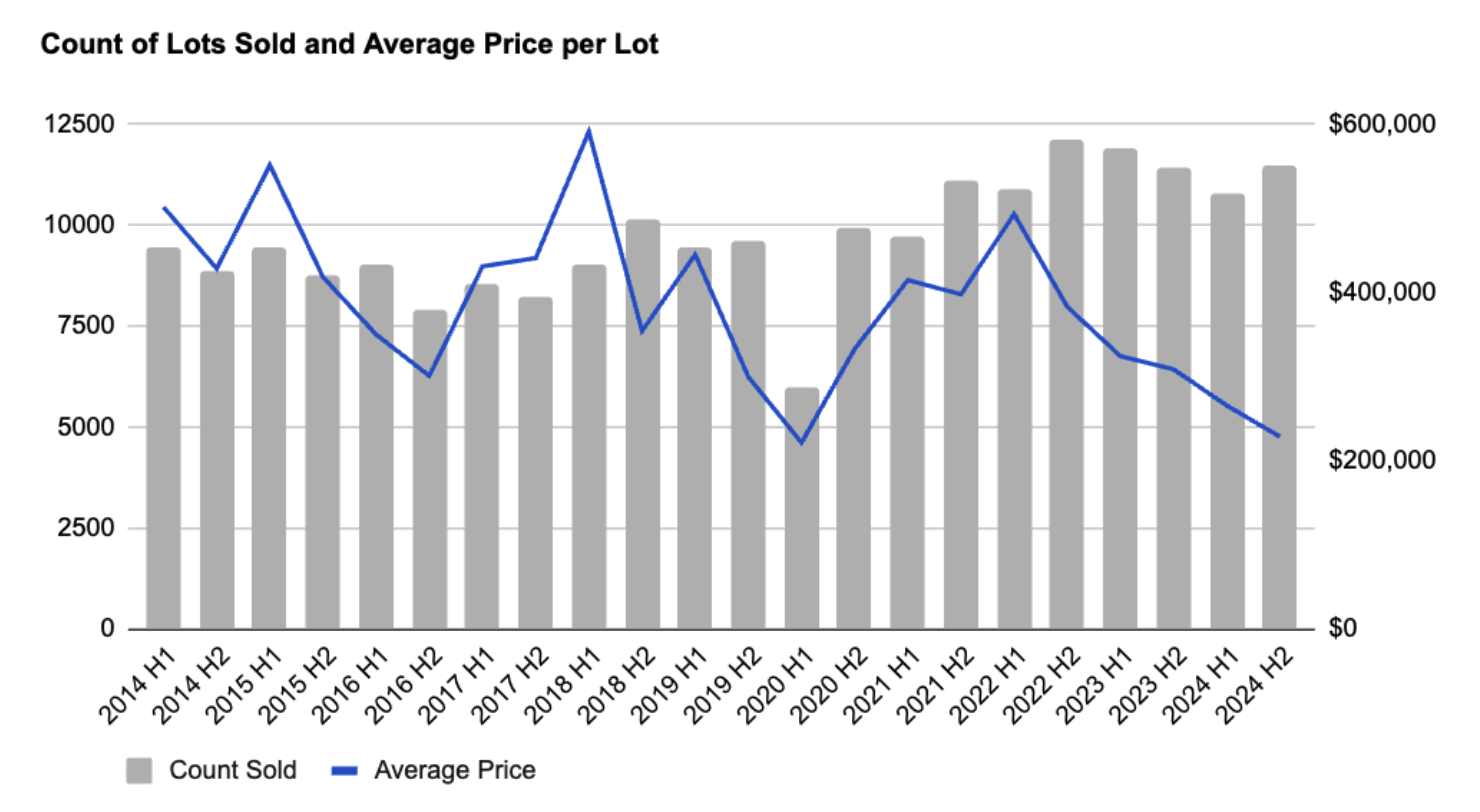
Those numbers offer some cause for concern. They show that the art market continues to lose volume, and that the decline has lasted longer than any previous slide during the last decade. Nevertheless, there is some good news buried in these metrics: Although the dollar volume of the auction market is down, the number of lots offered is near its all-time peak. In the second half of 2024, ARTDAI tracked 11,480 lots sold at auction. This is only slightly lower than the 12,149 lots offered in the same period two years ago, and still better than most 6-month periods before the second half of 2021, when the number of lots sold was consistently below 10,000.
But even as lot volume has stayed above the 10-year average, average prices of lots at auction have fallen consistently since the first half of 2022. It would appear that the long-anticipated democratization of the art market is upon us—more works of art are selling for lower prices—and nobody is happy about it.
|
|
I’ve also asked ARTDAI to track the number of lots and value of lots sold above, within, and below the estimates. Here, we’re trying to go beyond a simple hammer ratio—which measures the relative strength of bidding against estimates—and look at market composition. For the second half of 2024, 38 percent of lots sold above the estimates; 33 percent sold within the estimate range; and 29 percent of the lots were sold for prices that disappointed the consignor. That last figure, the percentage of lots sold at compromise prices below the estimates, has been stubbornly high and consistent during the last three half-year segments. Prior to the second half of 2023, the number of lots sold for compromise prices had peaked at 25 percent.
|
|
That means consignors are still anchored to unrealistic estimates from an earlier era. The good news is that, after bottoming at 35.2 percent in the second half of 2023, the percentage of lots sold above the estimate range has risen a few percentage points.
Switching to the percentage of value sold above, within, or below the estimates, we see that a very solid 43.8 percent of value was sold within the estimate range in the second half of 2024. That’s down from 48.4 percent the season before, but still on the upper end of the range for the last decade. The big improvement was in the percentage of value sold above the estimate range: For the second half of 2024, that number reached 38.7 percent, the highest in two years. Indeed, the percentage of value sold above the estimate has risen for the last year and a half, though it remains below the historical average over the past decade.
|
|
Taken together, these numbers suggest the market is healing, though estimates remain more aspirational than attractive to buyers. Although the dollar-volume numbers are worrisome, the number of lots sold continues to be encouraging.
|
|
Obviously, the broadest measure of the market doesn’t tell us very much. I asked ARTDAI to provide the same numbers for different market segments: works sold above $5 million; works from $1 million–$5 million; works from $500,000 to $1 million; and works sold below $500,000.
The low end of the market has seen a strong increase in the number of lots sold, with a big bump in the last two and a half years. In the second half of 2024, there were 10,760 lots sold in this price range, for a total sales volume of $619.5 million, with an average price of $57,582. This average price was the lowest number over the last decade, which may be a function of the auction houses being able to sell lower-value lots more efficiently through online sales. (Previously, the auction houses were inclined to reject lots that had too low a price point.)
Although the average price of lots sold between $500,000 and $1 million has been fairly consistent during the past decade, with an average of $696,000 in the second half of this year, the volume ($216 million) and the number of lots (311) sold reached their lowest levels since the second half of 2020. The positive news is that last season, the number and value of lots sold above the estimates exceeded the number and value sold within the estimates. Those proportions had been reversed for the previous two
half-years.
The band of works that sell for prices between $1 million and $5 million show a similar pattern. The number of lots (332) and the dollar volume ($708 million) are at four-and-a-half-year lows, and the average lot value ($2.13 million) is at the low end of a tight range. In this band, the number of lots sold above the estimates just exceeded the number sold within estimates, after showing the reverse pattern for the three previous half-year segments. However, the value of the lots sold within estimates remains slightly higher than the value sold above the estimates. That said, the spread was much wider two years ago, when the proportions first inverted.
Finally, the market segment above $5 million is naturally more volatile, given the potential range for values. In the second half of 2024, 77 lots totaling $1.08 billion were sold, at an average price of $14 million. Since the second half of 2022, the spread between lots sold within the estimates and those sold above the estimates widened to its most extreme in the first half of 2024. The spread has narrowed slightly, but remains historically large. The lack of bidding on lots priced above $5 million would seem to be the key factor in the perception of market weakness.
|
|
We can see these numbers as a sign of a successful market in one way: More lots selling for lower average prices should mean that there are more collectors out there buying art. And art is becoming, relatively, more accessible to buyers. The economics of art collecting reflect a sort of pyramid scheme. For a work of art to gain value, more people have to be interested in buying it tomorrow than there are today. That’s the fundamental logic of the auction market. Therefore, it’s a good sign that we have a larger number of buyers.
On the other hand, the declining numbers in the three price bands above $500,000 are troubling. Yes, we know the owners of artworks that might sell at that level aren’t motivated to sell. But without activity in the marketplace, we can never be sure there are still buyers for those works. And so, we wait. Anecdotal evidence from the private sales market is encouraging. But we won’t really know, if we do even then, the strength of demand until we see more sales in public at those price points.
|
|
Thank you for attending my TED Talk. I’ll see you back in the regular newsletter on Friday.
M
|
|
|
|
Puck founding partner Matt Belloni takes you inside the business of Hollywood, using exclusive reporting and insight to explain the backstories on everything from Marvel movies to the streaming wars.
|
|
|
|
The ultimate fashion industry bible, Line Sheet offers incisive reportage on all aspects of the business and its biggest players. Anchored by Lauren Sherman, the preeminent fashion journalist of her generation, Line Sheet also features veteran reporter Rachel Strugatz, who authors the definitive guide to what’s happening across the beauty industry, and Sarah Shapiro, a longtime retail strategist who writes about e-commerce, brick-and-mortar, D.T.C., and more.
|
|
|
Need help? Review our FAQ page or contact us for assistance. For brand partnerships, email ads@puck.news.
You received this email because you signed up to receive emails from Puck, or as part of your Puck account associated with . To stop receiving this newsletter and/or manage all your email preferences, click here.
|
|
Puck is published by Heat Media LLC. 107 Greenwich St, New York, NY 10006
|
|
|
|



_01JH4876SBWGHDMYW737K0Q9Z0.png "% of Lots Sold Above/Within/Below Estimate")
_01JH48778KDQM310010J617FEN.png "% of Value Above/Within/Below Estimate")