{{ 'now' | timezone: 'America/New_York' | date: '%b %d, %Y' }} |
|
|
Hello and welcome back to The Best & The Brightest. I’m Leigh Ann Caldwell,
catching my breath ahead of an extremely busy week in Washington.
On Thursday, I’ll sit down with House Republican Whip Tom Emmer, an O.G. crypto adopter, to talk about all things digital currencies, including market structure and regulation, etcetera. We’ll also discuss the news of the day, including the government funding showdown, political violence, and more. Space is limited, but email PuckEvents@puck.news if you’re interested in attending.
Plus: This week, we’re marking four years since Puck started covering the inside conversation in Washington, Wall Street, Silicon Valley, and Hollywood—a remit that’s since expanded to include the fashion industry, sports media, the art market, and artificial intelligence. Still getting these emails forwarded to you? Click
here for a special anniversary discount.
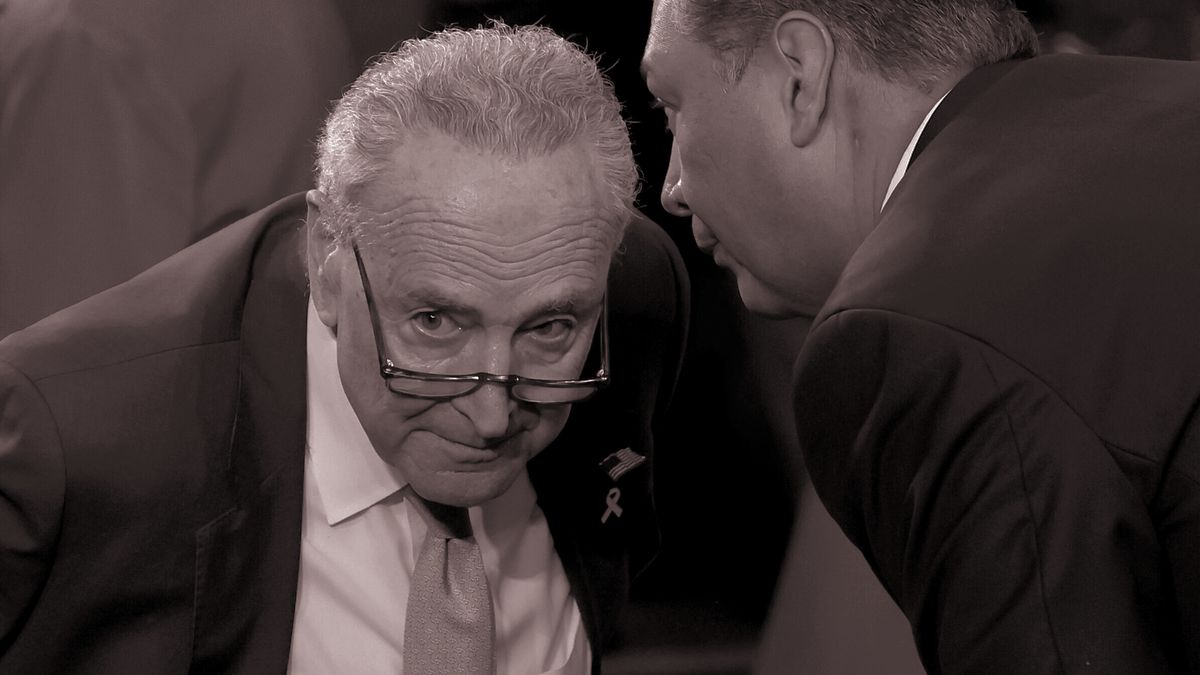
In tonight’s issue, Abby Livingston takes a good hard look at the Democratic Pinewood Box Caucus: the octogenarian House members who are refusing to retire, the PAC money enabling them, and the challengers who are organizing to respectfully push them out of Congress.
But first… |
- Funding
foibles: President Trump is urging Republicans to “stick together” as the House prepares to vote on Speaker Mike Johnson’s expected bill to extend government funding beyond September 30 and avoid a shutdown. Historically, the Freedom Caucus and its fellow travelers opposed every government funding bill, especially these stopgap measures. But under Trump 2.0, the Republican anti-government funding faction has voted repeatedly to keep the lights on—and at
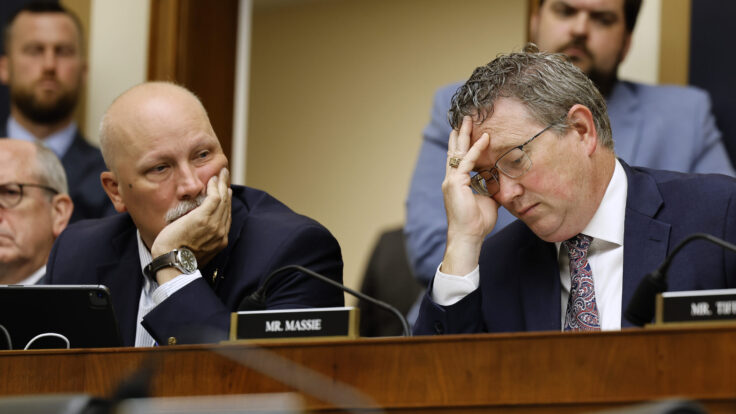
Joe Biden’s funding and programmatic levels. There will be a lot of complaining, but for Rep. Thomas Massie, the Kentucky libertarian, Johnson should be able to run the table this week, too—with Trump’s help, of course. “In times like these, Republicans have to stick TOGETHER,” Trump posted on Truth Social. “Democrats want the Government to shut down. Republicans want the Government to OPEN.”
Democratic leaders have been demanding that Johnson and Senate
Majority Leader John Thune enter into negotiations to discuss how to keep down healthcare costs and preserve access, but that’s not going to happen—not for a stopgap bill, anyway. Plus, as I wrote yesterday, trust and comity across parties is at a low point on the Hill right now. House Democrats are expected to be mostly united in their
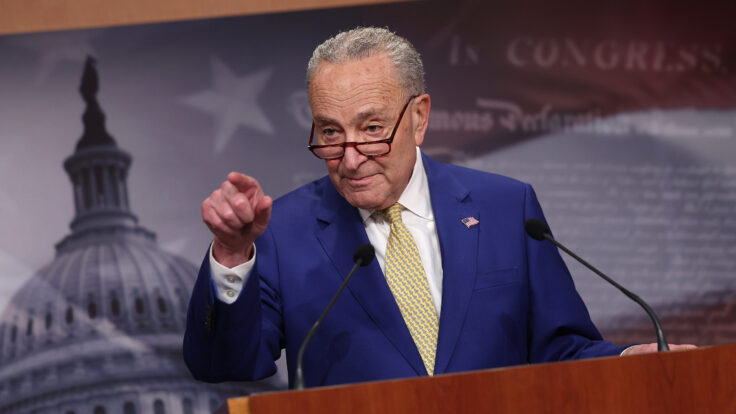
opposition to the bill—save, perhaps, for a few moderates in Republican districts—but the onus will be on Johnson to corral the votes. Things are much more complicated in the Senate, where at least seven Democratic votes are needed to keep the government open. Democrats, especially leader Chuck Schumer, are under tremendous pressure from the base to “fight back” as Trump continues to expand his executive authority and limit the role of Congress. They will try to use the threat
of a shutdown as leverage, but whether they blink in the end, as they did in March, remains to be seen.
|
|
|
A MESSAGE FROM OUR SPONSOR |
Hospitals are here when you need us most – but hospitals across America are at risk of closure. |
|
|
- Mamdani’s
slow drip of endorsements: New York Gov. Kathy Hochul has finally endorsed Zohran Mamdani in New York City’s upcoming mayoral election, while the state’s other top Democrats—Senators Schumer and Kirsten Gillibrand, and Rep. Hakeem Jeffries—continue to remain silent on the democratic socialist candidate. Hochul’s endorsement immediately drew fire from her likely Republican challenger this November, Rep.
Elise Stefanik, who will surely make this plug a central plank in her campaign to win the blue state.
Mamdani’s lack of other endorsements from party leaders has rankled the left, with one Democratic operative telling me that the lack of political support has “made this more of a story” than it should have been. The pressure might escalate even more after Trump threatened to withhold federal funding from the city today, posting on Truth Social: “Washington will be
watching this situation very closely. No reason to be sending good money after bad!” - Patel on the Hill: Embattled F.B.I. director Kash Patel is set to testify before the Senate Judiciary Committee tomorrow (and the House Judiciary Committee on Wednesday), where he could face a ton of questions about his leadership. Patel has been criticized from both the left and right for tweeting prematurely that Charlie Kirk’s
alleged assassin was in custody when local law enforcement were giving a press conference saying that they had released a suspect after questioning. (Patel defended himself on Fox News this morning, saying, “Could I have worded it a little better in the heat of the moment? Sure.”) According to reporting
by NBC News, a few hours after the shooting, and around the time of his tweet, Patel went to dinner at Rao’s in New York—a notoriously difficult reservation—while key events in the investigation were unfolding.
|
|
|
Amid enduring party anger over Biden’s decision to stand for reelection despite his decline,
Democrats are trying to figure out what to do with well-funded, institutionally coddled elderly members who have no intention of stepping aside. |
|
|
Among the many complicated factors that have neutered Democratic power in this country—the alienation of
young men, the rightward drift of certain minority voters, the MAGAfication of the Big Tech class, etcetera—one is relatively quite simple: age. It was Joe Biden’s age that doomed his presidential campaign and arguably dragged down Kamala’s; it was R.B.G.’s death under a Republican president that created the conservative supermajority on the Supreme Court. The death of three House Democratic incumbents in office this year dramatically reduced
the party’s leverage over the majority, temporarily expanding Republicans’ tiny margin.
Yet on the Hill, there remains a clutch of aging Democratic leaders who just won’t step aside, along with a fundraising apparatus that enables them and a social milieu that has traditionally treated the issue as taboo. Like many other political taboos, though, this one may be disintegrating under the pressures of 2025 America: A growing movement to oust aging members from the House Democratic
caucus has become a near-obsession after the Biden debacle, and one of the most buzzed-about questions in the House Democratic world these days is which incumbents will face a serious primary.
It’s not just about anger at Biden. Democratic members, staffers, and consultants worry that if they only narrowly control the House next year, the death of elderly members could possibly flip the chamber back to Republicans during Donald Trump’s final two years in the White House.
“It crosses my mind all of the time,” a Democratic former Hill staffer told me. |
|
|
A MESSAGE FROM OUR SPONSOR |
Hospitals need your help to stay. Protect 24/7 care—because when the doors close, it is too late. |
|
|
Meanwhile, most elderly Dems have no intention of going anywhere voluntarily. After all, they’re the members
who have committee and subcommittee gavels within their grasp should their party flip the House next year. When NOTUS polled all 50 members of Congress 75 or older who are up for reelection—the vast majority of whom are Democrats—about 70 percent said they intended to run again. |
Assuming those House Democrats don’t change their mind and retire, a generational shift will have to come
through primaries. But there’s a reason it’s so hard to beat incumbents: The caucus’s entire political apparatus is designed to protect them. Much of that energy is devoted to the frontliners, the vulnerable incumbents in competitive districts that hold the keys to the House majority. But more broadly, incumbents generally get the first pick of quality consultants, and they have access to unique fundraising streams. Often, they sit on multimillion-dollar cash-on-hand war chests built up over
years.
Most notably, corporate PACs are attracted to older members, who often have track records of winning reelection and leadership slots on committees by dint of seniority. “Most PACs won’t give to challengers,” a Dem corporate PAC lobbyist told me. “It’s usually a corporate PAC policy.”
Then there are the cultural deterrents to primaries. Party leaders dread seeing millions spent on party infighting when Democrats are already struggling to keep up with Republicans’ fundraising.
Colleagues could theoretically withhold donations from their own campaign accounts to aging colleagues, but in practice they rarely do so. There’s no more powerful force on Capitol Hill than political loyalty, and people are loath to deliver hard truths to mentors or colleagues who have had their backs in the past. People showing up for allies on their hardest days is what makes Capitol Hill run.
One former member, who has privately called for elderly incumbents to retire,
conceded to me that they’ve already written a check to one nervous elder member and will probably write more. “They all helped me,” this person told me. “I will write a check, and hope at the same time they don’t win. We have to make room for the next generation.”
Younger challengers, meanwhile, find dead ends everywhere. Leadership and rank and file almost never donate or endorse against colleagues in primaries. (For all the terror that Alexandria Ocasio-Cortez has
inspired in her colleagues over the years, she’s only actually endorsed against one of them.) Consultants get strong-armed out of working for challengers, knowing it could cost them big contracts down the road. |
Revenge of the Whippersnappers
|
Despite those obstacles, most members still get primaried from time to time in their careers, which usually
involves having to raise piles of money to fend off a snotty whippersnapper who eventually loses by a 60-point margin. One reason A.O.C.’s primary upset over Joe Crowley was major news was that it was exceptional; hers was one of only two successful House Democratic primary challenges that cycle. Most terms, two or three House Democrats lose reelection in a primary, at most. House challengers are still treated as black sheep in Democratic politics. |
|
|
What’s different this year, however, is that they have more-skilled shepherds to guide them, along with a
growing youthful fury that party elders just won’t step aside. The operatives and candidates involved know that defeating Democratic incumbents in primaries is nearly impossible; part of the mission at this stage is in fact to pressure certain members to retire through the threat of a difficult primary.
They’re also well aware that the old “challenge from the left” paradigm is so 2018. “The fight against Democratic incumbents right now isn’t ideological on the
traditional left-vs.-center policy debates—it’s a fight between older leaders who believe the G.O.P. can still be reasoned with and that our institutions can still be preserved, and the new generation, which is clear-eyed about the G.O.P. and ready to reimagine what comes next,” said Amanda Litman, the C.E.O. of Run for Something. “It’s a multi-axis tension—fight vs. fold, transform vs. return. So for those who don’t retire, good luck.”
The anti-gerontocracy movement is
getting its wish in some cases: Five elder House Dems have announced their retirements ahead of next cycle: Reps. Danny Davis, 84; Lloyd Doggett, 78; Dwight Evans, 71; Jerry Nadler, 78; and Jan Schakowsky, 81. “This decision has not been easy,” Nadler said in his retirement announcement. “But I know in my heart it is the right one and that it is the right time to pass the torch to a new
generation.” Meanwhile, three Democratic incumbents are facing strong primary challengers: Reps. John Larson of Connecticut, 77; David Scott of Georgia, 80; and Brad Sherman of California, 70. Even more Democratic challengers are expected to announce early in October, and more still could announce deep into the spring as state candidate filing deadlines approach. The numbers aren’t huge in the context of the Democrats’ 213-member House caucus,
but they’re enough to send a message. |
There are also signs of cracks spreading in the still-formidable incumbent protection racket. Democrats
pretty much unanimously tell me that donors are still furious about 2024 and anyone remotely associated with the Biden debacle—including members of Congress. I’m told there was even a nascent effort this summer to create a super PAC specifically to target incumbents; a senior Democratic strategist familiar with the plans told me it’s stalled out for now, but the very discussion of such a vehicle would have been unfathomable just a year ago, and it bespeaks the enduring discontent among the donor
class.
The professional class, too, is showing signs of a shift. Party-sanctioned consultants still don’t go out of their way to target incumbents, one Democratic consultant told me, “but, yes, there’s a growing group of challengers worth considering”—and they’re more willing to take them on as clients than they would have been five years ago. To wit: Jake Rakov, who is challenging his former boss, California’s Rep. Sherman, worked with Putnam Partners, one of
the top Democratic ad firms, to produce a viral video for his campaign. His candidacy has since created a permission structure for several other Democrats to challenge Sherman.
Indeed, the environment became almost too permissive; Rakov dropped out last week over concerns that the crowded field would split the anti-incumbent vote. “With so many Democrats now running in the 32nd District, the top-two primary math doesn’t add up anymore,” he said. “If all of the announced
Democrats continue into the race, Congressman Sherman will face a Republican in the general election again, ensuring that he’ll remain in Congress in a safe Democratic district.” Point: incumbent. |
|
|
Join Emmy Award-winning journalist Peter Hamby, along with the team of expert journalists at Puck, as they let you in on the
conversations insiders are having across the four corners of power in America: Wall Street, Washington, Silicon Valley, and Hollywood. Presented in partnership with Audacy, new episodes publish daily, Monday through Friday. |
|
|
Unique and privileged insight into the private conversations taking place inside boardrooms and corner offices up and down Wall
Street, relayed by best-selling author, journalist, and former M&A senior banker William D. Cohan. |
|
|
Need help? Review our FAQ page or contact us for assistance. For brand partnerships, email ads@puck.news. You received this email because you signed up to receive emails from Puck, or as part of your Puck account associated with {{customer.email}}. To stop receiving this newsletter and/or manage all your email preferences,
click here. |
Puck is published by Heat Media LLC. 107 Greenwich St, New York, NY 10006 |
|
|
|