 |
 |
|
Happy Monday everyone and welcome to The Best & The Brightest. I’m Peter Hamby coming to you from the Westside of Los Angeles, where R.F.K., Jr. bumper stickers continue to surface on the Teslas pulling into Erewhon. Today, I have a little scoop about Chris Christie and what it means for his kamikaze presidential campaign. And it’s time we had an honest conversation about Threads, which isn’t exactly living up to the hype as it struggles to maintain momentum against Elon Musk’s newly-rebranded Twitter.
But first…
|
| The Capitol Hill Cafeteria Report |
|
| An utterly indispensable, high-minded, and, yes, occasionally dishy readout of what our lawmakers are really legislating behind closed doors.
By Abby Livingston
- Boebert is the New Michele Bachmann…: Back in a long-ago era, all of ten years ago, the now-retired congresswoman Michele Bachmann was a political curiosity. She was so polarizing, in fact, that she became a powerful fundraiser both for herself and also Tea Party-hating Democrats. As her own district grew increasingly competitive, largely because competitors hated her guts, it became easier and easier for her Democratic opponents to raise outrage money off the internet.
A similar dynamic is playing out in the Texas Senate race, where Democratic challenger Colin Allred is outraising Ted Cruz. It is also playing out in western Colorado, which Democrats have long coveted, with sophomore Lauren Boebert. After the controversial Boebert won the seat by a mere 546 votes last year, Colorado’s 3rd District is now very much in play. And Boebert turned in a strong campaign finance report earlier this month: She raised more than $800,000 and reported $1.4 million in cash on hand. But her Democratic opponent, and rematch rival, Adam Frisch raised $2.6 million, and had $2.5 million in cash on hand. And, what’s more…
- Boebert is now the establishment: This race, without doubt, is an online fundraising war. But Boebert has the full structure of the party behind her (well, minus the support of Marjorie Taylor Greene…). I counted about two dozen Republican members who gave to Boebert’s campaign this past quarter, including the highest ranking members: Kevin McCarthy (the speaker), Steve Scalise (the majority leader), Tom Emmer (the majority whip), Elise Stefanik (conference chairwoman), Jim Jordan (chairman of the Judiciary Committee) and Michael McCaul (chairman of the Foreign Affairs Committee). To be sure, a handful of Democratic members ponied up for Frisch: Jake Auchincloss, Jason Golden, Paul Tonko and Nydia Velazquez. But the larger point from these reports is that while Boebert may have once seemed like an outrage-seeking Capitol Hill outlier, she’s now earned the complete acceptance of Republican leadership.
- And now for George Santos…: But another House Republican is, for now, on his own financially. No members of Congress gave money to the indicted congressman from Long Island, George Santos. The freshman, who is in both primary and general election trouble, turned in a campaign finance report that showed both meager fundraising ($162,000) and the fact that he had spent most of his money ($85,000) paying back old personal loans from his 2022 campaign.
He was also outraised by three challengers: Democrats Anna Kaplan and Josh Lafazan and Republican Kellen Curry. That’s unsurprising, given his pariah status, even among Republicans. Notably, two former members gave to Curry: John Shimkus, who had close ties to the current G.O.P. leadership, and Lamar Smith, who was the de facto leader of the Texas Republican delegation in the mid-2010s.
|
|
|
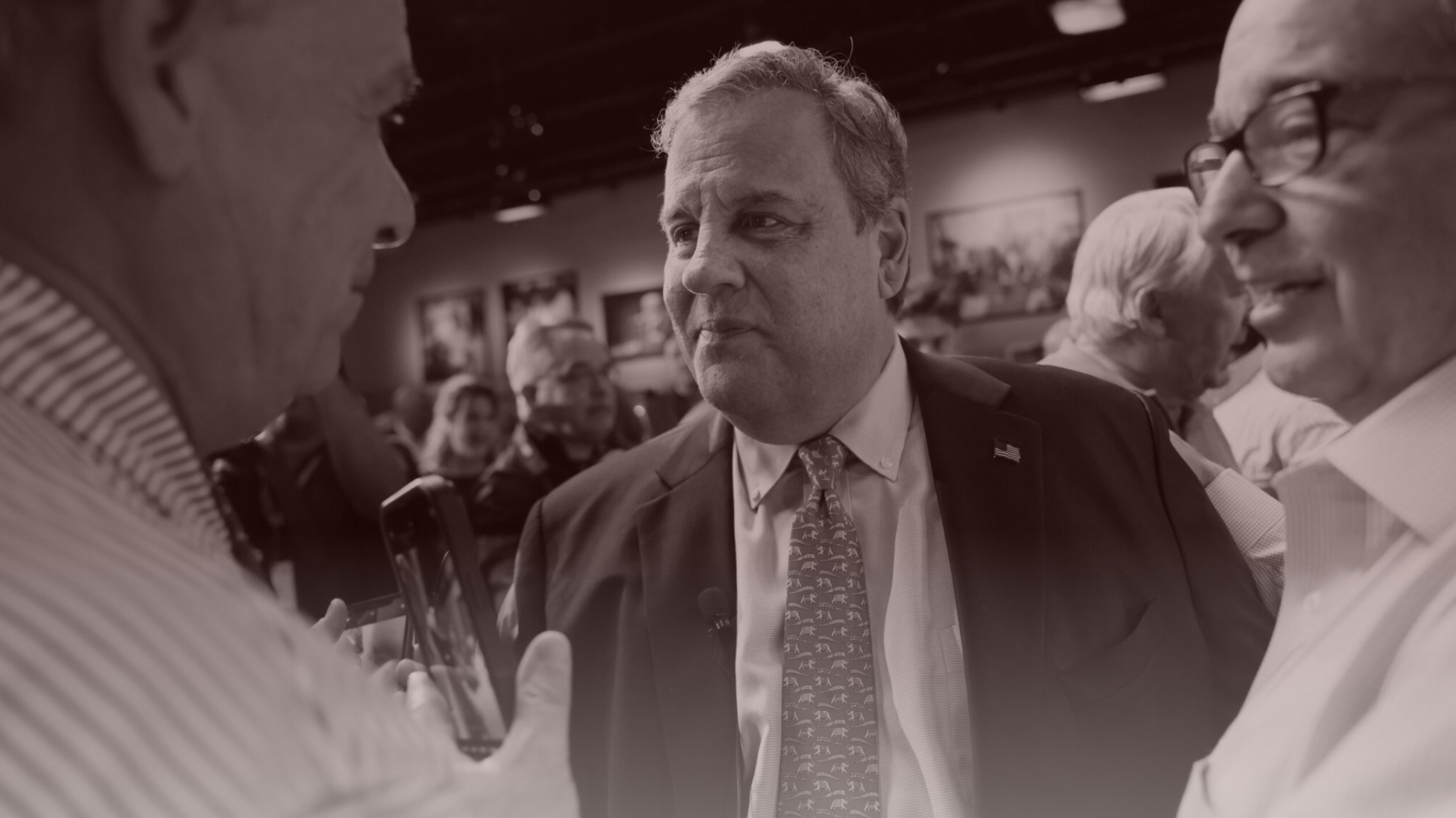
| Here’s a little 2024 media story guaranteed to make Republican eyes roll: I’m told that G.O.P. spoiler candidate Chris Christie will be appearing on Pod Save America this week, taping an interview for Thursday’s podcast with Crooked Media co-founder Jon Lovett. Yes, you read that correctly. The first presidential candidate of the 2024 cycle to appear on the popular progressive podcast won’t be Joe Biden—it will be the Bridgegate-stained former Republican governor of New Jersey who was once one of Barack Obama’s loudest critics.
The booking is obviously a nice get for Crooked, which routinely scores big interviews with friendly Democrats but never big-name Republicans. Why, though, would Christie choose to wade into liberal podcast waters when he’s ostensibly trying to win the Republican nomination? Especially with Lovett—a fearless comedian who isn’t afraid to roast the candidate, a Trump supplicant-turned-critic, in a way that Anderson Cooper or George Stephanopoulos never would. The simple answer is that Christie really has nothing to lose with Republicans, but plenty to gain from Democrats. |
|
A MESSAGE FROM OUR SPONSOR
|
| |
 |
| Second chance hiring could add $87B to the economy
JPMorgan Chase taps into new qualified talent, hiring 4,600 people with records within industry guidelines in 2022.
Opening up economic opportunities to this talent pipeline helps strengthen communities and boosts the workforce. See how
|
|
|
| To state the obvious: Christie will not be the Republican nominee. He has always had challenges with the G.O.P. base, sore spots that flared during his failed 2016 presidential campaign. He pushed for a DREAM Act in New Jersey, supported gun control laws, and once identified as pro-choice. And even though he ripped Obama, hardcore Republicans will never forgive him for embracing (literally and physically, in the form of that awkward bro-hug, or whatever it was) the sitting president in the aftermath of Hurricane Sandy, during the final days of the 2012 election.
Christie should obviously be forgiven for acknowledging the powers of a federal rescue effort in his home state during a natural disaster, but the rash of Obamaphilia (or at least being photographed with the president over multiple news cycles) spoke to his cagey opportunism. Four years later, after his misbegotten presidential campaign hit the skids, he was the first establishment Republican to go MAGA, and vied to be in Trump’s cabinet, if not his V.P., until a vengeful Jared Kushner nuked that idea. (As U.S. Attorney, of course, Christie prosecuted Kushner’s father for his sleazebaggery.)
Now, absent the sort of post-cycle economic opportunities he might have once expected, Christie has since turned his back on Trump and lashed out at the former president in interview after interview. In the process, Republican voters have finally and irrevocably turned their backs on him. Christie currently has the highest unfavorables of any Republican in the presidential race. And despite his recent polling gains in New Hampshire polls, 35 percent of New Hampshire primary voters said they would not vote for him under any circumstances, according to a University of New Hampshire poll that dropped last week. That’s higher than any candidate in the field.
Christie has made it pretty clear that he’s in the race for one purpose and one purpose only—to suicide bomb Donald Trump on the debate stage. (That is, if Trump even bothers to show up to the first debate in August—a topic Jon Kelly and I discussed on today’s episode of The Powers That Be. Short answer: Why would he?) Christie’s willingness to savage Trump has annoyed Republicans, but it’s earned him some strange new respect among a narrow constituency of green room dwellers, NeverTrump centrists, MSNBC viewers and… Democrats. Which is where Pod Save America comes in.
As my colleague Teddy Schleifer reported last month, Christie’s Super PAC, Tell It Like It Is, has raised a pretty penny from Democratic mega-donors, “who view supporting Christie’s super PAC as a cost-effective bankshot anti-Trump strategy.” And recent F.E.C. filings show that Christie’s campaign has received contributions from a range of prominent Trump critics, like Barry Diller, George Conway, and former congresswoman Barbara Comstock.
Despite his dismal poll numbers with Republicans, Christie’s Hack-a-Trump strategy has pushed him over the 40,000 donor threshold to qualify him for the G.O.P. debates. Going on Pod Save America is a decent way to get some Trump-hating podcast moms to send Christie five or ten bucks, and keep the kamikaze campaign going as long as possible. And even if he’s raging on a debate stage without the former president, this latest posture at least returns Christie to where he started: a fiscally conservative, socially liberal-ish Republican showcase in the Democratic petting zoo. It may also help him finally make some real coin for himself, too, which may have been the plan all along. |
|
|
| I know a lot of Elon Musk haters are rooting for Threads, the Twitter clone that Meta launched a few weeks ago to an explosive amount of growth and a heap of glowing media coverage. And I know Twitter is increasingly janky, filled with Bitcoin evangelists, shitposting political gremlins and cheapo ads for Cheech and Chong weed gummies. Monday’s official rebrand of Twitter, in which Musk killed the blue birdie and replaced the icon with a simple “X,” makes the product look “like an app for a membership-only human trafficking gentlemen’s club headquartered in Budapest,” at least according to one Twitter user named QAnon Latifah. But as I predicted after its launch, the Threads hype was always going to crash into reality.
As someone who works in tech—I also do political news for the younger set over at Snapchat—I’d like to share with you a term we use in the industry. It’s called “growth hacking.” Basically, a company, especially a social media platform as far-reaching and powerful as Meta, can pull any number of levers to drive downloads and acquire users. They can bombard you with red badge alerts and notifications, preying on user dopamine to keep them clicking on the app. They can tweak the product design or algorithm to force new “friends” or accounts into your feed, hoping you’ll add more people to your social graph and keep the virality engine whirling. They can partner with a mobile provider or phone manufacturer to automatically install an app on newly purchased phones, which technically counts as an app download even if you never look at it. |
|
|
| Or, in the case of Threads, they simply staple a new app onto an already popular one: Instagram, one of the most popular apps in the world. The integration all but guaranteed Threads would take off, taking Instagram users over to a new app and force-feeding them a pre-existing friend network of “people you may know.” It was a majestic growth hack, and Meta is still doing it. If you don’t believe me, look at the Threads app on your phone. I guarantee you there’s a red badge lurking there, baiting you to open the app.
Even so, when Threads suddenly scaled to over 100 million users in a matter of days, fawning business and tech reporters, with knives out for Elon, gushed about the sudden possibility that Twitter might finally collapse and die. But all the cheerleading avoided a rather obvious question for Threads: What’s the use case for a normal person? Sure, anti-Musk liberals, members of the press, opinion elites and a bunch of publishers all rushed to create accounts and start posting. But did your dad? Did the Zoomer who works at your local Starbucks? Did the local fire department in your town?
Maybe they downloaded it, but right now, they definitely aren’t coming back for more. According to SimilarWeb, a tracking firm, daily use of Threads on Android phones plummeted after its barnburner launch—dropping from 49 million daily users in week one to 24 million a week later. That’s a titanic drop. Time spent—the mother’s milk of social media, also known as “engagement”—also fizzled. Threads users spent 21 minutes with the app on July 7th, but only six minutes a week later, SimilarWeb found. It appears there aren’t enough humans out there with an opinion either way on Elon Musk.
These are only Android numbers, and tracking firms don’t always have perfect data. But Meta has yet to demonstrate why people should open Threads before they look at Twitter. That’s especially true for longtime power users, media companies, utilities, emergency alert systems, comedians, writers, sports fans and political activists who have spent more than a decade on the platform building followings. Meta says they are still working on the network—“early days” is another vapid tech term—with better search and a desktop version to come. Fine, but is the product itself distinctive enough from Twitter in the first place? Why would any normal person use the same duplicative app twice in a day? Why do I, an attention-seeking journalist, have to post the same thing in two different places? I’m still scratching my head.
Think about all the big platforms on your device. They have different use cases, with some overlap. Google is for search. WhatsApp is for chat. Instagram is a magazine, a place for lush pictures and videos. TikTok is for short form video, with the titillating risk of Chinese state surveillance. Snapchat is for connecting with close friends and watching content. Twitter is for news, comedy, and lately, ugly political conversations. Threads is for… what exactly? Very Online political obsessives who donated to Joe Biden in 2020? Posting the same brand content you just posted on Twitter so your director of marketing doesn’t get mad at you? In my mind, Threads is a zombie network until they can answer the only question that matters in social media: How do you keep millions of people coming back for more?
Two moments in the last week demonstrated how Threads is falling short of its own overheated expectations. The first came last Wednesday, when Mitt Romney posted a video honoring National Hot Dog Day. He declared, as he often does, that “hot dog is my favorite meat.” Romney’s office posted the video first to Twitter, where it garnered about 5,000 likes and 6 million impressions. They posted the same hot dog video at the same time on Threads. It got a grand total of 538 likes.
The second moment came over the weekend when I was watching the Women’s World Cup. During the USA-Vietnam game, Lionel Messi was making his American debut for Inter Miami, a game I was following on my phone. In stoppage time, he drilled an insane game-winning free kick, and Miami erupted. Fox Soccer immediately posted the clip to Twitter, where it quickly racked up more than 600,000 views. Meanwhile, Fox Soccer didn’t bother to post the Messi clip at all on Threads, where it has an account. Because why would any rabid sports fan be on Threads in the first place? |
|
|
|
| FOUR STORIES WE’RE TALKING ABOUT |
 |
|
 |
| Solomon’s Crunch |
| The Goldman C.E.O. is facing a pivotal quarter. |
| WILLIAM D. COHAN |
|
 |
|
 |
|
|
|

|
 |
|
|
|
Need help? Review our FAQs
page or contact
us for assistance. For brand partnerships, email ads@puck.news.
|
|
You received this email because you signed up to receive emails from Puck, or as part of your Puck account associated with . To stop receiving this newsletter and/or manage all your email preferences, click here.
|
|
Puck is published by Heat Media LLC. 227 W 17th St New York, NY 10011.
|
|
|
|