 |
|
|
|
Forward this email to a friend!
|
|
For our second anniversary, subscribers can share the benefit of Puck with an exclusive code (INSIDEACCESS) that gets your network 30% off.
|
|
|
|
|
|
Welcome back to The Best & The Brightest! I’m Tara Palmeri. Tonight, on the eve of my birthday, we’ll be covering all things related to D.C.’s gerontocracy. (Bleak, I know.) I’ll also explain why the Republican establishment’s desire to consolidate support around one non-Trump candidate before Iowa is all but a fantasy. It’s the subject of a fascinating discussion I had with Matt Mowers on the latest episode of my new pod, Somebody’s Gotta Win. Please subscribe and share with your friends!
But first, Abby Livingston’s report on the Capitol Hill chattering classes…
|
| Dancing with Hough & Cicilline Dreams |
|
- Utah 2nd Special: Two consequential House special election primaries are set for September 5th, and will take place just before the lower chamber returns from recess. Candidates vying for seats in Utah and Rhode Island filed their final campaign finance reports last week. Let’s dive in.
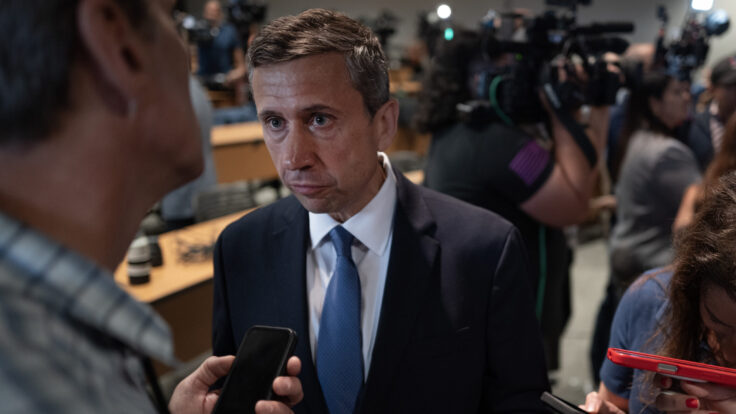
The top two Republican fundraisers in Utah’s 2nd Congressional district are former state Rep. Becky Edwards and R.N.C. Committeeman Bruce Hough. Edwards maintained her fundraising advantage over the G.O.P. field, raising almost $680,000, including a $200,000 candidate loan. She also received a contribution from the moderate Republican group Main Street Partnership. Edwards has hired the consulting firm Brabender Cox, which counts Todd Young, Shelley Moore Capito, and a number of House members and the N.R.C.C., as clients.
Hough, meanwhile, raised nearly $540,000, including $334,000 in candidate loans. (NB: He is the father of Dancing with the Stars personalities Derek and Julianne Hough.) This district, which encompasses northwestern Salt Lake City, also covers much of the western half of Utah, and is likely to stay in Republican hands. The district’s 6-term Republican, Chris Stewart, is resigning for personal reasons.
- Rhode Island 1st special: Over in Rhode Island, the race to replace David Cicilline has not been without drama. The top fundraiser was initially Don Carlson, who loaned his campaign $600,000, but suspended his campaign this week after allegations surfaced of inappropriate behavior. The second highest fundraiser is former state Rep. Aaron Regunberg, who raised $630,000 and spent $440,000. His donors include Ari Rabin-Havt, a top Bernie Sanders lieutenant, and he also picked up an endorsement from Alexandria Ocasio-Cortez.
Former Obama/Biden staffer Gabe Amo also put in a solid fundraising effort, raising $600,000 over the course of the campaign, including from donors like Reggie Love, Steven Horsford, Deval Patrick and the Congressional Black Caucus’ political arm. Patrick Kennedy, who represented the district prior to Cicilline’s tenure, endorsed Amo this week.
Members of the Congressional Hispanic Caucus rallied behind Lt. Gov. Sabina Matos, adding to her $580,000 aggregate haul. House members who contributed to her campaign included Salud Carbajal, Tony Cárdenas, Sylvia Garcia, Teresa Leger Fernandez, Annie Kuster, Ritchie Torres and the political arm of the moderate New Democrats group. State Sen. Sandra Cano has struggled to keep up with the other candidates—she’s raised a little over $300,000, but she picked up Carlson’s support in the final stretch of the campaign. Democrats are expected to easily hold this seat.
And now for my piece on Washington’s gerontocracy blues and super PAC realities… |
|
|
| Age is always on the mind in Washington—a town that likes to remind us that each election is the most consequential in a generation, and that still genuflects upon the Kennedy-Nixon debate, the Lloyd Bentsen quip to Quayle, the Reagan retort about Mondale’s youth and inexperience, etcetera. But age is really on the town’s mind at the moment, as the country faces down a presidential rematch between a septuagenarian and octogenarian. The latest AP-NORC Center for Public Affairs survey poll, featured at the top of Mike Allen’s Axios newsletter, noted that 77 percent of Americans think Joe Biden is too old to be effective for four more years, including 69 percent of respondents who were Democrats. In his newsletter, Allen called him “the unwanted candidate.”
Privately, some Democrats are fretting that the party is willfully ignoring these warning signs, and that their candidate might be as electorally vulnerable as Trump. Biden’s ham-fisted response to the devastating Maui fire hasn’t helped, and might end up in opposition ads down the line. “It’s going to become apparent this fall or the winter… that there’s a problem,” said a Democratic operative close to party leadership. “Winter is coming.” On a recent episode of my new podcast, Somebody’s Gotta Win, the Republican pollster Kristen Soltis Anderson noted that Biden’s most significant political strength—the long-held view that his decades of experience have made him a steady and reliable hand—could evaporate as the electorate is bombarded with reminders of his advancing age and examples of mismanagement, like the chaotic withdrawal from Afghanistan.
The next generation of Democratic leaders—Gavin Newsom and J.B. Pritzker chief among them—have continued to quietly cultivate campaign infrastructure, while trying to avoid getting caught with their hands too deep in the cookie jar. Indeed, even the perception of attempting to take on a sitting president would almost certainly result in condemnation from the likes of Hillary Clinton, Jim Clyburn, and the Obamas, and probably all of the other Democratic governors, and undercut their ability to fundraise.
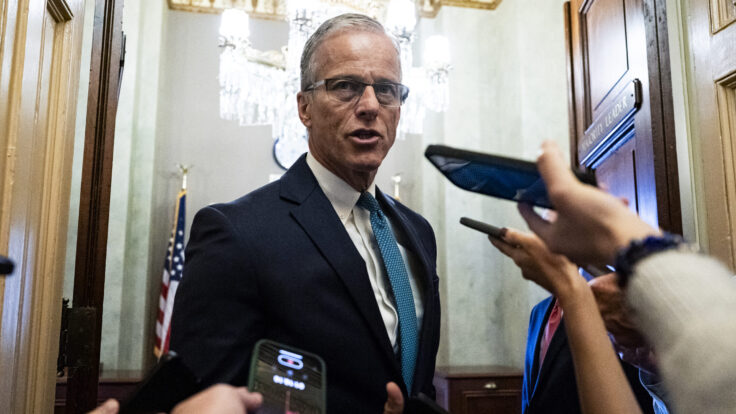
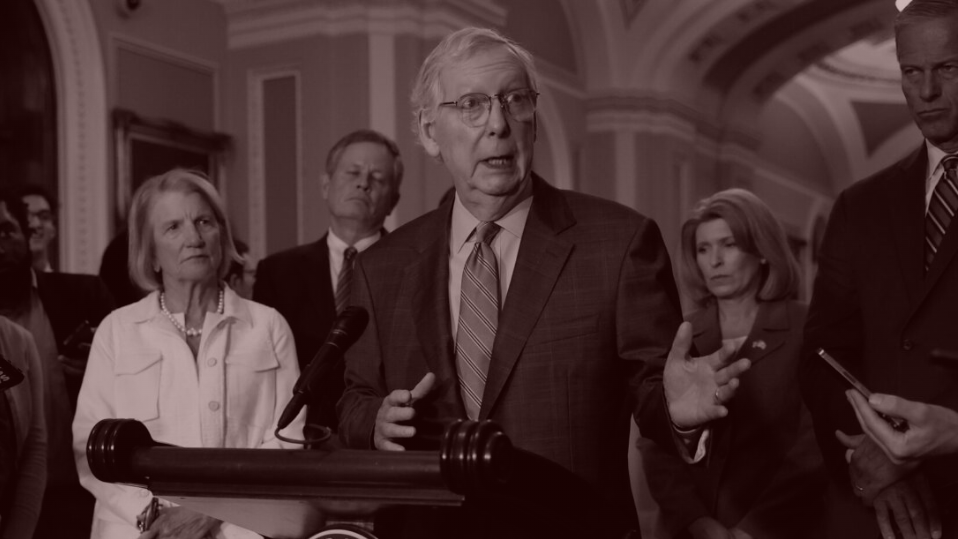
Of course, even as they attack his age, Republicans are also navigating the complex gerontocracy conundrum. Yesterday, their 81-year-old leader, Mitch McConnell, seemed to freeze up while addressing reporters in Kentucky, the second such incident in as many months. The Senate’s “Three Johns”—Cornyn, Barrasso and Thune—who are seen as the most likely candidates to eventually succeed McConnell, would never engage in anything so crass as outright jockeying. But I’m told they’ve been making more touchpoints with their colleagues of late, casually refreshing relationships, taking lunches, and asking about their needs, and reflecting on their fundraising prowess. “No one is openly running,” said a Senate source. “The Three Johns have been building up—they’ve done everything but ask. They’re making sure their colleagues are being taken care of.”
And yet, even people close to the Three Johns concede that this might be the right moment to elevate a member of the younger generation. (No one in leadership is yearning to endure a second coming of Rick Scott’s rebellion.) I have heard rumblings about Tom Cotton, the 46-year-old Harvard-and-Claremont Iraq vet, who is something of a young fogey. Some hope he would be able to bridge the rabble rousers with the more establishment folks, but I’m told that, like most senators under 70, he likely has his eyes on a bigger career opportunity, such as securing a cabinet position in the next Republican administration. That’s why some think he might sit this out. |
|
|
|
|
| As a Trump candidacy appears increasingly inevitable, indictments and long Atlantic articles be damned, establishment Republican figures like Chris Sununu and Mitt Romney have been ferociously advocating for what they see as the only remaining escape hatch—for the party to coalesce around a single candidate. In a recent Times op-ed, Sununu argued that, “Trump must face a smaller field. It is only then that his path to victory shrinks. Leaders within the Republican Party—governors, senators, donors and media influencers—have an obligation to help narrow the field.” Anyone who is polling in the single digits, he wrote, or hasn’t made the debate stage, should drop out by Christmas, ahead of the Iowa caucus and New Hampshire primary.
On paper, it may seem like a rational enough theory. In reality it’s highly unlikely. Most candidates will continue to slog it out, if for no other reason than because they can afford to. After all, they’ve outsourced a lot of their campaign duties to cash-rich super PACs, which will continue to support them financially even if grassroots support never materializes. “The super PACs are literally hosting the events and paying for everything,” said former Trump ambassador Chuck Larson, who runs a public affairs shop in Iowa.
Leaving the campaign costs up to a cash-rich outside organization, which can raise unlimited funds from individual donors, was first tested in 2016 when Carly Fiorina’s super PAC tried to arrange all of her events. That same year, John Kasich attempted to use his super PAC to run his data operation. And in 2012, of course, Newt Gingrich campaigned as a one-man pontificating machine, funded by a $20 million check from Sheldon Adelson. We’ll see how creative this new generation gets. Rival operations are currently looking at how Francis Suarez’s super PAC was able to direct hard dollar fundraising to his campaign. (Suarez dropped out after failing to qualify for the debate stage in Milwaukee.) Meanwhile, The Washington Post reported that DeSantis, who burned through campaign cash trying to quickly scale his operation, is sharing a campaign plane with his super PAC, Never Back Down, which is led by Jeff Roe. (The F.E.C. fines will probably come next year.)
This cycle, super PACs aren’t just handling events, but also managing expensive projects like prospecting, renting voter lists, canvassing, get-out-the-vote ops and data operations. This means that while Tim Scott had a lackluster performance at the debate in Milwaukee, he likely isn’t going away: he has $15 million in cash on hand in his super PAC, and is expected to get another very large eight-figure check from a single donor, Larry Ellison, who already seeded his super PAC with $35 million over three years, according to my colleague Teddy Schleifer. Neither is Nikki Haley, who has $17 million in her super PAC, and should be able to procure more by tickling big donors with her special brand of neoconservatism and socially moderate policies.
In short, it’s unlikely this primary race will ever devolve into a one-on-one race, so long as Haley, Scott, DeSantis, Mike Pence, and Chris Christie continue making it onto the debate stage and have enough money in their super PACs to keep them afloat. (Of course, there’s also Ramaswamy, who can continue to self-fund while potentially becoming a grassroots machine—or find his own stable of anti-establishment techy sugar daddies to fund his super PAC for six months.) As former Trump appointee and Chris Christie ’16 alum Matt Mowers told me: “Traditionally you don’t drop out because you’re losing. It’s because you run out of money, but in the era of super PACs, you never run out of money.” |
|
|
|
| FOUR STORIES WE’RE TALKING ABOUT |
 |
|
 |
| Vivek & Bake |
| How Ramaswamy disrupted the G.O.P. primary. |
| TINA NGUYEN |
|
 |
|
 |
|
|
|
|
|
|
|
 |
|
|
|
Need help? Review our FAQs
page or contact
us for assistance. For brand partnerships, email ads@puck.news.
|
|
You received this email because you signed up to receive emails from Puck, or as part of your Puck account associated with . To stop receiving this newsletter and/or manage all your email preferences, click here.
|
|
Puck is published by Heat Media LLC. 227 W 17th St New York, NY 10011.
|
|
|
|



_01H90TG76B9EYA5N4JEJY9CQM4.jpg)