Hello and welcome back to The Best & The Brightest. I’m Leigh Ann Caldwell,
writing to you just as the ceasefire in the Middle East appears to be faltering, with the U.S. and Iranian militaries reportedly trading fire in the Strait of Hormuz. We’ll have more on that soon.
In more pleasant news: Today marks Marianna Sotomayor’s first day at Puck. We’ve marked the occasion by letting her get after it. You’ll be seeing her byline in the very near future.
Tonight, I have some news and notes on tomorrow’s primary races in Ohio and Indiana.
Plus, for the main event, Abby looks at what’s next in the nation’s redistricting war after the Supreme Court ripped out the guardrails preventing state legislatures from radically gerrymandering their congressional districts. The end result may be mutually assured destruction, but neither party can afford not to fight.
Also mentioned in this issue: Marcy Kaptur, Derek Merrin, Josh Williams,
J.D. Vance, Madison Sheahan, Kristi Noem, Jim Banks, Trump, Ron DeSantis, R.B.G., Terri Sewell, James Clyburn, Bennie Thompson, Ken Calvert, Young Kim, and more… |
|
|
|
A MESSAGE FROM OUR SPONSOR |
When insurers delay approvals or require endless paperwork, patients are left waiting for care they need now. Addressing harmful corporate insurer practices can help ensure timely access to treatment and protect 24/7 care. See how. |
|
|
|
Are Republicans squandering a pickup in Ohio?: Ohio and Indiana—two red states
affected in different ways by redistricting—will both hold primaries tomorrow. Trump pressed Ohio to redistrict and take as many Democratic seats as possible, but the state’s bipartisan redistricting commission redrew its map last year with Democratic input, per the terms of the state constitution. Republicans’ best hope for a pickup is the seat currently held by Rep. Marcy Kaptur, one of the 13 House Democrats to represent a district that Trump won in
2024.
Under the new lines, it’s about Trump +10.5. But some Republicans worry they’re squandering their opportunity to flip the seat. The leader in the race is Derek Merrin, who has the most name recognition because of his narrow loss to Kaptur in the district Trump won by 6.5 points in 2024. Some Republicans worry he could lose to her again now that the political environment for their party is less hospitable. Trump also didn’t endorse in the race—a sign that he has no clear favorite. (In 2024, Trump endorsed Merrin hours before polls opened.)
But neither of the other two Republican primary
candidates has taken off. Josh Williams has been working with Luke Thompson—a longtime advisor to Vice President J.D. Vance, a fellow Ohioan—and leads fundraising with more than $800,000. But he was unable to raise more money in the final months of the race, in part because of the entry of Madison Sheahan, a former deputy director of ICE under Kristi Noem. Sheahan, who resigned from her post to run for Congress
shortly after an ICE agent killed Renee Good in Minneapolis in January, raised $157,000 in just about six weeks. But she faces misconduct
allegations and is closely associated with her former boss, which could prove either toxic or popular with Republican primary voters.
Meanwhile, in Indiana, the state legislators who opposed Trump’s redistricting efforts there will now have to face voters. One Indiana Republican said they’d
be surprised if any of the targeted members win their primaries—after all, the Club for Growth, Sen. Jim Banks, and even Trump’s own political organization have put millions toward defeating them.
Now, here’s Abby… |
|
|
|
With the Supreme Court gutting the Voting Rights Act and essentially legalizing even the
most extreme gerrymandering, party leaders say they need to fight fire with fire—even if it means mutually assured destruction. |
|
|
|
House Democrats had less than a week to savor their redistricting victory in Virginia before conservatives
punched back—twice. First came the passage of Ron DeSantis’s new Florida map, which could eliminate four Democratic seats. Then came the Supreme Court’s Louisiana v. Callais decision, which blew up Voting Rights Act protections for minority-majority districts across the South.
The court’s ruling came down too late to impact Democrats’ bullish chances of retaking the House next November. Even so, Dems are reaching an R.B.G.-death level of panic
about the 2028 cycle and the party’s longer-term capacity to control the House. With more time, Republicans are expected to dismantle around a dozen V.R.A.-mandated majority-minority districts, potentially unseating nearly all of the South’s Black Democrats. |
|
|
|
A MESSAGE FROM OUR SPONSOR |
Prior authorizations and administrative hurdles can slow down critical care, forcing patients to wait while their health
hangs in the balance. Reforming insurer practices can help reduce delays and keep care moving when it matters most. Learn more. |
|
|
|
But as Democrats have learned, the best way to fight gerrymandering is to gerrymander even harder in return.
They already have their sights set on new maps in New York and New Jersey next year, and are expected to try again in Illinois and Maryland. They’re also hopeful that the anticipated 2026 wave might consolidate their control of states like Michigan, Minnesota, and Washington—putting them in a position to execute even more retaliatory redraws. The court’s decision has not only intensified the existing redistricting war, but ensured it would spread to other neighborhoods: “This could be
done in more states by the next census, at the rate this is increasing,” said a Democratic chief.
Incumbents across the House now understand that if you are a member in a state where the opposition party controls all levers of the Capitol—a Democrat in a trifecta red state, for instance, or a Republican in a trifecta blue state—you’re in danger. “This has rattled incumbents,” the Democratic chief added. |
For the past 20 years, the operating logic with redistricting had been to first do no harm—to draw as
aggressively as possible without spreading your party’s voters so thin that incumbents lose when the political weather turns. Both sides have now abandoned such caution and embraced a damn-the-torpedoes mentality. The Florida, Texas, and Virginia maps were drawn for maximum seats, not incumbent protection, meaning they could—and likely will—backfire down the line.
Or even sooner. The Texas and Florida maps already look shaky for Republicans this cycle. Meanwhile,
Democrats—who are cautiously optimistic about taking the White House in 2028, given Trump’s plummeting approval ratings—are unnerved about 2030, when their own aggressive maps, i.e., in Virginia, could contribute to a midterm bloodbath for the party.
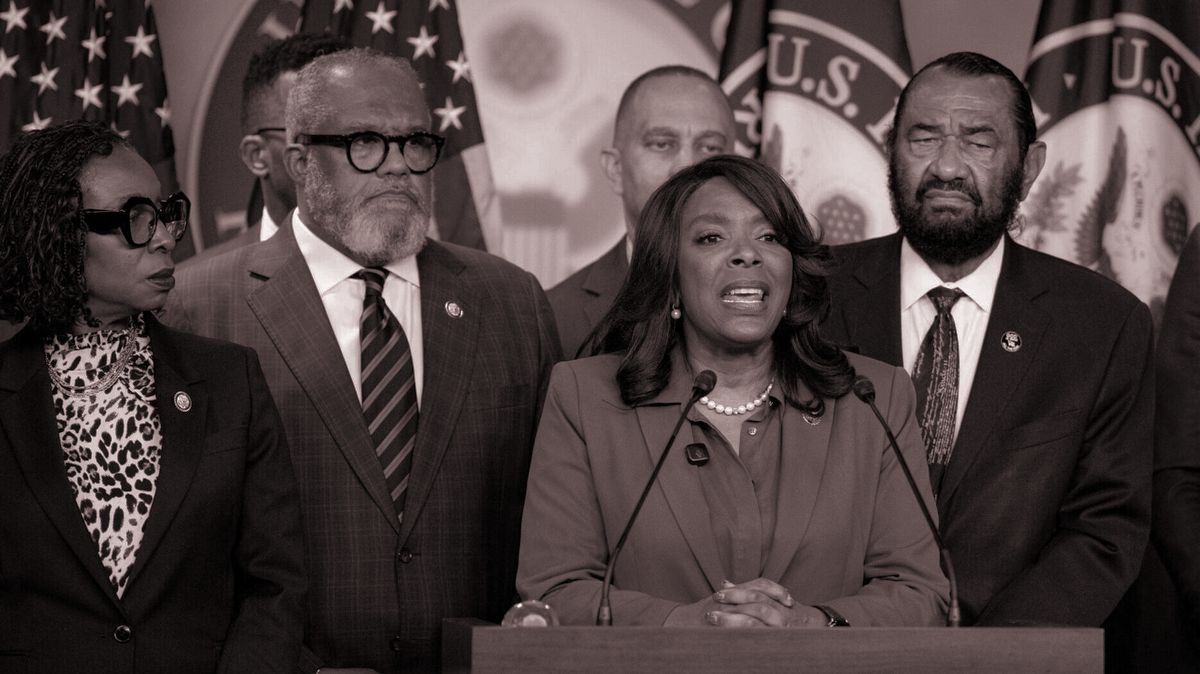
The Congressional Black Caucus will absorb the brunt of the V.R.A. ruling’s impact. The week’s most striking comment came from Rep. Terri Sewell, a temperamentally moderate Democrat who represents
Selma, Alabama, and one of the many C.B.C. members who could face serious political trouble post-Callais. In a quote to Politico, she called for full-blown retaliation. “I take 52 seats from California,” she said, “and 17 seats from Illinois, because at the end of the day, they’re rigging this election
to try to win. And we just can’t sit back here and do nothing. We’re going to play their game, and we’re going to beat them at it.”
Traditionally, state and federal Black legislators have fiercely defended their members’ heavily Democratic districts across not just the South, but the whole country. While Sewell’s openness to blowing up some of those districts in California and Illinois raised eyebrows, her comments underscored the severity of the threat to Democrats—and to the C.B.C. in
particular, as the most powerful bloc within the House Democratic caucus stands to lose significant clout. Some of the C.B.C.’s most respected elders—Rep. James Clyburn of South Carolina and Homeland Security ranking member Bennie Thompson of Mississippi—could see their districts torn apart next year. |
|
|
|
Still, there may be a silver lining: Some Democratic members “think unpacking districts could be an
opportunity for us in some places,” per a senior Democratic strategist. Competitive federal races could also bring professionalized campaigns and improved state parties to a region that Democrats have all but ignored in modern times. “The only way out is through,” said a Democrat who works on House races. “It’s going to kill us or make us stronger.” |
While national party leaders are bellicose about the redistricting war, individual soldiers—the actual
members and their aides—absolutely despise it. In nearly every conversation I had with operatives and members in both parties this week, three phrases kept recurring: “mutually assured destruction,” “Pandora’s box,” and “This is exhausting.”
That’s especially true for incumbents who haven’t run competitive general-election campaigns in decades, if ever, and now find themselves staring down the political fights of their lives. Suddenly landing on the D.C.C.C.’s “Frontline” or
N.R.C.C.’s “Patriot” list of vulnerable incumbents is a jarring change for members whose competitive edge has dulled over many terms in safe districts. Fundraising immediately becomes a dominant fact of life, as does hiring consultants, building a modern campaign infrastructure, and possibly moderating a voting record. As the Democratic chief put it, it’s a “very quick time frame where people are going to become more inward-looking and selfish, and look out for their own political
interests.”
The fall of the V.R.A. is guaranteed to prolong the redistricting fight that no one really wanted. Democrats blame Trump for starting it in Texas and are careful to characterize themselves as reluctant warriors; even Republicans speak similarly—albeit privately—knowing that challenging Trump means he’ll come after them in a primary. Members of neither party enjoy seeing their friends getting caught in the crossfire, nor do they want to deal with member-on-member violence like
in California, where the redraw unleashed a primary fight between Republican Reps. Ken Calvert and Young Kim. Next year’s redraws will only spread the dread of political annihilation to other delegations.
While most observers say the horse is out of the barn and that redistricting is a new way of life, a few optimistic operatives hope the collateral damage will lead to reform—either national anti-gerrymandering legislation or a ban on mid-decade
redistricting, perhaps after 2030 reapportionment. Or perhaps the frenzy could fade out with the man who ushered it in. Trump’s initial motive, after all, was to prevent Democrats from taking the majority in the midterms—and the subpoena and impeachment powers that come with it. But he’ll be leaving office next cycle. As one Republican put it: “You have to wonder if it’s not going to matter to him after 2028.” |
|
|
|
Join Emmy Award-winning journalist Peter Hamby, along with the team of expert journalists at Puck, as they let you in on the
conversations insiders are having across the four corners of power in America: Wall Street, Washington, Silicon Valley, and Hollywood. Presented in partnership with Audacy, new episodes publish daily, Monday through Friday. |
|
|
|
Unique and privileged insight into the private conversations taking place inside boardrooms and corner offices up and down Wall
Street, relayed by best-selling author, journalist, and former M&A senior banker William D. Cohan. |
|
|
|
Need help? Review our
FAQ page or contact us for assistance. For brand partnerships, email ads@puck.news.
You received this email because you signed up to receive emails from Puck, or as part of your Puck account associated with {{customer.email}}. To stop receiving this newsletter and/or manage all your email preferences, click here.
|
Puck is published by Heat Media LLC. 107 Greenwich St., New York, NY 10006 |
|
|
|
|