{{ 'now' | timezone: 'America/New_York' | date: '%b %d, %Y' }} |
|
|
Hello and welcome back to The Best & The Brightest. I’m Leigh Ann Caldwell,
hoping you’re having a wonderful holiday. With just a few more days left in this year, I’m thinking a lot about the next. Send me a note if there’s something you’d like me to write about more in 2026, or if you have tips, scoops, or funny anecdotes.
Apart from today’s Mar-a-Lago meeting between Donald Trump and Volodymyr Zelensky, it’s been relatively quiet on the political front. This Sunday, I’m taking a look at the political climate heading into an
election year: the paradox of Democrats’ favorability, where Republicans really stand with voters, and the G.O.P.’s odds of retaining control of the House and Senate. For a sober analysis, I decided to talk to a Republican pollster who’s not affiliated with Trump—Robert Blizzard, a partner at GP3, who’s worked for Republican House, Senate, gubernatorial, and presidential campaigns. We discussed the president’s vulnerability on the economy, whether past
midterm trends still apply, and other rumblings of what 2026 may hold.
Also mentioned in this email: Tony Fabrizio, John McLaughlin, Mark Carney, Ursula von der Leyen, Sergey Lavrov, Putin, Vladimir Solovyov, Biden, Zohran Mamdani, Abigail Spanberger, and many more… |
|
|
A MESSAGE FROM OUR SPONSOR |
We’re working to prevent disease before it starts. Too often, patients face barriers in getting the care they need. UnitedHealth Group is helping to remove these barriers while prioritizing new preventive care approaches that help keep patients healthy. |
|
|
But first, here’s Julia Ioffe on the Mar-a-Lago peace summit… |
|
|

| Julia Ioffe
|
|
- Trump and Zelensky take a
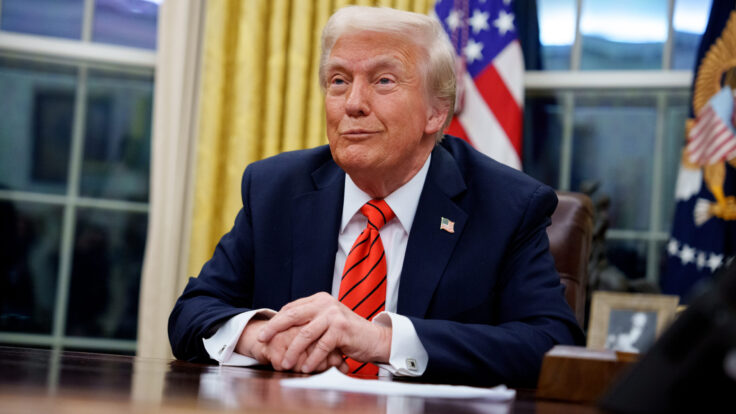
dip: Earlier today, Ukrainian President Volodymyr Zelensky met with Donald Trump at Mar-a-Lago to discuss the peace deal that the American president wants so badly, but that remains so elusive. Zelensky was coming down from Canada, where he’d met with Prime Minister Mark Carney and participated in an online call that included the president of the European Commission, Ursula von der Leyen, and the leaders of several
European nations that continue to stand by Ukraine. Meanwhile, Trump called Vladimir Putin ahead of Zelensky’s visit. The stated goal of the meeting was to discuss the constantly shifting peace plan, which now consists of 20 as-yet-undisclosed points. Trump and his administration have been insisting that they are now “90 percent” in agreement with Ukraine. Russia, on the other hand, continues to publicly shoot down every single proposal.
As usual, the Kremlin dispatched
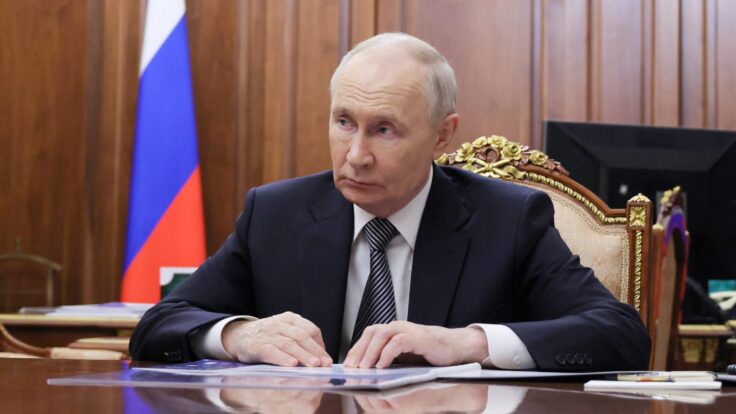
Foreign Minister Sergey Lavrov to act as the bad cop. This week, Lavrov not only categorically ruled out European peacekeepers in Ukraine—part of a proposal for security guarantees for Kyiv—but also said that they would constitute a “legitimate target” for Russian forces. Putin, who has continued threatening Europe with annihilation,
showed up yesterday at a command post decked out in camo, his sixth time visiting the front since October. (This too is a notable change: He never visited the front during the first couple of years of the war.) The Russian leader said that one of the Western proposals under discussion—creating a truly demilitarized zone in the Donbas, instead of just having Ukraine cede the territory to Russia—is
becoming “a moot point” because Russian troops are making progress in the area. Earlier in the week, he bestowed a state honor on Vladimir Solovyov, one of the Kremlin’s most vicious propagandists and someone who has regularly called for using nuclear weapons on Ukraine and Europe.
I mention all this because, regardless of the outcome
of the Mar-a-Lago summit, Putin has already demonstrated that he is only interested in one thing: victory. If peace negotiations do not provide him that goal—and they won’t—he is more than happy to continue the war for both geopolitical and domestic reasons. Earlier this year, Trump infamously told Zelensky that the Ukrainian leader does not hold the cards.
But it’s important to remember that neither does Trump. Putin does, and he’s not proved willing to compromise. - Make ambassadors great again?: A few days before Christmas, one of my State Department sources texted me while I was en route to Dulles: The Trump administration was telling about two dozen ambassadors—career foreign service officers (F.S.O.s), most of them serving in Africa and the Asia-Pacific—that they were being relieved of their posts and
had until January 16 to pack up and return to the mothership in Washington. Politico broke the news later that day.
The ambassadors were not given a reason, but the point was clear: From the very beginning of Trump’s presidency, his administration has reserved particular hostility for the State Department and the foreign service, which it
views as a den of “deep state,” “globalist,” “woke” resistance. This administration has slashed the State Department workforce and employed a right-wing, Federalist Society–style group, the Ben Franklin Fellows, as a feeder to promote its ideologically aligned members up the Foggy Bottom ranks and remake the foreign service into a less liberal institution.
All year,
there had been fearful rumors among Staties that ambassadors from the career F.S.O. ranks were seen as insufficiently loyal and insufficiently MAGA—both mortal sins in Trump 47—and that the White House was going to stop promoting F.S.O.s to ambassadorial posts for this reason. This was alarming to American diplomats, for whom an ambassadorship is the career pinnacle that motivates all F.S.O.s. Furthermore, the U.S. is already a global outlier in that it reserves many ambassadorships for
non-professional diplomats, while our adversaries, like Russia and China, rely exclusively on career professionals.
But as with everything else, the Trump administration seems intent on breaking with established ways of doing things. And in a way, the decision to recall Biden-era ambassadors was a logical manifestation of the shift to prioritizing ideological loyalty above all else. After all, as even some Trump critics noted, if you’re a foreign leader, it is much more
important that your interlocutor has a direct line to the president than that they understand the technical nitty-gritty of the profession.
|
|
|
A few months ago, Republicans thought they had the country on autopilot. Now the party is
stuck with a souring economy, beholden to Trump for turnout—whether they like it or not—and staring down an increasingly unpredictable midterm map. |
|
|
It seems like only yesterday that Republicans were riding high in Washington, and it can sometimes be hard to
fathom how far they’ve fallen in a remarkably short period. In November, polls showing voter discontent with Trump’s second term manifested as Democratic overperformance up and down the ballot, from Zohran Mamdani’s mayoral victory in deep blue New York City to Abigail Spanberger’s gubernatorial win in purplish Virginia, to Democrats flipping commission seats in rosy
Georgia and legislative ones in scarlet Mississippi. In particular, the party has found traction on affordability issues that the president has
called a “hoax”—even as Trump’s own pollsters, Tony Fabrizio and John McLaughlin, have been warning him that he’s losing ground on the economy and healthcare. (On December 17, Trump used a primetime address in the Oval Office to blame the previous administration, as well as immigrants, for persistent high prices.) |
|
|
A MESSAGE FROM OUR SPONSOR |
At UnitedHealth Group, we’re reshaping care with a new approach: Helping physicians focus on patients and prevention,
instead of paperwork. See how we’re helping patients live healthier lives with a new model for health care. |
|
|
To get a reality check on where things stand with both parties on the cusp of a midterm election year, I
called up a pollster with long experience in G.O.P. politics: Robert Blizzard, the founder and C.E.O. of UpOne Insights. A partner at GP3, the public affairs firm, Blizzard is a veteran of Republican House, Senate, gubernatorial, and presidential campaigns. We discussed the silver linings for Republicans and Democrats’ identity crisis, as well as the G.O.P.’s very real affordability struggles and why the 2026 midterm map is so unpredictable. As usual, the following
conversation has been lightly edited for clarity and length. |
“A Very
Weird Political Environment”
|
Leigh Ann Caldwell: Let’s start with the good news for Republicans. What
are they liking in the data?
Robert Blizzard: There are generally headwinds in your face if you’re the party in power [during the midterms]. But we’re in a very weird political environment. I don’t know what a true wave election looks like anymore. We are very polarized. We are very partisan-ized. And midterms aren’t necessarily uniform anymore. Look at the last couple—in 2022 and 2018, the president’s party lost seats in the
House, but picked up seats in the Senate. Were those wave years or not? I don’t know. I don’t know if we’re going to see 2006 or 2010 again, where you’re going to have five or six Senate seats go one way against the president, or 30 or 60 seats in the House. The battlefield map just doesn’t exist like that anymore.
What’s troubling for Republicans?
Voters gave the president and the administration—including some voters in the middle
and even some voters on the left—some good marks for how they’ve handled foreign affairs, immigration, and some crime and public safety [issues]. But going into ’24, there was a nostalgia for the Trump economy. One of the challenges the party faces now is affordability, inflation, rising costs, and the economy. It’s tough to get into other issues when voters are most focused on their day-to-day, kitchen table economics. It’s tough to get them to think about education policy or public safety when
voters are struggling to make ends meet.
Should Republicans distance themselves from the president? Or are they just going to be tied to whatever his favorability ratings are, specifically his approval rating on the economy?
It’s pretty foolish to try to distance yourself from the president as a Republican because you are going to be tied to the president regardless. You’re getting all the negatives anyway; you might as well get
the positives. It’s going to be important to stay connected with the president and the president’s agenda because one of the biggest challenges that we face going into ’26 is turnout. If you are trying to distance yourself from the leader of the party who can help turn out the voters that you need to win, that’s not an effective campaign strategy. |
|
|
A big challenge for Republicans going into 2026 is getting that coalition of Trump voters or lower propensity
voters to come out in 2026. They certainly came out for the president in 2016, 2020, and 2024. It’s not an uncommon midterm problem, but I think trying to show distance from the president will only exacerbate the issue even further. |
We saw in the November elections, and the Tennessee special congressional election, that Democrats
performed, on average, about 14 percent better than in 2024. But the party’s favorability is lower than Republicans’ by about 6 points. Meanwhile, the generic ballot has Democrats ahead by just under 4 points. How do you explain that divergence?
The Democrats have a lot of intraparty challenges—what they’re facing is not necessarily dissimilar to what we had in 2010 with the Tea Party. Where Democrats are in terms of their own image, it’s
obviously not great.
A new Quinnipiac poll found that 18 percent of registered voters approve of the way Democrats are handling their jobs, and 73 percent disapprove. But among Democrats, it’s 42 approve to 48 disapprove—meaning a lot of these Democrats are not happy with the direction of their own party, but at the end of the day, they’re going to hold their nose, put on their
partisan jersey, and vote Democrat.
How important is healthcare going to be? Is it going to continue to dog Republicans?
I don’t see where it goes, to be honest with you. One thing on the healthcare issue is that, for the most part, the voters who are most focused on it are not voters who are particularly inclined to vote Republican. Republican voters are much more focused on the economy. They’re much more focused on crime, public
safety, immigration, national security, taxes, things like that. Democrats are much more focused on healthcare. I think, in some ways, the challenge for our side is, What is the election about? Is the election going to be about two versions of where we go from here on the economy—how we make life more affordable? Or is the election about healthcare?
But polling isn’t great on the economy right now for Republicans.
Polling
over the course of the year, and even going back to ’24, has consistently shown that voters trust Republicans more on the economy, immigration, and border control. And Democrats are generally trusted more on climate change and healthcare. If the campaigns are being fought over issues where Republicans are at more of an inherent advantage, as opposed to kind of cultural battles or personality fights, that’s a better sandbox for us to be playing in. |
|
|
Join Emmy Award-winning journalist Peter Hamby, along with the team of expert journalists at Puck, as they let you in on the
conversations insiders are having across the four corners of power in America: Wall Street, Washington, Silicon Valley, and Hollywood. Presented in partnership with Audacy, new episodes publish daily, Monday through Friday. |
|
|
Unique and privileged insight into the private conversations taking place inside boardrooms and corner offices up and down Wall
Street, relayed by best-selling author, journalist, and former M&A senior banker William D. Cohan. |
|
|
Need help? Review our
FAQ page or contact us for assistance. For brand partnerships, email ads@puck.news.
You received this email because you signed up to receive emails from Puck, or as part of your Puck account associated with {{customer.email}}. To stop receiving this newsletter and/or manage all your email preferences, click here.
|
Puck is published by Heat Media LLC. 107 Greenwich St., New York, NY 10006 |
|
|
|



_01KCPX1GAC6X6R69PYDT17MG57.png "United Health Group")
_01KCPX1FPC0JZVHCMS1ZV87HPC.png "United Health Group")
_01KCPX1H98VT1VZ38F7MA9Q3M6.png "United Health Group")
_01KCPX1GS6BD7PN5N0H0J8258Z.png "United Health Group")