Hello, and welcome back to The Best & The Brightest, your daily politics dispatch. I’m
Julia Ioffe, and it’s foreign policy Monday… because Trump gets to do whatever he wants, apparently.
In tonight’s issue, the surprising foreign policy precedents for Trump’s smash-and-grab operation in Venezuela, and the emergence of what you might call the Donroe Doctrine. Also, tune in later this evening to catch me on The Late Show With Stephen Colbert. The last time I was on the show was the day Russia launched its full-scale
invasion of Ukraine. Tonight, we talk about Trump’s semi-not-quite-invasion of Venezuela.
Also mentioned in this issue: Bennie Thompson, Mary Clare Jalonick, M.T.G., David Valadao, Dan Newhouse, Don Bacon, Bill Cassidy, Thomas Massie, Ed Gallrein, Tim Walz, Amy Klobuchar, Nicolás
Maduro, Qassem Soleimani, Saddam Hussein, Obama, Denis McDonough, Marco Rubio, J.D. Vance, Xi, Putin, and more… |
|
|
Glyphosate is backed by regulators worldwide For 50 years, glyphosate-based products have been approved and reapproved by regulators in the U.S., EU, Canada, Japan and more. Bayer stands behind these thousands of findings and legislative language that reinforces science-based processes and keeps labels uniform. At Bayer, we succeed when farmers succeed. Learn more |
|
|
But first, here’s Leigh Ann with the latest on the Hill… |
|
|

| Leigh Ann Caldwell
|
|
- Greener pastures: Today
marks the last day in Congress for Rep. Marjorie Taylor Greene, the latest political casualty of the Trump years. M.T.G. has cited violent threats to her family as the main reason for her early retirement: Instead of spending another year as a backbencher with a microphone, she decided that constant battling with Trump wasn’t worth the price. Indeed, only two of the 10 House Republicans who voted to impeach Trump in 2021 remain in Congress—David Valadao of California
and Dan Newhouse of Washington, and Newhouse is retiring at the end of his term.
After years of Trump critics sailing into the sunset without a job in politics, the trend continues. The few remaining Trump critics in Congress have mostly been bullied into submission or reduced to anonymous ranting. Some, like Rep. Don Bacon, are retiring at the end of their term; others will face challenging reelections this year. Sen. Bill Cassidy, who
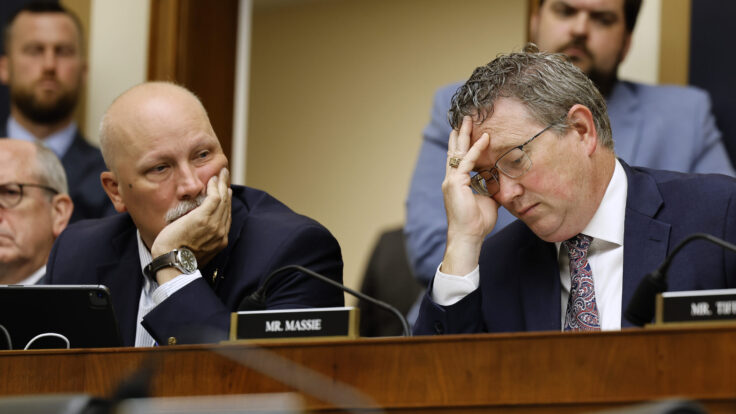
voted to convict Trump in his 2021 impeachment, is unlikely to get the president’s endorsement and risks losing his primary. Rep. Thomas Massie, one of the few outspoken Trump critics, faces the most difficult primary of his career against Ed Gallrein, a Trump-endorsed farmer and former Navy SEAL who officially filed his challenge to Massie today. - Minnesota not-so-nice: Earlier today, Minnesota Gov. Tim Walz
announced that he won’t seek a third term amid the fraud case rocking Minnesota day care centers. All eyes are now on Sen. Amy Klobuchar, who is considering running for governor, I’m told. She and Walz met yesterday to discuss the race.
As my colleague Abby Livingston notes, Klobuchar’s trial balloon essentially freezes the Democratic field until she makes her decision. Klobuchar is now in the upper tier of Democratic leadership, but her path to
succeeding Schumer was likely blocked after Sen. Brian Schatz seemed to have secured the votes to become whip, a key stepping stone to becoming leader. Now the governorship may be the way to go. - Five years after January 6…: Finally, on the eve of the fifth anniversary of the attack on the Capitol, Trump has pardoned those violent insurgents and moved to prosecute the prosecutors who put them behind
bars. Meanwhile, the president continues to attempt to rewrite the tragic history of that tumultuous day, and the Republican Party has mostly fallen in line. America itself has also largely moved on, although the memory remains harrowing for many of us who were at the Capitol that day—police officers, members of Congress, and, yes, journalists (including me).
House Democrats will mark the anniversary with a hearing tomorrow led by Rep. Bennie Thompson, the top Democrat on
the Homeland Security Committee, who led the January 6 Select Committee that investigated the attack. Republicans, most of whom were initially disgusted, shaken, and rushing to distance themselves from Trump, are now firmly aligned with the president and unlikely to attend. In fact, House Republicans are scheduled to meet with Trump at the renamed Kennedy Center tomorrow morning.
If January 6 is starting to fade from memory, pick up Storm at the Capitol, a new book by Associated
Press congressional reporter Mary Clare Jalonick, who has published an oral history of the day based on interviews with dozens and dozens of lawmakers about what they experienced. And yes, it includes all the quotes from many Republicans who blamed the president at the time.
|
|
|
Trump’s largely consequence-free projection of military power in Iran and elsewhere laid the
groundwork for last weekend’s shocking action in Venezuela—and validated a new framework for MAGA-style interventionism. But what happens when Xi starts playing by the same rules? |
|
|
On January 3, on orders from President Donald Trump, the U.S. military carried out a secret,
surgical strike to remove a foreign leader. No, this wasn’t last weekend’s early morning raid in Caracas in which U.S. special forces abducted Venezuelan President Nicolás Maduro. The year was 2020, and the leader was Iran’s General Qassem Soleimani, the head of the country’s notorious Quds Force, who was sitting in a car near Baghdad when an American missile took him out.
At the time, the chattering classes in Washington freaked out: Surely, Trump was
about to get the U.S. into another war in the Middle East, this one with a far more powerful and wily adversary than Saddam Hussein had ever been. But the escalatory spiral never materialized. Instead, four days later, the Iranian military fired a dozen ballistic missiles at two Iraqi military bases housing American
troops—and warned Iraqi officials that the attack was coming. There were no American deaths, although a few dozen troops reported traumatic brain injuries. And, despite the Ayatollah’s fury, that was that. |
|
|
Giving farmers the tools to succeed What helps farmers? Competition in agriculture and streamlined regulations. Because access to innovative tools means more choices for farmers and stronger food security for Americans. At Bayer, we succeed when farmers succeed. Find out about farming innovation |
|
|
Last June, Trump again launched a military strike against Iran, this time hitting the crown jewels of the
regime—its nuclear facilities. Once again, the chattering classes were certain: Trump had just tripped the wire for war in the Middle East. And wouldn’t it be rich, they said, if the man who’d campaigned on stopping the forever wars wound up dragging the country into another one? Again, though, the Iranian regime responded with far more bark than bite. After warning Qatar that they would strike the American base there and giving Americans troops enough time to evacuate, the Iranians lobbed a few missiles at the Al Udeid Air Base. And that, once again, was that.
The pattern has repeated itself in smaller ways, too. Trump repeatedly hit Yemen last spring, with no apparent blowback. Ditto after he struck Islamic State positions in Syria and Nigeria last month.
Time and time again on the world stage, Trump has learned the same lessons he learned in New York
real estate, while dealing with New York tabloids, and then enmeshed in the world of U.S. domestic politics: that intimidation works. That your opponents will wilt quickly if you throw the first punch—and threaten more. That might makes right. And that using American military power abroad doesn’t always lead to war. In fact, it rarely seems to, at least with Trump’s luck. |
Presidents Barack Obama and Joe Biden largely shared the
view of the Western foreign policy establishment that the rules-based international order had delivered unprecedented peace and prosperity across the world, particularly for the United States. But in Trump’s mind, there was a better deal to be had. For a man who thinks in zero-sum terms, there’s no such thing as a qualified victory, especially not in the technocratic, legalistic, tedious framework of multilateral diplomacy that just feels beta. (Or, as one MAGA personality recently called international law, “fake and gay.”)
The affinity for using American military force has, weirdly, thrown Trump into alignment with the same neoconservative camp that he trampled during his ascent to the White House. This cohort, which has praised Trump’s moves in both Venezuela and Iran, has long insisted that Democrats are constitutionally uncomfortable with American power and that they are too scared to use it. In their view, liberals overlearned the lessons of Iraq and, as a result, grew too prone to overthinking and overanalyzing—imagining consequences to military
action that are far worse than reality merits. Recall, for example, Obama’s August 2013 Rose Garden stroll with Denis McDonough, which gave him the peace of mind not to enforce his own red line against the use of chemical weapons in Syria. And how, when Trump made the opposite decision in 2017,
exactly none of the Democrats’ nightmare scenarios came to pass.
Now, with Trump’s decapitation of the Maduro regime, the G.O.P.’s remaining neocons are trying to make sense of an ostensibly isolationist president exulting in the projection of military power into Venezuela, and issuing threats against Colombia, Cuba, and Denmark as well. Even some advocates of regime change are cautioning that Trump hasn’t thought this through, that he hasn’t considered the second- or third-order effects or planned for the day after.
To be sure, this isn’t exactly the regime change that traditional neocons like Marco Rubio might have imagined. President Maduro and his
powerful wife are gone, but the rest of the Venezuelan government is still very much intact, led by Vice President Delcy Rodríguez. Opposition leader María Corina Machado has been sidelined by Trump on the grounds that “she doesn’t have the respect” within the country that she’d need to govern it.
Rodríguez, for her part, spent the weekend vocally slamming Trump’s actions—inciting the president to threaten her with a fate worse than Maduro’s and “boots on the ground.” (He also kept insisting, over Rubio’s denials, that
it’s actually the U.S. that’s “in charge” of Venezuela.)
Right on cue, Rodríguez changed her tune, saying on Sunday night that she wants a cooperative relationship with the U.S. Her rhetorical resistance cracked after less than 24 hours—no second-wave attack, no American boots on the ground, no forever war. The Trump doctrine, such as it is, seemed to have been vindicated again. |
Trump’s zest for intervention would be—should be—the stuff of America First nightmares, at least in
theory. According to an analysis by the Military Times, Trump has ordered at least 626 airstrikes in the past 12 months alone—and that doesn’t count this weekend’s rendition of Maduro. Biden, by comparison, ordered 555 airstrikes over four years. |
|
|
And yet, the MAGA movement has faithfully gotten on board with every foreign military strike. What used to
bill itself as a noninterventionist movement has deftly reformatted. Now, America First does not mean prioritizing domestic concerns over foreign ones. Instead, America First means “this is our hemisphere,” as right-wing influencer Benny Johnson wrote. “And Trump,” he continued, “just reminded everyone we run this joint.” Others dutifully chimed in. “I totally
support turning other countries in our hemisphere into subordinate vassals of the United States,” tweeted MAGA podcaster Matt Walsh. “That’s the very definition of an America First foreign policy.” It’s a message the administration ran with this afternoon, tweeting out an image from the State Department account of Trump with the words “THIS IS OUR HEMISPHERE.”
This is what Trump has dubbed the Donroe Doctrine—a juiced-up version of the 19th century U.S. imperialist approach to the Western hemisphere. It’s the export version of MAGA’s muscular approach to domestic politics and culture: hyperaggressive, cartoonishly macho, relentlessly bullying. It means Cuba could be next, and, hell, maybe even Colombia. And Greenland, too—as
Katie Miller, Stephen’s wife, tweeted and Trump re-threatened over the weekend.
You could point to dissenters like outgoing Congresswoman Marjorie Taylor Greene, who condemned the Venezuela operation as
“exactly what many in MAGA thought they voted to end.” You could wonder, as she did, why Trump pardoned Honduran ex-president Juan Orlando Hernández, who was convicted of “trafficking hundreds of tons of cocaine into America,” if the administration were really set on fighting “narcoterrorists.” You might even note J.D. Vance’s 2023 Wall Street Journal
editorial crowing that “Trump’s best foreign policy” is “not starting any new
wars.”
But pointing out hypocrisy in MAGA is a fool’s comfort. MAGA isn’t an ideology-first movement, and certainly not one built on consistency. It’s whatever Trump says it is. “MAGA was my idea. MAGA was nobody else’s idea,” Trump told Laura Ingraham in November. “I know what MAGA wants better than anybody
else.” And arguably, technically, Trump hasn’t started any new wars. He’s launched targeted strikes without, so far, drawing America into new quagmires. Call it dumb luck, call it strategic brilliance, but so far it’s worked. And if Trump does it, it’s MAGA. |
European officials were notably muted in public, if furious in private, over Trump’s brazen flaunting of the
international order upon which their own security depends. E.U. foreign affairs chief Kaja Kallas offered a typically needle-threading statement calling Maduro illegitimate while pleading that “the principles of international law and the U.N. Charter must be respected.”
China and Russia, meanwhile, were predictably apoplectic—with Beijing declaring
that Maduro’s rendition “threaten[s] peace and security” in the region and the Kremlin calling the operation “an act of armed aggression” and vowing to stand with the “Bolivarian” government. The rage was understandable given that Venezuela was their ally and client, a supplier of cheap oil as well as their foothold in America’s backyard.
But
in other ways, Trump’s kidnapping of a foreign leader is great news for Beijing and Moscow. Both regimes have long cynically amplified the Global South’s accusations that the U.S. dresses up its imperialist ambitions with the fig leaf of “values” and “democracy” (even as both regimes pursued imperialist aims in Ukraine and Taiwan). Now Trump has tossed away the pretense. After decades of Washington picking and choosing who gets to run which country, after fighting two wars with Iraq that America
said were about democracy but everyone suspected were really about oil, a U.S. president effectively came out and said: Yes, it’s about the oil. For skeptics of Pax Americana, I’d venture to guess, this admission was almost refreshing.
Moreover, if this hemisphere belongs to Trump, surely Russia and China can claim dominion over their own backyards now, too. Not long after he first launched the full-scale invasion of Ukraine, Vladimir Putin and his elites
dreamed of a Yalta 2.0, where the big boys leading the three big superpowers (as Russia imagined them) would carve up the world into spheres of influence in which Russia, China, and the U.S. could do what they wanted, without interference or scolding. The idea seemed laughable then. But after this weekend, it looks like Trump, armed with the Donroe Doctrine, might have given them
exactly that. |
That’s all from me, friends. Don’t miss me on Colbert tonight—or wherever you watch the day after.
I’ll see you back here next week. Until then, good night. Tomorrow will be worse.
Julia |
|
|
Unique and privileged insight into the private conversations taking place inside boardrooms and corner offices up and down Wall
Street, relayed by best-selling author, journalist, and former M&A senior banker William D. Cohan. |
|
|
Puck fashion correspondent Lauren Sherman and a rotating cast of industry insiders take you deep behind the scenes of this
multitrillion-dollar biz, from creative director switcheroos to M&A drama, D.T.C. downfalls, and magazine mishaps. Fashion People is an extension of Line Sheet, Lauren’s private email for Puck, where she tracks what’s happening beyond the press releases in fashion, beauty, and media. New episodes publish every Tuesday and Friday. |
|
|
Need help? Review our
FAQ page or contact us for assistance. For brand partnerships, email ads@puck.news.
You received this email because you signed up to receive emails from Puck, or as part of your Puck account associated with {{customer.email}}. To stop receiving this newsletter and/or manage all your email preferences, click here.
|
Puck is published by Heat Media LLC. 107 Greenwich St., New York, NY 10006 |
|
|
|




_01K77C0D9VDDGVNNP1DBKASPB4.jpg "Bayer")