 |
|
Welcome back to The Best & The Brightest. I’m Tara Palmeri.
Tonight, I’m digging into the latest cottage industry in town, cropping up among some of the most Trumpy Senate Republicans as they anticipate taking back the upper chamber in 2024. Plus, how Donald Trump really feels about the hush money trial and the dark musings among House Republicans on the brink.
Programming alert: If you haven’t heard my latest episode of Somebody’s Gotta Win, check out my conversation with Democratic strategist Nathan Daschle. We discuss the death of split-ticket voting, how he thinks the abortion measures will impact the battleground states, and how the Biden team could tune up their messaging. I also had former Southern District of New York prosecutor and CNN commentator Elie Honig on the show to chew over the drama of the Trump trial. He gives his odds that Trump is actually convicted.
But first…
- Trump’s cheery disposition: Sure, Donald Trump has been skulking around the remarkably dingy courtroom in Lower Manhattan, where his historic criminal trial is currently unfolding—mugging for TV camera, dropping off to sleep, griping about political persecution, possibly contemplating four years in the clink, etcetera. Nevertheless, sources close to the former president tell me that he’s actually, truly, really in a good mood. The earned media is free and plentiful and his base is fired up, they said, while Joe Biden is puttering around Pennsylvania with barely any national coverage.
The thinking inside the White House, as Politico reported, can be summed up as, Let Trump eat himself. Biden, who entered April with $192 million on hand compared with Trump’s $93 million, does not want to comment on Trump’s courtroom plight or say anything to bolster his claims of political persecution. Indeed, Republicans and Democrats (at least those not on the Biden campaign payroll) see the trial as an in-kind campaign contribution. If Trump is found not guilty—or if a verdict is voided by a hung jury—the upside for his campaign would be material. Meanwhile, as a Democrat close to Biden told me, Trump’s court cases are blurring together. The shock value dissipates daily, and with it the Biden camp’s key message that this election constitutes a choice between democracy and dictatorship. “Nobody should be surprised he’s in court, big whoop. Really, again? Who cares?” the Democrat said. “People are just becoming indifferent to Trump.”
- Johnson on the ropes: The House, which has been in crisis mode since well before Kevin McCarthy’s defenestration last October, has hit a new morale low. I’ve even heard Republican members harboring pipe dreams of expelling Marjorie Taylor Greene, Thomas Massie, and Matt Gaetz. That won’t happen, of course—there’s that precious, and very slim, majority to defend—but the very specter conveys the sheer pessimism. In any case, everyone believes Democrats would ultimately bail out Mike Johnson if a motion to vacate is brought to the floor. The worst-kept secret around town is that Democrats actually kind of like Johnson, despite his January 6th views and election trutherism, but perhaps because he is not particularly adept at his impossible job. And members of both parties simply trust him more than the duplicitous McCarthy.
At his sad presser yesterday, Johnson stood alone while facing questions about the renewed and looming motion to vacate threat. Afterward, insiders murmured about the notable and clearly symbolic absence of his lieutenants, Majority Leader Steve Scalise and whip Tom Emmer, who have their own ambitions for the next Congress and don’t want to become collateral damage. As one Republican member told me, “Scalise always goes dark when these fights get loud.”
|
| And now, here’s Abby Livingston’s readout of the latest chatter on the Hill… |
|
|
With Mike Johnson putting his job on the line to force no fewer than four major controversial bills over the weekend, frazzled House members are experiencing every emotion between bewilderment, cynicism, and despair. Here’s the latest readout from the Hill…
- Cold as ice: House Democrats have moved beyond anger, and now seem dumbfounded by what they’re witnessing on the other side of the aisle. Hakeem Jeffries reportedly directed his caucus to remain “frosty and united” in how they comport themselves over the next few days. This posture tracks with my private conversations with Democratic members and those close to them—they feel optimistic about Ukraine, but wary about the prospect of saving Johnson.
But it was mild-mannered Michigan Rep. Dan Kildee who said the quiet part out loud in an interview with Fox News, positing that while Johnson is merely incompetent, his predecessor was both “incompetent and dishonest.” Kildee’s tone was uncharacteristically sharp, but it reflected the general mood of Democrats I’ve spoken with both on and off the record: The prospect of Johnson’s removal doesn’t inspire nearly the level of bloodlust as did McCarthy’s.
- Laughing, not crying: On Thursday afternoon, Freedom Caucus members pledged to stand guard over the House floor to prevent procedural trickery, as part of their self-titled Floor Action Response Team, a.k.a. FART. (You can’t make this stuff up.) Meanwhile, Derrick Van Orden referred to Matt Gaetz as “Tubby” on the House floor, which is perhaps a half-step up in propriety from calling a colleague a “little bitch.” It would all make for amusing, absurdist performance art, if not for the other members racing around town, trying to defend Ukraine from Russia.
- Meanwhile, in Pittsburgh…: The Pennsylvania primary is Tuesday, and Summer Lee’s 12th District primary against Bhavini Patel will serve as the latest point of litigation for the electoral power of the Israel-Hamas war. Lee, who is pro-Palestinian, successfully amped up her campaign operation after the issue exploded last fall. She had a strong final quarter, raising $919,000 in the last reporting period before the primary, far outpacing Patel, who raised $291,000.
Several colleagues have since donated to Lee, including Maxwell Frost of Florida, Greg Casar of Texas, and Rashida Tlaib of Michigan. The general rule of thumb is that House incumbents—even those who’ve upset powerful constituencies—only tend to lose reelection in primaries when they’re caught napping. Lee appears to be running through the tape.
|
 |
| Dark Money on the Edge of Town |
| With McConnell waving the white flag and the Trump tax cuts expiring, Republicans are racing to set up dark money receptacles for corporations and kingmakers with the hopes of buying influence in a G.O.P.-dominated Senate. |
|
|
|
| That noise you don’t hear is the sound of 501(c)(4) groups popping up all over Washington as Senate Republicans prepare to find themselves back in the majority next year. These “dark money” nonprofits, so called because they don’t require donor disclosures and can take a year to be listed, are a sort of going-away present from the retiring Mitch McConnell, who’s given these fundraising vehicles his implicit blessing by not raising any objection to them. “There’s been an explosion of (c)(4)s on the Republican side,” one lobbyist told me. Said another: “You can take unlimited sums of cash, you can have a sugar daddy or a sugar momma.”
This quiet reversal, driven in part by the much-anticipated expiration of Trump’s tax reform bill in 2025, presages a flood of undisclosed money as every corporate interest in America looks to make friends with the Republicans who will be deciding their fate. These black-box instruments have long been employed by leadership, of course—McConnell’s Senate Leadership Fund super PAC works hand in glove with One Nation, a 501(c)(4) run by Steven Law, to raise gobs of cash doled out at McConnell and Law’s discretion.
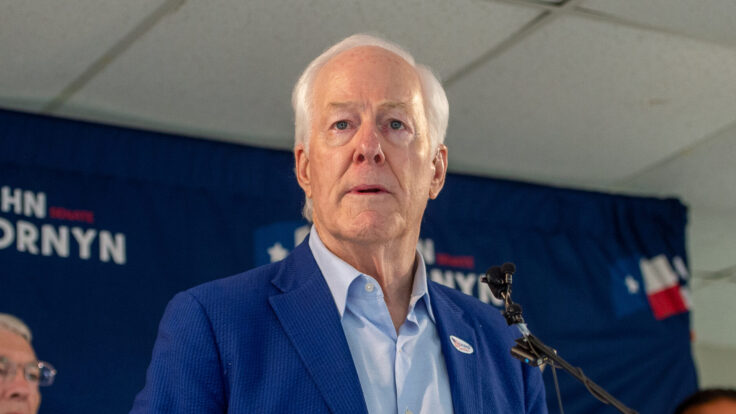
Now, everyone’s getting into the game. With Republicans poised to take back the Senate, those with leadership ambitions—including John Thune, John Cornyn, John Barrasso, Tom Cotton, Joni Ernst, Rick Scott, and Steve Daines—already have them. “People are making choices,” said another lobbyist. “I have friends who are giving to Thune rather than to McConnell.” I’m also told that several newer and more populist members—such as J.D. Vance, Eric Schmitt, Markwayne Mullin, Tommy Tuberville, and Bill Hagerty—have their own dark money groups. “These consultants are now saying everyone needs one,” yet another lobbyist told me. “There was a time when everyone needed a leadership PAC, and then everyone needed a 527, and now everyone needs a 501(c)(4).” One of those very consultants, who has been encouraging members to set up their own, said the dark money orgs are “becoming the new leadership PAC.”
The frenzy has only been heightened in anticipation of the end of the McConnell world order. “Everybody relied on Steven Law and that crowd for a long time,” said the consultant promoting (c)(4)s to clients. “This is the end of the Law-McConnell dominated time, when you needed to give your money to somebody else. You have to play a smart, sophisticated game now.” |
| More Money, More Problems… |
|
| These dark money instruments also have other political benefits, such as allowing Fortune 500 companies to exert influence on Capitol Hill without being publicly associated with MAGA Republicans. “Major corporations better start ponying up to Republicans, because we have tax reform coming up,” said one consultant who is creating a (c)(4) for a senator. “[But] they’re worried about the public implications: Nike gives $1 million to MAGA Republicans? Can you imagine?”
Wealthy individuals are watching, too: With the expiration of the Tax Cuts and Jobs Act, individual income tax rates will revert to 2017 levels, the estate tax exemption will be reduced, and a special deduction for passthrough income will disappear, among other changes unsavory to the 1-percent. With a 501(c)(4), donations are unlimited and undisclosed—crucial for those with family offices looking to tilt the scales without public scrutiny. “Every Senate vote is important if people want to invest in (c)(4)s to persuade people on the tax code, which is up on the individual side in 2025,” said another lobbyist.
It’s particularly lucrative for the people who operate these groups. Compensation for a 501(c)(4) treasurer, for example, can be more than 10 percent of the gross—a nice reward for a former staffer or campaign manager looking to cash in. Marco Rubio’s former chief of staff Mike Needham manages his (c)(4). Tiffany Smiley, who spent $20 million on her unsuccessful 2022 Senate race in Washington State, holds the reins for Rick Scott.
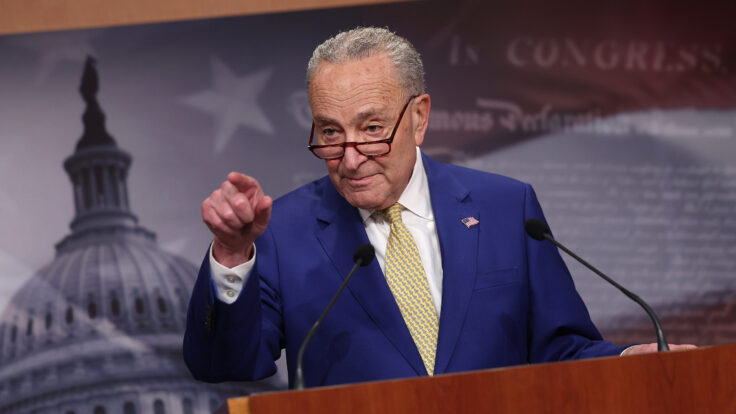
Things are less frothy across the aisle, where Chuck Schumer has kept a tight grip on Democrats by centralizing the money and discouraging individual members from starting their own nonprofit funds. “Schumer thinks it could dilute his efforts to his giant super PAC and (c)(4) that he runs,” sniffed a lobbyist. “It is a top-down authoritarian approach from that caucus with Schumer—the idea that others would freelance and have their own super PAC and do their own things. You would hear, ‘You could do it, but don’t get in the way of my efforts.’” Schumer, of course, thinks no individual member could raise as much as him. (“Silos aren’t smart for Democrats—we just raised $25 million dollars at Radio City the old-fashion way,” said a Schumer fundraiser. “If it ain’t broke, don’t fix it.”)
There are some limits, alas, on how the money can be spent for electioneering purposes. A 501(c)4 is technically an issue-advocacy vehicle, but its uses have not been fully debated in the courts, and many of the structures can be evaded with a little creativity. Thune, who is running for leadership, is using it as a vehicle to dole out cash to other members as he tries to increase his popularity. The same for his rival Cornyn. Barrasso has been using his 501(c)4 to conduct polling and test messaging.
The lobbyists, by the way, are not happy. Sure, hard dollars go further on advertising. But how is a lobbyist who’s donated the maximum $6,600 per cycle supposed to get points on this new scoreboard? “Does our money matter anymore, when you have these large corporations or individuals giving six, seven figures?” said one lobbyist. |
|
|
|
| FOUR STORIES WE’RE TALKING ABOUT |
 |
| Greene Inferno |
| Digging into M.T.G.’s motion-to-vacate theatrics. |
| TINA NGUYEN |
|
 |
| Diller’s Gambit |
| Evaluating the Daily Beast resuscitation strategy. |
| DYLAN BYERS |
|
 |
|
 |
| A Paramount Epiphany |
| On the deal dynamics underpinning the Ellison-KKR-RedBird bid. |
| WILLIAM D. COHAN |
|
|
|

|
 |
|
|
|
Need help? Review our FAQs
page or contact
us for assistance. For brand partnerships, email ads@puck.news.
|
|
You received this email because you signed up to receive emails from Puck, or as part of your Puck account associated with . To stop receiving this newsletter and/or manage all your email preferences, click here.
|
|
Puck is published by Heat Media LLC. 227 W 17th St New York, NY 10011.
|
|
|
|