 |
 |
|
Hello, and welcome to The Best & The Brightest, Wednesday foreign policy edition because I was off and fasting for Yom Kippur. I atoned for, among many things, messing up the TBTB calendar this week.
Before we get to the meat of the matter—what would happen to Ukraine if Matt Gaetz had his way—I wanted to draw your attention again to the tragedy unfolding in Nagorno-Karabakh. Last week, I mentioned that war was breaking out there—Azerbaijan moved to seize the mostly Armenian enclave—but that the fighting ended within 24 hours. The army of Nagorno-Karabakh folded and Azerbaijan took control of the region. Now, a flood of tens of thousands of Armenian refugees out of Nagorno-Karabakh and into Armenia is so large that it can be seen from space.
Secretary of State Tony Blinken has been working the phones with the leaders of both Armenia and Azerbaijan. U.S.A.I.D. Administrator Samantha Power, who made her name ringing the alarm over the genocide in Bosnia, visited the border between the two countries this week and promised more American aid. But the crisis is continuing unabated. Today, the president of Nagorno-Karabakh was arrested and transferred to Baku.
I happened to call Russian foreign policy provocateur (and college classmate of Sergei Lavrov) Andranik Migranyan today for my main story and found him quite literally huffing and puffing with rage. Ironically, Migranyan, who is an ethnic Armenian, wasn’t mad at Russia, which had mediated the 2020 ceasefire and whose peacekeepers were supposed to be making sure that, you know, peace had been kept and that the Azeri government wasn’t starving the Armenians into submission. No, he was mad at America and Europe. With all their talk about democracies fighting autocracies, he fumed, where were they?!
It was a deeply odd exhortation from him. Migranyan is a loud and profane critic of the West—where he spent a significant amount of time—and a frequent guest on Kremlin TV’s foreign policy shows. Now, this unstinting critic of American power and intervention was demanding American intervention to save Armenians. I asked him, essentially, how in the hell does this make sense? To which he said, “I am against American intervention, but if America is going to intervene somewhere, it might as well intervene where it matters.” That is, where it matters for Migranyan.
Regardless, if you’d like to help Armenians affected by this humanitarian disaster, please donate to the Armenian General Benevolent Union.
Now, on to the main show. But first… a congressional update from Abby Livingston, who will be in conversation with Penta’s Kevin Madden this Thursday, 9/28 at 1 p.m. ET during Puck’s first Quarterly Call, a new subscriber perk featuring conversations with industry analysts and insiders. You can sign up here.
|
| The Silence of the Pragmatists & Menendez Musical Chairs |
|
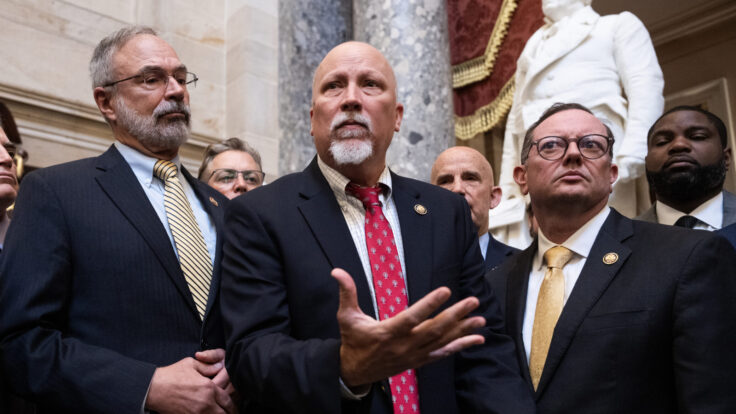
- House G.O.P. pragmatists quietly seethe: The focus of this shutdown fight has settled into a back-and-forth rhythm between Kevin McCarthy, the rebels (embodied by Matt Gaetz) and the Senate. But at the quiet center of this mess, pragmatic Republican members are increasingly incensed with House G.O.P. leadership over the course of the negotiations, two Capitol Hill Republican sources told me today. “They just want to get to yes,” said one of these Republicans.
The pragmatists—which broadly includes members of the Republican Main Street Caucus and the Republican Governance Group, formerly known as the Tuesday Group—are “more and more frustrated by the day. They’re toeing the company line, and the Matt Gaetzes and those guys are coming in and acting like assholes and saying they’ll do X, Y, Z and are going back on their word and being rewarded for it,” this person added.
Why aren’t we hearing from them? Unlike the rebels, they are predisposed to avoid the spotlight. And moreover, the pragmatists are, for now, loyal to McCarthy out of personal affection for him or because they are social climbers who owe their status within the conference to the speaker. Lastly, they’re also hemmed in by their own pragmatism. “What recourse do they have?” a G.O.P. lobbyist chimed in, agreeing with the detected sentiment. “Side with the Ds?”
- Shutdown timing: The government is expected to shut down at 12:01 a.m. on Sunday morning. A week ago, various Capitol Hill sources said they expected a two-to-three week shutdown. Given the current impotency of negotiations, those projections are becoming more and more grim, with many sources now wondering if this one could last into November. As for constituent feedback, some Hill Republicans expect the angry calls to start rolling in around Wednesday or Thursday.
- Changing of the gavels: Bob Menendez was still listed as the chairman of the Senate Foreign Relations Committee as of late Wednesday afternoon, but Ben Cardin once again assumed the committee’s Democratic leadership in light of the New Jersey Senator’s indictment. Cardin served as interim ranking member when Menendez stepped back from 2015-2018, during his previous indictment. This time around, Cardin will be chairman because Democrats have a majority.
Cardin, who is set to retire at the end of this term, is perceived as a caretaker chairman. A Democratic Senate aide told me that it’s a smooth transition due to his previous stint. But, assuming Menendez does not return to the chairmanship next term, Jeanne Shaheen is the most obvious contender, based on her seniority, to run the committee on the Democratic side in 2025.
|
 |
| What Happens if the U.S. Stops Aiding Ukraine? |
| Determined to answer the unspoken question hanging over the looming government shutdown, I reached out to my best sources in Washington and Moscow to conduct an explosive thought experiment. |
|
|
|
| As a small but mighty group of House Republicans continues to push us toward a government shutdown, I decided to conduct a bit of a thought experiment. Marjorie Taylor-Greene and members of the Freedom Caucus are adamant that the U.S. stop sending a “blank check” to Ukraine. Others, like Matt Gaetz, have been clear for months that they want zero money going to Ukraine. Back in February, Gaetz introduced a “Ukraine Fatigue Resolution,” which had ten co-sponsors but went nowhere. This summer, though, his amendment stating that “no federal funds may be made available to provide security assistance to Ukraine” got 70 votes in the House. The measure was easily outvoted, yes, but 70 members of Congress is not nothing.
And so, I thought, what would happen if the U.S. decided to turn off the Ukraine aid spigot? Would Ukraine collapse? Would Vladimir Putin take it as an opportunity to probe NATO? |
|
A MESSAGE FROM OUR SPONSOR
|
| |
 |
Your health insurance company and their pharmacy benefit manager (PBM) can steer you toward pharmacies that make them more money. How is that possible? Because they own the pharmacy, too. No one should stand between you and your medicine.
See what else PBM middlemen are up to. |
|
|
| I called some people in the D.C. foreign establishment to ask what they thought. Hilariously, this proved to be a surprisingly difficult question. All of them, to a person, wanted to dive head-first into the weeds. Were we just talking about this most recent $24 billion supplemental or all aid in the future? The presidential draw-down authority or supplementals? Which part of the Pentagon budget were we talking about? Was I assuming that this is a Republican House with a Biden White House, or a Republican White House with… what kind of Congress exactly?
The Russians, by the way, had absolutely no trouble gaming this out when I called a few folks, just out of curiosity. (To be fair, “detail-oriented” is not generally something ascribed to Russian culture.) When I rang Andranik Migranyan, a former classmate of Sergei Lavrov and a regular, flame-throwing presence on state TV, he was unequivocal. “It’ll be a few days and Ukraine will go to hell—and that’ll be the right outcome,” he said, using a far more colorful and untranslatable Russian expression involving fornication and someone’s mother. “Ukraine will stop existing as a government, and that’s for the benefit of Ukrainian people. Novorossiya [the Donbas] and Kievan Rus [central Ukraine] will become part of Russia, and we don’t need Galicia [western Ukraine]. It’s a cancerous tumor that corroded the rest of Ukraine and then the entire Soviet Union. We can throw the scraps that are left to Hungary, Poland, Romania, whoever wants to eat them.”
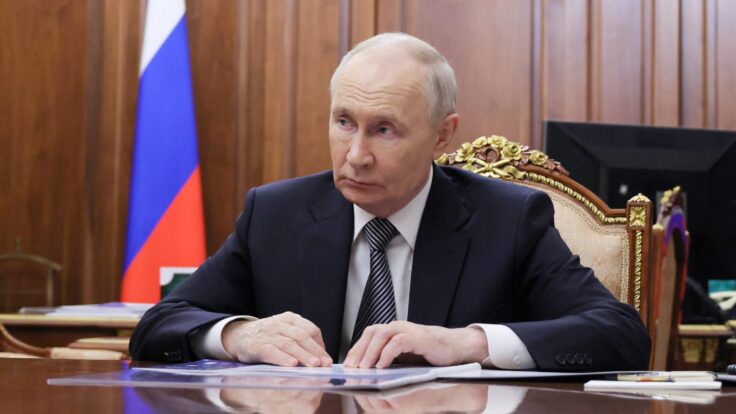
Another well-connected source in Moscow was more diplomatic about what they saw as the inevitability of Ukraine’s defeat should the U.S. withdraw its support completely, à la Gaetz. “The view in Moscow is that it would be between two weeks and a month,” the source said, adding that Putin would likely be “pleasantly surprised” at such a development out of Washington. “The Ukrainian resistance would collapse. You have seen it in Afghanistan, we saw it with the U.S. in Vietnam. It doesn’t happen in a steady progression. It collapses like a house collapses, not an evolutionary process.”
As for what comes next, the source added, “I don’t think there’s anything approaching consensus in Moscow that Ukraine has to stay as a sovereign state in its current borders. There would be an interest in changing the government of Ukraine and giving back to Russia the remaining territories that were incorporated by Russia but not yet occupied by Russian troops.” |
|
|
| Eventually, the Americans got on board with the experiment. What if U.S. aid to Ukraine went to zero—tomorrow?, I reiterated. The scenarios they presented were far more nuanced (surprise!) and interesting than those presented by the Russians—though, honestly, they were occasionally1 far more horrifying.
“The Europeans will try to make up for what the U.S. has cut off, but it will still fall short,” said Steven Pifer, who served as America’s ambassador to Ukraine. “The Europeans don’t have production capacity of 155s”—the most used and needed type of artillery round in Ukraine—“and, in terms of the F16s, they don’t have enough past what the Dutch and the Danes have pledged. There will be European countries—like, the U.K. and Poland—who will try to step up and fill the leadership role. But it will be hard to match U.S. capacity. I just don’t see the Europeans having the capacity to replace what the U.S. would stop providing.” The Ukrainian military, Pifer said, will have to take it all into account and perhaps ration weapons and systems they know will be harder to replace. “It will presumably have an effect on battle plans,” he went on. “My guess is they would have to shift to a more defensive posture. Because what they’re finding is that offensive posture has a high rate of fire.”
“In some areas, European countries will be able to step in and cover the gap, but in other places they won’t be able to,” concurred Michael Kofman, a military analyst with Carnegie. This was a common refrain: the U.S. provides so much weaponry, ammunition, and maintenance support to Ukraine, that a full U.S. withdrawal will leave a large hole. And though the Europeans have seriously stepped up since February 2022 and have become far better and faster at defense manufacturing and supplying Ukraine, the U.S. would still be hard to replace—both in terms of its hard supplies and its leadership over a fractious Western coalition.
“We play a very important coordinating role that would be very hard for another country to fulfill,” explained Eric Ciaramella, a senior fellow at Carnegie who was previously an analyst in various bodies in the U.S. intelligence community. He now focuses on the defense aspect of the war in Ukraine. “From a practical standpoint it would become a lot harder for Ukraine’s urgent [defense] requests to be met on a timely basis because Europeans can be slow,” he said. “We can mobilize our system so much faster. We can do it with essentially the snap of a finger. We have teams and teams of procurement specialists who can look at what’s in our global stocks. The Europeans are new to this. They’ve made a lot of strides to become more coherent in this, but procurement is still on a national level so doing it at scale is still a challenge,” in part because the E.U. defense sector is actually 27 defense sectors that are only now learning to talk to each other.
One of the main worries people in Washington expressed to me is that, without the U.S., there won’t be anyone left to herd all those European cats. “The Europeans will be much more divided in how to handle the crisis,” said Stephen Sestanovich, of the Council on Foreign Relations and the State Department’s former ambassador at large for the former U.S.S.R. “The impact of the U.S. pulling out will make it much much harder to sustain unity. Imagine what those meetings at Ramstein will be like if Gen. Austin has to explain that Europe has to really step up without us.”
“It will be a major, major blow,” Angela Stent agreed. Stent, now at Georgetown, was the National Intelligence Officer for Russia during the George W. Bush presidency. This will make navigating the internal politics of individual coalition members that much harder, she said. “If we stop giving aid, Poland and Slovakia have elections coming up—could that be their opening to say, Well, if the U.S. stops giving aid, do we have to?”
And if the U.S. pulls out, Stent said, echoing the words of pretty much everyone I spoke to, it would be yet another demerit for America’s standing in the world. “The signal it sends to the world is: the Biden administration put all this political capital into this coalition, and then to have it all suddenly evaporate, we would look like an unreliable ally and that our politics are a mess,” Stent said. “It’s a long-standing question, about the reliability of the U.S. People know that, but this would just reinforce it.” |
| AK-47s & Molotov Cocktails |
|
| Unlike the Russians, no one in D.C. thought the Ukrainians would give up. This was the lesson they all learned in February 2022, when intelligence assessments predicted that the mighty Russian army would crush the much smaller Ukraine in a matter of days. We know what happened next, and that informs the analysis of what American experts think will happen if the U.S. were to completely withdraw its support. “The Ukrainians will continue to fight,” said Pifer. “It may come down to Molotov cocktails and AK-47s, but they won’t stop.” Or, as one senior administration official told me, “They’ll fight with sticks and stones if they have to.”
Indeed, everything that has occurred to this point has completely contradicted the Gaetzian view that cutting off American aid would force Ukraine to the negotiating table. “It wouldn’t end the war,” said Ciaramella. “It would only lengthen the war, to be honest. You’re not going to make the Ukrainians want to stop fighting. They don’t have a choice. It’s not going to compel the Ukrainians to negotiate, that’s completely baseless thinking.” Last night, when I spoke to a visiting scholar from Kyiv, she reaffirmed that line of argument. “We don’t have a choice,” she said. “If we don’t fight, the Russians will torture and kill us all.” She knows that from everything Ukrainian forces have discovered when they liberated Ukrainian cities from the Russians: the torture chambers, the mass graves, the mass disappearances.
Still, what would happen if the U.S. pulled out, the European coalition fell apart, and Ukraine, outmanned, outgunned, and outproduced, did eventually fall? Even if Russia didn’t press on to Kyiv and try to subsume much of the country—and it’s hard to imagine they wouldn’t try—it will make Bosnia and the bloodletting in the former Yugoslavia seem tame by comparison, worried Sestanovich. “The breakup of Ukraine is one of the possibilities one has to contend with,” he said morbidly. “I could see Poland taking some part of Ukraine if it’s being broken up by the Russians—and then we discover we have an Article 5 commitment to greater Poland.” (Or, to put it another way, “If it’s Ukraine, we’re sending weapons,” said Pifer. “If it’s Estonia, we’re sending American troops.”)
Sestanovich also upended the idea, bandied about in far-right and “realist” circles, that if we just give the Donbas and Zaporizhzhya to Russia, Ukrainians would just come together and go on living in a slightly smaller Ukraine. “We sometimes think that if we get the Russians in control of territories they have, that the Ukrainian people will rally around the flag of what’s left,” Sestanovich posited. “But you can easily have chaos in the rest of that country. You thought Ukrainian politics was unpredictable before this? You have the possibility for chaos that is not unlike the Balkans in the 1990s: ethnic discord that can be revived, finger-pointing and a search for collaborators, paramilitary groups stepping up and a potential break-up of the military. The disorder and bloodshed will be much worse than in Bosnia, just the sheer amount of killing that will happen.”
All of that—either the fear of living under a brutal Russian occupation or fleeing strife in what’s left of Ukraine—will likely drive massive waves of Ukrainian refugees into a Europe that already sees itself as saturated. This would only embolden far-right groups that formed in response to the Syrian refugee crisis, like the Alternative for Germany, which is already surging in German polls. “This isn’t about which village of Zaporizhzya is being fought over, it’s about destroying the whole country,” explained Dmitri Alperovitch, who heads the Silverado Institute in Washington. “It would create an enormous humanitarian crisis and, aside from any lofty rhetoric about supporting democracies and averting humanitarian catastrophe, we have very real economic interests here.” The wave of refugees, Alperovitch said, would destabilize Europe both politically and economically. And as economic problems in Europe mount, the less likely they’ll be able to purchase American goods. “We send L.N.G. to Europe, and as economic problems there increase, their ability to purchase it will decrease,” he warned. “We send a lot of technology, a lot of agricultural products to Europe—all of that will be impacted.”
It was all a rather horrifying picture, one that seemed to depress and infuriate everyone I spoke to. “Honestly, this is all bc of Matt Gaetz being able to dislodge Kevin McCarthy?” fumed Sestanovich. “I mean, Jesus Christ.” |
|
|
|
|
| And now the good news. What I didn’t mention before is that the reason Washingtonians had such difficulty with this exercise is that literally none of them could imagine the thing that was necessary to accept as a condition to kick off the chain of events. No one could imagine that the U.S. would actually withdraw funding, not now, not ever. “I don’t really see a future where Ukraine funding stops,” said Kofman. It’s a sentiment I heard from Democrats, Republicans, and Blob members.
Even if the funding flowed at a diminished rate, people say, given the time horizons of military planning, weapons contracts, and the delivery of aid, so much is already in the pipeline that, even if the spigot were to be fully turned off tomorrow, it would take years for the aid to stop dripping. For example, production has already ramped up and contracts to both refill Pentagon and allies’ stockpiles and to send to Ukraine have already been issued. That money was spent back in the summer of 2022. Any cut-off in funding wouldn’t affect what’s already in the sausage-maker.
Moreover, there is more than one way to fund Ukraine. If Joe Biden is still in office and this standoff in Congress continues, the president would have some tricks up his sleeve. For example, this summer, the Pentagon happened to find over $6 billion in Ukraine aid it hadn’t spent yet. It wasn’t exactly shaking the couch cushions, but it was close: the people at D.O.D. went back and decided that their figures for how much it cost to replace a piece of weaponry they sent to Ukraine was inflated, so if they lowered the replacement cost and ran the math again, presto change-o!
Then there’s the fact that much of what the U.S. does for Ukraine doesn’t necessarily come out of the presidential drawdown authority or the money allotted by Congress. For example, some of the most valuable things America provides to Ukraine is the intangible: intelligence and situational awareness. But that is funded not by the Ukraine supplementals but by the regular intelligence and defense budgets, including their classified parts. Since those programs will continue to be funded, it’s not unlikely that the U.S. will continue sharing the products with Kyiv.
If, on the other hand, there’s a President Trump or even Ramaswamy, the fact remains that Congress is broadly in favor of arming Ukraine, from Elizabeth Warren to Mitch McConnell. Even in the House, there are Republicans who are incredibly committed to the issue, like House Foreign Affairs Committee chairman Mike McCaul, who can wax incredibly passionate about the issue. Faced with a pro-Russian White House, Congress could do what it did under Trump in the summer of 2017 when it passed C.A.A.T.S.A., a bill sanctioning Russian entities—and passed it with a veto-proof majority. (Sure, things like this may be why Gaetz hates the Swamp, but hey, them’s the breaks.)
Then there are other factors: Ukraine already has a lot of stuff we gave it, and so it wouldn’t be quite as bad as if we had pulled the plug a year ago; Europe has stepped up both in sharing the burden with the U.S. and in producing weapons systems that, like the British StormShadow, can do a lot. “Europe’s capability of supporting Ukraine shouldn’t be underestimated,” said Ciaramella. |
|
|
| So there you have it. An optimistic end to an appalling thought experiment caused by some appalling rhetoric and behavior here at home. Even if the worst-case scenario doesn’t happen, it’s still worth considering and remembering why it’s important to keep the aid flowing.
I’ll see you back here next week, back to our regularly scheduled time. Until then, good night. Tomorrow will be worse.
Julia |
|
|
|
| FOUR STORIES WE’RE TALKING ABOUT |
|
|
|

|
 |
|
|
|
Need help? Review our FAQs
page or contact
us for assistance. For brand partnerships, email ads@puck.news.
|
|
You received this email because you signed up to receive emails from Puck, or as part of your Puck account associated with . To stop receiving this newsletter and/or manage all your email preferences, click here.
|
|
Puck is published by Heat Media LLC. 227 W 17th St New York, NY 10011.
|
|
|
|