 |

|
|
Welcome back to The Best & The Brightest, I’m Abby Livingston, filling in for Peter Hamby.
Tonight, my fresh reporting on the spectacular and entirely predictable “mess” ensuing from Larry Hogan’s tweet urging voters to respect the rule of law regarding the Trump verdict. Shortly after his tweet, Mar-a-Lago surrogates piled on and promised to turn his lead in the Maryland Senate race upside down.
|
|
A MESSAGE FROM OUR SPONSOR
|

|
WORKING-CLASS AMERICANS DEPEND ON CREDIT CARD REWARDS: A new study finds credit card rewards like cashback empower low-income families to pay for the rising price of everyday essentials—like groceries and gas. So why are DC politicians partnering with corporate mega-stores to end those hard-earned rewards programs that Americans rely on? The Durbin-Marshall Credit Card Bill takes billions from American families, lining corporate pockets instead. Tell DC politicians to OPPOSE the Durbin-Marshall Credit Card Bill.
|
|
|
But first, here’s Dylan Byers with an inside-the-room update on the latest shake-up atop Washington’s hometown paper…
- Will Lewis’s Sunday night coup: As everyone knows, Washington Post C.E.O. Will Lewis shook up the editorial leadership of D.C.’s storied but beleaguered paper on Sunday evening, discarding executive editor Sally Buzbee and appointing two of his former colleagues to the top of a restructured masthead. Matt Murray, who served as editor-in-chief of The Wall Street Journal under Lewis, will take over as acting executive editor until the ’24 election before segueing to a more narrow and specific role focused on service journalism—presumably in an attempt to re-create some of the magic that The New York Times Company has concocted with Cooking, Wordle, etcetera. Robert Winnett, a deputy editor at The Daily Telegraph, where Lewis was once editor-in-chief, will eventually take over the news report. David Shipley will continue to oversee the opinion section. All three will report to Lewis, a former Fleet Street investigative reporter turned media C.E.O., fully cementing his control of Jeff Bezos’s baby.
On one hand, this news is hardly surprising. The shake-up comes a little over a week after Lewis unveiled his plan to fix a business that lost $77 million last year and half its audience since the 2020 election. It was also a long time coming. Last fall, while Bezos and his longtime deputy Patty Stonesifer were searching for a new C.E.O., I reported that the two had privately intimated that Buzbee’s future at the paper was an open question: “Bezos’s first order of business was to identify a new publisher and C.E.O. who could make that decision for him,” I wrote, “in a worst-case scenario, Buzbee could be delicately offboarded and replaced with a new editor of the C.E.O.’s choosing.”
That is precisely what happened, except that the offboarding—which came to public view in the form of an 8:40 p.m. Sunday staff memo—wasn’t so delicate. And Lewis didn’t want to wait until the November elections, as many presumed he might, before moving forward with a critical personnel change. Yes, Lewis technically split the newsroom, which effectively demoted Buzbee and gave her little choice but to resign. But, on the other hand, it’s not quite resigning when the C.E.O. takes away half your job and has your successor ready to relocate from England.
As the Times previously reported, Lewis faced the music this morning in the form of a staff meeting where he was peppered with tough questions by, among others, top Posties such as Ashley Parker. Lewis, for his part, seemed to handle it all in stride, even pushing back more than a little. “We are losing large amounts of money,” he told his colleagues, in remarks first reported by Vanity Fair. “Your audience has halved in recent years. People are not reading your stuff. I can’t sugarcoat it anymore. So I’ve had to take decisive, urgent action to set us on a different path, sourcing talent that I have worked with that are the best of the best.”
I’ll have more news and notes on the editorial shake-up, the internal drama, and what it portends for the Post in Wednesday’s edition of In the Room. —Dylan Byers
|
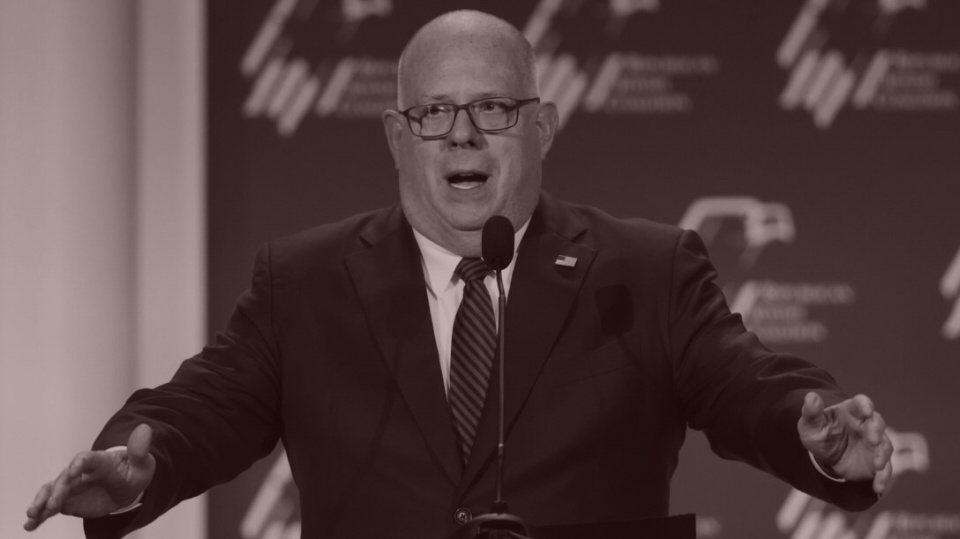 |
| Hogan’s Anti-Heroes |
| Larry Hogan, the popular former Maryland governor and Republican Senate candidate, is getting the shiv following his measured call to “respect the verdict and the legal process” in the Trump trial. It’s the latest example of the self-defeating penalty for misalignment with Trump’s G.O.P. |
|
|
|
| So far, at least, the number one casualty in the Trump conviction aftermath isn’t the former president—now a certified felon—but rather the popular former governor of Maryland, Larry Hogan, who is also currently the Republican candidate for Senate in the state, having won his primary just three weeks ago. Hogan, of course, responded to the guilty verdict on Twitter by urging Americans “to respect the verdict and the legal process”—a seemingly innocuous comment that set off the dogs in Mar-a-Lago. “You just ended your campaign,” Trump senior advisor Chris LaCivita immediately responded. Lara Trump, the newish Republican National Committee co-chair, told CNN’s Kasie Hunt over the weekend that Hogan “doesn’t deserve the respect of anyone in the Republican Party at this point, and, quite frankly, anybody in America.”
Not since Todd Akin’s “legitimate rape” comments amid his disastrous 2012 Missouri campaign have I seen party leaders so willingly throw away a U.S. Senate seat, which can cost nine figures to flip. Hogan, who currently leads by a wide margin in the otherwise deep blue state, alone won’t determine control of the Senate. Races in Nevada, Ohio, Arizona, and Michigan, among others, are highly competitive. But LaCavita, Lara Trump, and their ilk are being short-sighted if they believe they don’t actually need to win Maryland. The G.O.P. aim should be to bank as many seats as possible to build a majority that can withstand difficult cycles two or four years down the road. This, after all, is the best map that the Republicans will have for several years. |
|
A MESSAGE FROM OUR SPONSOR
|
|
WORKING-CLASS AMERICANS DEPEND ON CREDIT CARD REWARDS: A new study finds credit card rewards like cashback empower low-income families to pay for the rising price of everyday essentials—like groceries and gas. So why are DC politicians partnering with corporate mega-stores to end those hard-earned rewards programs that Americans rely on? The Durbin-Marshall Credit Card Bill takes billions from American families, lining corporate pockets instead. Tell DC politicians to OPPOSE the Durbin-Marshall Credit Card Bill.
|
|
|
| Also, Hogan is still liked by many Republicans in his state. In fact, as one G.O.P. consultant suggested to me, this kind of friendly fire may actually strengthen Hogan’s chances with moderates and independents in the largely Democratic state. It’s also possible that, if the Trump campaign’s broadsides indeed cut Hogan off from the rest of the party, he may be the kind of moderate candidate a Republican billionaire would be happy to fund with a Hogan-specific super PAC. I’ve been assured by a Hogan insider that even amid this drama, the campaign is not anticipating money problems in the fall.
Regardless, Maryland was supposed to be a mischief race for Republicans—an opportunity to force the opposing party to expend valuable resources defending friendly territory. To be sure, Democrats across the board are bullish about holding this seat. But Hogan’s much-celebrated recruitment, and his crossover appeal, has forced Democrats to worry about shifting money from other races to secure what should have been an easy win for Angela Alsobrooks. Instead, Alsobrooks may have received a boost from Mar-a-Lago, as Hogan’s hold on Trump voters feels seriously diminished. “It scares me for the normal moderates,” one G.O.P. consultant told me of the attacks on Hogan. “Something like this is even more polarizing and creates a bigger fissure in the American psyche.” |
|
|
| Many Democrats, meanwhile, are publicly and privately arguing that the voluble Republican response to the Trump verdict in fact signals weakness—that they’re circling the wagons around a grievously wounded candidate. “The people who think voters like someone more because they’re now a convicted felon, they probably need to go outside and touch grass,” texted Democratic consultant Jesse Ferguson, who’s closely involved with the down-ballot campaigns.
But other Democrats are more cautious. After the Access Hollywood video, the January 6 riot, and all the chaos in between, many Democrats are reticent to make any confident prognostications. Sure, the epithet “convicted felon” is now inextricably tied to vulnerable Republicans in swing state television markets, and some early surveys show small but encouraging responses for Democrats. But many veteran insiders are waiting for results to emerge from focus groups gathering over the next few weeks. |
|
|
| One Democratic House campaign operative predicted that Republican candidates celebrating Trump’s conviction will only alienate independent voters, and forfeit the chance to brand themselves as mavericks. Instead, this person said, “I would use this very over-the-top, vigorous defense of Trump, not to litigate the issue, but to say, ‘Listen, this Republican can’t even bring himself to say being a convicted criminal is bad. When will they say no to Mike Johnson or Trump?’”
In reality, of course, the conviction of a former president and the G.O.P.’s current standard-bearer is so unprecedented that neither the White House nor Mar-a-Lago really know the best way to spin it. At the end of the day, the only certainty is that the New York jury’s ruling, and Judge Juan Merchan’s upcoming sentencing, will have an impact on control of the House and Senate, and will both help and hurt down-ballot candidates running this cycle. “What a mess,” a Republican consultant familiar with competitive races told me on Monday.
So how much does this conviction matter? Trump’s regularly shocking behavior is diluted by the sheer volume of news surrounding his antics on a near-daily basis. And arguably, events of much greater import await: the first debate with Biden on June 27, Trump’s sentencing on July 11—which some strategists argue will clarify the impact of the verdict—followed a few days later by the Republican convention in Milwaukee, the sure-to-be-protested Democratic convention in Chicago in August, and of course, the expected unexpected developments in the fall. For now, strategists are watching, waiting, and listening to voters with a rare humility. |
|
|
|
| FOUR STORIES WE’RE TALKING ABOUT |
 |
| Paramount Heat |
| Mapping out the Paramount Global endgame. |
| WILLIAM D. COHAN |
|
 |
|
 |
|
 |
|
|
|

|
 |
|
|
|
Need help? Review our FAQs
page or contact
us for assistance. For brand partnerships, email ads@puck.news.
|
|
You received this email because you signed up to receive emails from Puck, or as part of your Puck account associated with . To stop receiving this newsletter and/or manage all your email preferences, click here.
|
|
Puck is published by Heat Media LLC. 227 W 17th St New York, NY 10011.
|
|
|
|