 |
 |
|
Hello, and welcome back to The Best & The Brightest, your one-stop shop for all things politics, foreign and domestic, left and right, deadly serious and often not. It is brought to you by our absolutely fabulous politics team here at Puck, Tara Palmeri, Tina Nguyen, Peter Hamby, and myself.
Before we get into it today, I just wanted to draw your attention to the fact that Ron DeSantis’s position on Ukraine has drawn responses from all sides, from Volodymyr Zelensky to DeSantis’s own putative competitor for the 2024 nomination, Nikki Haley. The Ukrainian president told Anne Applebaum in Kyiv that the Floridian’s position was, essentially, as shortsighted as that of American isolationists of the 1930s. It was important, in his words, to help the Ukrainians fight the Russians in Ukraine so that Ukraine is as far as the Russians get, so that Vladimir Putin doesn’t turn into a 21st-century conqueror of Europe, much like the one America had to fight in the 1940s.
Haley, in an op-ed in the Wall Street Journal, made an argument that might seem to resonate more among her fellow Republicans. Her pitch? “If Russia wins in Ukraine, China wins too.” Haley, who served as Donald Trump’s ambassador to the U.N. and has more foreign policy chops than the Florida governor, is not wrong. It is becoming increasingly clear that Beijing, for all its unhappiness with the war in Ukraine and all the economic volatility it is causing, clearly does not want Russia to lose. More on that below, but the long and the short of it is that Russia is a good Chinese ally for undermining China. And if, as I wrote last week, Haley’s fellow Republicans have gone soft on Russia, they are still very hungry for confrontation with China, their arch-villain on the world stage.
Like Republicans with more establishment foreign policy views, such as Mitch McConnell, Haley is trying to tie the two countries together and persuade her fellow party members—and future voters—that Ukraine and Taiwan are not, in fact, separate issues. And, counter to the likes of Josh Hawley, who believes that the U.S. is abandoning Taiwan for Ukraine, trying to explain that winning in Ukraine is a means of defending Taiwan, too.
Unfortunately for Haley, the base of the party seems to have moved away from that logic—and from the opinion pages of the Journal.
|
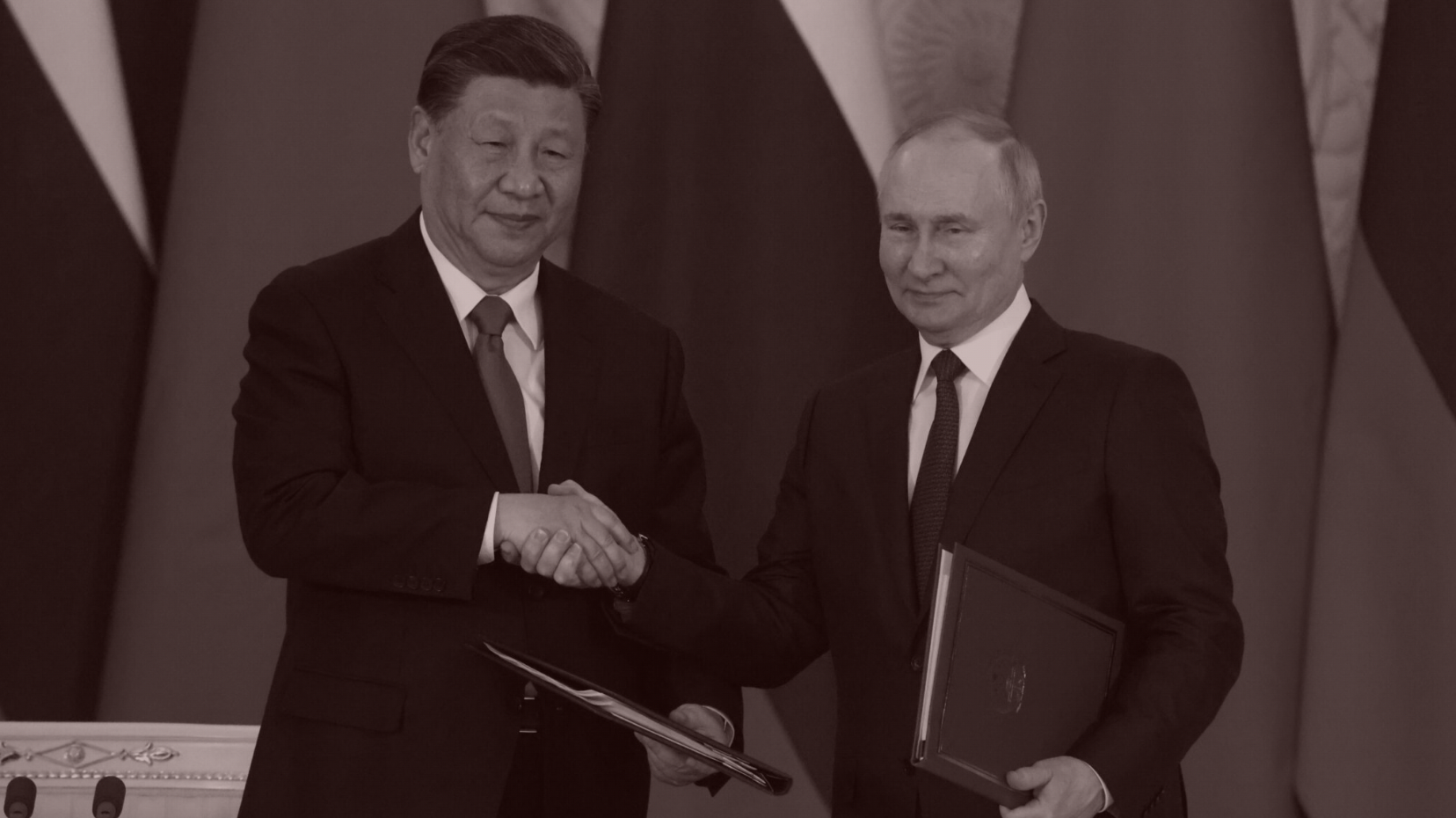 |
| Xi Jinping, Superstar |
| An ecstatic reception for the Chinese premier in Moscow revealed the dearth of diplomatic and military options before Russia, and just how few friends Vladimir Putin has left. |
|
|
|
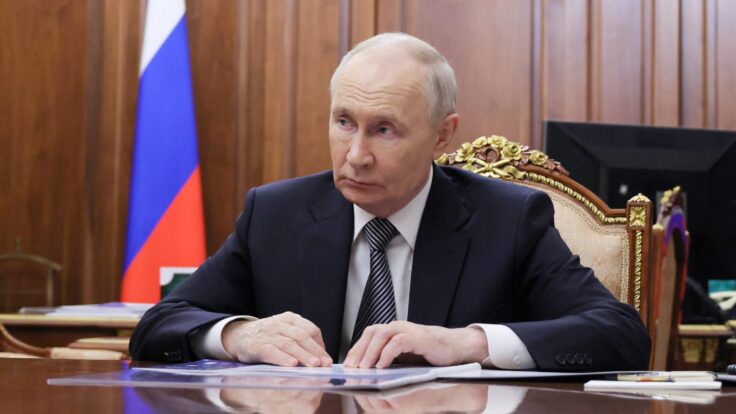
| When Chinese premier Xi Jinping arrived in Moscow, on Monday, for his first overseas trip after securing his third term as leader of the Communist Party and of China, you may have been forgiven for thinking it was Jesus Christ himself who had returned. Traffic in the Russian capital was snarled to a standstill. State television was breathless in its wall-to-wall coverage of the Chinese leader’s three-day visit. The menu for the first night’s dinner, showcasing traditional Russian cuisine, thank you very much, featured venison and blinys with quail, and finished with Russian ice cream, apparently Xi’s favorite. We know this because, as a beaming news anchor explained, on one of his many visits to Moscow, Xi tried Russian ice cream from a humble street vendor and loved it! “Now,” the anchor continued, “Putin sends it to him by the case load.”
It was a notable departure in sentiment from the usual light xenophobia on Russian airwaves. One Kremlin reporter said on the air that Biden was so eager to talk to Xi, who had, in the minds of official Moscow, arrived in Russia to help end American hegemony, that he would surely call him while the Chinese leader was in Moscow so he could plead his case. The reporter, who hastily mentioned that he had no evidence of any plans for such a call, then asked a very amused Dmitry Peskov, Putin’s spokesman, if the Kremlin would be against Biden calling Xi while the latter was in Moscow. (Peskov said that Xi, as the leader of a sovereign nation, could do what he pleased.) Another Kremlin reporter stated, totally straight-faced, that, just as there is a boom in demand for Chinese-language instruction in Russia, Chinese citizens are all signing up for Russian lessons, too. |
|
A MESSAGE FROM OUR SPONSOR
|
| |
 |
| The NFL and its teams have surpassed their $250 million commitment to support social justice.
Through targeted investments in education, criminal justice reform, police-community relations, and economic advancement, the NFL is working to inspire change and create a more equitable world for all. The investments include over $47 million in social justice grants and $10 million in NFL foundation grants, and support more than 600 social justice organizations.
Explore how the NFL is investing to inspire change. LEARN MORE
|
|
|
| More importantly, Xi’s long-planned visit was heralded in Moscow as a potential turning point in the war in Ukraine. Shortly before the trip, Beijing put out a twelve-point peace plan, which called for vague, feel-good things like resuming peace talks and protecting civilians and also things that sound good but aren’t, like respecting territorial integrity and ceasing hostilities in Ukraine. The former would imply respecting not just Ukraine’s territorial integrity but China’s vis-à-vis Taiwan. The latter would freeze the conflict and grant Russia the territories it had seized from Kyiv and illegally annexed.
With that in mind, the Biden administration immediately rejected the peace plan—which, it has been at pains to instruct everyone, is not a peace plan, but a position paper. (Yes, these things matter in Washington.) The Kremlin, which had been skeptical of the Chinese proposal because it alluded to Ukraine’s territorial integrity, jumped at the chance to demonstrate that, actually, it was the more reasonable, peace-loving party. “The initial reaction to the Chinese peace plan was skeptical,” said one informed Moscow source. “They obviously noticed that there was a reference to Ukrainian territorial integrity. It was clearly formulated in a way to project Beijing’s image of neutrality and objectivity. But once the Biden admin reacted the way it did, the Kremlin saw an opportunity to embrace the proposal to demonstrate that they were reasonable people and to demonstrate to China that they were taking their proposal seriously.” (Said one state TV reporter, “The U.S. is now against stopping the shooting, as hard as that is to believe.”)
The Biden administration also began working to undermine the Chinese narrative. Starting with a rollout at the Munich Security Conference last month, Biden officials began warning publicly that China was, depending on who you talked to, either considering or on the verge of supplying Russia with weapons. This was obviously an alarming claim. China had already provided a lot of support to Russia in this war: serving as a safe veto on the U.N. Security Council and in other diplomatic bodies, most recently at the G20, where it had blocked a joint statement condemning Russia’s invasion; buying Russian oil while filling import gaps and thus bankrolling Russia’s war and keeping its economy from collapsing; and supplying Russia with microchips and other dual-use technology for Moscow’s military-industrial machine.
But Beijing had, to this point, stopped just short of supplying lethal aid. To do so would radically alter the balance on the battlefield, which was now roughly even. And so the Biden administration did what it had done to great effect just before Putin sent his tanks into Ukraine: it weaponized intelligence, leaking it in order to scare its allies as well as China. This put Xi on a defensive footing as he set off for Moscow and drove a further wedge between China and Europe, which Beijing has courted heavily. “China has been trying to balance strengthening the relationship with Russia and not alienating Europe,” noted Bonnie Glaser of the German Marshall Fund. It’s why, Glaser says, China flicked at territorial sovereignty in its proposal and why it keeps teasing Europe with the possibility of a Xi-Zelensky phone call. “China is concerned that they’re looking too pro-Russian,” Glaser explained, though she noted that ship may have sailed. “They want to be seen as a responsible player.” And the optics of visiting a leader who has started a land war in Europe and who has been indicted by the Europe-based International Criminal Court aren’t great for that. “China doesn’t accept this ruling, but it does look like he’s going to Moscow to meet with an international criminal.”
This put Xi in a bind. Yes, he was going to Moscow to visit his “dear friend” Putin, as he called his Russian counterpart in their public fireside chat. (The two have met about 40 times.) But would he go the distance for his little brother? Would he supply Putin the lethal aid that he needed to win? |
| “Chips Can Be More Lethal Than Bullets” |
|
| Let’s start with the fact that there is no agreement, really, on what the U.S. intelligence actually said. Some in Washington claim that Russian requests for weapons kicked off deliberations within the Chinese government about whether to comply. Other sources say the intelligence was thin at best and that there was no evidence of China actually making moves to supply Russia with weapons.
Some, like Carnegie’s Alexander Gabuev, said that intelligence of internal discussions could have been stretched and interpreted to serve a political purpose since they did not tell us if the discussions were at the level of the Politburo or, say, a military seminar. “Technically, neither William Burns or Antony Blinken are saying something that’s untrue, but they might be saying something without context,” Gabuev explained.
Most of these people do agree on two things, however. First, China doesn’t seem to want to supply Russia with weapons because doing so would cross a Rubicon that would likely incur bracing sanctions in both the U.S. and Europe, two markets that are far larger than Russia’s. And second, the Biden administration, once again, was able to use whatever intelligence it did have to provoke a strong enough reaction inside the U.S. and Europe to scare Beijing away from such considerations. “If China had any doubt about what the response would be from the collective West, they don’t have it anymore,” said Dmitri Alperovitch, the chairman of Silverado, a D.C.-based think tank. “It doesn’t mean they’ll stop supplying body armor or dual-use technology but something as provocative as thousands of artillery shells probably is off the table.” The White House has, by most accounts, breathed a temporary sigh of relief. |
|
|
| Still, points out Michael Kofman, military analyst at the Center for Naval Analyses, that can sometimes be a distinction without a difference. “The distinctions being made today, between dual-use technology and bullets, are somewhat dubious,” he told me. “Chips can be more lethal than bullets, but the criteria we use to assess direct military assistance is somewhat dated. There’s a policy distinction being made here, but in practice China has already significantly enabled the Russian war effort.”
The Russians are well aware of this. When I called Andranik Migranyan, a Russian foreign-policy insider who always reminds me that he was Russian foreign minister Sergei Lavrov’s classmate, he was dismissive. “Why do we need more weapons, we have tons of our own!” he spat. “North Korea is better for this anyway. It’s better to keep China out of this, so they can help us in more sensitive areas. It’s a normal division of labor.” |
|
|
| In Moscow, hopes ran high that Xi had come to do nothing less than help Putin topple the American-led world order. All the talk shows led with the 20th anniversary of the U.S. invasion of Iraq and Beijing’s insistence on a return to a world governed by the U.N.—something Russia, which also has veto power on the Security Council, has insisted on since 2003. In the mind of patriotic Muscovites, this and Beijing’s insistence on “multipolarity” was an agreement to what Putin had outlined in his 2007 speech at the Munich Security Conference: the world could not be dominated by one superpower and still be democratic. Other countries needed to act as counterweights to American hegemony. Russia, led by Putin, had been trying, valiantly, for so long. Now a bigger, stronger partner had joined the fight on their side. Now, finally, they would succeed together. America, a Russian TV anchor smirked, would no longer be able to impose its will on the world.
One Moscow source who had talked to the Chinese delegation told me that Chinese officials said they had no plans for weapons deliveries but “there was clearly an interest in China in not allowing Russia to be defeated by a hostile Western coalition led by the U.S.” China, in the view of Russian and American analysts I spoke to, seemed to need Russia as an ally—or a wedge—against the U.S., which it sees as unfairly surrounding and suffocating its growth. Gabuev echoed this sentiment. “Russia is seeking to punish the West for its support for Ukraine, but not finding much. Energy blackmail, cyber attacks, none of it has worked,” Gabuev said, summarizing his conversations in Moscow. Now, people are coalescing around the idea of “strengthening America’s only peer competitor, China, and giving it everything it needs to defeat U.S. hegemony.”
There was a lot of talk, including in Moscow, as I wrote, going into the summit, about Russia having very clearly become the junior partner in a relationship with a country that it has traditionally looked down on, culturally and racially. (It is in part why state TV went into overdrive these last few days talking about the richness of ancient Chinese culture and diplomatic protocol. China’s diplomatic protocol, one pundit said, was descended from the centuries-old imperial traditions—just as Russia was the heir to Byzantium.) “Russia is not a supplicant,” Migranyan told me. “You don’t visit a little brother or a vassal with a state visit for your first foreign visit like this.”
“Maybe Russia really is the weakest link, but considering that Russia will resist for itself and for the other guy, China will lend a hand and not allow regime change in Russia,” Migranyan continued. “China is doing far more than what we could’ve expected from them. It didn’t allow the collapse of the Russian economy. It is standing like a wall for us diplomatically. Even on an official level, China had to say, how can you say that you can’t send weapons when you send weapons to Taiwan when you once acknowledged the One China policy. Yes, China isn’t looking for adventure or an immediate participation in this conflict but it’s clear that China will push back hard. Russia has to win, even if it will emerge in a complicated state, because China needs it.” When I asked Migranyan why China needed Russia not to lose in Ukraine, he put it this way: “There are no hugs and kisses and other foolishness. This is sheer pragmatism and a calculation of interests.” |
|
|
| In the end, though, it was clear where the balance of interests lay. After Monday’s four-hour tête-à-tête, after Tuesday’s marathon of meetings, including Xi and Putin negotiating for hours with their teams, the Russians had given much and received precious little. At the joint press conference, Putin wanted so badly to tout something, anything, but there was little to show for it.
He tried to make it sound like there had been a deal reached on the Power of Siberia gas pipeline that would supply Russian gas to China—which Russia needs more than China, now that Moscow has lost its entire European market—but it turned out that it had been little more than a verbal agreement to keep talking. He agreed to deal with much of the world in the Chinese Yuan (the Euro, the dollar, and the Swiss Franc having become problematic), to export more grain and more meat to China, to have more student exchanges, hell, he even agreed to make more TV shows with the Chinese. But there was no deal on weapons, though Gabuev warned me that there may have been something cut in private and not advertised (bad optics and all), though it was more likely the sale of Russian systems to China, not the reverse. There was nothing on Ukraine other than non-binding platitudes by Xi at their joint press conference and a milquetoast statement by the Chinese foreign ministry that “the purposes and principles of the United Nations Charter must be observed” and that sanctions that were not approved by the Security Council are no fun. You could see why Putin looked so deflated at the presser. He had bought all that ice cream for nothing.
One veteran American diplomat called me to gloat over the Chinese statement. “I’m just cracking up,” this person told me, noting that they had written statements like this for decades. “The Russians just look pathetic. The Chinese look like they scolded the Russians but didn’t drive it home out of forbearance of their weaker brother who’s gotten in over his head.”
“The Chinese-Russian relationship is built on foundations like Turkish construction material,” the diplomat went on. “It’s only good until the next earthquake. I understand that China won’t throw Russia under the bus, but they’re not thrilled with the position that Putin has put them in. They’re shackled to a corpse.” As for the Biden administration, with whom this diplomat, now retired, is in constant touch, “Let me put it this way: If I were senior director on this, I would indulge myself with 10 seconds of a smile.” |
|
|
| That’s all for this week folks. Stay tuned as always for Tina tomorrow and I’ll see you back here next week.
Good night, tomorrow will be worse,
Julia |
|
|
|
| FOUR STORIES WE’RE TALKING ABOUT |
 |
| CNN’s Trump Test |
| How would an indictment play in the New CNN & post-Dominion Fox News? |
| TARA PALMERI & DYLAN BYERS |
|
 |
| Tiger’s Legal Snafu |
| Dissecting the legal ramifications of the star golfer’s $30 million breakup. |
| ERIQ GARDNER |
|
 |
|
 |
| SVB’s Final Days |
| The definitive post-mortem of the bank’s harried end. |
| WILLIAM D. COHAN |
|
|
|

|
 |
|
|
|
Need help? Review our FAQs
page or contact
us for assistance. For brand partnerships, email ads@puck.news.
|
|
|
|
Puck is published by Heat Media LLC. 227 W 17th St New York, NY 10011.
|
|
|
|