 |
|
Hello, and welcome back to The Best & The Brightest, your daily politics letter from Puck—and your regular Tuesday installment of foreign policy and national security from me.
Before we get started, I wanted to let you know that, starting next week, I’ll be on book leave for all of June. After getting derailed by the full-scale invasion of Ukraine, I’ll be (finally) finishing up Motherland and forking over a complete draft to my publisher. Until then, please enjoy the work of my talented colleagues. I hope—I know—that you’ll use this opportunity to discover topics and writers you didn’t know you needed that will help you better understand the machinations of #thistown. I’m sure you’ll enjoy it!
|
|
|
| Last week, I attended two conferences. The first was the Brussels Forum, organized by the German Marshall Fund, on the future of Ukraine. The second, organized by the Lithuanian Foreign Ministry, focused on what will happen to Russia. It was a week spent imagining a long-term forecast for both countries at a time when even the present is hard to fathom.
The questions are myriad. How, for example, do you rebuild a country while it is being actively destroyed by a foreign army? How do you understand the future of a country that has kicked out all real journalists, making the present reality so hard to understand? How do you reimagine a country whose territorial integrity is very much up in the air, or one whose dictator seems more powerful at home than ever?
These are questions I find exceedingly hard to grapple with. In the context of a panel discussion, they can devolve into the equivalent of arguing about the shape of a cloud. And they often did. At one point, a young Ukrainian activist from Odessa, understandably furious at the Russian people, asked me if I thought it was probable that Russia would ever be a democratic country. I told her I had absolutely no idea. Was it likely? No. Was it impossible? Also no. After all, who in 1942 would have thought that Germany would become a liberal multi-ethnic democracy, and a pillar of the democratic trans-Atlantic alliance that mostly held Europe and NATO together while Donald Trump was in power? In Vilnius, scholar Sergey Medvedev made an almost identical point: it was hard to imagine an Allied victory, in 1942, let alone the contours of the world that emerged from it.
And yet, left to entropy, this process would never have gone from improbable to inevitable. Without plans—the Marshall Plan, specifically—the things that now seem like historical inevitabilities would have remained historical counterfactuals.
There was, however, a striking difference between the two conferences and the two topics. Discussions of Ukraine’s future were quite concrete. Any concreteness, however, fell away at the conference in Vilnius, which was dedicated to the future of Russia. |
|
|
| In Brussels, there were panels about how to provide war insurance to private Western companies so that they would have some protection against the risk of doing business in an active war zone. The head of the U.S. Chamber of Commerce in Kyiv explained what businesses there need to survive and even prosper in a country under attack. Offering private business some protection and assurance would allow them to supplement the billions that American and European governments were spending while helping the Ukrainian economy, which has shrunk by a third, begin to recover.
Senator Cory Booker and the State Department’s Dorothy McAuliffe were there to explain various U.S. government initiatives and investments in Ukraine. Booker told me on the sidelines that he was hoping to rev up the process of getting private businesses to invest in Ukraine. McAuliffe, who runs State’s public-private partnership wing, has been working to do the same, and named a string of Western corporations—Honeywell, Nestle, and the like—who were continuing to show up. In the meantime, she told me, the U.S. government has helped Ukraine rebuild hundreds of bridges damaged amid the fighting. It’s hard to imagine construction under constant threat of Shaheds and Kinzhals, but it was harder, McAuliffe said, to imagine a successful Ukrainian army without bridges.
There were specific discussions about rooting out corruption in Ukraine, which was ably weaponized by Russia before the war, both to influence events inside the country and to discredit Ukraine in the eyes of the West. The head of the Ukrainian government office charged with this responsibility dialed in from Kyiv, though the official was periodically interrupted by his obviously busy staff. There have been several high-profile arrests of Ukrainian officials on corruption charges, including the head of the country’s supreme court.
This is clearly an effort both to clean house domestically and publicly demonstrate to Western allies that Ukraine is taking serious steps to prove itself worthy of accession to its most coveted alliances, the E.U. and NATO. A Biden administration official told me privately that the behind-the-scenes discussions with the Ukrainians are far more tense, with Kyiv periodically giving Washington “the Heisman” and saying, essentially, that they can’t be expected to fight corruption while fighting the Russian army. The official said there were now deliberations in Washington about attaching strings to the billion and change that it sends to Kyiv every month, and making the cash aid to the Ukrainian government conditional. “But then, we have to be prepared to follow through,” the official said, and the White House wasn’t there yet.
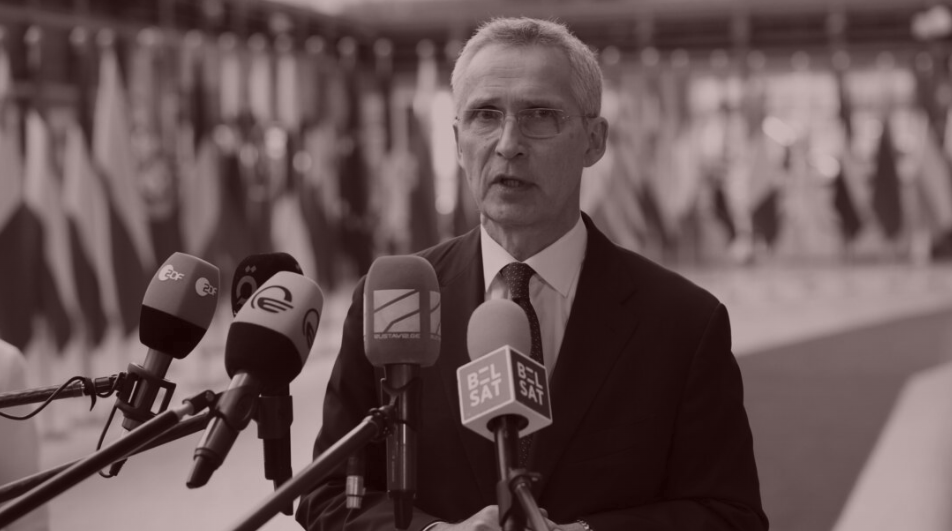
The most frustrating for all, especially for the Ukrainians in attendance in Brussels, however, were Jens Stoltenberg’s answers about Ukrainian NATO ascension. In the last month, he has made it a habit of repeating that Ukraine will join NATO and that all NATO allies have agreed on this—and then acting like it’s not news and like this wasn’t one of the key questions in the lead-up to February 24. Now that he is constantly pressed on this, especially by Ukrainians, he has reverted to the same line, which he trotted out at Ramstein and repeated in Brussels. “We all agree that NATO’s door is open,” Stoltenberg said, adding that “it’s up to Ukraine to decide when they join NATO, not Russia.” But, he said, let’s not talk about that right now—or the fact that it’s not Russia who’s been holding up Ukraine’s accession, but NATO itself. “If Ukraine doesn’t prevail [in the war], then there’s no membership to discuss,” he said in his punchy Norwegian cadence. “To become a member in the middle of a war, that’s not on the agenda.”
Given the fact that former Russian president Dmitry Medvedev said on Friday that this war “will last for decades”—two-three years of ceasefire, then two-three years of hot war, he explained—and given that the U.S. predicts a long-playing stalemate or a frozen conflict, everyone knew what that meant. It meant that NATO was still where it was before the war: insisting that the door was open to Ukraine, while never allowing the country to cross the threshold.
In fact, Ukraine’s ascension seems even further away now than it was before, given Washington’s reddest of red lines: not getting into a hot conflict with Russia. That would be all but guaranteed should Ukraine join while the threat of Russian attack remains anywhere on the horizon, even if the war were to end tomorrow. |
|
|
| At the Vilnius conference dedicated to the future of Russia, however, any sense of a concrete tomorrow fell away. Many of the Russian opposition’s pillars—Mikhail Khodorkovsky, Garry Kasparov, Aleksey Navalny’s right-hand man, Leonid Volkov—were all in attendance, though they usually don’t like each other and don’t like appearing in the same room. (Which, according to many longtime observers, was part of the opposition’s problem.) They and others in attendance took turns analyzing Russian history and the Russian people and scolding them for their innate imperialism—or their passivity that, in Khodorkovsky’s telling, made Russia “a cushy place for an autocrat.”
They debated what Russia would look like after the war, or whether there would even be one Russia or several statelets to replace it. (Many in the old guard, however, were perfectly happy to discuss the contours of a future demilitarized liberal democracy in Moscow, or even moving the capital, but absolutely balked at the idea of breaking Russia up.) They debated whether history is destiny and whether Russia possessed a tragic flaw, a fatal social gene that doomed the country to reincarnate itself as an imperialist autocracy in slightly different wrapping until the end of time. They debated which metaphor was more apt, the Cold War or World War III.
Meanwhile, the old Eastern European hawks (former prime ministers of Lithuania and former foreign ministers of Poland) berated the West for not fighting Russia hard enough. “Putin is a cannibal,” Vytautas Landsbergis, the first prime minister of post-Soviet Lithuania, growled into the microphone as he hunched over it like a gnarled old tree. “And he will eat us all if we don’t tell this cannibal to go back to the jungle.”
Over dinner, a Lithuanian government official complained that Washington wasn’t spending nearly enough on fostering Russian civil society while it waited in the wings for Putin’s exit. The Lithuanian government was trying to help by organizing this conference, trying to give the opposition a place to talk and come together, but there was only so much a country with 2 million people could do, especially when its population still remembered the brutality of Soviet occupation and didn’t much want to help Russians of any kind.
“Guess how much the U.S. spends on supporting the Russian opposition? Just guess!” the official asked me. I guessed $10 million. “Eight million,” he said. “That’s it! Eight million!” Compared to the tens of billions America was pouring into Ukraine, the official explained, this was nothing. And the Russian opposition needed all the help it could get. (A USAID official at the conference couldn’t help but shrug and agree when I asked them about it afterwards.)
In the end, it felt eerily like witnessing all the debates I had read about in Russian history: Russian political émigrés, whether fleeing the tsars or the Bolsheviks, scattered across European capitals and discussing the two evergreen questions in Russian opposition politics: “Who is to blame?” and “What is to be done?” Lenin and Trotsky and Herzen and Nechaev had debated them for decades in Zurich and Paris and London, but only two of them ever got to implement their vision. So had the white exiles in the 1920s and 1930s, but most died without ever setting foot back in Russia. The vicious and petty internal fights they had, the ideological hairs they split, mattered for who took power in 1917, but not in 1991. And, at any time before then, they must have sounded like pedantic squabbling over what kind of unicorn to buy.
Leonid Nevzlin, Khodorkovsky’s former lieutenant at Yukos who fled to Israel in 2003 to escape arrest, took those present to task for this. The opposition to Russia, he scolded, was not in this room. It was fighting in Ukraine. It was staging cross-border raids into Russia. The Russian opposition was the Ukrainian military and Free Russia Legion. If those who called themselves the Russian opposition really wanted to topple Putin and change Russia, Nevzlin said, then they would need to spend all their resources to help Ukraine win—“and only then, with the change they have left, they can shitpost about each other.”
Still, I left with the words of the wonderful Sergey Parkhomenko in my head. Parkhomenko came of age as a journalist during the brief glimpse Russia had of democracy in the 1990s. In the years before he fled Russia in 2022, he founded many crowd-sourcing projects, including one that helped uncover plagiarism in the fancy-sounding dissertations of high-ranking Russian officials. His most important project, however, has been “Redkollegia,” which means “editorial meeting” in Russian. It is a monthly cash prize awarded to the best work of independent Russian journalism, which has always been squeezed for resources by the Kremlin. It is also an annual conference where Russian journalists can gather (abroad) and safely talk through their professional dilemmas.
These days, Parkhomenko told me, independent Russian journalists, almost all of them in exile in Europe, Turkey, or Israel, tell him they don’t understand who needs them and why they exist at all. Why not just give up and burn it all to the ground?
And what do you tell them? I asked him.
“I tell them that I’ve always thought it was important to keep esoteric dog breeds alive,” he said simply. “At some point, someone’s going to want them.” |
|
|
| That’s all from me, friends. Wish me luck on finally finishing this monster of a manuscript. Enjoy the work of my incredible colleagues and I’ll see you back here in July. In the meantime, good night. Tomorrow will be worse.
Julia |
|
|
|
| FOUR STORIES WE’RE TALKING ABOUT |
 |
| A Yellowstone Mystery |
| Notes on an $80M lawsuit surrounding TV’s No. 1 series. |
| MATTHEW BELLONI & ERIQ GARDNER |
|
 |
| Bezos at Sea |
| A conversation encircling the latest mediaworld plot lines. |
| DYLAN BYERS |
|
 |
| Iger’s Vulcan Chess |
| Notes from the Maidstone crowd and Burning Tree delegation. |
| WILLIAM D. COHAN |
|
 |
|
|
|

|
 |
|
|
|
Need help? Review our FAQs
page or contact
us for assistance. For brand partnerships, email ads@puck.news.
|
|
|
|
Puck is published by Heat Media LLC. 227 W 17th St New York, NY 10011.
|
|
|
|