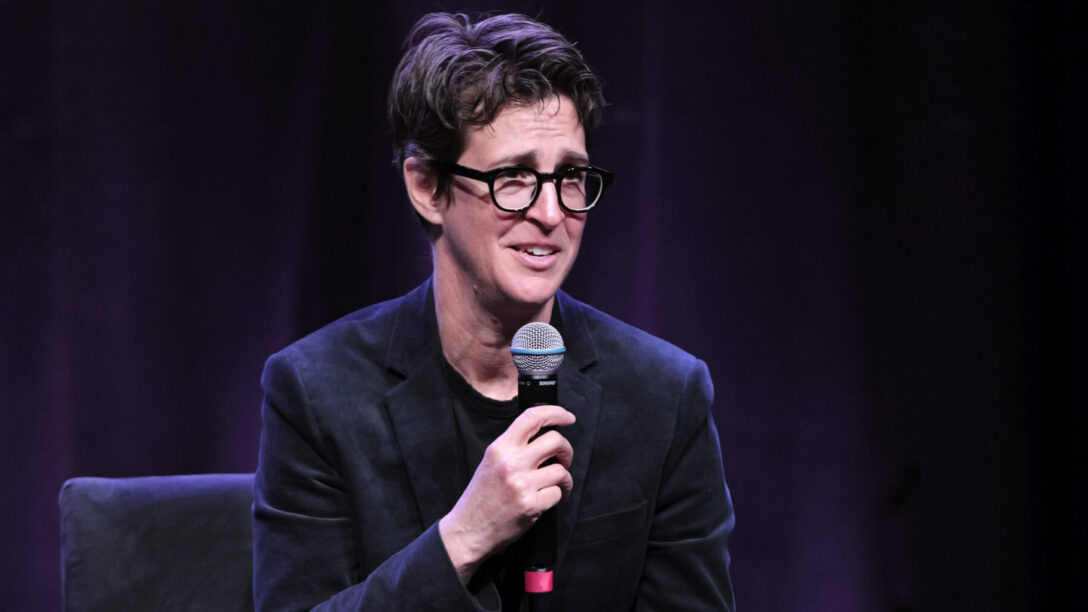

On Monday, newly appointed MSNBC president Rebecca Kutler formally put her stamp on the network via a slate of quickly executed programming changes, many of which I previewed here last week. As planned, Rachel Maddow will soon be ending her 100-day run as a five-night-a-week anchor and returning to her famously plum $25 million-a-year, Mondays-only gig. Jen Psaki, the network’s next great hope, will replace the beloved but ratings-challenged Alex Wagner in the 9 p.m. hour on the other four weeknights. And, most notably, the three co-hosts of The Weekend—Symone Sanders, Alicia Menendez, and Michael Steele—will be elevated to weeknights at 7 p.m., replacing Joy Reid, who is leaving the network.
All the moves seem logical enough. MSNBC leadership has been pitching Psaki on the promise of marquee stardom since her final days as Biden’s White House press secretary, when she would sneak off to the Georgetown Rosewood to meet with NBC talent scout Jessica Kurdali. Notably, Kutler herself led the Psaki recruitment effort for CNN, when she was S.V.P. there, and later helped the anchor build her shingle at MSNBC. Since then, Psaki has rated well enough on weekends and Mondays, while also demonstrating the multiplatform versatility—podcasts, TikTok presence, etcetera—that will soon be required of all the major talent. Even Joe and Mika, I’m told, will become active in the podcast and events space.
The 7 p.m. shake-up was inspired by another evolving thesis. In recent years, Fox News’s roundtable program The Five has frequently outperformed its network’s own primetime shows, potentially signalling demand for more View or Morning Joe–style gabfest content from a familiar cast of characters, rather than the staid anchor-guest format that has become almost unbearable in the post-Covid era of grainy Zooms. (We’re still making television here, people.) The Sanders-Menendez-Steele trio—another Kutler project—has so far shown promise, at least by MSNBC weekend standards. And Kutler is standing up two more roundtable shows on the weekend, one of which will be co-hosted by Eugene Daniels, the Politico White House correspondent and Playbook co-author who, as I reported this week, will be leaving Arlington for the role. (Yes, another Politico departure, but also one the leadership saw coming. Eugene is a fixture of the green room and the D.C. party circuit, but not necessarily Harris & Burns’s Platonic ideal of a Politico journalist. As Harris noted in a graceful farewell note, his pivot to TV felt inevitable.)
Anyway, this was also a move born of desperation: Reid simply didn’t rate, and she had also become emblematic of the worst instincts of partisan punditry, building up a formidable sizzle reel of anti-conservative attacks in which she sometimes portrayed all Republicans as racists—including, most memorably, when she said conservatives “don’t vote based on economics, … they’re voting on race.” She once claimed that the media’s preoccupation with Russia’s invasion of Ukraine was motivated by the fact that the victims were “white and largely Christian.” (Kyiv was under siege at the time.) Ratings for Tuesday night’s Reid-less 7 p.m. hour were up from her February average by double-digit percentages in both total viewership and the demo.
The Reid move may have been necessary, but some people at MSNBC noted a disturbing pattern. In addition to Wagner and Reid, Kutler had also canceled dayside and weekend shows anchored by Katie Phang, Jonathan Capehart and Ayman Mohyeldin—all anchors of color. News like that hits especially hard at a liberal network that has put a premium on diversity, and it didn’t help that Kutler had replaced Rashida Jones, the first Black woman to run a major TV news network. Meanwhile, Kutler told the show’s production teams they would be laid off with an option to reapply for new jobs at the company—a standard practice in television news, but an unpleasant message to receive by way of a strategically placed weekend leak to The New York Times.
Rachel, Rachel
Unfortunately for Kutler, one of the MSNBC staffers who took issue with the changes was Maddow, herself. And rather than air her concerns constructively in private, she decided to put her boss on public blast. On Monday night, she took the “personal privilege” of addressing the matter on her show: “I do not want to lose [Reid] as a colleague here at MSNBC, and personally, I think it is a bad mistake to let her walk out the door,” Maddow said, later adding that it was “unnerving to see that on a network where we’ve got two—count ’em, two—nonwhite hosts in primetime, both of our nonwhite hosts in primetime are losing their shows. … And that feels worse than bad, no matter who replaces them. That feels indefensible, and I do not defend it.”
Maddow then went on to condemn the firing of the production teams, stating that the decision to have them reapply for new jobs “has never happened at this scale in this way before, … presumably because it’s not the right way to treat people, and it’s inefficient, and it’s unnecessary, and it kind of drops the bottom out of whether or not people feel like this is a good place to work.” Finally, Maddow seemed to issue a direct challenge to Kutler: “We want to grow and succeed and reach more people than ever and be resilient and stay here forever. I also believe … that the way to get there is by treating people well, finding good people, good colleagues, doing good work with them, and then having their back. That we could do a lot better on—a lot better.”
Besides the hundreds of thousands of elderly loyal viewers who had no earthly idea what the fuck their favorite political commentator was talking about, it initially seemed like Maddow had succeeded in her ostensible goal of fomenting a Ronna McDaniel–style insurrection. A year ago, as you might recall, Maddow and the irascible Chuck Todd had slammed NBC News brass for hiring the former R.N.C. chair as a contributor, catalyzing a stupid daylong, Dead Poets Society-style desk-jumping cascade in which nearly every MSNBC anchor took a turn dunking on the suits at 30 Rock. It worked: Ronna was fired days later.
This time around, however, the response inside the network to Maddow’s chest-thumping was more skeptical. After all, her critique of the network glossed over a few important details that did not go unnoticed by her colleagues, including several other anchors. Most obviously, Reid was being replaced at 7 p.m. by another Black woman (Symone), a Black man (Steele), and the first Latina woman (Menendez) to host an MSNBC primetime show in the network’s history. Not to put too fine a point on it, but the “two, count ’em two, nonwhite hosts” were actually being replaced by three—count ’em three—nonwhite hosts. In her diatribe, Maddow also claimed that the ouster of the hosts “was worse than bad, no matter who replaces them”—but why didn’t that matter? And was it really “indefensible” to make space for three anchors of color whose chemistry might conceivably enhance the network’s popularity at a time when its ratings have been in the gutter?
Several of Maddow’s colleagues also noted the peculiarity of the star anchor’s cri de coeur on behalf of the 30 Rock proletariat. In all, roughly 125 production staffers will be laid off and invited to reapply for about 110 positions—not ideal, sure, but pretty good for a downsizing industry. Indeed, CNN now routinely lays off hundreds of its employees on a near-annual basis while offering no similar job posts.
More to the point, Maddow seemed to miss an obvious irony of her critique: She gets paid $25 million a year to effectively work one day a week, an absurdly misaligned salary that allows her to comfortably shuttle between her Manhattan apartment and pre-Civil War farmhouse retreat in the Berkshires, but puts a financial burden on MSNBC to stringently manage the unit economics of every other hour in primetime. Put another way, her annual salary is roughly equivalent to the combined salary of about—go figure—125 production staffers.
Of course, NBCUniversal decided long ago that the Maddow imprimatur was worth all that and then some (recall, Maddow’s salary used to be $30 million a year, and she still owns most of her I.P.). But that now seems like the arithmetic of a bygone era—and one probably exacerbated by Ari Emanuel and Mark Shapiro’s negotiating tactics and Jeff Shell’s anxieties. In those days, NBCU suits largely convinced themselves that Maddow was MSNBC and the network would lose viewership and distribution agreement leverage without her. These days, of course, MSNBC is being pushed off to sea with other declining cable assets. It isn’t their problem anymore.
In this brave new world, how valuable is a talent who now brings in only 2 million viewers for one hour a week, and reserves the right to occasionally fly off the handle and nuke her bosses? It’s an unknowable question, on some level, since Maddow occupies a market of one. On another level, of course, the abundant challenges are clear. In the Kutler era, MSNBC will be required to stabilize ratings with less-expensive talent, all in the hopes that SpinCo C.E.O. Mark Lazarus can manage the decline of advertising rates and affiliate fees in the cord-cutting era. And while everyone wishes them well on this journey, it’s all but inevitable that there will be significant bumps along the way.
Maddow may have a point about “treating people well” and “having their back,” but terminally declining industries aren’t Montessori schools—shit gets real. In the increasingly ruthless world of cable news, anchors who don’t rate won’t be sent off to sinecures; budgets will continue to dwindle; other apparent indignities will present themselves, just as they once did in book publishing or the record industry. Where will anchors and producers go for a drink after their shows… in Stamford? If she’s this fired up about Joy Reid, she might not be able to stay here forever.